纺织服饰

Search documents
12月15日基金调研瞄准这些公司
Zheng Quan Shi Bao Wang· 2025-12-16 09:37
Group 1 - On December 15, a total of 13 companies were investigated by institutions, with 6 companies being focused on by funds [1] - The most attention was given to Boin Special Welding, which had 5 participating funds, while Vision China and Chaojie Co., Ltd. had 5 and 1 funds respectively [1] - Among the companies investigated, there was 1 from the main board of the Shenzhen Stock Exchange, 2 from the ChiNext board, 2 from the main board of the Shanghai Stock Exchange, and 1 from the Sci-Tech Innovation Board [1] Group 2 - Three companies among those investigated had a total market capitalization of less than 10 billion yuan, specifically Jingsong Intelligent, Boin Special Welding, and Taihua New Materials [1] - In terms of market performance, 3 stocks among the investigated funds increased in the past 5 days, with Chaojie Co., Ltd., Boin Special Welding, and Jingsong Intelligent showing increases of 29.17%, 15.28%, and 2.94% respectively [1] - Conversely, 3 stocks experienced declines, with Vision China, Xinzuobiao, and Taihua New Materials showing decreases of 6.93%, 2.59%, and 0.67% respectively [1] Group 3 - In terms of capital flow, 4 stocks among the investigated funds saw net inflows in the past 5 days, with Boin Special Welding receiving a net inflow of 215 million yuan, the highest among them [1] - Other stocks with significant net inflows included Chaojie Co., Ltd. and Jingsong Intelligent, with net inflows of 175 million yuan and 19.7 million yuan respectively [1]



纺织服饰行业今日净流入资金2.16亿元,九牧王等7股净流入资金超千万元
Zheng Quan Shi Bao Wang· 2025-12-16 09:19
Market Overview - The Shanghai Composite Index fell by 1.11% on December 16, with only three sectors showing gains: retail trade (up 1.32%), beauty care (up 0.66%), and social services (up 0.13%) [2] - The sectors with the largest declines were telecommunications (down 2.95%) and non-ferrous metals (down 2.81%) [2] - The textile and apparel sector also experienced a decline of 1.12% [2] Capital Flow Analysis - The net outflow of capital from the two markets reached 701.17 billion yuan, with five sectors seeing net inflows [2] - The retail trade sector led with a net inflow of 38.18 billion yuan, while the food and beverage sector had a slight decline of 0.02% but still saw a net inflow of 3.02 billion yuan [2] - A total of 26 sectors experienced net capital outflows, with the power equipment sector leading at 131.01 billion yuan, followed by the electronics sector at 116.07 billion yuan [2] Textile and Apparel Sector Performance - The textile and apparel sector had a net capital inflow of 2.16 billion yuan, with 24 out of 105 stocks rising, including one hitting the daily limit [3] - The top stock in terms of net inflow was Jiumuwang, with an inflow of 3.78 billion yuan, followed by Fengzhu Textile and Hailan Home with inflows of 1.15 billion yuan and 228.51 million yuan, respectively [3] - The sector also saw significant outflows, with 15 stocks experiencing outflows exceeding 10 million yuan, led by Furui Shares at 64.09 million yuan [5] Top Gainers and Losers in Textile and Apparel - The top gainers in the textile and apparel sector included: - Jiumuwang: up 10.03% with a capital flow of 377.81 million yuan [4] - Fengzhu Textile: up 3.79% with a capital flow of 115.06 million yuan [4] - Hailan Home: up 0.98% with a capital flow of 22.88 million yuan [4] - The top losers included: - Furui Shares: down 5.22% with a capital outflow of 64.09 million yuan [5] - Huamao Shares: down 1.05% with a capital outflow of 22.32 million yuan [5] - Jinyi Culture: down 1.62% with a capital outflow of 21.73 million yuan [5]


上市公司捧出大蛋糕!今年分红将超2.6万亿元
Yang Zi Wan Bao Wang· 2025-12-16 08:29
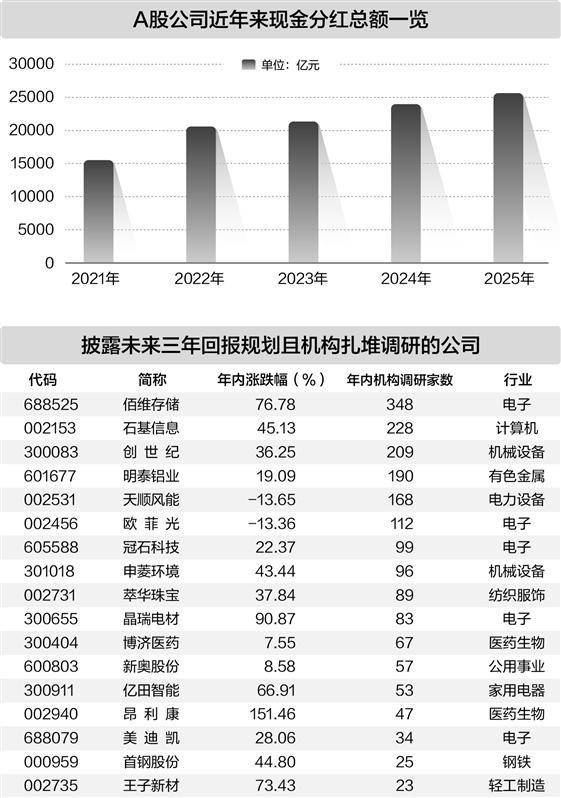
扬子晚报网12月16日讯(记者 范晓林 薄云峰 实习生 潘伊笑)据数据统计,截至12月10日,以股权登记 日计算,今年以来,3762家A股上市公司合计分红金额达2.46万亿元,超过去年全年,再创历史新高。 | 代码 | 简称 | 年内涨跌幅(%) | 年内机构调研家数 | 行业 | | --- | --- | --- | --- | --- | | 688525 | 佰维存储 | 76.78 | 348 | 电子 | | 002153 | 石基信息 | 45.13 | 228 | 计算机 | | 300083 | 创世纪 | 36.25 | 209 | 机械设备 | | 601677 | 明泰铝业 | 19.09 | 190 | 有色金属 | | 002531 | 天顺风能 | -13.65 | 168 | 电力设备 | | 002456 | 欧菲 光 | -13.36 | 112 | 电子 | | 605588 | 冠石科技 | 22.37 | da | 电子 | | 301018 | 申菱环境 | 43.44 | 96 | 机械设备 | | 002731 | 萃华珠宝 | 37.84 | 89 | 纺织服 ...
12月港股消费观察:1-2月流动性改善后港股消费买什么?
2025-12-16 03:26
12 月港股消费观察:1-2 月流动性改善后港股消费买什么? 20251215 摘要 服务零售额逆势增长,2025 年累计同比增长 5.4%,超过出口和投资增 速,成为提高居民消费率的关键。服务消费受房地产市场波动影响小, 且不存在消费透支问题,政府可通过构建消费场景有效拉动。 茅台通过控价措施稳定批发价,预计 2026 年批价至少维持在 1,500 元 左右,供给侧显著改善。大众占比提升可弥补部分商务缺失,经销商有 维护批价动力,食品饮料板块或已见底,建议积极布局。 李宁公司处于经营周期底部,营销和产品推新动作频繁,重新获得中国 奥委会合作权益,多条产品线将在 2026 年推出新品。经销商渠道库存 处于低位,实控人持续增持,建议在底部布局。 服装和鞋类制造业订单自 2025 年二季度以来逐步恢复,三季度增速加 快,美国服装零售及批发的库销比处于近三年低位。预计 2025 年三季 度是制造业订单低谷,四季度开始下游将陆续补库。 2026 年鞋服代工龙头企业利润率有望修复,推荐高股息率的龙头公司, 如申洲国际、精苑国际和九星控股。港股新标的乐舒适在非洲卫生用品 市场占据领先地位,收入和净利润复合增长率显著。 Q ...
渤海证券研究所晨会纪要(2025.12.16)-20251216
BOHAI SECURITIES· 2025-12-16 00:29
Core Insights - The report emphasizes that domestic demand will dominate and set the economic tone for the coming year, with a short-term focus on improvements in the export chain [2] Industry News - The Central Economic Work Conference was held in Beijing, highlighting the importance of domestic demand [2] - A notification on strengthening the collaboration between commerce and finance to boost consumption was officially released [2] Important Company Announcements - Jian Sheng Group announced an investment of 818 million yuan in capacity construction in Egypt [2] - Ribo Fashion plans to acquire 71% of Indile's shares for 1.42 billion yuan through a combination of issuing shares and cash payment [2] Market Review - From December 8 to December 12, the light industry manufacturing sector underperformed the CSI 300 index by 0.96 percentage points, with a decline of 1.04% compared to the CSI 300's decline of 0.08% [2] - During the same period, the textile and apparel sector lagged behind the CSI 300 index by 2.49 percentage points, with a decline of 2.57% [2] Weekly Strategy - The Central Economic Work Conference emphasized the need to build a strong domestic market as a primary task for economic work next year. Policies for replacing old products in sectors like automobiles, home appliances, and home furnishings are expected to continue [2] - The real estate market will be stabilized with city-specific measures to control inventory and encourage the purchase of existing homes for affordable housing [2] - Approximately 100 cities, including Hangzhou and Wuhan, have increased housing purchase subsidies this year, indicating a less pessimistic outlook for the real estate sector [2] Recommendations - The report maintains a "neutral" rating for the light industry manufacturing and textile apparel sectors, while suggesting to continue monitoring companies with strong overseas capacity and brand pricing power [3] - Companies such as Oppein Home (603833), Sophia (002572), Pathfinder (300005), Semir Apparel (002563), Guibao Pet (301498), and Zhongchong Co. (002891) are rated as "overweight" [3]
大消费行业周报(12月第2周):坚持内需主导、提振消费-20251215
Century Securities· 2025-12-15 09:40
Investment Rating - The report maintains a positive outlook on the consumer sector, emphasizing the importance of domestic demand and consumption recovery [1]. Core Insights - The consumer sector experienced a decline across various segments, with notable drops in retail, social services, food and beverage, beauty care, home appliances, and textiles [3]. - High-end liquor, particularly Moutai, is showing signs of bottoming out despite a significant price drop, indicating potential recovery as demand stabilizes [3]. - The central economic work conference highlighted the commitment to boosting domestic consumption, with policies aimed at increasing residents' income and optimizing supply of quality goods and services [3]. - The report suggests focusing on service consumption sectors, which have room for growth compared to developed countries [3]. Summary by Sections Market Weekly Review - The consumer sector saw a broad decline, with specific weekly performance metrics indicating negative trends across various sub-sectors [3][5]. - Notable stock performances included significant gains for certain companies, while others faced substantial losses [3][13][14]. Industry News and Key Company Announcements - Recent regulatory approvals and policy initiatives are expected to impact various sectors, including tourism and electric vehicles, with a focus on enhancing consumer experiences and market growth [15][16][19]. - Companies like Tim Hortons and others reported positive financial results, indicating resilience in the consumer market despite broader sector challenges [19][20].




龙头引领、业态焕新 浙企传统产业升级迎“新引擎”
Zheng Quan Shi Bao· 2025-12-14 18:32
Core Insights - Zhejiang's capital market is driving the transformation of the real economy, with traditional industries accelerating their upgrade through "high-end, intelligent, and green" reforms [1] - The 268 listed companies in 17 key traditional manufacturing sectors are pivotal for regional industrial upgrades, contributing significantly to Zhejiang's economic growth [1] Group 1: Traditional Manufacturing Sector - In 2024, the 17 key traditional manufacturing companies in Zhejiang are projected to achieve a revenue of 1.77 trillion yuan, a year-on-year increase of 5.30%, and a total profit of 103.66 billion yuan, up 2.04% [1] - These companies have maintained an annual R&D investment of over 40 billion yuan, reaching a historical high of 45.44 billion yuan in 2024 [1] Group 2: Chemical Manufacturing - The chemical manufacturing sector, with the highest number of listed companies, is a key indicator of traditional industry upgrades, achieving a revenue of 260.9 billion yuan in 2024, a growth of 5.99%, and a net profit of 19.42 billion yuan, up 13.45% [2] - Leading companies like Zhejiang Longsheng and Hangyang Co. are diversifying their product offerings to strengthen their market positions [2] Group 3: Automotive Parts - The automotive parts sector reported a revenue of 111.76 billion yuan in 2024, growing by 8.20%, with a net profit of 6.89 billion yuan, an increase of 9.40% [4] - Companies like Shuanghuan Transmission and Yinlun Co. are leading the transition from traditional fuel vehicles to new energy and robotics [4][5] Group 4: Low Voltage Electrical Equipment - The low voltage electrical equipment sector achieved a revenue of 165.27 billion yuan in 2024, with a year-on-year growth of 9.62% [6] - Leading firms such as Chint Electric and Hengdian East Magnetic are innovating through digital transformation and expanding into renewable energy [6][7] Group 5: Textile and Apparel - The textile industry generated a revenue of 39.69 billion yuan in 2024, a growth of 15.38%, while the apparel sector reached 37.30 billion yuan, up 0.92% [8] - Companies like Semir and Baoxiniao are innovating through brand renewal and smart customization to capture new market opportunities [8] Group 6: Overall Transformation - The transformation of Zhejiang's traditional manufacturing has evolved from mere technical upgrades to a systematic change, characterized by "capital empowerment, technology-driven, and ecological collaboration" [9] - These listed companies are expected to provide valuable insights for the national transformation of traditional industries [9]
可选消费行业周报:焦点转向基本面,关注韧性突出或底部反转的标的-20251214
NOMURA· 2025-12-14 13:55
Investment Rating - The report maintains an "Overweight" rating for the retail sector, focusing on companies with strong operational resilience or signs of bottom reversal [6][63]. Core Insights - The focus has shifted from policy catalysts to fundamental performance, with an emphasis on companies demonstrating operational resilience or potential recovery from low points [2][15]. - The retail sector experienced a relatively small decline of -0.21% during the week of December 8-12, 2025, outperforming other consumer-related sectors [1][7]. - The report highlights specific stocks that have shown significant price movements, such as Guai Bao Pet and TCL Electronics, which saw increases due to various catalysts [2][16]. Summary by Sections Market Overview - The retail sector's performance was relatively stable compared to other sectors, with a decline of only -0.21%, ranking 12th among all sectors [1][7]. - The overall market sentiment has shifted towards technology and high-end manufacturing, leading to weaker returns in consumer and cyclical sectors [2][15]. Stock Performance - Notable gainers included Guai Bao Pet, which rose by 2.7%, and TCL Electronics, which increased by 2.5%, attributed to factors such as oversold rebounds and improved performance expectations [2][16]. - Conversely, stocks like Pop Mart faced declines due to disappointing sales during the overseas Black Friday promotions, raising concerns about future growth [2][16]. Future Outlook - The report suggests that investment opportunities may be limited as policy expectations have stabilized, recommending stocks with strong fundamentals and low valuation percentiles [3][17]. - Three main investment themes are proposed: benefiting from holiday travel and tourism, domestic brands with competitive advantages, and durable goods companies likely to benefit from U.S. interest rate cuts [3][17]. Sector News - In the cosmetics sector, sales on major platforms reached 37.64 billion yuan in the first 11 months, with Proya leading in several categories [4][18]. - The home appliance sector saw the launch of a new smart air conditioning factory by Xiaomi, enhancing its production capabilities [4][19]. - The furniture sector is addressing consumer pain points with new commitments from leading companies to ensure quality and service [4][20].


中央经济工作会议点评:政策定调强信心,服装消费预期向好
Yin He Zheng Quan· 2025-12-14 03:17
Investment Rating - The report maintains a "Recommended" rating for the textile and apparel industry [1] Core Insights - The central economic work conference emphasizes the importance of domestic demand, which is expected to boost consumer confidence in the textile and apparel sector. The retail sales of clothing showed a cumulative year-on-year growth of 3.5% from January to October 2025, with a notable increase of 6.3% in October alone, indicating a potential shift from "moderate recovery" to "accelerated warming" in 2026 [3] - Despite challenges such as tariff fluctuations and overseas inventory cycles, textile exports maintained a positive growth of 1.2% year-on-year from January to November 2025. However, apparel exports faced a decline of 3.7% during the same period, highlighting the pressure on finished garment exports [3] - The report highlights the significance of innovation and technological advancement in the industry, with leading companies focusing on product innovation and digital transformation to enhance competitiveness and meet evolving consumer demands for high-quality and sustainable products [3] - Investment suggestions include focusing on high-demand outdoor sports brands and textile manufacturers with overseas production capabilities. Recommended companies include Anta Sports, Li Ning, and Shenzhou International, among others [3]
【12日资金路线图】电子板块净流入逾150亿元居首 龙虎榜机构抢筹多股
证券时报· 2025-12-12 13:11
Market Overview - The A-share market experienced an overall increase on December 12, with the Shanghai Composite Index closing at 3889.35 points, up 0.41%, and the Shenzhen Component Index at 13258.33 points, up 0.84% [2] - Total trading volume in the A-share market reached 21191.52 billion yuan, an increase of 2337.46 billion yuan compared to the previous trading day [2] Capital Flow - The main capital outflow in the A-share market was 89.34 billion yuan, with an opening net outflow of 136.84 billion yuan and a closing net outflow of 5.49 billion yuan [3] - The CSI 300 index saw a net capital outflow of 65.19 billion yuan, while the ChiNext index had a net outflow of 42.56 billion yuan and the STAR Market saw a net outflow of 32.26 billion yuan [5] Sector Performance - The electronics sector led with a net inflow of 154.33 billion yuan, followed by the power equipment sector with 95.56 billion yuan and the communications sector with 76.08 billion yuan [7][8] - Conversely, the basic chemicals sector experienced a net outflow of 35.35 billion yuan, with retail and light industry sectors also seeing significant outflows [8] Notable Stocks - Dongshan Precision's main capital inflow was 11.14 billion yuan, making it the top stock in terms of capital inflow [9] - Institutions showed significant interest in stocks such as Guocera Materials, which had a net institutional buy of 153.14 million yuan, and Zhongneng Electric with 124.26 million yuan [11][12] Institutional Focus - Recent institutional ratings highlighted stocks like Changhong Technology with a target price of 16.00 yuan, indicating a potential upside of 21.77% from its latest closing price [13]