军工

Search documents
一图看懂:主动优选基金经理,在2025年3季报里都说了啥?
银行螺丝钉· 2025-11-19 13:56
Core Insights - The article provides an overview of fund managers' perspectives and strategies based on their recent quarterly reports, highlighting different investment styles and market outlooks [1][2]. Group 1: Fund Manager Perspectives - Fund managers express varying views on market conditions, with some maintaining optimism about equity assets due to low interest rates and the potential for corporate earnings recovery [17][18]. - Different investment styles are categorized, including deep value, growth value, balanced, and growth styles, each with distinct characteristics and focus areas [19][35][51]. Group 2: Deep Value Style - Deep value managers focus on low valuation metrics such as low P/E ratios and high dividend yields, primarily investing in sectors like finance, real estate, and energy [10][12]. - Historical performance shows that this style performed well in 2016-2017 and 2021-2024, while underperforming in 2019-2020 [15][16]. Group 3: Growth Value Style - Growth value managers prioritize companies with strong profitability and stable cash flows, often holding stocks for the long term [20][22]. - Concerns about market risks and valuation levels are noted, with some managers highlighting the extreme valuation disparities across sectors [22][24]. Group 4: Balanced Style - Balanced style managers seek a combination of growth and value, focusing on companies with favorable PEG ratios and exploring opportunities across various sectors [35][36]. - They emphasize the importance of maintaining a diversified portfolio while identifying high-quality investment opportunities [40][46]. Group 5: Growth Style - Growth style managers focus on high revenue and earnings growth, often investing in emerging industries such as AI, renewable energy, and technology [51][62]. - The article notes a shift in focus from technology to consumer sectors as the market stabilizes, with an emphasis on identifying companies with strong growth potential [55][58]. Group 6: Market Outlook - The overall market sentiment is cautiously optimistic, with expectations of continued structural opportunities despite potential short-term volatility [40][62]. - Fund managers are adjusting their portfolios in response to macroeconomic conditions, focusing on sectors with strong growth prospects and managing risks associated with high valuations [31][70].


国科军工:股东减持系基于其自身资金安排需求
Zheng Quan Ri Bao· 2025-11-19 13:08
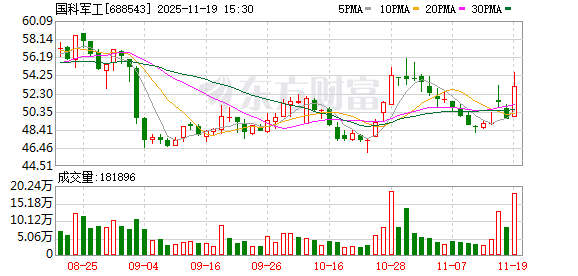
Core Viewpoint - The company, Guokai Military Industry, has addressed shareholder reduction issues and emphasized compliance with disclosure regulations while maintaining operational transparency under confidentiality requirements [2]. Group 1: Shareholder Actions - The company has disclosed that shareholders are reducing their holdings based on personal financial arrangements and will continue to monitor compliance with reduction rules [2]. - The company has fulfilled its information disclosure obligations regarding shareholder reductions as per regulatory requirements [2]. Group 2: Company Operations and Communication - The absence of an official website and adjustments in promotional content are attributed to the unique attributes of military enterprises and confidentiality management requirements [2]. - The company is committed to adhering to information disclosure regulations and aims to provide accurate and complete operational updates to investors while respecting confidentiality [2]. Group 3: Market Influences - The company's stock price fluctuations are influenced by various factors, including macroeconomic conditions, industry policies, and market sentiment [2]. - The management is focused on improving operational performance to deliver stable and sustainable returns to investors [2].

尤洛卡:公司支持师凯科技引入战略合作伙伴,共同推动公司军工业务发展
Zheng Quan Ri Bao Wang· 2025-11-19 12:13
Group 1 - The company, Youloka (300099), expressed support for Shikai Technology in introducing strategic partners to jointly promote the development of its military industry business [1]

申万宏源傅静涛:2026年春季前科技成长至少还有一波机会
Guo Ji Jin Rong Bao· 2025-11-19 11:39
Core Viewpoint - The 2025 technology structural bull market is considered "Bull Market 1.0," with a potential peak in spring 2026, followed by a comprehensive bull market termed "Bull Market 2.0" in the second half of 2026 [1] Group 1: Market Trends - The AI industry trend is expected to deepen, but the cost-effectiveness of the A-share AI industry chain is deemed low, similar to previous years in 2014, 2018, and 2021 [1] - A mid-2026 supply clearing in midstream manufacturing is anticipated, with a notable increase in sectors where capacity growth is lower than demand growth [1] - The sequence of "policy bottom, market bottom, economic bottom" is expected to occur, with mid-2026 potentially validating the "policy bottom" [1] Group 2: Investment Recommendations - Investors are advised to focus on three main lines in 2026: 1. Recovery trading sectors such as cyclical Alpha, basic chemicals, and industrial metals 2. Technology industry trend sectors including AI industry chain, humanoid robots, energy storage, photovoltaics, pharmaceuticals, and military industry 3. Sectors related to manufacturing influence enhancement, such as chemicals and engineering machinery [2] - The transition from Bull Market 1.0 to 2.0 is characterized by high dividend defensiveness, with the latter stage driven by cyclical policies and technological trends [2]
揭秘涨停丨水产板块多股持续涨停
Zheng Quan Shi Bao Wang· 2025-11-19 11:35
Group 1: Market Activity - 21 stocks had closing orders exceeding 100 million yuan today, with Huaci Co., Langchao Software, and Aerospace Development leading the pack with amounts of 657 million yuan, 502 million yuan, and 455 million yuan respectively [2] - Huaci Co. achieved a cumulative increase of 46.35% with a four-day consecutive limit-up, while its main funds experienced a net outflow of 49.97 million yuan, marking the highest outflow since July 31, 2025 [2][3] Group 2: Company Performance - Huaci Co. reported a revenue of 1.133 billion yuan for the first three quarters, reflecting a year-on-year growth of 15.32%, and a net profit attributable to shareholders of 189 million yuan, up 12.17% year-on-year [3] - The water product sector saw multiple stocks hitting the limit-up, including Guolian Aquatic Products and Zhongshui Fishery, with Zhongshui Fishery focusing on deep-sea economic development and sustainable marine resource projects [4] Group 3: Industry Insights - The military industry featured stocks like Jianglong Shipbuilding and Yaxing Anchor Chain, with Jianglong being a leading manufacturer of small and medium-sized law enforcement vessels, and Yaxing being a major supplier of anchor chains for the navy [5] - The water product industry is characterized by companies like Dahu Co., which has established a full industry chain from ecological breeding to sales, and has products available in major supermarkets [4]


龙虎榜复盘 | 水产养殖板块爆发,军工也有强势表现
Xuan Gu Bao· 2025-11-19 10:42
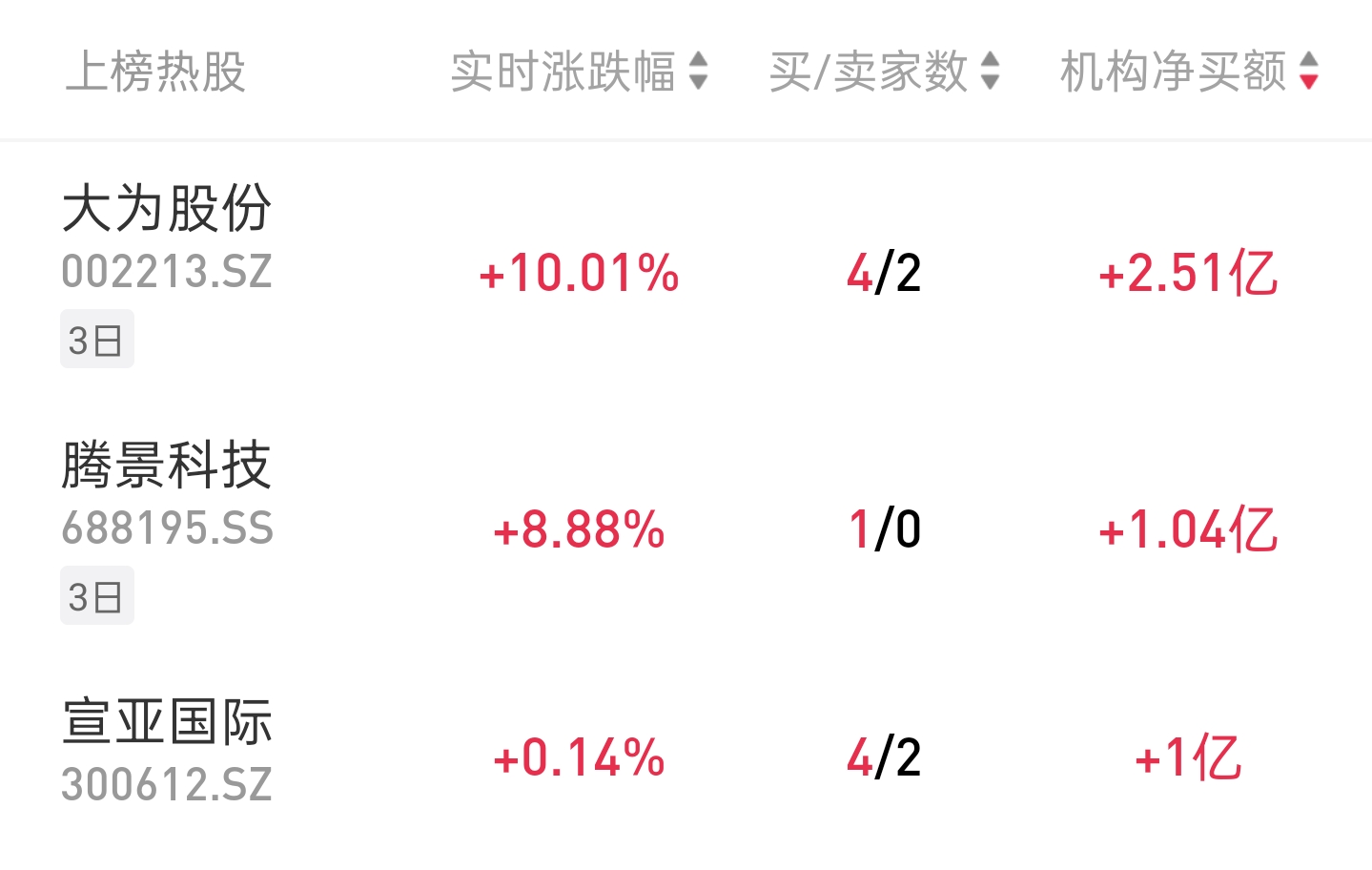
Group 1: Stock Market Activity - On the institutional trading leaderboard, 27 stocks were listed, with 15 seeing net purchases and 12 experiencing net sales [1] - The top three stocks with the highest net purchases by institutions were: Dawi Co., Ltd. (2.51 billion), Tengjing Technology (1.04 billion), and Xuanya International (1 billion) [1] Group 2: Semiconductor Industry - Dawi Co., Ltd. specializes in semiconductor storage, primarily offering NAND and DRAM storage products, with its subsidiary Dawi Chuangxin providing products applicable in data centers [1] Group 3: Aquaculture Industry - Guolian Aquatic Products is a leading company in the aquaculture and prepared food sector [1] - Zhongshui Fishery, under China Agricultural Development Group, focuses on deep-sea aquatic products, including prepared foods like tuna dumplings and tuna rings [1] - Recent news indicates that China has suspended imports of Japanese aquatic products due to political tensions, which may impact market dynamics [1] Group 4: Military Industry - A domestic company is a major producer of military microwave circuits and devices, involved in satellite development and ground station support, holding exclusive supply positions with core clients [2] - Jianglong Shipbuilding specializes in law enforcement vessels, leisure boats, and special operation vessels, and has qualified as a supplier for the People's Liberation Army, enabling it to produce and repair small surface combat vessels and auxiliary ships [2]


杨德龙:2026年本轮牛市行情将延续有望从结构牛走向全面牛
Xin Lang Ji Jin· 2025-11-19 09:56
从全球局势来看,G2格局逐步确立,未来国际格局中,中美有望出现你追我赶、齐头并进的发展态 势,而非美国在科技上遥遥领先的局面。未来,中美在经贸领域还会继续在合作中竞争、在竞争中发 展。我国在硬件和软件两个方面均实现突破,特别是DeepSeek大模型横空出世,以及在芯片、半导体 方面实现的突破,都提升了全球资本对于中国科技创新的信心,这也是这轮牛市以科技为主线的重要原 因。虽然前期科技板块涨幅较大,一些投资者选择暂时获利了结,导致科技板块出现调整,但科技牛市 预计并没有结束。人工智能带来的科技进步以及生产力提升的趋势将会延续。结构性牛市以科技为主, 主要体现在资金集中投资于少数科技创新板块,如机器人、芯片、半导体、算法创新、固态电池等;到 了全面牛市阶段,更多板块可能会出现上涨,这或将会给市场带来赚钱机会。因此,预计2026年市场的 赚钱效应可能比今年更强,投资机会可能也更多,投资者的体验也可能会更好。 2025年,市场虽走出了牛市走势,但呈现出典型的哑铃型结构:一头是以银行为代表的低估值、高股息 板块,部分个股甚至创新高;另一头是代表新质生产力的科技股大幅上涨,而大多数板块没有明显表 现。2026年,如基本面 ...
港股速报|港股四连跌 黄金股成避风港
Mei Ri Jing Ji Xin Wen· 2025-11-19 09:14
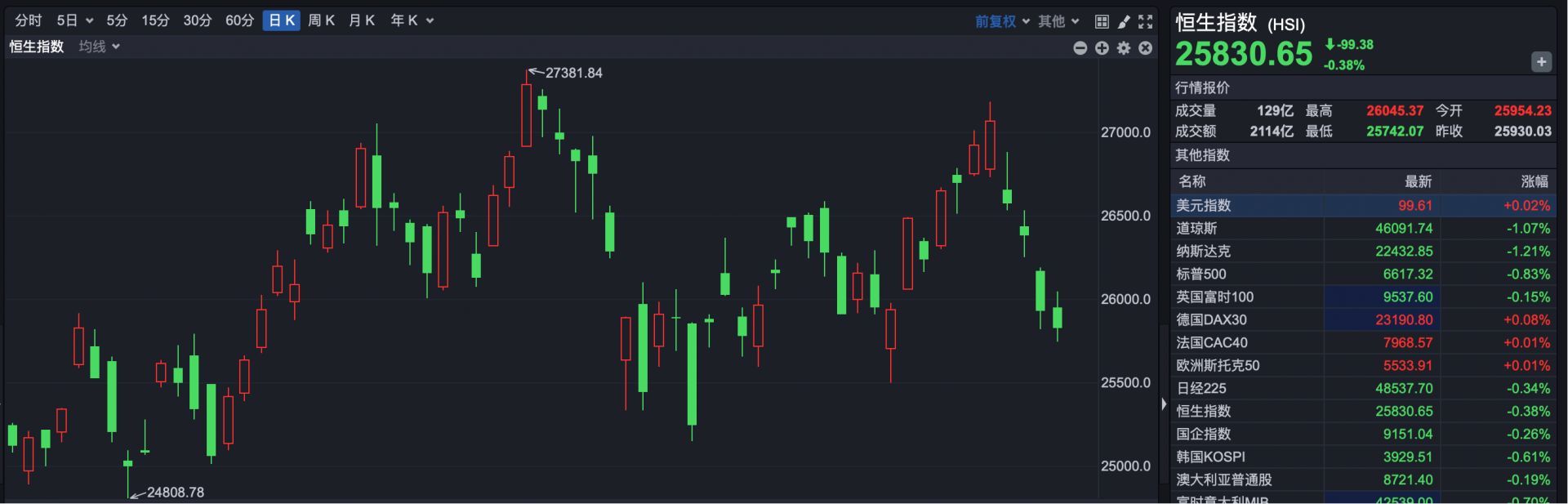
Market Overview - The Hong Kong stock market experienced a four-day decline, with the Hang Seng Index closing at 25,830.65 points, down 99.38 points, a decrease of 0.38% [1] - The Hang Seng Technology Index closed at 5,606.90 points, down 38.83 points, a decline of 0.69% [4] Sector Performance - Gold stocks emerged as a primary safe haven, with major gold stocks showing strong performance. China Gold International rose over 8%, Zhaojin Mining increased over 6%, Shandong Gold gained over 7%, Zijin Mining rose over 2%, and Luoyang Molybdenum increased over 1% [3] - Jewelry concept stocks also strengthened, with Luk Fook Holdings rising nearly 3% and Lao Poo Gold increasing over 1% [3] - Technology stocks generally declined, with Xiaomi dropping over 4% and Kuaishou down over 1%, while Alibaba rose over 1% [6] - Defense stocks were strong, with China Shipbuilding Industry rising over 9%, and oil stocks also performed well, with Sinopec increasing over 2% [6] - New energy vehicle companies weakened, with Li Auto and NIO both down over 2% [6] Investment Outlook - Recent adjustments in the Hong Kong market have led to a divergence in institutional views, but there is a general consensus that the market holds medium to long-term allocation value [8] - Current market sentiment is influenced by external market fluctuations, particularly in the US, and an internal policy vacuum. However, the valuation attractiveness of the Hong Kong market has become evident after recent adjustments [9] - The Hang Seng Technology Index's price-to-earnings ratio is at a relatively low level since its inception, positioning it as a "value pit" in the global market [9] - The technology sector is still in an adjustment phase, with a lack of new catalysts for H-shares in AI technology stocks, despite renewed market interest in US AI stocks [9] - Historically, dividend stocks tend to perform better during November and December, and the current market appears to be following this trend [9]
时报图说丨券商展望2026年股市,如何配置?
Zheng Quan Shi Bao Wang· 2025-11-19 08:44
Core Viewpoint - The outlook for the A-share market in 2026 is optimistic, driven by global market demand rather than solely domestic factors, with key influences from the China-US relationship and significant events such as trade agreements and US midterm elections [1][5][11]. Configuration Directions - Three major themes to focus on include: 1. Upgrading traditional manufacturing and resource industries to enhance pricing power and profit margins [2][4]. 2. Chinese companies expanding globally, significantly increasing profit growth potential and market capitalization [2][4]. 3. The commercialization of AI, which will continue to expand the technology sector's influence and amplify the competitive advantages of Chinese enterprises [2][4]. Market Phases - The market is expected to experience a two-phase bull market: "Bull Market 1.0" in 2025 focused on technology, and a potential transition to "Bull Market 2.0" in the second half of 2026, driven by cyclical recovery and growth in manufacturing [3][6]. Investment Opportunities - Key sectors to watch include: 1. Recovery trades in cyclical industries such as basic chemicals and industrial metals [4]. 2. Technology trends with opportunities in AI, humanoid robots, energy storage, photovoltaics, pharmaceuticals, and military industries [4][8]. 3. Enhanced influence of manufacturing, particularly in chemicals and engineering machinery [4][8]. Market Dynamics - The A-share market is expected to continue its upward trend post "9·24" with a focus on fundamental improvements and risk management against volatility, particularly in the context of evolving China-US relations and the AI revolution [5][11]. Sector Focus - Recommended sectors include: 1. New energy, non-ferrous metals, basic chemicals, oil and petrochemicals, non-bank financials, military, machinery, and computing [8][12]. 2. Themes such as new materials, solid-state batteries, commercial aerospace, nuclear power, and cross-strait integration [8][12]. Overall Market Sentiment - The sentiment remains cautiously optimistic, with expectations of continued inflow of incremental funds and a focus on sectors that may outperform expectations, particularly in AI and pragmatic cooperation between China and the US [11][12].

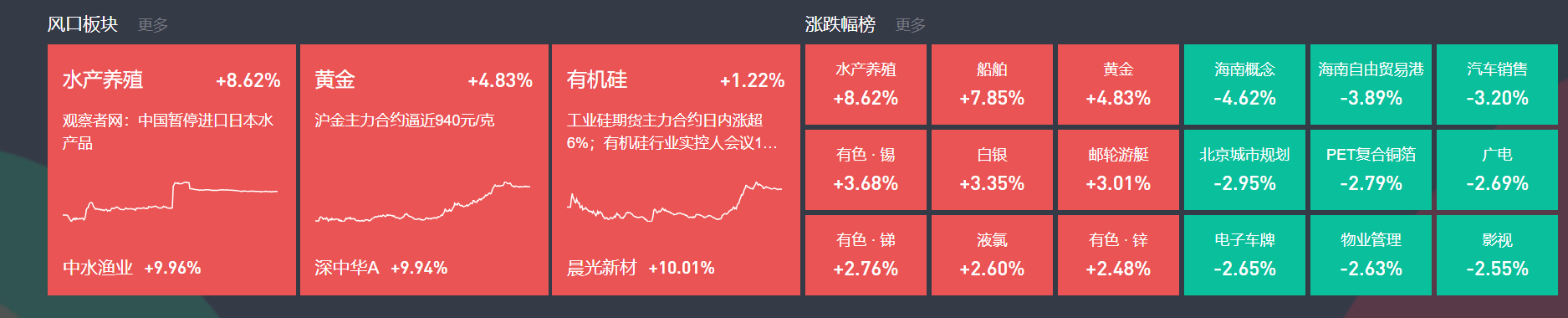
11月19日主题复盘 | 水产养殖大涨,黄金、有机硅等走强
Xuan Gu Bao· 2025-11-19 08:33
Market Review - The Shanghai Composite Index experienced narrow fluctuations, while the ChiNext Index saw a rise followed by a decline. The aquaculture sector surged, with stocks like Zhangzi Island and Dahu Co. hitting the daily limit. Gold stocks also rose in the afternoon, with Shen Zhonghua A reaching the daily limit and Zhongjin Gold touching the limit. The military industry performed actively, with Jianglong Shipbuilding and China Shipbuilding Defense hitting the daily limit. Conversely, popular sectors in Fujian and Hainan saw declines, with Haima Automobile and Sanmu Group hitting the daily limit. Overall, over 4,200 stocks in the Shanghai, Shenzhen, and Beijing markets were in the red, with a total transaction volume of 1.74 trillion yuan [1]. Hot Topics Aquaculture - The aquaculture concept saw a significant rise today, with Zhongshui Fishery achieving four consecutive limits, and stocks like Kaichuang International, Guolian Aquatic Products, Dongfang Ocean, and Haodangjia also hitting the daily limit. According to CCTV news, on November 19, the Chinese Foreign Ministry announced the suspension of imports of Japanese seafood due to strong public outrage over Japanese Prime Minister Fumio Kishida's remarks on major issues like Taiwan. This situation suggests that even if Japan exports seafood to China, there will be no market for it [4]. Organic Silicon - The organic silicon sector saw renewed activity in the afternoon, with Chenguang New Materials hitting the daily limit and Dongyue Silicon Materials and Yuanxiang New Materials rising over 10%. A seminar on the high-quality development of methyl chlorosilane enterprises is being held in Shanghai, which may lead to the establishment of production reduction targets [6]. Gold - The gold sector experienced another significant rise, with Shen Zhonghua A hitting the daily limit and Zhongjin Gold and Shandong Gold following suit. Market data indicated that the main gold futures contract surged over 1% in the afternoon, approaching 940 yuan per gram [8]. Military Industry - The military sector remains active, with stocks like Jianglong Shipbuilding and China Shipbuilding Defense hitting the daily limit. Reports indicate heightened concerns regarding Japan's military stance, as highlighted in a recent article from the Liberation Army Daily [14]. Lithium Battery - The lithium battery sector showed signs of recovery, with lithium carbonate futures breaking through the 100,000 yuan mark, and prices of electrolyte additives continuing to rise [16].