
有色金属

Search documents
长江有色:股油双杀及春节前现货采销清淡 13日锌价或下跌
Xin Lang Cai Jing· 2026-02-13 02:50
【ccmn.cn摘要】股油双杀重挫市场乐观情绪与美指反弹压制,隔夜伦锌跌超 1%;高盛预测今年全球锌 市将小幅过剩,国内春节临近现货采销清淡,今现锌或下跌。 【ccmn.cn锌期货市场】隔夜伦锌震荡下挫,开盘报3416.5美元/吨,高点报3449美元,低点报3356.5美 元,尾盘收于3482美元,跌36美元,跌幅1.07%;成交量9738手减少1065手,持仓量227792手减少7690 手。晚间沪锌走势先扬后抑,主力2603合约最新收盘价报24435元/吨,跌155元,跌幅0.63%。 长江锌业网(pb.ccmn.cn)今日现货锌价行情预估:股油双杀重挫市场乐观情绪与美指反弹压制,隔夜 伦锌跌超 1%,收报3482美元/吨; 宏观层面,美国1月非农就业岗位新增13万个,12月数据还获上修,与市场此前预期的就业市场降温明 显不符。更意外的是,失业率不升反降至4.3%。虽随后公布的周度初请失业金人数略高于预期,但22.7 万人的数值仍显示劳动力市场状况良好,远未到需美联储干预救助的地步。周四,美国股市因人工智能 引发大跌,纳斯达克指数重挫2%,标普500指数跌超1.5%,道指也未能幸免。市场对AI颠覆效应深度 ...


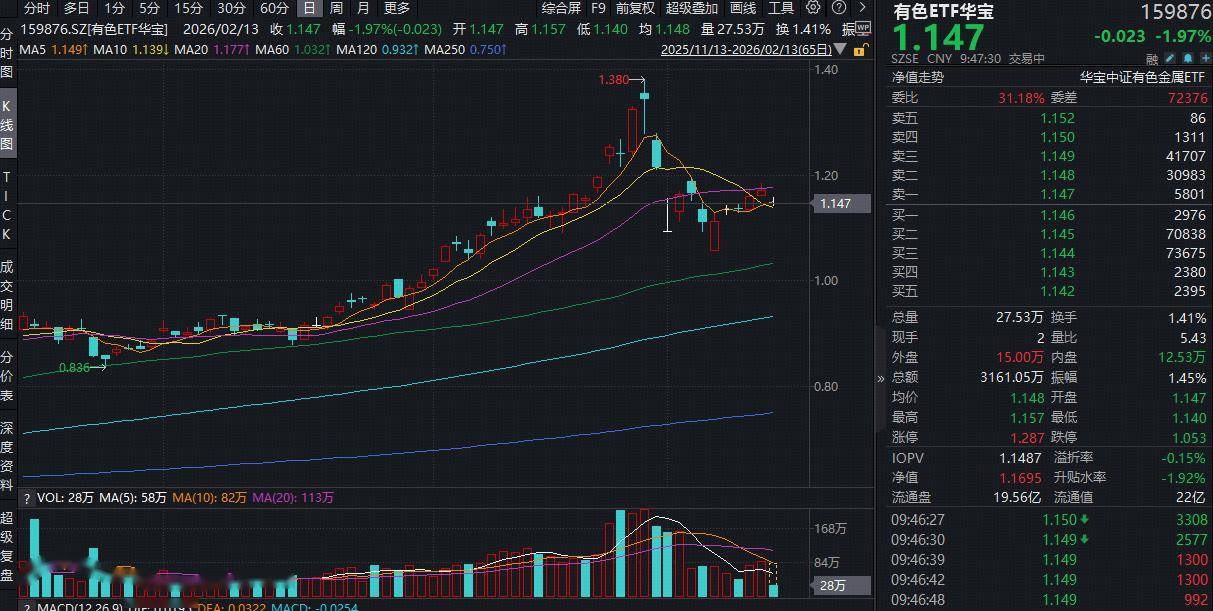
ETF盘中资讯|情绪面扰动,有色ETF跌破5日线!但下方仍有10日线支撑!机构:中期有望重拾升势!
Sou Hu Cai Jing· 2026-02-13 02:40
Group 1 - The core viewpoint of the articles indicates that the current trends in the metals market, particularly in precious and industrial metals, are influenced by liquidity expectations and geopolitical tensions, which are driving prices upward [2][3] - The performance of the Huabao ETF (159876) reflects a comprehensive coverage of various metals including copper, aluminum, gold, rare earths, and lithium, positioning it as an efficient tool for investors to gain exposure to the sector [3] - Recent fluctuations in the market have seen the Huabao ETF experience a decline of over 2.4%, with a current drop of 1.97%, indicating a short-term weakness but not a negative trend overall [1] Group 2 - The report from CITIC Securities suggests that the upward trend in gold prices is not yet over, with expectations of a recovery in both Chinese and global economies in the next 6-12 months, which could boost market demand [2] - The analysis from CICC indicates that the resource stock market has not ended, and after a short-term adjustment, there is potential for a mid-term recovery in prices [2] - Long-term perspectives from Huatai Securities maintain that the macroeconomic logic for non-ferrous metals remains intact, supporting a positive outlook for the sector [2]
铜冠金源期货商品日报-20260213
Tong Guan Jin Yuan Qi Huo· 2026-02-13 02:33
1. Report Industry Investment Rating No relevant content provided. 2. Core Views of the Report - Overseas: Before the release of the January CPI, market risk - aversion sentiment significantly increased. Concerns about the potential structural reshaping of the industry by AI led to a "counter - AI trade", amplifying the selling pressure on the technology sector. The Nasdaq fell by over 2%, gold dropped by more than 3%, silver declined by over 10%, copper and oil fell by over 2%, and the 10 - year US Treasury yield dropped to 4.1%. The market is in a high - volatility environment, and attention is focused on the release of the US January CPI data [2]. - Domestic: Amid the expected April meeting between the Chinese and US presidents and Trump's planned visit to China, the US has postponed key technology and security restrictions on China. The A - share market continued its volatile and differentiated pattern on Thursday. Small - and medium - cap and growth styles were relatively dominant. Although the trading volume slightly rebounded to 2.16 trillion yuan, over 3,200 stocks fell. The market is in a slow recovery phase with shrinking volume, and is expected to maintain a volatile recovery trend in the short term. Attention is paid to the January financial data [3]. - Precious Metals: Gold and silver prices dropped significantly on Thursday. The international gold price fell by 4.1% and silver plunged by 11%. This was due to the decline of US technology stocks and strong US employment data, which weakened the market's expectation of the Fed's near - term interest rate cut. The adjustment of precious metal prices may not be over, and attention should be paid to the US CPI data [4][5]. - Copper: The main contract of Shanghai copper declined on Thursday, and LME copper also fell. The market is worried about the potential burst of the global AI bubble, and hawkish remarks from Fed officials have dampened market risk appetite. The global refined copper market is in a tight balance, and copper prices are expected to remain in a high - level shock in the short term [6][7]. - Aluminum: The main contract of Shanghai aluminum closed at 23,690 yuan/ton on Thursday. Strong US employment data has suppressed the expectation of Fed rate cuts, and the aluminum ingot inventory has continued to increase significantly. The aluminum price is expected to continue to fluctuate in a range, and attention should be paid to controlling position risks [8]. - Alumina: The supply and demand of alumina have changed little recently. The supply pressure has slightly decreased, and the procurement of raw materials by electrolytic aluminum enterprises has been postponed. The market is waiting and seeing about the resumption of production of previously reduced - production capacity after the Spring Festival. Alumina prices are expected to fluctuate in a range [10]. - Cast Aluminum: Upstream and downstream enterprises of cast aluminum have entered the holiday stage, and the market supply and demand are weak. The holiday time of cast aluminum enterprises this year is slightly longer than usual. Cast aluminum prices are expected to fluctuate in a range [11]. - Zinc: Before the release of the US CPI data, the AI panic escalated, and the zinc price followed the adjustment of the non - ferrous metal sector. The domestic spot market has become stagnant, and the social inventory has continued to increase seasonally. The zinc price is expected to be cautious during the Spring Festival holiday [12]. - Lead: The upstream and downstream of the lead industry chain are mostly on holiday, the spot purchase has ended, and the social inventory has continued to rise. The Shanghai lead is expected to continue to fluctuate in a narrow range at a low level [13][14]. - Tin: The market's concern about the subversive impact of AI has led to a sharp decline in US stock indexes. Traders sold metals to cover stock market losses, and the tin price dropped at night. The market is in a holiday atmosphere, and the tin price is expected to fluctuate weakly [15]. - Steel (Screw and Coil): The steel futures fluctuated on Thursday. The supply of the five major steel products decreased, the inventory increased rapidly, and the apparent consumption decreased. The spot market has stopped trading before the festival, and the steel price is expected to fluctuate in the short term [16]. - Iron Ore: The trading volume of iron ore at ports has significantly slowed down, the steel mills have completed replenishment, and the iron ore consumption is at a low level. The overseas shipment and arrival volume have both decreased, and the port inventory remains high. The iron ore price is expected to fluctuate in the short term [17]. - Coking Coal and Coke: The coking coal supply has shrunk, and the inventory has decreased. The profit of coke enterprises has slightly recovered, but production is still restricted by environmental protection policies. The raw material inventory of steel mills and coke enterprises is at a high level in the past two years. The coking coal and coke prices are expected to fluctuate in the short term [18][19]. - Beans and Rapeseed Meal: Trump's expected visit to China has improved the trade outlook, and the US soybean price has continued to rise. The precipitation in the Argentine soybean - producing area is expected to be higher than normal in the next two weeks. Due to the exchange's margin increase before the festival, funds have a high risk - aversion sentiment, and the longs in the domestic bean meal market have increased. The bean meal price is expected to fluctuate in a range [20][21]. - Palm Oil: The Malaysian government has raised the reference price of crude palm oil in March but kept the export tariff unchanged. Indonesia has suspended the decision to expand the biodiesel blending ratio. The supply and demand of palm oil in Malaysia have both decreased in early February, and the inventory reduction may slow down. The palm oil price is expected to decline in a shock in the short term [22][23]. 3. Summary by Relevant Catalogs 3.1 Metal Main Variety Trading Data - Copper: SHFE copper closed at 102,330 yuan/ton, up 0.15%; LME copper closed at 12,856 US dollars/ton, down 2.90% [24]. - Aluminum: SHFE aluminum closed at 23,610 yuan/ton, down 0.21%; LME aluminum closed at 3,098 US dollars/ton, down 0.63% [24]. - Alumina: The main contract of SHFE alumina closed at 2,808 yuan/ton, down 1.20% [24]. - Zinc: SHFE zinc closed at 24,650 yuan/ton, up 0.26%; LME zinc closed at 3,382 US dollars/ton, down 1.07% [24]. - Lead: SHFE lead closed at 16,700 yuan/ton, down 0.24%; LME lead closed at 1,984 US dollars/ton, down 0.53% [24]. - Nickel: SHFE nickel closed at 139,610 yuan/ton, up 0.18%; LME nickel closed at 17,250 US dollars/ton, down 4.51% [24]. - Tin: SHFE tin closed at 391,320 yuan/ton, down 0.86%; LME tin closed at 47,800 US dollars/ton, down 4.52% [24]. - Precious Metals: COMEX gold closed at 4,941.40 US dollars/ounce, down 3.26%; SHFE silver closed at 20,626 yuan/kg, down 1.52%; COMEX silver closed at 75.01 US dollars/ounce, down 10.79% [24]. - Steel: SHFE rebar closed at 3,050 yuan/ton, down 0.13%; SHFE hot - rolled coil closed at 3,218 yuan/ton, down 0.31% [24]. - Iron Ore: DCE iron ore closed at 762.0 yuan/ton, down 0.07% [24]. - Coking Coal and Coke: DCE coking coal closed at 1,120.0 yuan/ton, down 0.31%; DCE coke closed at 1,664.0 yuan/ton, down 0.18% [24]. - Industrial Silicon: GFEX industrial silicon closed at 8,335.0 yuan/ton, down 0.42% [24]. - Agricultural Products: CBOT soybeans closed at 1,151.3 yuan/ton, up 2.47%; DCE bean meal closed at 2,790.0 yuan/ton, up 0.61%; CZCE rapeseed meal closed at 2,303.0 yuan/ton, up 0.66% [24]. 3.2 Industrial Data Perspective - Copper: On February 12, SHFE copper main contract was 102,330 yuan/ton, up 150 yuan from the previous day; LME copper 3 - month contract was 12,855.5 US dollars/ton, down 383.5 US dollars. LME inventory increased by 4,550 tons to 196,650 tons [25]. - Nickel: SHFE nickel main contract was 139,610 yuan/ton on February 12, up 250 yuan; LME nickel 3 - month contract was 17,250 US dollars/ton, down 815 US dollars. LME inventory increased by 636 tons to 286,386 tons [25]. - Zinc: SHFE zinc main contract was 24,650 yuan/ton on February 12, up 65 yuan; LME zinc was 3,381.5 US dollars/ton, down 36.5 US dollars. LME inventory decreased by 1,750 tons to 103,500 tons [28]. - Lead: SHFE lead main contract was 16,700 yuan/ton on February 12, up 35 yuan; LME lead was 1,994.5 US dollars/ton, up 17 US dollars. LME inventory increased by 200 tons to 232,950 tons [28]. - Aluminum: SHFE aluminum continuous - three contract was 23,745 yuan/ton on February 12, down 50 yuan; LME aluminum 3 - month contract was 3,097.5 US dollars/ton, down 19.5 US dollars. LME inventory decreased by 2,200 tons to 483,550 tons [28]. - Alumina: SHFE alumina main contract was 2,808 yuan/ton on February 12, down 34 yuan; the national average spot price of alumina was 2,646 yuan/ton, unchanged. The SHEF warehouse inventory increased by 14,094 tons to 276,825 tons [28]. - Tin: SHFE tin main contract was 391,320 yuan/ton on February 12, down 3,380 yuan; LME tin was 47,800 US dollars/ton, down 2,265 US dollars. LME inventory decreased by 60 tons to 7,490 tons [28]. - Precious Metals: SHFE gold was 1,126.12 yuan, unchanged; COMEX gold was 4,948.40 US dollars/ounce, unchanged. SHFE silver was 20,626.00 yuan/kg, unchanged; COMEX silver was 75.682 US dollars/ounce, unchanged [28]. - Steel: Rebar main contract was 3,050 yuan/ton on February 12, down 4 yuan; the Shanghai spot price of rebar was 3,220 yuan/ton, unchanged. The iron ore main contract was 762.0 yuan/ton, down 0.5 yuan [30]. - Coking Coal and Coke: Coke main contract was 1,664.0 yuan/ton on February 12, down 3.0 yuan; coking coal main contract was 1,120.0 yuan/ton, down 3.5 yuan [30]. - Agricultural Products: CBOT soybean main contract was 1,151.25 yuan/ton on February 12, up 27.75 yuan; DCE bean meal main contract was 2,790 yuan/ton, up 17 yuan; CZCE rapeseed meal main contract was 2,303 yuan/ton, up 15 yuan [30].
铜:海外扰动增强,价格承压
Guo Tai Jun An Qi Huo· 2026-02-13 02:32
商 品 研 究 2026 年 02 月 13 日 铜:海外扰动增强,价格承压 季先飞 投资咨询从业资格号:Z0012691 jixianfei@gtht.com 【基本面跟踪】 铜基本面数据 | | | 昨日收盘价 | 日涨幅 | 昨日夜盘收盘价 | 夜盘涨幅 | | --- | --- | --- | --- | --- | --- | | | 沪铜主力合约 | 102,330 | 0.15% | 100030 | -2.25% | | | 伦铜3M电子盘 | 12,856 | -2.90% | - | - | | | | 昨日成交 | 较前日变动 | 昨日持仓 | 较前日变动 | | 期 货 | 沪铜指数 | 243,029 | 49,638 | 560,666 | -7,381 | | | 伦铜3M电子盘 | 22,114 | -4,377 | 322,000 | -3,871 | | | | 昨日期货库存 | 较前日变动 | 注销仓单比 | 较前日变动 | | | 沪铜 | 187,179 | 8,282 | - | - | | | 伦铜 | 196,650 | 4,550 | 11.01% | -0 ...
华泰期货:有色板块回暖,中证500领涨
Xin Lang Cai Jing· 2026-02-13 02:09
Group 1: Macroeconomic Analysis - Inflation showed a month-on-month increase, with China's CPI rising by 0.2% in January, and a year-on-year increase of 0.2%. The core CPI increased by 0.8% year-on-year [2][6] - The PPI also rose by 0.4% month-on-month, marking the fourth consecutive month of increase, with the growth rate expanding by 0.2 percentage points compared to the previous month. Year-on-year, PPI decreased by 1.4%, with the decline narrowing by 0.5 percentage points from the previous month [2][6] - In the U.S., January's non-farm payrolls added 130,000 jobs, significantly exceeding the market expectation of 70,000. The unemployment rate fell to 4.3%, the lowest since August 2025, with an hourly wage increase of 0.4% month-on-month [2][6] Group 2: Market Performance - The A-share market experienced fluctuations, with the Shanghai Composite Index rising by 0.09% to close at 4131.98 points, while the ChiNext Index fell by 1.08%. Sector performance was mixed, with construction materials, non-ferrous metals, and oil and petrochemicals leading gains, while communication, media, and social services sectors saw the largest declines [3][7] - The trading volume in the Shanghai and Shenzhen markets remained low, with total transactions below 2 trillion yuan [3][7] - In the futures market, the basis for IC and IM contracts increased, with both trading volume and open interest for IH and IM contracts rising [3][7] Group 3: Sector Insights - The non-ferrous metals sector showed signs of recovery, with previous strategies indicating that stabilization in this sector could drive further increases in the CSI 500 Index. Continuous monitoring of this trend is advised [4][8]

未知机构:交易台高盛中国收盘综述上证指数005科创501-20260213
未知机构· 2026-02-13 02:00
Summary of Key Points from Conference Call Industry Overview - The focus of the market has shifted back to AI infrastructure, with domestic chip manufacturers generally recording steady gains [4] - The non-tech sector has shown strong performance following official plans to increase electricity trading ratios and unify the electricity market [4] Market Performance - The Shanghai Composite Index increased by 0.05%, while the ChiNext Index rose by 1.32% [2] - Total trading volume reached 2.16 trillion RMB, reflecting an 8% increase compared to the previous period [2] - Afternoon trading volume saw a rebound [3] Sector Highlights - The AI supply chain has performed exceptionally well, with the CPO sector being the best performer of the day [4] - Liquid cooling technology has strongly supported the performance of data center-related stocks, with Invec (002837.SZ) hitting the daily limit up by 10% [4] - Optimistic fourth-quarter order data from U.S. cooling solutions provider Vertiv, which saw a 252% increase, boosted sentiment and expectations for local liquid cooling suppliers [4] Investment Trends - Despite the government's introduction of subsidy plans to support consumption during the Spring Festival, consumer stocks have faced ongoing profit-taking [5] - The financial sector lagged due to poor performance from insurance stocks [5] - The buying and selling ratio is 1.03, indicating a slight preference for buying [5] - Investments are being directed towards batteries, GPUs, and AI liquid cooling, while tourism and AI applications are being sold off [5] Additional Insights - The strong momentum in the non-ferrous metals sector, particularly in rare earths, continues to be notable [5] - The market is experiencing a rapid rotation of sectors as the Spring Festival approaches [4]
澳新银行:铝价持平,但供应干扰可能带来支撑
Xin Lang Cai Jing· 2026-02-13 01:57
Group 1 - Analysts from ANZ suggest that supply disruptions may support prices [1] - South32 confirmed plans to mothball the Mozal smelter in Mozambique, a major aluminum supply source for the European market [1] - Some investors may seek to take profits before the Spring Festival, introducing some downside risk for aluminum [1] Group 2 - The three-month aluminum contract on the London Metal Exchange (LME) remained flat at $3,099.00 per ton [1]
国泰君安期货商品研究晨报-贵金属及基本金属-20260213
Guo Tai Jun An Qi Huo· 2026-02-13 01:53
1. Report Industry Investment Ratings - No industry investment ratings are provided in the report. 2. Core Views - Gold is expected to oscillate and rebound; silver is likely to decline from its high level [2]. - Copper prices are under pressure due to increased overseas disturbances [2]. - Zinc prices will fluctuate following macro - economic trends [2]. - Lead prices are under pressure due to an increase in domestic inventory [2]. - It is recommended to control positions in tin before the holiday [2]. - Aluminum prices will decline slightly; alumina will operate weakly; cast aluminum alloy will follow the trend of electrolytic aluminum [2]. - Platinum prices are dragged down by the U.S. stock market; palladium in the precious metals sector shows signs of weakness and retreats [2]. - Nickel prices will fluctuate widely due to the game between news from Indonesia and the Philippines; stainless - steel prices will see an upward shift in the cost - support center due to frequent maintenance and production cuts in February [2]. 3. Summary by Commodity Precious Metals - **Gold and Silver** - **Price Performance**: Gold and silver prices showed declines. For example, Comex gold 2602 dropped 3.26%, and Comex silver 2602 fell 10.79% [5]. - **Trading Volume and Open Interest**: Trading volumes and open interests of gold and silver futures contracts had different changes. For instance, the trading volume of沪金2602 increased by 28,688, while its open interest decreased by 5,958 [5]. - **ETF and Inventory**: SPDR gold ETF and SLV silver ETF holdings decreased. Gold and silver inventories in Comex and Shanghai Futures Exchange also had corresponding changes [5]. - **Trend Intensity**: Gold trend intensity is 0; silver trend intensity is 1 [8]. - **Platinum and Palladium** - **Price Performance**: Platinum and palladium prices declined. For example, New York platinum main - continuous (previous day) dropped 5.28%, and New York palladium main - continuous (previous day) fell 5.27% [27]. - **Trading Volume and Open Interest**: Trading volumes and open interests of platinum and palladium futures contracts had different changes. For example, the trading volume of NYMEX platinum increased by 1,760, while its open interest decreased by 365 [27]. - **ETF and Inventory**: Platinum and palladium ETF holdings decreased. Inventories in NYMEX platinum and palladium remained unchanged [27]. - **Trend Intensity**: Platinum trend intensity is 0; palladium trend intensity is 0 [30]. Base Metals - **Copper** - **Price Performance**: Copper prices were under pressure. The Shanghai copper main - contract closed at 102,330 with a 0.15% daily increase, but the night - session price dropped 2.25%. The LME copper 3M electronic - disk price fell 2.90% [9]. - **Trading Volume and Open Interest**: The trading volume of the Shanghai copper index increased by 49,638, and its open interest decreased by 7,381. The LME copper 3M electronic - disk trading volume decreased by 4,377, and its open interest decreased by 3,871 [9]. - **Inventory and Spread**: Copper inventories in Shanghai and LME increased. Spreads such as LME copper basis and spot - to - futures spreads had corresponding changes [9]. - **News**: Before the release of U.S. CPI data, AI panic escalated, causing a decline in stocks, commodities, and cryptocurrencies. Anglo American's copper production in Q4 2025 decreased by 14% year - on - year [9]. - **Trend Intensity**: Copper trend intensity is 0 [11]. - **Zinc** - **Price Performance**: Zinc prices fluctuated following the macro - economic trend. The Shanghai zinc main - contract closed at 24,670 with a 0.12% increase, and the LME zinc 3M electronic - disk price increased 0.59% [12]. - **Trading Volume and Open Interest**: The trading volume of the Shanghai zinc main - contract increased by 20,594, and its open interest increased by 3,215. The LME zinc trading volume increased by 2,795, and its open interest decreased by 7,690 [12]. - **Inventory and Spread**: Shanghai zinc futures inventory increased by 725 tons, and LME zinc inventory decreased by 1,750 tons. Spreads such as Shanghai 0 zinc basis and LME CASH - 3M basis had corresponding changes [12]. - **News**: China introduced new regulations on the automobile industry price. The U.S. Treasury Secretary agreed to transfer the Powell investigation to the Senate [13]. - **Trend Intensity**: Zinc trend intensity is 0 [15]. - **Lead** - **Price Performance**: Lead prices were under pressure due to increased domestic inventory. The Shanghai lead main - contract closed at 16,700 with a 0.33% decrease, while the LME lead 3M electronic - disk price increased 0.86% [16]. - **Trading Volume and Open Interest**: The trading volume of the Shanghai lead main - contract increased by 8,120, and its open interest increased by 1,748. The LME lead trading volume increased by 19, and its open interest increased by 1,494 [16]. - **Inventory and Spread**: Shanghai lead futures inventory increased by 6,501 tons, and LME lead inventory decreased by 50 tons. Spreads such as Shanghai 1 lead basis and LME CASH - 3M basis had corresponding changes [16]. - **News**: Before the release of U.S. CPI data, AI panic escalated, causing a decline in stocks, commodities, and cryptocurrencies [17]. - **Trend Intensity**: Lead trend intensity is 0 [17]. - **Tin** - **Price Performance**: The Shanghai tin main - contract closed at 391,320 with a 0.88% increase, but the night - session price dropped 4.27%. The LME tin 3M electronic - disk price fell 4.52% [20]. - **Trading Volume and Open Interest**: The trading volume of the Shanghai tin main - contract decreased by 80,098, and its open interest decreased by 3,027. The LME tin trading volume increased by 130, and its open interest decreased by 737 [20]. - **Inventory and Spread**: Shanghai tin futures inventory increased by 3,780 tons, and LME tin inventory decreased by 60 tons. Spreads such as LME tin (spot/three - month) basis and spot - to - futures basis had corresponding changes [20]. - **Trend Intensity**: Tin trend intensity is - 1 [21]. - **Aluminum, Alumina, and Cast Aluminum Alloy** - **Price Performance**: Aluminum prices declined slightly; alumina operated weakly; cast aluminum alloy followed the trend of electrolytic aluminum. For example, the Shanghai aluminum main - contract closed at 23,610, down 50 from the previous day [23]. - **Trading Volume and Open Interest**: Trading volumes and open interests of aluminum, alumina, and cast aluminum alloy futures contracts had different changes [23]. - **Inventory and Spread**: Aluminum, alumina, and cast aluminum alloy inventories and spreads had corresponding changes [23]. - **News**: The global market is experiencing a "major change", with funds flowing from crowded U.S. tech stocks to emerging markets, commodities, and value stocks. A U.S. - Japan $550 billion investment fund is about to be launched [25]. - **Trend Intensity**: Aluminum trend intensity is 0; alumina trend intensity is - 1; cast aluminum alloy trend intensity is 0 [25]. - **Nickel and Stainless Steel** - **Price Performance**: Nickel prices fluctuated widely due to the game between news from Indonesia and the Philippines. Stainless - steel prices saw an upward shift in the cost - support center due to frequent maintenance and production cuts in February. For example, the Shanghai nickel main - contract closed at 139,610, up 250 from the previous day [32]. - **Trading Volume and Open Interest**: Trading volumes and open interests of nickel and stainless - steel futures contracts had different changes [32]. - **Industry Chain Data**: Data such as nickel plate - high - nickel iron spread, nickel plate import profit, and stainless - steel product prices had corresponding changes [32]. - **News**: Indonesia has suspended the issuance of new smelting licenses. The Indonesian government will revise the benchmark price formula for nickel ore. Some Indonesian mines are facing potential fines [32][33]. - **Trend Intensity**: Nickel trend intensity is 0; stainless - steel trend intensity is 0 [36].
国泰君安期货商品研究晨报-20260213
Guo Tai Jun An Qi Huo· 2026-02-13 01:52
Report Industry Investment Ratings - Gold: Neutral [7] - Silver: Neutral [7] - Copper: Bearish [10] - Zinc: Neutral [13] - Lead: Bearish [16] - Tin: Bearish [21] - Aluminum: Neutral [24] - Alumina: Bearish [24] - Cast Aluminum Alloy: Neutral [24] - Platinum: Neutral [29] - Palladium: Neutral [29] - Nickel: Neutral [36] - Stainless Steel: Neutral [36] - Lithium Carbonate: Neutral [40] - Industrial Silicon: Bullish [44] - Polysilicon: Neutral [44] - Iron Ore: Bearish [45] - Rebar: Neutral [49] - Hot-Rolled Coil: Neutral [49] - Ferrosilicon: Neutral [53] - Silicomanganese: Neutral [53] - Coke: Neutral [57] - Coking Coal: Neutral [57] - Logs: Neutral [60] - Rubber: Neutral [61] - Synthetic Rubber: Neutral [68] - LLDPE: Bearish [71] - PP: Neutral [74] - Caustic Soda: Bullish [78] - Pulp: Neutral [82] - Glass: Neutral [86] - Methanol: Neutral [93] - Urea: Bullish [97] - Styrene: Neutral [98] - Soda Ash: Neutral [102] - LPG: Neutral [110] - Propylene: Neutral [110] - PVC: Bearish [115] - Fuel Oil: Neutral [117] - Low-Sulfur Fuel Oil: Neutral [117] - Container Shipping Index (European Line): Neutral [130] - Short Fiber: Neutral [132] - Bottle Chip: Neutral [132] - Offset Printing Paper: Neutral [134] - Pure Benzene: Neutral [140] - Palm Oil: Bearish [147] - Soybean Oil: Bearish [147] - Soybean Meal: Neutral [150] - Soybean: Neutral [150] - Corn: Neutral [154] - Sugar: Bearish [158] - Cotton: Bullish [163] - Eggs: Neutral [166] - Live Pigs: Bearish [171] - Peanuts: Neutral [176] Core Views - The report provides daily research and analysis on various futures commodities, including precious metals, base metals, energy, chemicals, agricultural products, etc. It presents the latest market prices, trading volumes, open interests, and other data, as well as analyzes the market trends and influencing factors of each commodity [2][10][13]. - The report also includes macro and industry news, such as economic data releases, government policies, and corporate announcements, which help investors understand the broader market environment and potential impacts on commodity prices [8][10][14]. - Based on the above information, the report provides trend strength ratings for each commodity, ranging from -2 (most bearish) to 2 (most bullish), to assist investors in making investment decisions [9][12][15]. Summary by Related Catalogs Precious Metals - **Gold**: Expected to oscillate and rebound, with a trend strength of 0 [7]. - **Silver**: Forecasted to decline from a high level, with a trend strength of 1 [7]. - **Platinum**: Driven down by the US stock market, with a trend strength of 0 [25]. - **Palladium**: The precious metals sector shows signs of weakness, with a trend strength of 0 [26]. Base Metals - **Copper**: Overseas disturbances intensify, putting pressure on prices, with a trend strength of 0 [10]. - **Zinc**: Follows macro fluctuations, with a trend strength of 0 [13]. - **Lead**: Domestic inventories increase, depressing prices, with a trend strength of 0 [16]. - **Tin**: Control positions before the holiday, with a trend strength of -1 [19]. - **Aluminum**: Slightly declines, with a trend strength of 0 [23]. - **Alumina**: Weakens, with a trend strength of -1 [23]. - **Cast Aluminum Alloy**: Follows electrolytic aluminum, with a trend strength of 0 [23]. - **Nickel**: The news from Indonesia and the Philippines creates a tug-of-war, leading to wide price fluctuations, with a trend strength of 0 [31]. - **Stainless Steel**: Frequent maintenance and production cuts in February, with the cost support center shifting upward, with a trend strength of 0 [31]. Energy and Chemicals - **Lithium Carbonate**: Weekly inventory decreases, and attention should be paid to pre-holiday capital behavior, with a trend strength of 0 [37]. - **Industrial Silicon**: Focus on the downside space, with a trend strength of 1 [41]. - **Polysilicon**: Pay attention to the post-holiday spot trading situation, with a trend strength of 0 [42]. - **Iron Ore**: Demand expectations weaken, and prices oscillate downward, with a trend strength of -1 [45]. - **Rebar**: Wide fluctuations, with a trend strength of 0 [47]. - **Hot-Rolled Coil**: Wide fluctuations, with a trend strength of 0 [47]. - **Ferrosilicon**: Weakly oscillates, with a trend strength of 0 [51]. - **Silicomanganese**: Wide fluctuations, with a trend strength of 0 [51]. - **Coke**: Wide fluctuations, with a trend strength of 0 [54]. - **Coking Coal**: Wide fluctuations, with a trend strength of 0 [54]. - **Logs**: Range-bound oscillations, with a trend strength of 0 [58]. - **Rubber**: Oscillates, with a trend strength of 0 [61]. - **Synthetic Rubber**: Oscillates before the holiday, with a trend strength of 0 [66]. - **LLDPE**: Northeast Asian ethylene bottoms out, and pre-holiday capital hedging leads to a volatile market, with a trend strength of -1 [69]. - **PP**: C3 raw materials are strong, but valuation repair is limited, with a trend strength of 0 [72]. - **Caustic Soda**: Cost increases, leading to a strong oscillation, with a trend strength of 1 [75]. - **Pulp**: Oscillates, with a trend strength of 0 [80]. - **Glass**: The original sheet price remains stable, with a trend strength of 0 [85]. - **Methanol**: Oscillates, with a trend strength of 0 [88]. - **Urea**: The price center shifts upward, with a trend strength of 1 [94]. - **Styrene**: Oscillates at a high level, with a trend strength of 0 [98]. - **Soda Ash**: The spot market shows little change, with a trend strength of 0 [101]. - **LPG**: Geopolitical disturbances persist, and the fundamental driver is downward, with a trend strength of 0 [105]. - **Propylene**: Supply and demand are in a tight balance, and the spot price remains stable, with a trend strength of 0 [106]. - **PVC**: Weakly oscillates, with a trend strength of -1 [114]. - **Fuel Oil**: Narrowly adjusts, and is stronger than low-sulfur fuel oil in the short term, with a trend strength of 0 [117]. - **Low-Sulfur Fuel Oil**: Weakens at night, and the spread between high- and low-sulfur spot prices on the external market continues to narrow, with a trend strength of 0 [117]. Agricultural Products - **Container Shipping Index (European Line)**: Oscillates, and investors are advised to hold light positions during the holiday, with a trend strength of 0 [119]. - **Short Fiber**: A short-term oscillating market, and investors are advised to reduce long positions on rallies, with a trend strength of 0 [131]. - **Bottle Chip**: A short-term oscillating market, and investors are advised to reduce long positions on rallies, with a trend strength of 0 [131]. - **Offset Printing Paper**: Wait and see before the holiday, with a trend strength of 0 [134]. - **Pure Benzene**: Strongly oscillates, with a trend strength of 0 [138]. - **Palm Oil**: Prices return to normal, with a trend strength of -1 [142]. - **Soybean Oil**: Leave the old behind and embrace the new, with a trend strength of -1 [142]. - **Soybean Meal**: Avoid risks during the Spring Festival holiday, with a trend strength of 0 [148]. - **Soybean**: Avoid risks during the Spring Festival holiday, with a trend strength of 0 [148]. - **Corn**: Oscillates strongly, with a trend strength of 0 [151]. - **Sugar**: Weakens, with a trend strength of -1 [155]. - **Cotton**: Expected to oscillate before the holiday, with a trend strength of 1 [160]. - **Eggs**: Oscillates and adjusts, with a trend strength of 0 [165]. - **Live Pigs**: The peak-season stocking is over, and the futures price is at a premium to the small-standard warehouse receipts, with a trend strength of -1 [172]. - **Peanuts**: Oscillates, with a trend strength of 0 [174].
国泰君安期货商品研究晨报-绿色金融与新能源-20260213
Guo Tai Jun An Qi Huo· 2026-02-13 01:49
2026年02月13日 国泰君安期货商品研究晨报-绿色金融与新能源 观点与策略 不锈钢:二月检修减产频出,成本支撑重心上移 张再宇 投资咨询从业资格号:Z0021479 zhangzaiyu@gtht.com | 镍:印尼与菲律宾消息博弈,镍价宽幅震荡 | 2 | | --- | --- | | 不锈钢:二月检修减产频出,成本支撑重心上移 | 2 | | 碳酸锂:周度库存去库,关注节前资金行为 | 4 | | 工业硅:关注下方空间 | 6 | | 多晶硅:关注节后现货成交情况 | 6 | 国 泰 君 安 期 货 研 究 所 请务必阅读正文之后的免责条款部分 1 期货研究 商 品 研 究 2026 年 2 月 13 日 镍:印尼与菲律宾消息博弈,镍价宽幅震荡 【基本面跟踪】 镍基本面数据 | | | 指标名称 | T | T-1 | T-5 | T-10 | T-22 | T-66 | | --- | --- | --- | --- | --- | --- | --- | --- | --- | | | | 沪镍主力(收盘价) | 139,610 | 250 | 5,180 | -7,860 | 1,160 | ...