非银金融

Search documents
10月15日国企改革(399974)指数涨0.95%,成份股生益科技(600183)领涨
Sou Hu Cai Jing· 2025-10-15 09:47
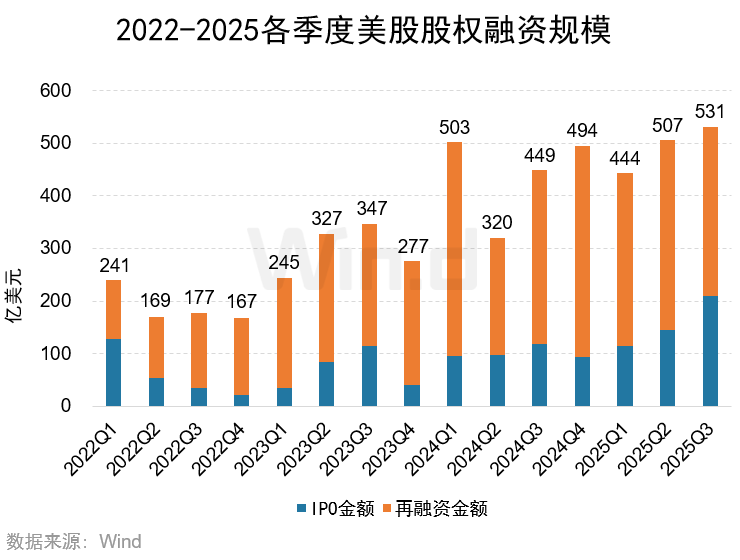
Market Performance - The State-Owned Enterprise Reform Index (399974) closed at 1924.72 points, up 0.95%, with a trading volume of 188.78 billion yuan and a turnover rate of 0.92% [1] - Among the index constituents, 65 stocks rose, with Shengyi Technology leading with a 10.0% increase, while 30 stocks fell, with Western Superconducting leading the decline at 4.36% [1] Key Constituents - The top ten constituents of the State-Owned Enterprise Reform Index include: - Zijin Mining: 3.46% weight, latest price 30.98, up 5.02%, market cap 823.37 billion yuan [1] - Northern Huachuang: 3.02% weight, latest price 412.38, up 2.58%, market cap 298.60 billion yuan [1] - CITIC Securities: 2.94% weight, latest price 29.69, up 2.27%, market cap 440.02 billion yuan [1] - Changjiang Electric Power: 2.80% weight, latest price 27.93, down 0.21%, market cap 683.40 billion yuan [1] - Other notable constituents include China Merchants Bank, Wrigley, and China Shipbuilding [1] Capital Flow - The net inflow of main funds into the index constituents totaled 1.871 billion yuan, while retail funds experienced a net outflow of 1.499 billion yuan [3] - Key stocks with significant main fund inflows include: - Changan Automobile: 651 million yuan net inflow, 20.30% of main fund [3] - Zijin Mining: 563 million yuan net inflow, 5.09% of main fund [3] - CITIC Securities: 488 million yuan net inflow, 8.45% of main fund [3] - Retail funds saw significant outflows from stocks like Shengyi Technology and Zhongke Shuguang [3]


10月15日深证国企ESGR(470055)指数涨0.82%,成份股东方电子(000682)领涨
Sou Hu Cai Jing· 2025-10-15 09:47
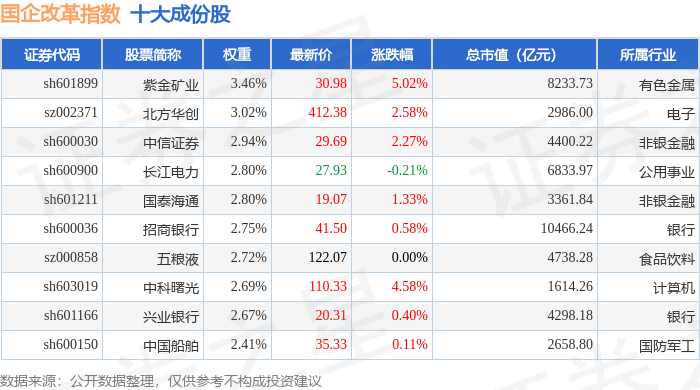
Core Points - The Shenzhen State-Owned Enterprises ESGR Index (470055) closed at 1616.23 points, up 0.82%, with a trading volume of 37.146 billion yuan and a turnover rate of 1.29% [1] - Among the index constituents, 38 stocks rose while 11 fell, with Dongfang Electronics leading the gainers at 4.46% and Dongfang Tantalum leading the decliners at 3.83% [1] Index Constituents Summary - The top ten constituents of the Shenzhen State-Owned Enterprises ESGR Index are as follows: - Hikvision (sz002415) has a weight of 9.64%, latest price at 33.37 yuan, with a market cap of 305.832 billion yuan [1] - BOE Technology Group (sz000725) has a weight of 9.31%, latest price at 4.10 yuan, with a market cap of 153.397 billion yuan [1] - Wuliangye Yibin (sz000858) has a weight of 8.62%, latest price at 122.07 yuan, with a market cap of 473.828 billion yuan [1] - Inspur Information (sz000977) has a weight of 7.30%, latest price at 67.73 yuan, with a market cap of 99.708 billion yuan [1] - Weichai Power (sz000338) has a weight of 6.78%, latest price at 14.72 yuan, with a market cap of 128.264 billion yuan [1] - AVIC Optoelectronics (sz002179) has a weight of 4.48%, latest price at 39.46 yuan, with a market cap of 83.587 billion yuan [1] - Shenwan Hongyuan (sz000166) has a weight of 4.14%, latest price at 5.44 yuan, with a market cap of 136.217 billion yuan [1] - Yunnan Aluminum (sz000807) has a weight of 4.08%, latest price at 20.90 yuan, with a market cap of 72.480 billion yuan [1] - Changchun High & New Technology (sz000661) has a weight of 3.73%, latest price at 127.16 yuan, with a market cap of 51.873 billion yuan [1] - China Merchants Shekou (sz001979) has a weight of 3.31%, latest price at 10.21 yuan, with a market cap of 92.511 billion yuan [1] Capital Flow Analysis - The net inflow of main funds into the ESGR index constituents totaled 454 million yuan, while retail funds saw a net outflow of 114 million yuan [1] - The detailed capital flow for key stocks includes: - BOE Technology Group saw a net inflow of 221 million yuan from main funds [2] - Wuliangye Yibin had a net inflow of 108 million yuan from main funds [2] - Inspur Information experienced a net inflow of 102 million yuan from main funds [2] - Yunnan Aluminum had a net inflow of 74 million yuan from main funds [2] - Changchun High & New Technology saw a net inflow of 66 million yuan from main funds [2]

9月末M1增速升至7.2% 专家释疑居民存款“搬家”
Zheng Quan Shi Bao Wang· 2025-10-15 09:40
Core Insights - The People's Bank of China reported a significant increase in narrow money (M1) growth, which rose by 7.2% year-on-year as of the end of September, marking a substantial acceleration of 1.2 percentage points from the previous month and a 7.1 percentage point increase from the year's low in February [1] - The narrowing of the "scissors difference" between M1 and broad money (M2) to 1.2 percentage points in September indicates a recovery in corporate production and personal consumption demand [1] - The revised M1 statistics now include both corporate and personal demand deposits, reflecting changes in deposit behaviors amid a recovering capital market and declining interest rates [1] Financial Market Dynamics - The concept of "deposit migration" represents a reallocation of residents' assets, where individuals shift savings from banks to other assets based on changes in return rates [2] - In the first three quarters of this year, resident deposits increased by 12.73 trillion yuan, showing a notable growth compared to the previous eight months, while deposits in non-bank financial institutions rose by 4.81 trillion yuan, indicating a decline in growth compared to earlier in the year [2] - Experts suggest that "deposit migration" is a result of changes in yield relationships across different financial markets, leading funds to flow from lower-yielding assets to higher-yielding ones [2]
两融余额,连增两日!A股,新纪录
Zheng Quan Shi Bao· 2025-10-15 03:51
Group 1 - The total margin trading balance in the A-share market reached a historical high of 24,469 billion yuan as of October 14, 2025, with a single-day increase of nearly 2.6 billion yuan [2] - The financing balance also hit a record high of 24,302 billion yuan, increasing by over 2.3 billion yuan in a single day [2] - The margin trading balance has shown fluctuations since mid-September, with significant increases and decreases observed during this period [2][3] Group 2 - From October 1 to October 14, 2025, most industry sectors experienced net financing inflows, with the non-ferrous metals sector leading with over 10 billion yuan in net financing [3] - The electrical equipment sector followed with net financing exceeding 5 billion yuan, while semiconductor, software services, chemicals, and non-bank financial sectors also ranked high in net financing [3] - The distribution of financing net inflows in October differs from September, where TMT sectors dominated, particularly hardware equipment with over 30 billion yuan in net financing [4] Group 3 - Notable stocks with significant net financing inflows from October 1 to October 14 include ZTE Corporation, Zijin Mining, and Baosteel, each exceeding 1 billion yuan [4] - Conversely, several stocks in the TMT sector, such as Cambridge Technology and Industrial Fulian, experienced negative net financing, indicating higher repayment amounts than new financing [4]
两融余额,连增两日!A股,新纪录!
证券时报· 2025-10-15 03:37
Core Insights - The A-share market's margin trading balance has reached a new historical high, indicating increased investor activity and confidence in the market [2][4][3]. Group 1: Margin Trading Balance - As of October 14, 2025, the total margin trading balance across Shanghai, Shenzhen, and Beijing markets reached 24,469 billion, marking a single-day increase of nearly 2.6 billion [4]. - The financing balance also saw a similar trend, reaching 24,302 billion with a single-day increase of over 2.3 billion [4]. Group 2: Changes in Financing Fund Trends - There has been a subtle shift in the financing funds' preferences across different industries since early October, with most sectors experiencing net buying [5][6]. - The non-ferrous metals sector led with a net buying amount exceeding 10 billion, followed by the electrical equipment sector with over 5 billion [6]. Group 3: Industry Performance Comparison - The distribution of financing net inflows in October differs from September, where TMT sectors dominated the net buying figures [8]. - In September, hardware equipment topped the list with over 30 billion in net buying, while the non-ferrous metals sector was ranked sixth with approximately 8.6 billion [8]. Group 4: Individual Stock Performance - Notable stocks with significant net buying from October 1 to October 14 include ZTE Corporation, Zijin Mining, and Baosteel, each exceeding 1 billion [8]. - Conversely, several stocks in the TMT sector, such as Cambridge Technology and Industrial Fulian, experienced negative net buying, indicating higher repayment amounts than new purchases [8].

国泰海通:节后外资和融资资金回流市场
智通财经网· 2025-10-14 23:21
A股行业配置:偏好科技与周期,内外资共振加码电子与有色金属。 智通财经APP获悉,国泰海通证券发布研究报告称,节后外资资金和融资资金在节前短暂流出后重新回 流中国市场,ETF流入放缓,内外资共同加仓电子和有色金属。A股行业配置方面,偏好科技与周期, 内外资共振加码电子与有色金属。南下资金流入减少,外资边际流入发达市场。 国泰海通证券主要观点如下: 市场定价状态:本期市场成交保持活跃。 1)市场情绪(上升):本期市场交易热度大回升,全A日均成交额上升至2.6亿,日均涨停家数升至71.6 家,最大连板数为7个,封板率上升至70.2%,龙虎榜上榜家数升至66家;2)赚钱效应(上升):本期个股上 涨比例上升至54.1%,全A个股周度收益中位数上升至0.4%;3)交易集中度(上升):行业交易集中度持续 提升,本期行业换手率历史分位数处于90%以上的行业有11个,其中汽车换手率连续四期维持榜首。 A股资金流动:节后外资和融资资金回流市场,ETF资金流入放缓。 1)公募:本期偏股基金新发规模下降至8.7亿,各类公募基金股票较上期减仓;2)私募:10月私募信心指 数小幅下降,仓位持续逼近年内最高(截至09/19);3)外资: ...

国泰海通|策略:节后外资和融资资金回流市场
国泰海通证券研究· 2025-10-14 14:08
Core Viewpoint - After the holiday, foreign and financing funds have returned to the Chinese market, with a notable increase in trading activity and a preference for technology and cyclical sectors, particularly electronics and non-ferrous metals [3][4][5]. Group 1: Market Activity - Market sentiment has significantly improved, with average daily trading volume rising to 2.6 billion and the average number of stocks hitting the daily limit up to 71.6 [3]. - The proportion of stocks that increased in value has risen to 54.1%, with the median weekly return for all A-shares increasing to 0.4% [3]. - Industry trading concentration has continued to rise, with 11 industries having turnover rates in the historical top 10% [3]. Group 2: Fund Flows - After the holiday, foreign capital inflow reached 3.0 billion USD, with northbound trading accounting for 30.5% of total trading volume [4]. - Public funds saw a decrease in new issuance to 870 million, while private fund confidence slightly declined, nearing the highest levels of the year [4]. - The net inflow of ETF funds totaled 37.7 billion over the past four trading days, maintaining a high level of passive trading [4]. Group 3: Sector Preferences - Foreign capital has shown a strong preference for electronics (+3.47 billion) and non-ferrous metals (+2.04 billion), while sectors like household appliances and banks experienced outflows [5]. - Financing activities also favored electronics (+10.85 billion) and non-ferrous metals (+6.58 billion), with a slight outflow in the comprehensive sector [5]. - The top sectors for ETF inflows included non-bank financials (+3.74 billion) and power equipment (+2.89 billion), while communication and computing sectors saw outflows [5]. Group 4: Hong Kong and Global Fund Flows - Southbound capital inflow decreased to 2.65 billion, marking a significant drop since 2022 [6]. - Global capital flows indicate a marginal inflow into developed markets, with the US and China receiving the most inflows [6]. - The overall trend shows a preference for North American funds, particularly in pharmaceuticals and financial sectors, while technology funds experienced outflows [6].

每周宏观经济和资产配置研判-20251014
Soochow Securities· 2025-10-14 09:12
Domestic Macro Viewpoints - The impact of the new round of tariffs on the domestic economy is expected to be limited, with a 16.9% year-on-year decline in exports to the U.S. in the first nine months, yet overall exports still achieved a 6.1% year-on-year growth[3] - Since Q3, domestic economic pressure has increased, with fixed asset investment growth dropping to 0.5% year-on-year in August and retail sales growth at 3.4% year-on-year, indicating a need for new growth stabilization policies[3] - The anticipated new growth stabilization policies are expected to be moderate, focusing on support rather than strong stimulus, with Q3 economic growth projected between 4.7% and 4.9%[3] U.S. Economic Outlook - The U.S. economy is expected to remain resilient, with the Federal Reserve likely to implement two more rate cuts, although the market has already priced in approximately 4.7 rate cuts by the end of next year, limiting further rate reduction space[3] - Market sentiment regarding tariffs is divided, with optimistic views suggesting a quick rebound in U.S. and Chinese stock markets, while pessimistic views foresee potential corrections due to a lack of substantial concessions[3] Market Trends - Following the tariff-related adjustments, the market is expected to enter a consolidation phase from October to November, with a potential shift from AI hardware to defensive sectors and industries supported by performance logic[3] - The bond market is experiencing a temporary downward adjustment in rates, with the 10-year yield expected to stabilize between 1.70% and 1.75% due to external risks and domestic economic fundamentals[4]
A股,盘中突变
Zheng Quan Shi Bao· 2025-10-14 04:48
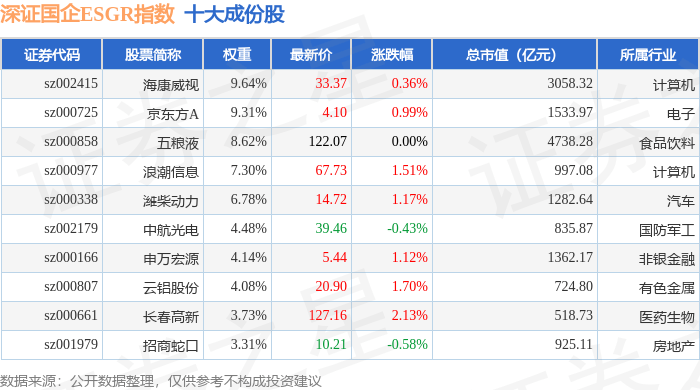
Market Overview - The A-share market opened higher but experienced a pullback, with technology stocks significantly adjusting, leading to a decline in market sentiment. Several semiconductor-related ETFs fell by over 5% [1][2][7]. - The major indices initially rose, with the Shanghai Composite Index reaching a peak increase of over 0.7%, but eventually turned negative. By midday, the Shanghai Composite Index was up 0.21% at 3897.56 points, while the Shenzhen Component Index fell by 1.02% to 13096.03 points, and the ChiNext Index dropped by 2.24% [2][3]. Sector Performance - The financial sector showed strength, particularly the banking sector, which rose by over 2%. Notable banks such as Chongqing Bank, Xiamen Bank, Jiangsu Bank, and China Merchants Bank saw increases exceeding 3% [3][4]. - Non-bank financial stocks also performed well, with New China Life Insurance rising over 6% and Guoyuan Securities increasing by over 5% [5]. - The coal sector experienced significant gains, with some stocks like Dayou Energy and Baotailong hitting the daily limit up, and the sector's intraday increase approaching 3% [6]. Technology Sector - The technology sector faced a broad decline, with communication, electronics, and computer-related stocks leading the losses. Notable declines included Xinyisheng down nearly 8% and Tongfu Microelectronics down over 7% [7]. - Multiple semiconductor-related ETFs reported declines exceeding 5%, indicating a significant downturn in this segment [8]. Hong Kong Market - The Hong Kong market opened high but also saw a decline, with technology stocks leading the drop. Notable stocks like SMIC and CSPC Pharmaceutical Group were among the biggest losers [9]. - In contrast, InnoTech saw a substantial increase, rising over 18% during the session [9]. InnoTech Announcement - InnoTech announced a collaboration with NVIDIA to support the 800VDC power architecture, which is expected to enhance efficiency and power density in AI data centers while reducing energy consumption and CO2 emissions. This transition is likened to the upgrade in the electric vehicle industry from 400V to 800V [11][12].
2025年前三季度美股市场股权融资规模总计1481亿美元
Zhi Tong Cai Jing· 2025-10-13 23:32
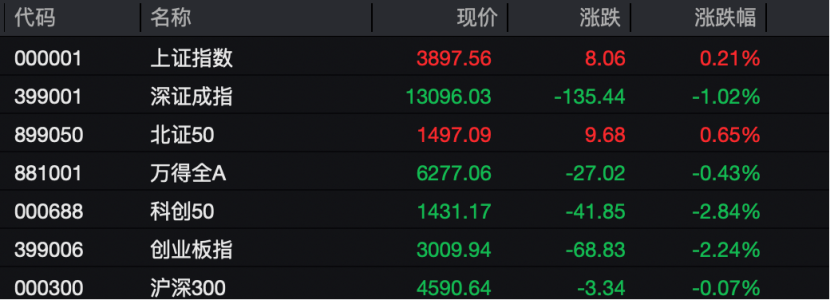
Core Insights - The U.S. equity underwriting market showed strong performance in the first three quarters of 2025, with total equity financing (including IPOs and refinancing) amounting to $148.1 billion, an increase of $20.9 billion or 16.40% year-over-year [1][3][38]. Equity Financing Overview - Total equity financing in the U.S. for the first three quarters of 2025 reached $148.1 billion, with IPOs contributing $46.9 billion (up 50.07% year-over-year) and refinancing totaling $101.2 billion (up 5.42% year-over-year) [3][7][38]. - The non-bank financial sector led the fundraising with $49.9 billion, followed by software services at $18.4 billion and pharmaceuticals at $13.8 billion [10][45]. IPO Market Analysis - A total of 310 companies went public in the first three quarters of 2025, an increase of 128 companies compared to the previous year [15]. - The Nasdaq remained the leading exchange for IPOs, with 246 companies raising $29.4 billion, accounting for 62.73% of the total IPO market [17]. - The largest IPO was by Venture Global, raising $1.75 billion, followed by CoreWeave at $1.5 billion and SailPoint Parent at $1.38 billion [29]. SPAC and Chinese Companies - There were 85 SPAC IPOs in the first three quarters of 2025, a significant increase of 56 from the previous year, raising $16.2 billion, up 190.93% year-over-year [32]. - 59 Chinese companies went public in the U.S., raising $1 billion, a decrease of 58.35% year-over-year [34]. Refinancing Trends - The refinancing market saw 665 events, a slight increase of 16 from the previous year, with total proceeds of $101.2 billion [2][38]. - The non-bank financial sector led refinancing with $24.2 billion, followed by software services at $12.5 billion and pharmaceuticals at $12.1 billion [45]. Underwriting Rankings - Goldman Sachs topped the IPO underwriting rankings with $4.758 billion from 29 deals, followed closely by Cantor Fitzgerald and JPMorgan [54][56]. - In refinancing, JPMorgan led with $15.458 billion from 58 deals, followed by Goldman Sachs and Morgan Stanley [58][59].