消费

Search documents
如何看待今年以来港股IPO爆发︱重阳问答
重阳投资· 2025-05-30 06:27
Core Viewpoint - The significant increase in Hong Kong IPOs this year is attributed to a combination of policy support, improved market conditions, and strategic moves by companies [1][2][3] Group 1: IPO Market Overview - As of May 28, 2023, 27 companies have successfully listed on the Hong Kong stock exchange, raising over 77 billion HKD, nearing the total for the entire previous year [1] - Notable IPOs include the successful fundraising of 177 billion HKD by Mixue Group and over 35 billion HKD by CATL, making it the second-largest IPO globally after Saudi Aramco [1] - There are currently 157 companies waiting to go public, with 18 projects seeking to raise over 5 billion HKD [1] Group 2: Policy and Market Environment - Policy support is fundamental to the IPO surge, with the Hong Kong Stock Exchange optimizing listing rules and introducing a "special line" for tech companies to submit applications confidentially [2] - The China Securities Regulatory Commission has implemented measures to facilitate mainland companies listing in Hong Kong, reducing the review time from 100 days to 60 days [2] - The introduction of the FINI settlement platform has improved the efficiency of new stock issuances [2] Group 3: Market Liquidity and Investment Trends - Since the fourth quarter of last year, the Hong Kong market has shown strong performance, with net inflows from southbound funds exceeding 600 billion HKD [2] - The average daily trading volume in Hong Kong has surpassed 240 billion HKD this year, nearly doubling from the previous year [2] - Hong Kong has become a hub for scarce technology and consumer stocks, with over 80% of the MSCI index comprising Hong Kong stocks, indicating a sustained trend of foreign capital inflow [2] Group 4: Internationalization of Chinese Enterprises - The internationalization of high-quality Chinese enterprises is accelerating, with Hong Kong serving as a key platform for global financing [3] - Companies are seeking offshore funding through Hong Kong to support overseas expansion, brand acquisitions, and supply chain development [3] - The improved IPO environment is leading to a structural upgrade in the supply of quality assets in Hong Kong, attracting long-term capital [3]



追德超日,印度第四?
Zhong Guo Xin Wen Wang· 2025-05-30 01:17
Group 1 - India has officially surpassed Japan to become the world's fourth-largest economy, a claim supported by the Indian government's NITI Aayog [1] - The IMF predicts that India's GDP will exceed Japan's by 2025 and Germany's by 2027, reflecting confidence in India's domestic consumption growth [1][3] - India's domestic consumption market accounts for approximately 60% of its GDP and has been growing steadily, while Japan's domestic consumption is around 55%-60% [2] Group 2 - Over the past decade, India's household consumption has nearly doubled, with a compound annual growth rate of 7.2%, contributing to optimistic GDP forecasts [3] - In contrast, Japan's domestic consumption has declined due to rising prices outpacing wage growth, leading to a 0.1% decrease in consumption data [3] - Japan's corporate bankruptcies reached a new high in 2024, with a 15.1% increase from the previous year, primarily affecting small and medium-sized enterprises [3] Group 3 - India's consumption market is currently driven by the affluent class, leading to a significant imbalance, with luxury goods seeing growth while entry-level products decline [4] - The middle class in India is facing economic challenges, with a high unemployment rate among young graduates and stagnant income levels [5][6] - The Reserve Bank of India reports that household savings are nearing a 50-year low, indicating reduced consumer spending capacity among the middle class [6]
内地优质科技企业“排大队”赴港上市
news flash· 2025-05-29 23:55
科技企业纷纷涌向港股市场。Wind资讯数据显示,截至5月29日,有5家企业聆讯通过,另有155家企业 状态为"正在处理中"。其中,不少企业的拟募资规模大于10亿美元。这些企业中,既有A股上市公司寻 求"A+H"二次上市,也有A股龙头拟分拆子公司赴港上市,以及未上市的独角兽企业和新兴科技公司, 它们覆盖了消费、新能源、生物医药、智能机器人、自动驾驶等多个细分领域。截至5月29日,年内27 家企业登陆香港市场,实际募资总额达771.23亿港元。(证券日报) ...
消费者支出疲软+贸易动荡 美国Q1经济萎缩0.2%
智通财经网· 2025-05-29 13:34
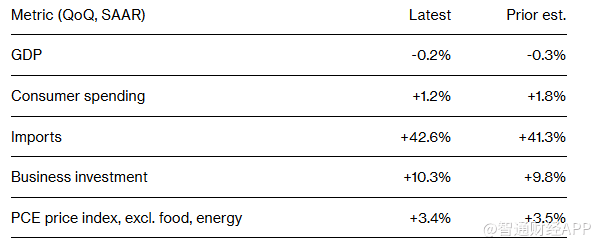
Economic Overview - The U.S. economy experienced a contraction at the beginning of the year, with the first quarter GDP annualized rate revised to -0.2%, slightly better than the initial estimate of -0.3% [1] - Consumer spending, a key driver of economic growth, increased by only 1.2%, down from the initial estimate of 1.8%, marking the lowest growth rate in nearly two years [1][2] - Net exports negatively impacted GDP by nearly 5 percentage points, slightly worse than initial predictions [1] Consumer Spending and Business Investment - The downward revision in consumer spending was primarily due to weakened demand for automobiles and reduced spending on services, including healthcare and insurance [4] - Business investment showed stronger performance, increasing by 10.3%, up from a prior estimate of 9.8% [2] Trade and Tariff Impact - A surge in imports, driven by businesses trying to stock up before tariffs imposed by the Trump administration, contributed to the economic slowdown [2] - The White House has since rescinded or delayed some punitive tariffs, which has alleviated some economic concerns, although tariff rates remain higher than pre-Trump levels [2] Future Economic Outlook - Economists expect a rebound in GDP for the second quarter due to reduced tariffs and the accumulation of imported goods into larger inventories, which may stimulate economic growth [3] - The overall demand in the economy was weaker than initially anticipated, with final sales to domestic private buyers growing by only 2.5%, the lowest level in nearly two years [3]
港股市场今日表现亮眼,香港证券ETF(513090)涨超2%
news flash· 2025-05-29 03:06
港股市场今日表现亮眼,香港证券ETF(513090)涨超2%,成交额22.27亿元,较昨日此时放量269.17%, 近1月份额减少1.77亿份,该基金支持T+0交易。 截至发文,其他相关ETF表现如下:港股消费ETF(159735)涨幅为0.62%,港股创新药ETF(159567)涨幅 为2.01%,港股汽车ETF(520600)涨幅为2.04%,港股科技50ETF(513980)涨幅为1.17%。 ...
港股分化加剧凸显“高切低”趋势南向资金转战防御板块
Zhong Guo Zheng Quan Bao· 2025-05-28 20:35
Market Overview - The Hong Kong stock market experienced a collective pullback on May 28, with the Hang Seng Index down by 0.53%, the Hang Seng Tech Index down by 0.15%, and the Hang Seng China Enterprises Index down by 0.31% [1] - Despite the overall decline, the energy sector showed resilience, with companies like Yanzhou Coal Mining and China Shenhua Energy seeing gains of 2.31% and 1.2% respectively [1] Sector Performance - The consumer sector showed a clear "high cut low" trend, with brands like Pop Mart and Mixue experiencing significant pullbacks after reaching new highs, dropping 7.12% and 5.53% respectively [2] - The technology sector also faced mixed results, with Kuaishou's net profit exceeding expectations, leading to a 5.95% increase in its stock price, while other tech giants like Meituan and Tencent saw declines [2] Capital Flows - Southbound capital saw a net inflow of 291.12 billion yuan in May, with a significant portion directed towards defensive sectors, particularly the financial sector, which attracted 223.9 billion yuan [4] - The trend indicates a structural change in capital flows, with individual investors dominating the southbound capital, making the market more sensitive to changes in sentiment [4] Valuation and Market Sentiment - Analysts suggest that the current valuation of the Hong Kong stock market is at a historical average level, with potential for recovery in both valuation and earnings, particularly in sectors benefiting from domestic demand policies [6] - The market is expected to experience a rebound in the third quarter, supported by improved liquidity and the return of quality companies to the Hong Kong market [6] Future Outlook - The ongoing listing of quality companies and the influx of capital are expected to enhance the asset quality and liquidity of the Hong Kong market [6] - Analysts predict that the combination of domestic growth policies and the resurgence of the AI industry will reshape the valuation of the technology sector, leading to a dual recovery in valuation and earnings for the Hong Kong market [6]




城市24小时 | 河南“联手”安徽,在交界处建“新城”
Mei Ri Jing Ji Xin Wen· 2025-05-28 16:28
Core Points - The article discusses the launch of the "Yejian-Gushi 'One River, Two Banks' Ecological Priority Green Development Industrial Cooperation Zone" development plan by the Anhui and Henan provincial development and reform commissions, aimed at creating a pilot area for industrial cooperation between the Central Plains and the Yangtze River Delta [1][2] - The cooperation zone covers an area of 3,514 square kilometers, with a projected permanent population of 1.21 million and a regional GDP of 55.52 billion yuan by 2024 [1] - The plan emphasizes "industrial cooperation leading, integrated urban development, and common prosperity across the region," focusing on the construction of a demonstration industrial park, a new medium-sized city, and a collaborative prosperity zone [1][3] Summary by Sections Development Plan - The cooperation zone will include a 5 square kilometer industrial cooperation demonstration park in Yejian Economic Development Zone and Gushi County Shihewan Experimental Zone [1] - The plan aims to integrate the main urban area of Yejian with the ecological new city of Gushi County, creating a new medium-sized city with a population exceeding 500,000 [1][3] Economic Context - The cooperation is positioned as a strategic move to enhance regional collaboration, particularly between the Central Plains and the Yangtze River Delta, as highlighted in previous government documents [2] - Gushi County, with a registered population of 1.85 million, is noted for its labor resources and consumer market potential, while Yejian District is recognized for its economic growth driven by the Yangtze River Delta [2] Future Goals - By 2028, the cooperation zone aims to establish a modern industrial system, with a vision to achieve high-quality development of "One River, Two Banks, One City" by 2035 [3] - The plan includes the development of cross-regional transportation infrastructure, such as the Nanjing-Xinhe high-speed railway, to facilitate connectivity [3]

北水成交净买入35.78亿 美团再获10亿港元加仓 石油股稍显分化
Zhi Tong Cai Jing· 2025-05-28 10:00
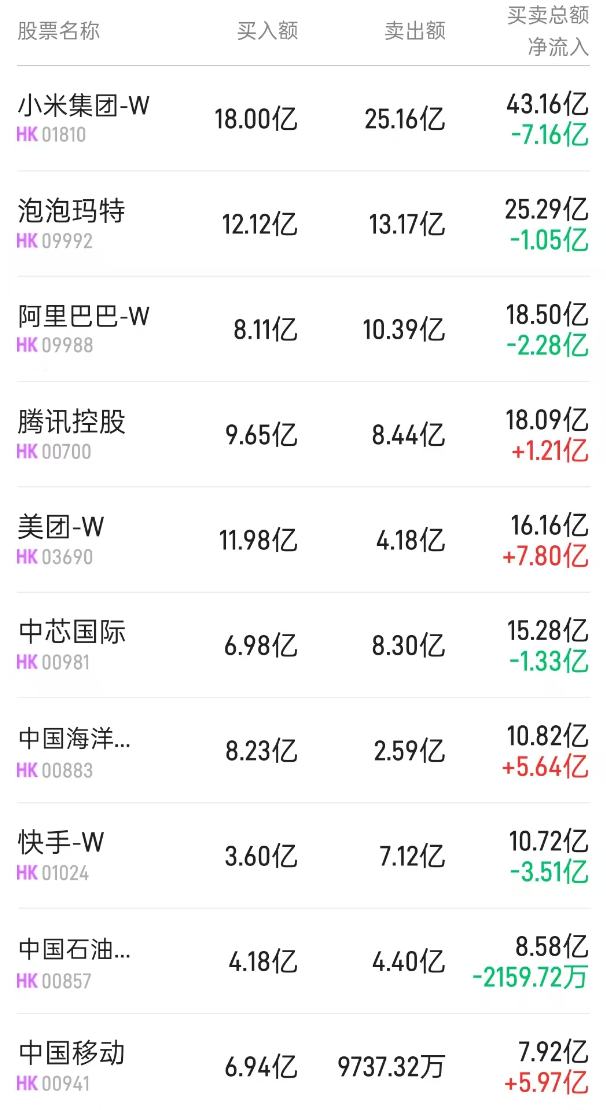
Summary of Key Points Core Viewpoint - The Hong Kong stock market experienced significant net inflows from northbound trading, with a total net buy of HKD 35.78 billion on May 28, 2023, indicating strong investor interest in certain stocks while others faced net selling pressure [1]. Group 1: Stock Performance - Meituan-W (03690) received the highest net buy of HKD 10.74 billion, supported by positive analyst reports highlighting its solid local life service barriers and potential for long-term growth [5]. - China Mobile (00941) and Tencent (00700) also saw net buys of HKD 5.97 billion and HKD 0.28 billion, respectively, reflecting investor confidence in their business models [7]. - Conversely, Xiaomi Group-W (01810) faced the largest net sell of HKD 7.09 billion, attributed to mixed market sentiment despite strong revenue and profit forecasts [7]. - Alibaba-W (09988) and Hang Seng China Enterprises (02828) experienced net sells of HKD 3.77 billion and HKD 4.29 billion, respectively, indicating a shift in investor preference [7]. Group 2: Sector Insights - The oil sector showed mixed results, with CNOOC (00883) gaining a net buy of HKD 5.64 billion, while PetroChina (00857) faced a net sell of HKD 21.59 million, influenced by external market conditions and geopolitical factors [5]. - Horizon Robotics-W (09660) received a net buy of HKD 1.81 billion, benefiting from the growth in advanced driver-assistance systems driven by major automotive companies [6]. - Pop Mart (09992) saw a net buy of HKD 42.62 million, with forecasts indicating strong revenue and profit growth in the coming years due to new product launches and global market expansion [6]. - Semiconductor company SMIC (00981) faced a net sell of HKD 2.79 billion, with analysts noting production disruptions affecting revenue and margins [6].

不确定性或贯穿2025年整个行情,关注全市场唯一超200亿元中证A500ETF(159338)
Mei Ri Jing Ji Xin Wen· 2025-05-28 02:09
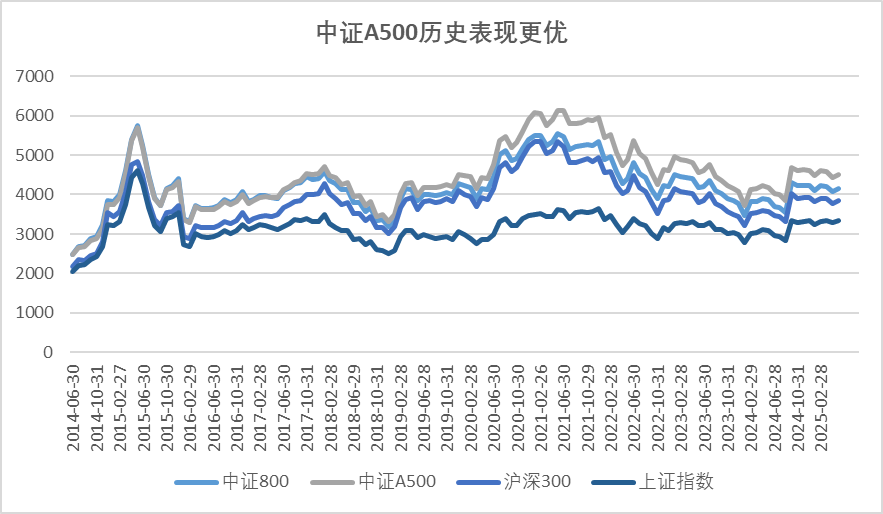
Group 1 - Recent tariff policy easing, interest rate cuts, and technological advancements are expected to lead the A-share market towards an upward trend after previous risk factors have been released [1] - Despite positive factors, uncertainties remain due to fluctuating Trump policies and weak economic recovery, which may affect market performance until 2025 [2] - The main economic characteristics anticipated for the second half of the year include strong production, recovering investment, stable consumption, and resilient exports [2] Group 2 - The CSI A500 index is designed with an "industry balance" approach, representing a selection of 500 large-cap, liquid securities across various sectors, akin to a domestic "S&P 500" [4] - The index includes approximately 50% traditional value sectors and 50% emerging growth sectors, making it more growth-oriented compared to other value indices [4] - Historical performance shows that the CSI A500 index has achieved a return of 359.17% since its inception, outperforming other major indices like the Shanghai Composite and CSI 300 [5]
财报更新,港股上市公司盈利增长情况如何?|第387期直播回放
银行螺丝钉· 2025-05-27 13:52
Group 1 - The article discusses the periodic reports of Hong Kong listed companies, including their types and disclosure timelines, which are similar to A-shares but with some differences [3][4][5][6][7] - Hong Kong companies do not have a mandatory requirement for quarterly report disclosures, and the actual disclosure times are generally later than those of A-shares [4][5][6] - The fiscal year for Hong Kong companies can be customized, unlike A-shares which follow the natural calendar year [6][7] Group 2 - The overall profitability of Hong Kong stocks can be observed through the Hang Seng Index, which showed a slight decline in profitability in 2020 but has stabilized in subsequent years [8] - In Q1 2025, the year-on-year growth rate of profitability for Hong Kong listed companies reached 16.32% [8] Group 3 - The Hang Seng Index and the China Enterprises Index (also known as the National Enterprises Index) have shown stable profitability, with a recovery in growth from 2022 to Q1 2025 [11][12][14] - The Hong Kong Small Cap Index has experienced significant volatility, with profitability declining sharply in 2020 and 2021, but showing recovery starting in 2022 [16][17][19] Group 4 - The Hong Kong Dividend Index has also shown considerable volatility, with a significant drop in 2020 and a rebound in 2022, but a decline of 12.81% in Q1 2025 [20][22] - The Shanghai-Hong Kong-Shenzhen Dividend Low Volatility Index has mirrored this volatility, with profitability fluctuating over the years [24][26] Group 5 - The Hong Kong Technology Index has demonstrated rapid profitability growth, with a year-on-year increase of 128.92% in Q1 2025, following a period of stagnation from 2020 to 2023 [30][31] - The Hang Seng Technology Index also showed strong growth, with a nearly 60% increase in 2024 and 55.43% in Q1 2025 [33][35] Group 6 - The Hang Seng Consumer Index has maintained stable profitability growth, with a year-on-year increase of 14.52% in Q1 2025 [39][41] - The Hang Seng Healthcare Index has shown significant growth, with a year-on-year increase of 172.89% in Q1 2025 [42]