
化工

Search documents
A股化工股集体走强,长华化学涨超10%
Ge Long Hui· 2026-02-12 05:44
Core Viewpoint - The A-share market has seen a significant rally in the chemical sector, with multiple companies experiencing substantial gains in their stock prices [1] Group 1: Company Performance - Changhua Chemical has increased by over 10% [1] - Meibang Co. has reached a 10% limit up [1] - Jianxin Co. has risen by over 9% [1] - Weike Technology has gained over 8% [1] - Kexin Innovation Source has increased by over 6% [1] - Huide Technology, Xinjin Road, and Zhenhua Co. have all risen by over 5% [1]




正丹股份完成股份注销,股价近期震荡
Jing Ji Guan Cha Wang· 2026-02-12 05:44
Company Overview - Zhengdan Co., Ltd. completed the repurchase and cancellation of 7.1375 million shares on January 7, 2026, which accounts for 1.34% of the total share capital, resulting in a new total share capital of 526 million shares [1] Stock Performance - Over the past 7 trading days, Zhengdan's stock price exhibited volatility, with a single-day increase of 4.34% on February 9, closing at 20.91 yuan and a trading volume of 465 million yuan; however, it adjusted in the following two trading days, closing at 20.28 yuan on February 11, reflecting a cumulative fluctuation of 2.63% from the opening price on February 6 [2] - Trading activity varied, with a turnover rate of 4.30% on February 9, which dropped to 1.70% on February 11; the financing balance increased by 0.04 billion yuan over the past five days, reaching 3.45 billion yuan as of February 10 [2] Institutional Insights - Current institutional interest in Zhengdan is relatively low, with a neutral sentiment in public opinion; the fund holding ratio is only 0.02%, and there have been no recent institutional surveys or rating adjustments [3] - In the chemical sector, there is increased capital attention due to price increase logic, but there are no significant catalysts for the individual stock of Zhengdan [3]

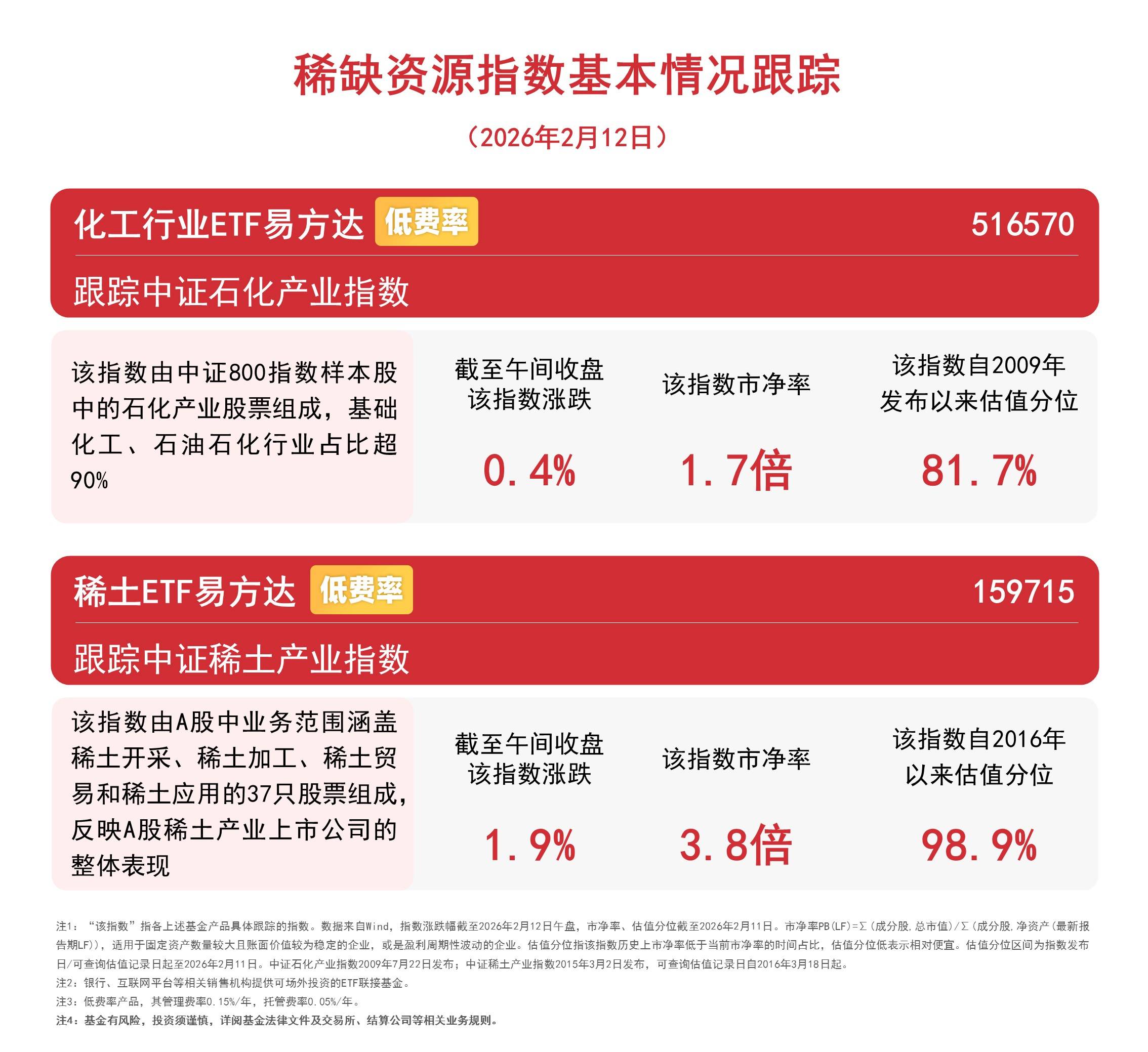
稀缺资源指数低开高走,关注稀土ETF易方达(159715)、化工行业ETF易方达(516570)等产品投资机会
Sou Hu Cai Jing· 2026-02-12 05:23
Group 1 - The core viewpoint of the article highlights the strong performance of the rare earth and chemical industries, with significant price increases in key products driving market interest [1] - The China Rare Earth Industry Index rose by 1.9% and the China Petrochemical Industry Index increased by 0.4% as of the midday close [1] - The ETF for the chemical industry, E Fund (516570), attracted nearly 1.5 billion yuan in the past month, indicating strong investor interest [1] Group 2 - In the rare earth sector, the price of praseodymium and neodymium oxide reached 805,000 yuan per ton, with a week-on-week increase of 9.9% and a month-on-month increase of 28.8% [1] - In the chemical sector, prices for PX, MEG, and PTA products are on the rise, suggesting a potential traditional price increase window during the "golden March and silver April" period [1]

马年投资锦囊|长城基金汪立:关注内需价值与新兴科技两大方向
Sou Hu Cai Jing· 2026-02-12 05:11
Core Viewpoint - The A-share market is expected to stabilize gradually after the Spring Festival holiday, with investors advised to hold stocks during the holiday, focusing on domestic demand and emerging technology sectors [1][2] Group 1: Market Analysis - The A-share market is currently fluctuating around the 4100-point mark, with a noticeable decline in trading volume [1] - Positive factors for the market include the global market pricing in the potential hawkish stance of the Federal Reserve, while domestic policies are shifting towards prioritizing domestic demand [1] - The China Securities Regulatory Commission has emphasized efforts to maintain a stable and positive trend in the capital market, leading to a surge in stock buybacks by A-share companies [1] Group 2: Investment Directions - Two main investment directions are recommended: 1. Domestic demand value, with a high probability of outperformance post-holiday, focusing on sectors like food, retail, tourism services, hotels, and commodities such as oil, non-ferrous metals, and chemicals [2] 2. Emerging technology, highlighting the competition between China and the U.S. in production efficiency, with attention on sectors like internet, media, computing, robotics, electronics, military industry, and energy storage [2]
法国想复制广场协议,30%关税压中国?时代变了,这招不灵了!
Sou Hu Cai Jing· 2026-02-12 04:42
Core Viewpoint - The report from the French Institute for Strategic and International Relations (IRIS) indicates that European industry is facing a survival crisis due to competition from China, proposing two radical solutions: imposing a 30% tariff on Chinese goods and devaluing the euro by 20% to 30% against the yuan [1][5][12] Group 1: Proposed Solutions - The first proposal suggests a 30% tariff on Chinese goods, which may face significant opposition from EU member states due to their reliance on the Chinese market for various industries, including automotive and luxury goods [7][9] - The second proposal involves devaluing the euro by 20% to 30%, which could lead to increased import costs and inflation, particularly affecting countries like Germany that are sensitive to inflation [7][9] Group 2: Historical Context and Comparison - The report draws parallels to the 1985 Plaza Accord, where the U.S. pressured Japan to appreciate the yen, resulting in long-term economic stagnation for Japan [3][5][12] - The current situation is different as China has a strong military and economic position, making it less susceptible to external pressures compared to Japan in the 1980s [5][12] Group 3: Economic Implications - If tariffs are implemented, European consumers would face higher prices, and Chinese companies could circumvent tariffs by relocating production or utilizing alternative markets [9][10] - A devaluation of the euro could lead to increased import costs, capital outflows, and potential financial instability in Europe, particularly affecting countries with high debt levels [10][12] Group 4: Underlying Issues - The report reflects a broader anxiety within Europe regarding its industrial decline and the need for innovation and structural optimization rather than relying on administrative and monetary measures to suppress competition [12]
光大期货金融期货日报-20260212
Guang Da Qi Huo· 2026-02-12 04:35
1. Report Industry Investment Rating - Not mentioned in the provided content 2. Core Views of the Report - **Stock Index Futures**: The market showed a narrow - range oscillation with mixed performance of the three major indices. Recently, various departments have intensively introduced economic control policies, which provide fundamental support for the indices. The central bank's interest rate cut on structural monetary policy tools helps guide funds into relevant sectors and push up their valuations in the long - run. However, after the adjustment of the minimum margin ratio for margin trading, the market has entered a high - level oscillation mode with increased short - term volatility, so it is advisable to be cautious about chasing high prices and mainly adopt a wait - and - see approach [1]. - **Treasury Bond Futures**: After the central bank's structural interest rate cut, fiscal policies continue to exert force. Against the background of continuous introduction of growth - stabilizing policies, the bond market lacks the impetus for continuous strengthening, and the pattern of interest rate range oscillation remains [2]. 3. Summary by Relevant Catalogs 3.1 Research Views - **Stock Index Futures**: On February 11, 2026, the market had a narrow - range oscillation throughout the day, with more stocks falling than rising. The trading volume was 2.12 trillion. The Shanghai Composite Index rose 0.13%, the Shenzhen Component Index rose 0.02%, and the ChiNext Index fell 0.37%. The National Development and Reform Commission plans to set up a national - level merger fund, regulate local economic promotion behaviors, and promote high - tech projects. The central bank cut the interest rate of structural monetary policy tools by 25BP, which is beneficial to relevant sectors in the long - run. The adjustment of the margin ratio for margin trading has increased the risk - aversion sentiment of funds, and the market has entered a high - level oscillation mode [1]. - **Treasury Bond Futures**: On February 11, 2026, the 30 - year, 10 - year, and 5 - year main contracts of treasury bond futures rose by 0.05%, 0.06%, and 0.04% respectively, while the 2 - year main contract remained stable. The central bank conducted 400 billion yuan of 14 - day and 78.5 billion yuan of 7 - day reverse repurchases, with a net injection of 403.5 billion yuan. The short - term upward movement of DR001 and downward movement of DR007 indicate that the bond market lacks the power for continuous strengthening, and the interest rate will continue to oscillate in a range [2]. 3.2 Daily Price Changes - **Stock Index Futures**: On February 11, 2026, compared with February 10, 2026, IH decreased by 2.2 points (- 0.07%), IF decreased by 9.2 points (- 0.19%), IC increased by 45.6 points (0.55%), and IM increased by 12.0 points (0.15%) [3]. - **Stock Indices**: On February 11, 2026, compared with February 10, 2026, the Shanghai 50 Index rose by 1.1 points (0.03%), the CSI 300 Index decreased by 10.5 points (- 0.22%), the CSI 500 Index increased by 19.4 points (0.23%), and the CSI 1000 Index decreased by 10.8 points (- 0.13%) [3]. - **Treasury Bond Futures**: On February 11, 2026, compared with February 10, 2026, TS decreased by 0.01 points (- 0.01%), TF increased by 0.035 points (0.03%), T increased by 0.055 points (0.05%), and TL increased by 0.07 points (0.06%) [3]. 3.3 Market News - **Overall Trend**: The market showed an oscillating and differentiated trend, with the ChiNext Index falling by more than 1%. More stocks fell than rose, with over 3,200 stocks in the Shanghai, Shenzhen, and Beijing stock markets closing down. The trading volume was about 2 trillion. The Shanghai Composite Index rose 0.09%, the Shenzhen Component Index fell 0.35%, and the ChiNext Index fell 1.08% [5]. - **Industry Sectors**: Glass fiber, non - ferrous metals, chemicals, and lithium ore sectors led the gains, while film and television media, AI applications, tourism, and CPO sectors led the losses [5]. - **Popular Concepts**: Glass fiber concept stocks soared, with many stocks such as Shandong Glass Fiber and China Jushi hitting the daily limit. The non - ferrous metals sector strengthened, and stocks like Zhongwu High - tech and Xianglu Tungsten Industry hit the daily limit. Chemical stocks were repeatedly active, and stocks like Huatai and Jihua Group hit the daily limit. On the decline side, film and television concept stocks adjusted, and stocks like Hengdian Film and Jinyi Film hit the daily limit down [5]. 3.4 Chart Analysis - **Stock Index Futures**: The report provides multiple charts showing the trends of IH, IF, IM, IC main contracts, and their respective monthly basis trends [7][9][11]. - **Treasury Bond Futures**: The report presents charts of the trends of treasury bond futures main contracts, treasury bond spot yields, basis, inter - period spreads, cross - variety spreads, and capital interest rates [14][17][19]. - **Exchange Rates**: The report includes charts of the central parity rates of the US dollar and euro against the RMB, forward exchange rates, the US dollar index, and exchange rates between different currencies [22][23][26]
财政政策2025年回顾和2026年展望
Bank of China Securities· 2026-02-12 04:16
Index Performance - The Hang Seng Index (HSI) closed at 27,266, up 0.3% for the day and 6.4% year-to-date (YTD) [2] - The Taiwan Stock Exchange (TWSE) showed a significant increase of 1.6% for the day and 16.0% YTD [2] - The Nikkei 225 rose by 2.3% for the day and 14.5% YTD, indicating strong performance in the Japanese market [2] Commodity Price Performance - Brent Crude oil prices increased by 1.3% to US$70 per barrel, with a YTD rise of 15.2% [3] - Gold prices rose by 1.2% to US$5,084 per ounce, reflecting a YTD increase of 17.7% [3] - Copper prices decreased by 0.5% to US$13,108 per ton, with a YTD increase of 5.5% [3] Fiscal Policy Insights - In 2025, China's broad fiscal deficit reached a record high of RMB 12.1 trillion, accounting for 8.6% of GDP, with a public budget deficit ratio of 4% [6] - Fiscal revenue fell by 2.2% in 2025, which was RMB 640 billion below the initial budget target [6] - Broad fiscal expenditure grew by 2.2% to RMB 40.3 trillion, a decrease in growth rate of 0.4 percentage points from 2024 [6] Economic Outlook - For 2026, broad fiscal expenditure growth is expected to accelerate to 3.3%, with a projected fiscal deficit ratio narrowing to 8.2% [7] - CPI in January showed a 0.2% YoY increase, while core CPI growth weakened to 0.8% [9] - PPI decline narrowed from -1.9% in December to -1.4% in January, indicating some recovery in industrial prices [11] Sector Performance - The Chinese pop toy sector is expected to gain traction globally in 2026, driven by increased consumer familiarity and diverse IP offerings [14] - Fertiglobe's core earnings surged 87% YoY to US$325 million in 2025, with a forecasted growth of 42% YoY in 2026 [18] - SMIC reported mixed results for 4Q25, with revenue exceeding expectations but margins under pressure due to increased costs [21]
港口库存再度回升
Hua Tai Qi Huo· 2026-02-12 04:11
Report Industry Investment Rating - Not provided in the content Core Viewpoints - The port inventory of methanol has risen again, and the decline cycle has not been realized. The import volume in February has dropped to a seasonal low, but the downstream is also in the off - season, and the MTO maintenance of some enterprises has dragged down the demand [2] - In the inland area, the coal - based methanol plants maintain high operation rates. The downstream pending orders are in good condition, and the inland factory inventory has declined again, failing to achieve the pre - holiday seasonal inventory build - up. The traditional downstream is in the seasonal off - season [3] Summary by Directory I. Methanol Basis & Inter - period Structure - The report presents multiple charts related to methanol basis, including methanol Taicang basis and the main contract, and the basis of methanol in different regions compared with the main futures contract. It also shows the price differences between different methanol futures contracts, such as the 01 - 05, 05 - 09, and 09 - 01 contracts [6][12][19] II. Methanol Production Profit, MTO Profit, and Import Profit - The report includes charts on the production profit of coal - based methanol in Inner Mongolia, the MTO profit in East China, and the import price differences, such as the price difference between Taicang methanol and CFR China, as well as the price differences between CFR Southeast Asia, FOB US Gulf, FOB Rotterdam and CFR China [23][24][29] III. Methanol Operation and Inventory - Charts show the total port inventory of methanol, the MTO/P operation rate (including integrated enterprises), the inland factory sample inventory, and the overall methanol operation rate in China [31][38] IV. Regional Price Differences - The report provides charts on regional price differences, such as the price difference between northern Shandong and northwest, East China and Inner Mongolia, Taicang and southern Shandong, etc. [35][43][45] V. Traditional Downstream Profits - Charts display the production gross profits of traditional downstream products, including formaldehyde in Shandong, acetic acid in Jiangsu, MTBE in Shandong, and dimethyl ether in Henan [47][51]
每日市场观察-20260212
Caida Securities· 2026-02-12 03:03
Market Overview - On February 11, major indices showed mixed results, with the Shanghai Composite Index up 0.09% and the ChiNext Index down 1.08%[2] - The total trading volume was 2 trillion yuan, a decrease of approximately 120 billion yuan from the previous trading day[1] Sector Performance - Over half of the sectors declined, with construction materials, non-ferrous metals, steel, and chemicals showing the most significant gains, while media, telecommunications, electronics, and military industries faced the largest declines[1] - The leading sectors included chemicals, non-ferrous metals, and oil, which outperformed the broader market index during the same period[1] Capital Flow - On February 11, net inflows into the Shanghai Stock Exchange were 15.499 billion yuan, while the Shenzhen Stock Exchange saw net inflows of 2.915 billion yuan[3] - The top three sectors for capital inflow were small metals, batteries, and glass fiber, while the sectors with the highest outflows were communication equipment, advertising, and semiconductors[3] Economic Indicators - January's Consumer Price Index (CPI) saw a year-on-year increase, primarily affected by the timing of the Spring Festival, with energy prices dropping by 5.0%, contributing to a 0.34 percentage point decrease in CPI[7] - The core CPI maintained a moderate upward trend, indicating a recovery in consumer demand[7] Industry Dynamics - In January, China's new energy vehicle production and sales reached 1.041 million and 945,000 units, respectively, marking year-on-year increases of 2.5% and 0.1%[8] - The overall automotive market remained stable, with total production and sales of 2.45 million and 2.346 million vehicles, showing a production increase of 0.01% but a sales decrease of 3.2% year-on-year[9] Investment Sentiment - Over 60% of private equity firms plan to maintain high positions during the holiday, with an average calculated position of 75.68% among surveyed firms, reflecting positive expectations for the A-share market[12][13]
华泰证券今日早参-20260212
HTSC· 2026-02-12 03:01
Group 1: Macroeconomic Overview - In January 2026, the US added 130,000 non-farm jobs, exceeding Bloomberg's consensus estimate of 65,000, while the unemployment rate fell by 0.1 percentage points to 4.3% [2] - China's January CPI rose by 0.2% year-on-year, below the expected 0.4%, while PPI decreased by 1.4%, slightly better than the forecast of -1.5% [3][5] - The central bank is focusing on coordinating monetary and fiscal policies to boost domestic demand, with potential further easing expected during the upcoming Two Sessions [4] Group 2: Industry Insights - The unified national electricity market in China aims to be established by 2030, which is expected to benefit the development of new energy systems, particularly in energy storage and grid infrastructure [8] - The demand for iron phosphate is anticipated to grow due to the rapid increase in energy storage needs and the expansion of lithium iron phosphate production [9] - The commercial aerospace sector is expected to perform well in 2026, driven by advancements in reusable rocket technology [10] Group 3: Company-Specific Analysis - NetEase reported a revenue of 7.759 billion yuan for 2025, slightly below expectations, but adjusted net profit increased by 68.2% year-on-year [19] - Siemens Energy achieved a revenue of 9.675 billion euros in Q1 2026, a year-on-year increase of 8%, with a significant rise in net profit [20] - New Energy Technology Company reported a revenue of 9.639 billion yuan for 2025, a year-on-year increase of 22.84%, driven by the demand for battery chemicals [23]