茶饮

Search documents
喜茶、霸王茶姬们陷反式脂肪酸争议,企业回应:符合国家标准
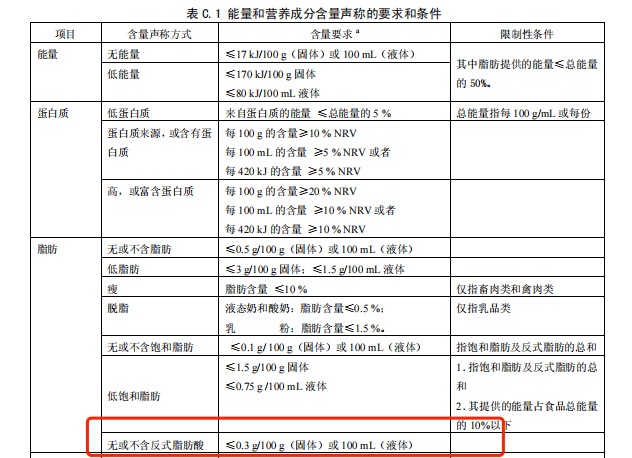
Di Yi Cai Jing· 2025-08-27 11:47
Core Viewpoint - The presence of trans fatty acids in tea beverages may be attributed to natural sources if real milk is used, and the media's reporting on this issue has been criticized for misleading consumers [1][2][8]. Group 1: Trans Fatty Acids in Tea Beverages - Trans fatty acids (TFA) can originate from both natural and industrial sources, with dairy products containing an average of 0.83g/100g of natural TFA [2]. - Companies like Heytea and Bawang Tea Ji have stated that the detection of trace amounts of trans fatty acids in their products is due to the use of real milk, which can naturally contain these acids [1][2][8]. Group 2: Regulatory Standards - According to the national food safety standards, pre-packaged foods can claim "0 trans fatty acids" if they contain less than 0.3g/100g [3][4]. - The detected levels of trans fatty acids in specific products were 0.0133g/100g for Bawang Tea Ji and 0.113g/100g for Heytea, both of which are below the regulatory threshold [3]. Group 3: Health Guidelines - The recommended daily intake of trans fatty acids should not exceed 2 grams, as per the Chinese Dietary Guidelines (2022) [3]. - Excessive intake of trans fatty acids is linked to increased risks of chronic diseases such as cardiovascular diseases and diabetes [3]. Group 4: Industry Trends - The tea beverage industry is becoming more regulated, with Shanghai leading the way in implementing nutritional labeling for ready-to-drink beverages [8]. - Companies are now being encouraged to provide comprehensive grading based on the content of non-dairy sugars, saturated fats, trans fats, and non-sugar sweeteners [8].

日均订单量同比提升11.4%!奈雪2025上半年靠“健康产品”打开增长空间
Ge Long Hui· 2025-08-27 11:43
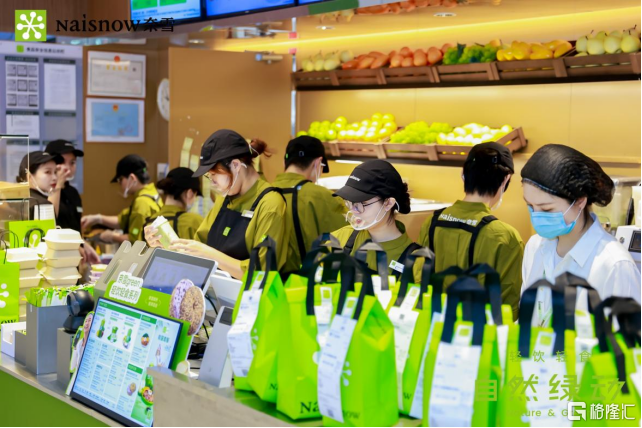
Core Viewpoint - Naixue's Tea has shown significant improvement in its mid-2025 performance report, indicating the success of its health strategy with a substantial reduction in adjusted net loss and positive growth in key operational metrics [1][3][12] Financial Performance - Adjusted net loss narrowed by 73.1% year-on-year, from 438 million to 117 million [1][12] - Operating cash flow increased by 33.1% year-on-year to 138 million [1][3] - Cash on hand as of June 30 reached 2.79 billion, indicating strong financial stability [3] Sales and Operational Metrics - Average daily sales per store increased by 4.1% compared to the same period in 2024 [3] - Daily order volume rose from 265.9 to 296.3, a year-on-year increase of 11.4% [3] - Same-store sales grew by 2.3% year-on-year to 1.76 billion [3] Membership and Customer Engagement - Registered membership increased to 111 million, with 8.3 million new members, predominantly from younger demographics [3][12] - The shift in consumption scenarios from "immediate thirst" to "daily light nutrition" reflects changing consumer preferences [3] Product Innovation and Market Strategy - The launch of the "No Sugar Natural Nutrition+" initiative marks a shift towards healthier product offerings [4][10] - The "Little Purple Bottle" series achieved over 500,000 sales within three days of launch, showcasing strong market acceptance [6] - The introduction of "Nai Xue Green" stores aims to cover all-day dining scenarios, enhancing consumer engagement [8][10] Future Strategic Directions - The company plans to optimize store models and explore new market scenarios, focusing on health-oriented products [10][12] - Emphasis on digital membership strategies for precise customer engagement and expansion into overseas markets [10][12]
奈雪的茶发布中期业绩,收益21.78亿元 共拥有奈雪的茶茶饮店1638家
Zhi Tong Cai Jing· 2025-08-27 11:36
Core Viewpoint - Nai Xue's Tea reported a revenue of RMB 2.178 billion for the six months ending June 30, 2025, with a loss attributable to equity shareholders of RMB 117 million, translating to a loss per share of RMB 0.07 [1] Group 1: Financial Performance - The average daily sales per store for Nai Xue's Tea increased by 4.1% to RMB 7,600 compared to the same period in 2024 [1] - The average daily order volume per tea shop rose by 11.4% to 296.3 orders compared to the same period in 2024 [1] - Same-store sales for Nai Xue's Tea increased by 2.3% to RMB 1.76 billion compared to the same period in 2024 [1] Group 2: Store and Membership Metrics - As of June 30, 2025, the company operated a total of 1,638 tea shops, including 1,321 direct-operated stores and 317 franchised stores [1] - The registered membership reached approximately 111 million, with monthly active members totaling around 3.9 million and a monthly repurchase rate of approximately 23.5% [1] Group 3: Future Strategies - In the second half of 2025, the company aims to enhance store revenue performance and optimize cost structure by focusing on existing store optimization and adjusting store formats [2] - The company will continue to improve the new store model launched in the first half of 2025, such as the "Nai Xue Green" store, and explore new store types or consumption scenarios to reach a broader consumer base [2] - The company plans to create high-quality, cost-effective health products and utilize a diversified product matrix and targeted brand marketing strategies to meet the consumption needs of different age groups throughout the day [2]
古茗(01364):25H1 收入利润高增,开店&单店亮眼
SINOLINK SECURITIES· 2025-08-27 11:27
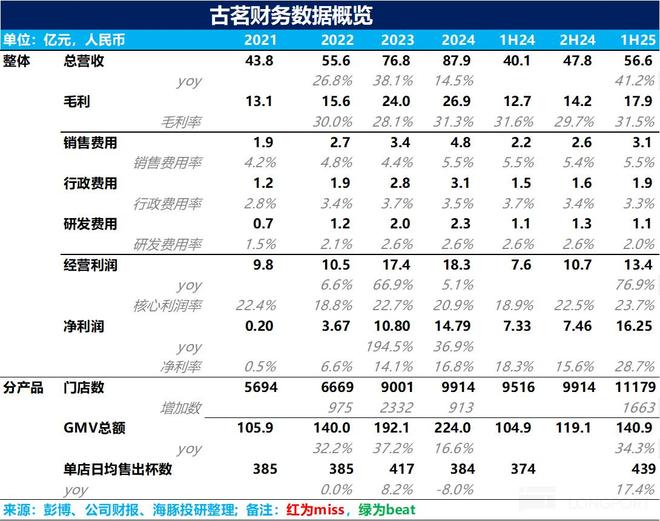
Investment Rating - The report maintains a "Buy" rating for the company, expecting a price increase of over 15% in the next 6-12 months [3][11]. Core Insights - The company reported a revenue of 5.663 billion yuan for the first half of 2025, representing a year-on-year growth of 41.2%. The net profit attributable to shareholders reached 1.625 billion yuan, up 121.5% year-on-year [1]. - Adjusted net profit for the same period was 1.086 billion yuan, reflecting a growth of 42.4%, while adjusted core profit was 1.136 billion yuan, marking a 49.0% increase [1]. - The company is benefiting from promotional activities in the food delivery sector, leading to an upward revision of profit forecasts for FY2025, FY2026, and FY2027, with adjusted net profits projected at 2.196 billion, 2.616 billion, and 3.148 billion yuan respectively [3]. Financial Performance - The company achieved a single-store daily cup volume of 439 cups in the first half of 2025, a year-on-year increase of 17.4%, with a total of 79.4 thousand cups sold per store, up 16.6% year-on-year [9]. - The average price per cup increased to 17.25 yuan, a rise of 3.3% year-on-year, contributing to a 20.6% year-on-year growth in single-store GMV, reaching 1.3705 million yuan [9]. - The company accelerated its store openings, adding 1,265 new stores in the first half of 2025, bringing the total number of stores to 11,179, a year-on-year increase of 17.5% [9]. - The gross margin for the first half of 2025 was 31.5%, with stable sales and administrative expense ratios, leading to an operating profit margin of 23.7%, up 1.6 percentage points year-on-year [9]. Future Projections - Revenue projections for the company are as follows: 11.914 billion yuan for 2025, 13.801 billion yuan for 2026, and 16.569 billion yuan for 2027, with growth rates of 35.52%, 15.84%, and 20.05% respectively [8]. - Adjusted net profit is expected to grow significantly, with rates of 42.41% for 2025, 19.12% for 2026, and 20.33% for 2027 [8].
2025上半年,中国企业在全球刷出了新副本
Tai Mei Ti A P P· 2025-08-27 10:16
Core Viewpoint - The article highlights the accelerating trend of Chinese companies expanding internationally, showcasing significant growth in various sectors, particularly in the automotive and new consumer goods industries, emphasizing the theme of "going global" [1][4]. Group 1: Automotive Industry - Great Wall Motors' factory in Brazil officially commenced production in mid-August, marking a significant step in its international expansion [1]. - BYD's global sales of passenger cars and pickups exceeded 470,000 units in the first half of 2025, a 130% year-on-year increase, with new market entries including Romania [4]. - BYD's electric vehicle exports are projected to reach 1.203 million and 1.284 million units in 2023 and 2024, respectively, with a 75.2% year-on-year growth in the first half of 2025 [4]. Group 2: New Consumer Goods - Pop Mart reported over 100% growth across all regions in its 2025 mid-year financial report, with revenue in the Americas reaching 2.26 billion yuan, a tenfold increase [1][5]. - The company is focusing on brand protection and cultural output, as seen in its recent trademark registration updates [10]. - New consumer brands like Heytea and Labubu are also experiencing significant growth, with Labubu's sales in the US and Europe increasing by 800% and 500%, respectively [10]. Group 3: Manufacturing and Technology - China's direct investment abroad reached 574.86 billion yuan in the first half of 2025, with non-financial direct investment growing by 0.6% year-on-year [4]. - The article emphasizes the shift from low-cost manufacturing to high-quality and technologically advanced production capabilities among Chinese companies [6][8]. - Companies like Vivo are increasingly focusing on local market strategies, with over 50% of their revenue coming from overseas, aiming for 60% by next year [5][11]. Group 4: Strategic Adaptation - Chinese companies are adapting to global market challenges by forming strategic partnerships and localizing operations, as seen with BYD's collaboration with local governments in Brazil for workforce training [18]. - The trend of "precision deepening" in market strategies is evident, with companies like Vivo and Pop Mart tailoring their approaches to specific regional markets [16][17]. - The article notes a shift from a broad market approach to a more focused strategy, with companies like Meituan and Kuaishou recognizing the potential of emerging markets like Brazil [18].


古茗:左手外卖,右手咖啡,“茶饮界 Costco” 又笑了?
Xin Lang Cai Jing· 2025-08-27 09:57
Core Viewpoint - The overall performance of the company in the first half of 2025 is considered good, driven by store expansion, delivery subsidies, and the introduction of coffee business, despite the lack of market consensus on expectations due to the absence of previous half-year reports [1][2][10]. Group 1: Financial Performance - The total revenue for the first half of 2025 reached 5.66 billion RMB, representing a year-on-year growth of 41.2% [2][6]. - The gross profit for the same period was 1.79 billion RMB, with a gross margin of 31.5% [6][21]. - The operating profit margin reached a record high of 23.7%, driven by improved operational efficiency [4][23]. Group 2: Store Expansion - The company added 1,265 new stores in the first half of 2025, bringing the total to 11,179 stores, making it the second tea brand to surpass 10,000 stores [2][12]. - The store expansion is primarily focused on lower-tier cities, with 43% of new stores located in townships, up from 39% year-on-year [2][12]. - The company is on track to exceed its target of adding over 2,000 new stores for the year [2][12]. Group 3: Revenue Structure - Revenue from the sale of goods and equipment was 3.6 billion RMB, growing by 20% year-on-year, but its share of total GMV decreased to 25.6% [3][16]. - The average GMV per store reached 1.37 million RMB, a year-on-year increase of 20.6% [3][19]. Group 4: Customer Engagement and Product Offering - The average daily cup sales per store reached 439 cups, a 17.4% increase year-on-year, driven by delivery subsidies and the introduction of coffee products [3][19]. - The coffee business has been integrated into over 8,000 stores, contributing 15%-20% to total GMV, enhancing customer engagement during previously low-traffic hours [19][20]. Group 5: Cost Management - The company maintained stable gross margins by passing on cost savings from supply chain efficiencies to franchisees through lower raw material prices [21]. - Selling expenses remained stable despite increased advertising and promotional spending, while administrative expenses decreased to 3.3% of revenue [4][23].
宣称0反式脂肪酸,多款茶饮被检出反式脂肪酸!企业回应了
Nan Fang Du Shi Bao· 2025-08-27 08:33
Core Viewpoint - Recent evaluations by NetEase Finance have raised concerns about several tea beverage brands, revealing that products from brands like Heytea and Jasmine Milk White contain trans fatty acids, despite claims of "0 trans fatty acids" [1][2] Group 1: Trans Fatty Acids Findings - Five brands, including Heytea, Naixue, and Jasmine Milk White, were found to have trace amounts of trans fatty acids in their products, with levels ranging from 0.0117g/100g to 0.113g/100g [2][6] - Heytea's product, "Roasted Brown Sugar Bubble Milk Tea," had the highest trans fatty acid content at 0.113g/100g, while Naixue's "Golden Mountain Pearl Milk Tea" had 0.0144g/100g [2][3] - Brands claim that the detected trans fatty acids are naturally occurring from dairy products, not intentionally added [1][8] Group 2: Sodium Content Concerns - The evaluation also highlighted high sodium levels in several products, with Heytea's "Roasted Brown Sugar Bubble Milk Tea" containing the highest sodium level at 942mg/kg [3][4] - The sodium content in the tested beverages ranged from 100mg/kg to 942mg/kg, raising concerns about potential health risks associated with high sodium intake [3][4] Group 3: Sugar Content Analysis - All eight tested beverages had significant sugar content, with the highest being 7.7g/100g in the "Pearl Milk Tea" from Mixue Ice City, and the lowest at 3.0g/100g in Tea Baidao's "Signature Taro Milk Tea" [4][5] - The sugar content in the other brands ranged from 3.7g/100g to 6.4g/100g, prompting recommendations to limit daily sugar intake [4][5] Group 4: Brand Responses - Brands like Heytea, Naixue, and Jasmine Milk White have stated that their products meet national standards for trans fatty acids, asserting that the detected levels are compliant with the "0 trans fatty acids" claim [6][7] - The brands emphasize that the presence of trans fatty acids is due to natural sources in dairy products, and they do not add artificial trans fats [8][9][10]
古茗2025年上半年净利润同比增长121.5%
Zheng Quan Ri Bao· 2025-08-27 08:09
Group 1 - The core viewpoint of the news is that Gu Ming Holdings Co., Ltd. has shown significant growth in both revenue and net profit in the first half of 2025, indicating strong operational performance and market expansion potential [2] - In the first half of 2025, Gu Ming achieved a revenue of 5.663 billion yuan, representing a year-on-year growth of 41.2%, and a net profit of 1.625 billion yuan, which is a 121.5% increase compared to the previous year [2] - As of June 30, 2025, Gu Ming's store network has expanded to 11,179 locations across over 200 cities in China, marking a 17.5% increase from 9,516 stores as of June 30, 2024 [2] Group 2 - The proportion of stores in second-tier cities and below accounts for 81% of Gu Ming's total, with the share of town stores increasing to 43%, highlighting the potential for further market development [2] - Revenue from franchise stores constituted 95.8% of total revenue, with product and equipment sales reaching 4.496 billion yuan, a 41.8% increase, and franchise management service revenue at 1.159 billion yuan, up 39.2% [2] - The total gross merchandise volume (GMV) for Gu Ming reached 14.09 billion yuan, with average daily GMV per store increasing from 6,200 yuan to 7,600 yuan, and average daily cup sales rising from 374 to 439 [2] Group 3 - Gu Ming launched 52 new products in the first half of 2025 and expanded its coffee category, with over 8,000 stores now equipped with coffee machines [3] - As of the end of June, Gu Ming's mini-program registered 178 million members, with approximately 50 million active members per quarter, indicating increasing user engagement [3] - The company plans to continue expanding its store network, strengthen its supply chain, and optimize its product matrix while seeking development opportunities in uncharted provinces and overseas markets in the second half of the year [3]
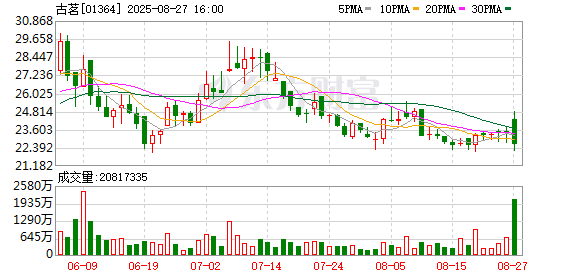
古茗(01364):营收利润双高增,拓品类强化成长动能
HTSC· 2025-08-27 07:03
Investment Rating - The report maintains a "Buy" rating for the company with a target price of HKD 34.57 [7][8]. Core Insights - The company reported strong growth in both revenue and profit, with a 1H25 GMV of RMB 141 billion, up 34.4% year-on-year, and revenue of RMB 56.63 billion, up 41.2% year-on-year. The net profit attributable to the parent company reached RMB 16.25 billion, a significant increase of 121.5% year-on-year [1][2]. - The company is actively expanding its product categories, including coffee and breakfast, while also increasing its store count, which reached 11,179 by the end of 1H25. This expansion strategy is expected to sustain growth in the medium to long term [1][3]. - The company has a strong focus on enhancing operational efficiency and brand positioning, which supports high repurchase rates. Even with potential reductions in delivery subsidies, the company is expected to demonstrate resilience in same-store sales [1][2]. Revenue and Profitability - In 1H25, the company's revenue from sales of goods and equipment, franchise management services, and direct store sales were RMB 44.96 billion, RMB 11.59 billion, and RMB 0.78 billion, respectively, showing year-on-year increases of 41.8%, 39.2%, and 14.0% [3]. - The adjusted core profit margin for 1H25 was 20.1%, reflecting a year-on-year increase of 1.0 percentage points, indicating improved profitability [4]. Expansion and Market Strategy - The company has opened 1,570 new stores in 1H25 while closing 305, with a notable increase in the proportion of stores located in lower-tier cities and rural areas [3]. - The introduction of coffee machines in over 8,000 stores and the launch of 16 new coffee products are expected to enhance same-store sales and overall revenue [2][4]. Financial Forecast and Valuation - The adjusted net profit forecasts for 2025, 2026, and 2027 are RMB 21.63 billion, RMB 25.17 billion, and RMB 30.58 billion, respectively, with corresponding adjusted EPS of RMB 0.91, RMB 1.06, and RMB 1.29 [5][11]. - The report suggests a valuation of 30 times the expected PE for 2026, leading to a target price adjustment to HKD 34.57 [5][11].
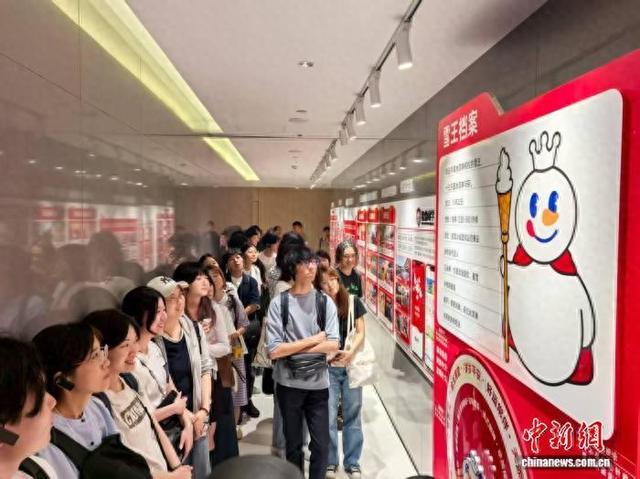
日本大学生河南访名企 深度体验科技与新潮
Zhong Guo Xin Wen Wang· 2025-08-27 05:38
Group 1 - The event "2025 Year of 100 Japanese University Students Visiting China" was organized to promote cultural exchange, with participation from various associations and the Chinese Embassy in Japan [1] - The visit to Mixue Ice City highlighted its popularity among young people due to its high cost-performance ratio, showcasing it as a well-structured and innovative company rather than just a typical tea shop [3][5] - The visit to BYD's "Di Space" demonstrated advanced manufacturing processes and the impact of new energy vehicles on environmental improvement, impressing the students with the level of automation and efficiency [5] Group 2 - Japanese students expressed their surprise at the comprehensive supply chain and modern concepts of Mixue Ice City, changing their previous perceptions of the brand [3] - The students engaged with the brand's various IPs during their visit, indicating strong brand recognition and appeal among the youth [3] - The experience at BYD's facility provided insights into the intelligent manufacturing processes, enhancing the students' understanding of the automotive industry [5]