金融

Search documents
伊朗突发!崩盘、失控!发生了什么?
Zheng Quan Shi Bao Wang· 2025-12-30 23:58
Core Insights - Iran is facing a severe economic crisis characterized by a historic low of the Iranian rial at 42,125 rials per US dollar and a rapid inflation rate of 42.2% as of December [1] - Protests have erupted across multiple cities, including Tehran, in response to soaring inflation and currency collapse, indicating widespread public discontent [2] - The Iranian government, led by President Pezeshkian, is prioritizing economic reforms and dialogue with protesters, acknowledging the urgent need to address citizens' livelihoods [3] Economic Situation - The Iranian rial has depreciated significantly, reaching its lowest value against the US dollar, which is a critical indicator of the country's economic instability [1][3] - Inflation has accelerated to 42.2%, exacerbating the financial struggles of households and contributing to public unrest [1] Protests and Public Response - Protests have spread to various cities, including Mashhad, Kermanshah, and Hamedan, with demonstrators expressing their frustrations through marches and strikes [2] - The protests have escalated in intensity, with confrontations between demonstrators and security forces, highlighting the potential for ongoing civil unrest [2] Government Actions - President Pezeshkian has emphasized the importance of economic reform and has initiated dialogue with protest representatives to address their concerns [3] - The resignation of the central bank governor reflects the government's attempt to respond to the economic crisis and public dissatisfaction [3]
伊朗,突发!崩盘、失控!发生了什么?
券商中国· 2025-12-30 23:56
Core Viewpoint - Iran is facing a severe economic crisis characterized by a historic low of the Iranian rial at 42,125 rials per US dollar and a rapid inflation rate of 42.2% as of December, leading to widespread protests and civil unrest [1][4]. Group 1: Economic Situation - The Iranian rial has depreciated significantly, reaching its lowest value against the US dollar, which has contributed to economic chaos and financial distress for households [1][4]. - Inflation in Iran has accelerated to 42.2%, exacerbating the economic challenges faced by the population [1]. - The Iranian economy is grappling with soaring inflation, a collapsing currency, stagnant GDP growth, and capital flight due to US sanctions [4][6]. Group 2: Protests and Civil Unrest - Protests have erupted in Tehran and other cities, with demonstrators expressing their frustration over rising inflation and the currency crisis [2][3]. - The protests have spread to multiple cities, including Mashhad, Kermanshah, and Hamedan, with participants engaging in confrontations with security forces [3]. - Merchants in Tehran have vowed to extend their strikes, indicating a sustained wave of civil disobedience against the government [3]. Group 3: Government Response - Iranian President Ebrahim Raisi has stated that the government is prioritizing economic reforms and dialogue with protesters, emphasizing the importance of citizens' livelihoods [5]. - The resignation of the Central Bank Governor has been reported, with indications that the government is seeking to respond to public discontent and stabilize the situation [6]. - Raisi's administration is under pressure to demonstrate responsiveness to societal demands amid ongoing economic difficulties and protests that have persisted since 2017 [6].

恒指夜期收盘︱恒生指数夜期(1月)收报25880点 高水25点
Zhi Tong Cai Jing· 2025-12-30 22:40
Group 1 - The Hang Seng Index night futures (January) closed at 25,880 points, down 45 points or 0.174%, with a premium of 25 points [1] - The total number of open contracts was 106,714, a decrease of 2,377 contracts [1] - The net number of open contracts reported was 35,272, a decrease of 2,178 contracts [1]
财经观察:外媒热议中国2025年经济亮点
Huan Qiu Shi Bao· 2025-12-30 22:34
Core Viewpoint - In 2025, China's economy demonstrates resilience and vitality amidst global challenges, attracting international attention and investment opportunities in various sectors, including stock markets, AI development, and soft power expansion [1] Trade Resilience - Despite ongoing U.S. tariff policies, China's goods trade has shown consistent growth, with exports expected to increase by 8% year-on-year in 2025 [2][4] - China achieved a record annual trade surplus of $1 trillion in November 2025, offsetting declines in specific markets through expanded trade with Europe, Latin America, and Africa [4] - China's export innovation and new trade dynamics are crucial for maintaining global supply chain stability, with predictions of increased global market share by 2030 [4] Artificial Intelligence Advancements - 2025 marks a pivotal year for AI, with China's DeepSeek releasing the R1 model, challenging U.S. dominance in the AI sector [5][6] - China has emerged as a leader in open-source AI, with significant competition against U.S. companies, as evidenced by the rapid development and availability of free models [6] - The influence of Chinese technology extends beyond AI into robotics and deep-sea science, showcasing a systematic advancement in various high-tech fields [5] Stock Market Performance - The total market capitalization of A-shares surpassed 100 trillion yuan for the first time in 2025, with significant returns exceeding initial predictions [7][8] - High expectations for the Chinese stock market are supported by a bullish outlook, with forecasts indicating a potential 38% increase by the end of 2027 [7] - Global investors are increasingly interested in Chinese equities, driven by strong market performance and the emergence of innovative companies like DeepSeek [8] Soft Power and Global Influence - China ranks second in the global soft power index, surpassing the UK, with cultural products like the toy "Labubu" gaining international acclaim [9][10] - The success of Chinese lifestyle brands and cultural exports reflects a shift towards China leading global trends rather than merely following them [9] - The expansion of Chinese brands into international markets, including the U.S., highlights the growing global presence of Chinese products [10] Economic Growth Outlook - Multiple international organizations have raised China's GDP growth forecast for 2025 to 5%, recognizing its role as a key stabilizer in global growth [11][12] - Consumer spending is projected to significantly contribute to economic growth, with its quarterly contribution rate rising from 29.7% at the end of 2024 to 56.6% by the third quarter of 2025 [12] - The outlook for 2026 remains positive, with expectations of continued strong performance in the technology sector driven by AI innovations and supportive policies [12]
白银大跌之后又大涨 现货白银涨超6% 接下来还会“疯狂”吗?华尔街经济学家:明年有望冲破100美元!美联储大消息
Mei Ri Jing Ji Xin Wen· 2025-12-30 22:20
Market Performance - Major tech stocks showed mixed performance, with Intel and Meta rising over 1%, while Microsoft, Google, and Amazon saw slight increases; Tesla dropped over 1%, and Apple, Nvidia, and Netflix experienced minor declines [1] - The Nasdaq Golden Dragon China Index opened high but closed down 0.26%, with Baidu up over 4%, NIO up over 3%, and NetEase up nearly 1%; JD.com fell nearly 2%, and Kingsoft Cloud dropped nearly 1% [1] Commodity Prices - WTI crude oil futures settled down 0.22% at $57.95 per barrel, while Brent crude oil futures fell 0.03% to $61.92 per barrel [1] - As of December 31, spot silver was reported at $76.55 per ounce, with a gain of 6.16%, and New York silver at $76.459 per ounce, up 8.51% [1] - Spot gold was reported at $4347.10 per ounce, with a gain of 0.35% [3] - New York copper rose by 4% to $5.7895 per pound [5] Market Dynamics - Analysts indicated that the recent drop in precious metals was primarily due to technical factors, including profit-taking and stricter margin requirements, rather than fundamental changes [5] - The silver market is expected to face a supply-demand gap exceeding 100 million ounces by 2025, marking the fifth consecutive year of supply shortages [6] - The largest silver ETF, SLV, reported a holding of 16,400 tons as of December 26, 2025, with a week-on-week increase of 2% [6] Federal Reserve Insights - The Federal Reserve's December meeting minutes revealed significant internal divisions regarding interest rate decisions, with a 25 basis point cut bringing the target range to 3.50% to 3.75% [7] - Some officials expressed concerns about the risks of inflation and unemployment, indicating a cautious approach to further rate cuts [8] - The minutes suggested that if inflation decreases as expected, further rate cuts may be appropriate, but some members advocated for maintaining the current rate for a period [8]
贵金属深夜集体反弹,白银期货涨近8%,中概股普涨,蔚来涨近7%,百度涨超5%
2 1 Shi Ji Jing Ji Bao Dao· 2025-12-30 15:41
Group 1: Stock Market Performance - Several gold stocks in the US market saw significant increases, with Kintan, Harmony Gold, and Pan American Silver rising over 3% [2] - Notable performance in tech stocks, with Meta and Intel both rising approximately 2% [2] - The Nasdaq Golden Dragon China Index rose over 1%, with NIO increasing nearly 7%, XPeng up over 5%, and Baidu rising nearly 6% [2] Group 2: Precious Metals Market - After a significant drop, the precious metals market rebounded, with COMEX silver rising nearly 8% and spot silver increasing over 4% [5] - Gold prices reached up to $4,400, while platinum and palladium rose approximately 5% and 2%, respectively [5] - Year-to-date, gold has seen an increase of over 66%, marking its best performance since 1979 [7] Group 3: Future Price Predictions - UBS has raised its gold price forecast for the first three quarters of 2026 to $5,000 per ounce, with potential increases to $5,400 in case of political or economic turmoil [10] - CITIC Securities has warned of potential volatility in silver prices, suggesting caution due to historical high volatility indices [10]

贵金属深夜集体反弹,白银期货涨近8%,中概股普涨,蔚来涨近7%,百度涨超5%
21世纪经济报道· 2025-12-30 15:36
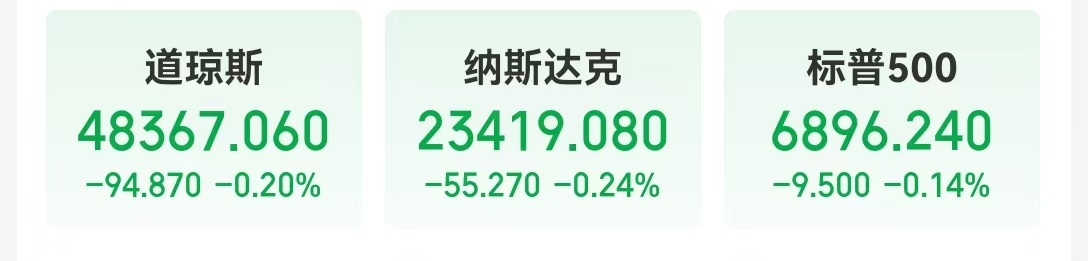
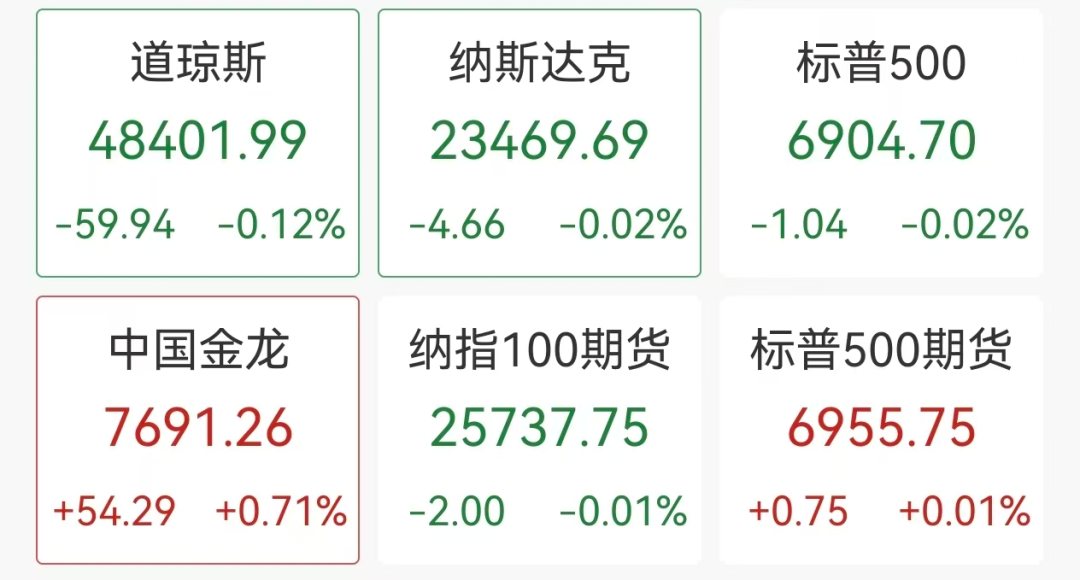
Core Viewpoint - The article discusses the recent performance of the U.S. stock market, particularly focusing on the rebound of precious metals and the rise of Chinese concept stocks, highlighting significant movements in various sectors and the outlook for gold and silver prices in the coming years [1][5][10]. Stock Market Performance - The U.S. stock market opened slightly lower but saw a rebound, with the Dow Jones down by 0.12%, Nasdaq down by 0.02%, and S&P 500 down by 0.02% [2]. - Notable movements included a rise in several gold stocks, with companies like K92 Mining and Harmony Gold increasing by over 3% [2]. - Chinese concept stocks performed well, with NIO rising nearly 7%, XPeng up over 5%, and Baidu increasing by nearly 6% [2]. Precious Metals Market - After a significant drop, precious metals experienced a rebound, with COMEX silver rising nearly 8% and spot silver up over 4% [5]. - Gold prices reached approximately $4,400 per ounce, with platinum and palladium increasing by about 5% and 2%, respectively [5]. - Year-to-date performance shows gold has increased by over 66%, platinum by 141.57%, and silver futures by over 150%, marking them as some of the highest-performing assets globally [7]. Future Outlook for Precious Metals - UBS has raised its gold price forecast for the first three quarters of 2026 to $5,000 per ounce, with potential increases to $5,400 in case of political or economic turmoil [10]. - Citic Securities has warned about the volatility of silver, indicating a need to be cautious of potential corrections after significant price increases [10]. - TD Securities anticipates that silver prices will slow down to around $40 per ounce in the next year [10].

经济U型反弹社会提升包容,广州城市韧性是否具备可持续性
Nan Fang Du Shi Bao· 2025-12-30 14:44
Core Insights - The article highlights Guangzhou's economic resilience and urban development as it transitions into 2025, emphasizing innovation, social welfare, and infrastructure improvements [2][3]. Economic Resilience - Guangzhou's economy demonstrated a U-shaped recovery, with growth rates increasing from 3.0% in Q1 to 4.1% in Q3, indicating a return to normal economic conditions [7]. - The city has completed a two-year economic adjustment, showcasing strong resilience amid challenges in the automotive and real estate sectors [7]. - Industrial output, urban renewal, and the financial sector have been key contributors to this economic rebound, with industrial value added growing by 1.4% year-on-year in Q3 [7][9]. - The automotive industry is increasing R&D investments, maintaining double-digit growth, which supports its transformation [8]. - Real estate investment in urban renewal projects rose by 4.1% in H1 and 2.4% in Q3, contrasting with a broader provincial decline [8]. Social Resilience - Urban renewal projects, particularly in village renovations, have enhanced social inclusivity and safety, with significant progress in the 康鹭片区 and other areas [11][14]. - The successful hosting of the 15th National Games and the Special Olympics has improved urban functionality and social cohesion [14]. - The implementation of a "zero-barrier" initiative during the events has made the city more accessible for disabled individuals and the elderly, contributing to a more inclusive urban environment [16].

雷总又要搞事情了
表舅是养基大户· 2025-12-30 13:33
Group 1 - The Hang Seng Technology Index experienced its largest single-day gain in December, rising by 1.74% [1] - A surge in buying activity was noted in the Hong Kong stock market, particularly in major stocks like Tencent, Alibaba, and Xiaomi, with Xiaomi's stock rising due to a live-streaming event announcement by its CEO [2] - Xiaomi's upcoming live-streaming event is seen as part of public relations and market value management, especially following the announcement of a share reduction plan by its second-in-command, Lin Bin, who plans to reduce holdings by up to $5 billion annually starting December 2026 [5][6] Group 2 - Silver faced significant volatility, with a single-day drop of 16% and a further decline of 6.5% in the Silver LOF, totaling over a 24% drop from its peak [8][9] - The premium rate of Silver LOF decreased from over 60% to just above 10% [12] Group 3 - The robotics sector saw a sudden increase in stock prices, while the commercial aerospace sector experienced a decline [13][14] - The Ministry of Industry and Information Technology and other departments released a plan focusing on the digital transformation of the automotive industry, emphasizing key equipment like intelligent robots [15] Group 4 - The A500 ETF saw a net outflow exceeding 10 billion, marking the first net sell since December 10, while still experiencing a significant net inflow of over 100 billion for the month [19] - The A500 ETF has outperformed the CSI 300 by approximately 4.5% year-to-date, with a notable 1.2% excess return in December alone [21] - The South China A500 ETF's scale increased from 21 billion to over 46 billion in December, reflecting a surge of 25 billion [23] Group 5 - The onshore and offshore RMB broke the 7 mark for the first time since May 2023, indicating a potential strategy to avoid rapid appreciation [31] - The Shanghai Composite Index closed at a neutral point of "0.00%", marking a ten-day streak of positive closing prices [31][32] Group 6 - The number of companies listed on the STAR Market reached 600, indicating a significant expansion and potential impact on the Shanghai Composite Index [33]

Market resilience is encouraging amid AI weakness, says Baird's Mayfield
Youtube· 2025-12-30 12:17
Market Overview - The S&P 500 has shown a strong performance, up over 17% on a price basis in 2025, although it is currently flat compared to levels from two months ago [1] - The market is characterized by a rotation rather than a sell-off, with a focus on cyclical real economy stocks [2] Investment Sentiment - The market's resilience in the face of AI skepticism is viewed positively, indicating a healthy market environment [2] - There is a notable lack of volatility, which could pose risks to market sentiment in the first quarter [4] Sector Performance - There is a potential revival for lagging categories such as quality and value stocks, alongside the continued leadership of AI-related stocks [5] - Recent weeks have seen a rebound in discretionary spending, suggesting a more favorable consumer outlook than previously anticipated [6] Global Market Dynamics - The market's strength is not limited to the US, with positive performance observed in Japan, Europe, and emerging markets [6] - Global participation in the market is considered under-discussed, yet it plays a significant role in the overall market dynamics [3] Interest Rates and Economic Outlook - Interest rates are expected to remain sticky above 4%, which necessitates a focus on quality investments, especially in value sectors [8] - Concerns regarding fiscal issues and inflation pressures are influencing the long end of the yield curve, with expectations that the 10-year yield may approach 5% in 2026 [10][11]