采矿业

Search documents
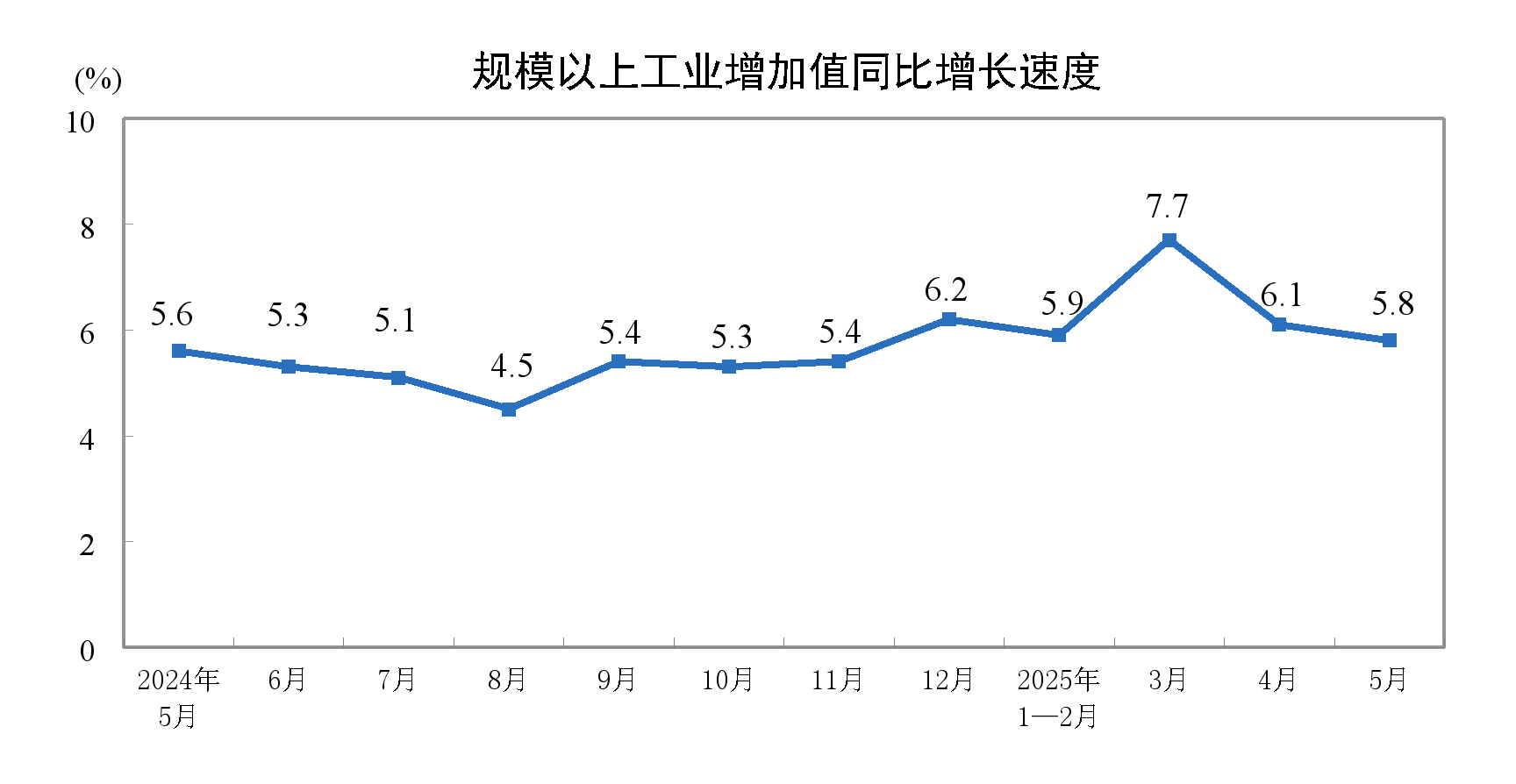
2025年5月份规模以上工业增加值增长5.8%
Guo Jia Tong Ji Ju· 2025-06-16 02:00
分经济类型看,5月份,国有控股企业增加值同比增长3.8%;股份制企业增长6.3%,外商及港澳台投资企业增长3.9%;私营企业增长5.9%。 分行业看,5月份,41个大类行业中有35个行业增加值保持同比增长。其中,煤炭开采和洗选业增长5.5%,石油和天然气开采业增长5.3%,农副食品加工业 增长7.6%,酒、饮料和精制茶制造业增长4.1%,纺织业增长0.6%,化学原料和化学制品制造业增长5.9%,非金属矿物制品业下降0.6%,黑色金属冶炼和压 延加工业增长4.8%,有色金属冶炼和压延加工业增长8.1%,通用设备制造业增长6.3%,专用设备制造业增长2.3%,汽车制造业增长11.6%,铁路、船舶、航 空航天和其他运输设备制造业增长14.6%,电气机械和器材制造业增长11.0%,计算机、通信和其他电子设备制造业增长10.2%,电力、热力生产和供应业增 长2.0%。 分产品看,5月份,规模以上工业623种产品中有326种产品产量同比增长。其中,钢材12743万吨,同比增长3.4%;水泥16500万吨,下降8.1%;十种有色金 属683万吨,增长2.9%;乙烯303万吨,增长14.4%;汽车264.2万辆,增长11.3 ...

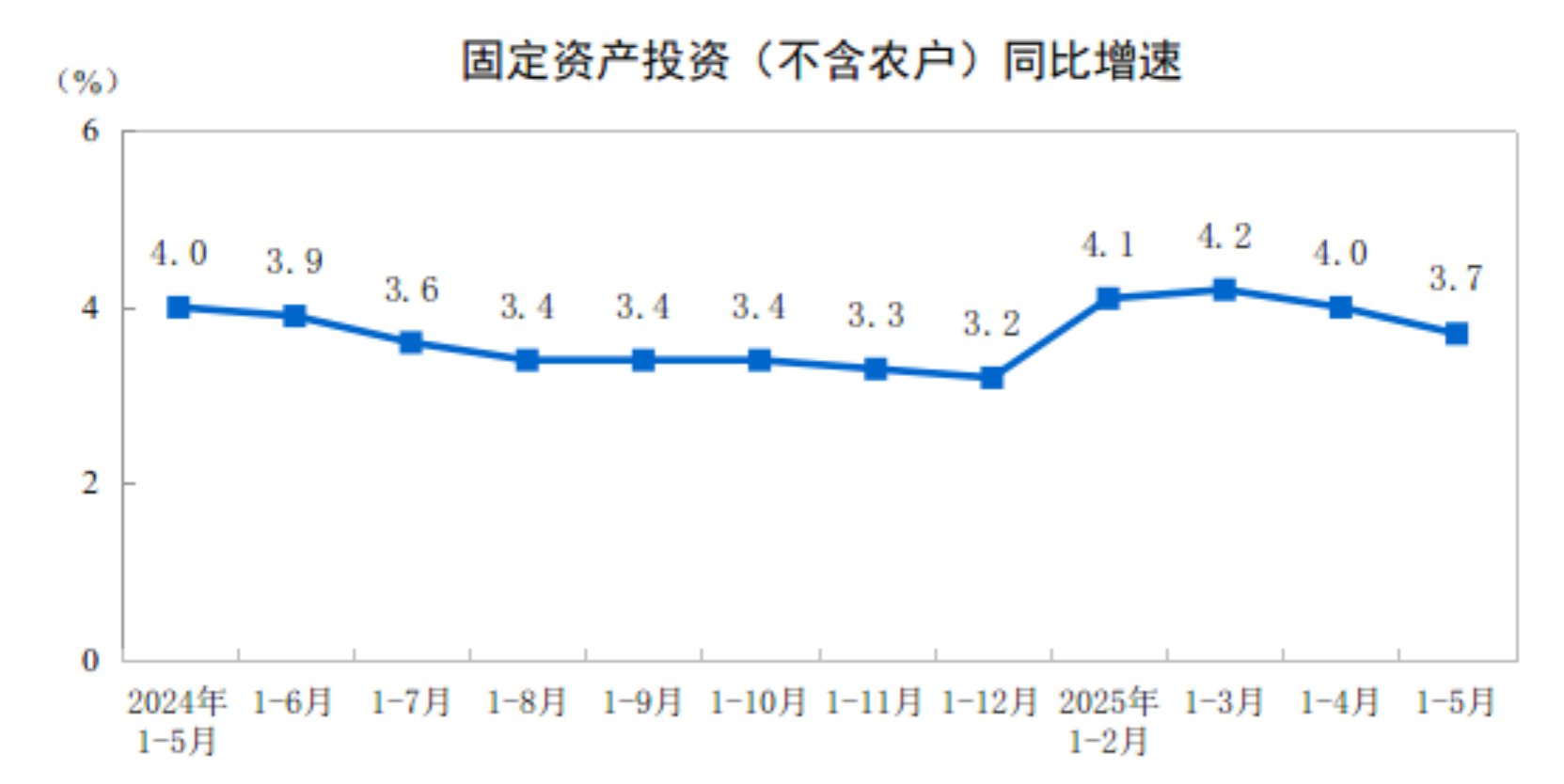
2025年1—5月份全国固定资产投资增长3.7%
Guo Jia Tong Ji Ju· 2025-06-16 02:00
Core Insights - The fixed asset investment (excluding rural households) in China for the first five months of 2025 reached 191,947 billion yuan, showing a year-on-year growth of 3.7% [5] - The investment growth varied across different industries, with the primary industry growing by 8.4%, the secondary industry by 11.4%, and the tertiary industry declining by 0.4% [2][5] Investment by Industry - In the secondary industry, industrial investment increased by 11.6%, with mining investment up by 5.8%, manufacturing investment up by 8.5%, and investment in electricity, heat, gas, and water production and supply rising by 25.4% [3][5] - The tertiary industry saw infrastructure investment (excluding electricity, heat, gas, and water production and supply) grow by 5.6%, with significant increases in water transport (27.2%), water management (26.6%), and air transport (4.7%) [3] Regional Investment Trends - Investment growth varied by region, with the eastern region growing by 0.5%, the central region by 4.5%, the western region by 4.9%, and the northeastern region by 2.1% [3] Investment by Ownership Type - Domestic enterprises saw a fixed asset investment growth of 3.7%, while investment from Hong Kong, Macau, and Taiwan enterprises grew by 6.5%. In contrast, foreign enterprises experienced a decline of 13.4% [4][6]
有色金属:海外季报:Sibanye Stillwater 2025Q1的PGM产量环比减少12.5%至13.94吨,黄金产量环比减少22.0%至4.39吨
HUAXI Securities· 2025-06-12 15:21
Investment Rating - Industry rating: Recommended [4] Core Insights - The report indicates a decrease in PGM production by 12.5% quarter-on-quarter to 448,114 ounces (13.94 tons) and a decrease in gold production by 22.0% to 141,110 ounces (4.39 tons) in Q1 2025 [1][3] - The average basket price for PGM increased by 4% quarter-on-quarter to $1,362 per ounce, while the average gold price received was $2,832 per ounce, reflecting a 7.0% increase quarter-on-quarter [1][3] - The adjusted EBITDA for the group grew by 89% year-on-year to 4.1 billion Rand ($222 million), indicating significant financial improvement [6] - The report highlights operational challenges in the South African gold mining business, which are expected to improve in Q2 2025 [7] Production and Financial Performance - PGM sales decreased by 15.2% quarter-on-quarter to 473,028 ounces (14.71 tons), with a year-on-year decrease of 26.2% [1] - The operational cost for PGM was $1,393 per ounce, reflecting a 4% increase quarter-on-quarter and a 6.7% increase year-on-year [1] - The total cost for gold was $2,522 per ounce, with a quarter-on-quarter increase of 10.6% and a year-on-year increase of 14.3% [3] - The adjusted EBITDA for South African gold operations increased by 178% year-on-year to 1.8 billion Rand ($98 million) [7] Future Guidance - The operational guidance for 2025 remains unchanged, with expected PGM production in the U.S. between 255,000 ounces and 270,000 ounces [11] - The anticipated capital expenditure for the U.S. PGM business is projected to be between $100 million and $110 million [11] - The report forecasts a decrease in gold production in South Africa to between 16,000 kg (514,000 ounces) and 17,000 kg (546,000 ounces) [12]
美元暴跌!坦桑先令竟从“全球最弱”逆袭为涨幅最大
Jin Tou Wang· 2025-06-12 07:03
Group 1 - The US dollar has depreciated nearly 9% this year, influenced by the uncertainty of the Trump administration's tariff policies and a global trend towards reducing reliance on the dollar post-pandemic [1] - Central banks worldwide have significantly increased their gold reserves over the past three years to mitigate dollar risk, suggesting a potential long-term weakening of the dollar [1] - The Tanzanian shilling has appreciated significantly, becoming one of the best-performing currencies this year, with a 7% increase against the dollar, primarily due to strong growth in agriculture, mining, tourism, and transportation sectors [1] Group 2 - African countries are experiencing high inflation and debt levels, exacerbated by the dollar's appreciation and the impact of the Russia-Ukraine conflict, leading to a wave of de-dollarization in 2023 [2] - Some African nations are establishing local currency settlement mechanisms and using the Chinese yuan for transactions as part of the de-dollarization trend [2] - The United Nations Economic Commission for Africa has indicated that de-dollarization can benefit African nations' development and help mitigate risks [3] Group 3 - The International Monetary Fund (IMF) forecasts a 6% economic growth for Tanzania this year, amidst a global shift away from dollar dependency that has persisted for over half a century [4] - Deutsche Bank reported a decline in the dollar's safe-haven status and a crisis of confidence, predicting a gradual depreciation of the dollar, although its dominance will not be overturned quickly [4]
A股配置价值提升
Qi Huo Ri Bao· 2025-06-11 02:19
Group 1: US Labor Market and Economic Indicators - The US non-farm payroll report for May showed resilience in the labor market, with 139,000 new jobs added, exceeding the expected 126,000 [2] - The unemployment rate remained at 4.2%, aligning with expectations, but there was notable internal structural divergence, with the U1 unemployment rate decreasing and the U4 rate increasing [2] - Job growth in the service sector was strong, with an increase of 145,000 jobs, particularly in leisure and hospitality, as well as transportation and warehousing, while the goods-producing sector saw a decline of 13,000 jobs [2] Group 2: Wage Growth and Inflation Concerns - Private sector hourly wages increased by 0.4% month-over-month, surpassing the expected 0.3%, with a year-over-year growth rate steady at 3.9% [2] - The broad increase in wages across various sectors has intensified inflation concerns, providing the Federal Reserve with more reasons to maintain a cautious stance [2] Group 3: China's Foreign Trade Performance - China's foreign trade maintained a steady growth trajectory, with total goods trade value reaching 17.94 trillion yuan, a year-on-year increase of 2.5% [3] - Exports amounted to 10.67 trillion yuan, growing by 7.2%, while imports fell by 3.8% to 7.27 trillion yuan [3] - The central region of China led the growth in foreign trade, significantly outpacing the national average, supported by the "Central China Rising" strategy [3] Group 4: US-China Economic Negotiations - Following internal conflicts within the US administration, there is potential for a shift in the US's hardline stance during US-China economic negotiations, with initial meetings expected to yield positive outcomes [4] - US Treasury Secretary and Commerce Secretary reported productive discussions, indicating a possible easing of external pressures on China's economy [4]
摩洛哥2024年经济增长3.8%
Shang Wu Bu Wang Zhan· 2025-06-10 14:53
Economic Growth - Morocco's economy is projected to grow by 3.8% in 2024, slightly higher than the 3.7% growth in 2023, driven mainly by domestic demand while facing inflation and increased financing needs [1] - The GDP growth at current prices is expected to be 7.9% in 2024, down from 11% in 2023, indicating a reduction in inflationary pressures [1] Sector Performance - The primary sector is underperforming, with an overall value added decline of 4.5%, agricultural output shrinking by 4.8%, and fisheries growth slowing from 6.9% in 2023 to 2.6% in 2024 [1] - The secondary sector shows strong growth, with value added increasing by 4.2% in 2024 compared to only 0.8% in 2023, driven by mining (+13%), construction (+5%), manufacturing (+3.3%), and utilities (+2.6%) [1] - The tertiary sector remains active but experiences a slight slowdown, with growth rates decreasing from 5% in 2023 to 4.6% in 2024, although sectors like transportation and storage (+7.4%) and financial services (+7.3%) are accelerating [1] Income and Savings - National disposable income is expected to grow by 7.7% in 2024, down from 10.2% in 2023, while the national savings rate rises to 28.9% of GDP, compared to 28% in 2023 [2] - The investment rate is projected to be 30.1% of GDP in 2024, up from 29% in 2023, leading to an increase in the financing gap from 1% of GDP to 1.2% [2]
这一关键材料,或将对芯片供应造成威胁
半导体行业观察· 2025-06-10 01:18
Core Insights - The semiconductor industry is facing a critical supply constraint due to the increasing demand for high-purity copper, which is essential for chip interconnections as technology advances towards smaller nodes [2][3][5] - The performance and reliability of copper interconnects are becoming significant challenges as chip architectures shrink to 3 nanometers and below, leading to potential bottlenecks in semiconductor manufacturing [2][4][14] Industry Overview - Semiconductors are the backbone of modern electronics, powering devices from smartphones to supercomputers, but the challenges have shifted from transistor counts to material limitations [5] - Copper has replaced aluminum as the standard for interconnects since the late 1990s due to its superior electrical and thermal properties, but now faces issues related to size, signal loss, and durability as dimensions shrink [5][11] Cost Pressures and Production Risks - A tightening copper supply or declining copper quality could increase production costs and delay delivery timelines for leading chip manufacturers like Nvidia, AMD, and TSMC, impacting their profitability [6][12] - The mining sector presents selective opportunities, as the demand for high-grade, ultra-pure copper is rising, benefiting mining companies with cleaner ore bodies or downstream refining capabilities [6][12] Geopolitical and Volatility Factors - Most copper refining occurs in Asia, particularly China, making the market vulnerable to export controls, trade disputes, and supply disruptions from major mining regions [6][9] - Vertical integration is becoming a strategy for tech companies like Apple and Microsoft to secure supply chains, as they actively seek to mitigate risks associated with copper supply [9] Technological Challenges - Techniques such as barrier layer thinning and low-k dielectrics are being developed to manage heat and signal issues, but they complicate and increase the cost of chip manufacturing [7] - The ability to improve chip performance is increasingly dependent on effective interconnectivity rather than just the number of transistors, positioning copper as a critical limiting factor [7][10] Competitive Landscape - Major semiconductor companies in North America, such as Intel, AMD, and Nvidia, are on one side of the equation, while mining and materials companies like Freeport-McMoRan and Southern Copper supply this essential metal [9] - The concentration of supply poses a key risk, increasing vulnerability to trade shocks and regulatory actions, while the demand for high-purity copper is expected to rise as the industry transitions to advanced semiconductor nodes [9][10]



也门哈杰省一非法金矿发生山体滑坡 造成6人死亡
news flash· 2025-06-09 18:09
也门哈杰省一非法金矿发生山体滑坡 造成6人死亡 智通财经6月10日电,记者当地时间9日获悉,据胡塞武装消息,也门哈杰省一处非法开采的金矿发生山 体滑坡,造成6人死亡,1人受伤。 (央视新闻) ...
库存周期跟踪报告:转向“主动去库存”
SINOLINK SECURITIES· 2025-06-09 13:27
1. Report Industry Investment Rating - No relevant content provided 2. Core View of the Report - In April 2025, the inventory cycle of the entire industrial sector shifted to "active destocking" [2][15][16] - The upstream, mid - stream, and downstream industries all entered the "active destocking" phase in April 2025 [2][17][18] 3. Summary by Relevant Catalogs 3.1 Inventory Cycle Overview - In April 2025, the year - on - year growth rate of finished product inventory of industrial enterprises decreased by 0.3 percentage points to 3.9% [7][8][9] 3.2 Inventory Cycle Overview (by Industry) - **Upstream Industry**: It accounts for only 2% of the total inventory and returned to "active destocking" in April 2025 after three months [17] - **Mid - stream Industry**: It accounts for 54% of the total inventory, and most of it was in the "active destocking" phase in April 2025 [18] - **Downstream Industry**: It accounts for 43% of the total inventory and was in the "active destocking" phase in April 2025 [19] - **Specific Industries**: In April 2025, electronics was in "passive restocking", electrical machinery was in "active restocking", chemical was in "passive restocking", paper - making, automotive, non - ferrous metals, instrument and meter, and general equipment were in "active destocking" [7]
广发证券:2025年香港IPO市场或迎来全面复苏
智通财经网· 2025-06-08 23:33
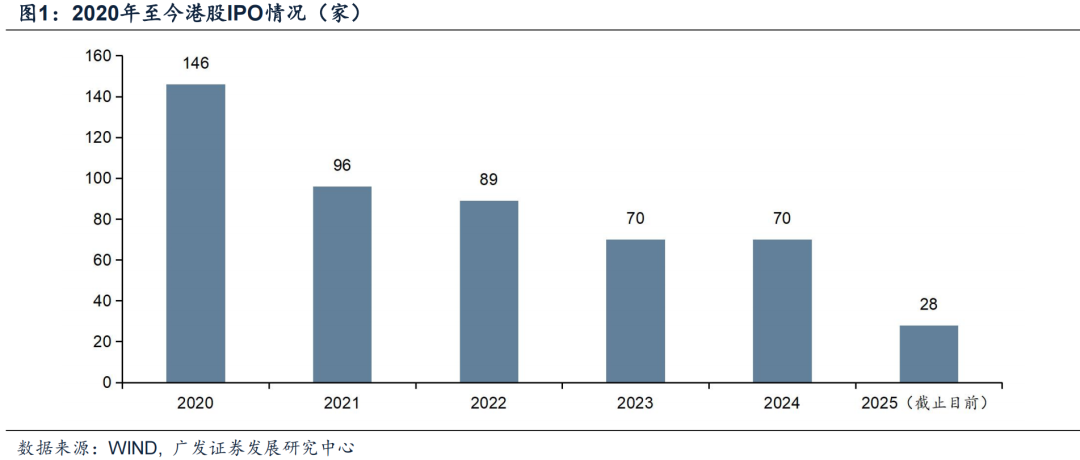
智通财经APP获悉,广发证券发布研报称,2025年香港IPO市场或迎来全面复苏。截至2025年5月31日,港交所IPO数量达28家,较2024年同期增长7.1倍, 中概股回归港股、A股公司发行H股等也将进一步带动市场热度。 广发证券主要观点如下: 港股IPO提速的市场背景: (1)成交量方面,2025年至今恒生指数日均成交量达2409.16亿港元,市场活跃度维持在较高水平。 (2)换手率方面,2025年至今日均换手率达38.2%,市场情绪好。 内陆企业赴港上市原因:(1)政策支持,鼓励中国优质资产国际化;(2)宽松的政策环境为在港上市提供了灵活的上市机制与较高的上市效率;(3)企业自身出 海战略和国际化发展需要。 2025年至今A股赴港IPO募资投向:(1)产能扩张与项目建设;(2)研发与技术投入;(3)海外市场拓展,包括销售渠道建设、跨境电商、矿山收购等;(4)并购与战 略投资;(5)营运资金补充。 | 公司 | 用途 | | | --- | --- | --- | | 宁德时代 | (1) 约90%或 27.646.1百万港元将用于推进匈牙利项目第一期及第二期建设: | | | | (2) 约 10%或 ...