中式餐饮

Search documents
西贝下架“罗永浩套餐”,停止开放后厨参观!记者实探上海一门店:个别用餐者情绪激动!西贝或就“冷冻西兰花”发公告
Zhong Guo Ji Jin Bao· 2025-09-14 11:00
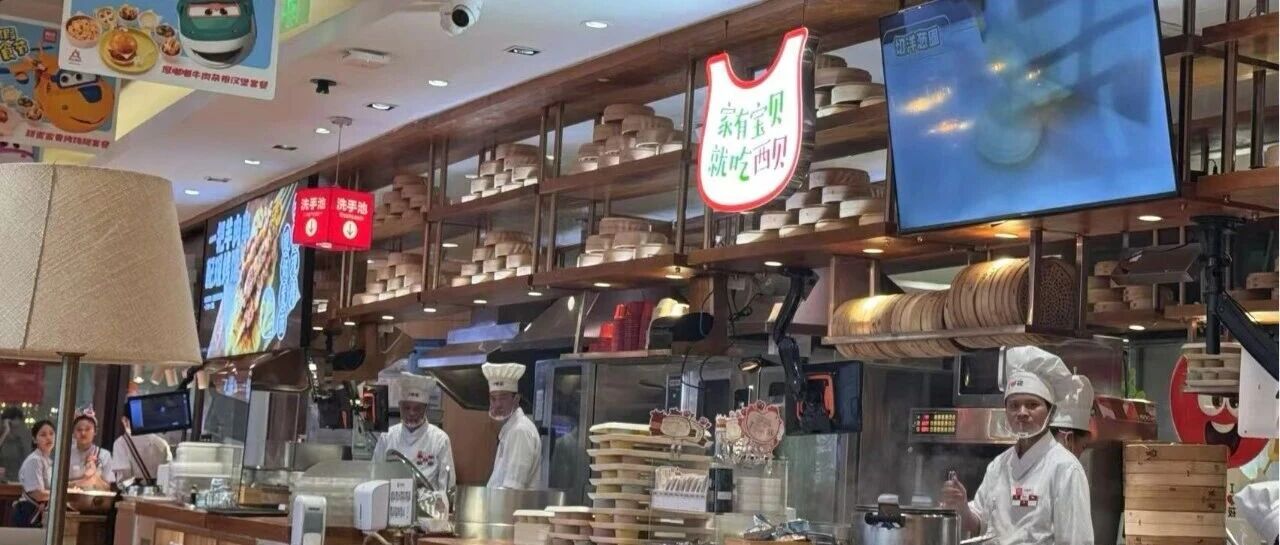
Core Viewpoint - The company Xibei is facing a public relations crisis following the controversy involving Luo Yonghao, despite a recent announcement of a "ceasefire" between them. The impact on customer traffic and sales is being closely monitored. Group 1: Customer Traffic and Sales Impact - Xibei's sales have reportedly decreased by 10% to 15% compared to the previous week, indicating a slight decline in customer traffic [1] - Despite the controversy, a visit to a Shanghai location showed that customer traffic increased during the lunch hour, with the restaurant reaching full capacity around noon [1] - Some customers expressed loyalty to Xibei, stating that they would continue to dine there despite the ongoing issues, while others were more critical and indicated they would not return [1][3] Group 2: Operational Changes - Xibei has announced a nationwide suspension of kitchen tours to ensure normal operations amid the controversy [4] - The company has also decided to remove the "Luo Yonghao" menu from its offerings, which included 13 dishes, with one dish exclusive to Beijing [4] - The store manager explained that the kitchen setup is older and retains a cooking area, which is not common in most of Xibei's newer locations [2] Group 3: Product Quality and Supply Chain - The store manager defended the use of frozen broccoli, stating that it is organic and that the company relies on bulk purchasing to ensure supply, as fresh sourcing daily would be insufficient [3] - The kitchen was noted to have various frozen ingredients, including a specific sauce that requires storage at -18 degrees Celsius [2]

西贝这家门店客流不降反增,员工:今天使用的西兰花是8月14日的
第一财经· 2025-09-14 06:40
Core Viewpoint - The ongoing dispute between Luo Yonghao and Xibei Group has led to mixed impacts on customer traffic in Xibei restaurants, with some locations experiencing a decline while others see an increase [3][4]. Group 1: Customer Traffic Changes - Some Xibei locations reported a decrease in customer traffic by approximately 20% following the Luo Yonghao incident, with staff at the Rudi Huoli City store noting that there was no need to queue for tables [3]. - The Sanlin store indicated a 10% drop in customer traffic, while the Shanghai Center store reported a 10% increase compared to the previous weekend [3]. Group 2: Consumer Sentiment - Consumer opinions are divided; some patrons continue to support Xibei, citing acceptable taste and a willingness to try pre-prepared dishes, while others express a preference for freshly cooked alternatives at similar price points [3]. - A customer mentioned that they frequently visit Xibei with their children and are open to pre-prepared meals, indicating a level of brand loyalty despite the controversy [3]. Group 3: Product Quality Assurance - In response to concerns about the shelf life of the organic broccoli used in children's meals, staff clarified that the broccoli has a production date of late August and emphasized the use of organic produce sourced from Gansu [4]. - The Shanghai Center store staff explained that they utilize freezing technology to preserve nutritional value and ensure that vegetables are delivered fresh every few days [4].
罗永浩VS西贝之争:预制菜风口下的认知鸿沟与商业困局
Sou Hu Cai Jing· 2025-09-13 09:18
Core Viewpoint - The ongoing dispute between well-known figure Luo Yonghao and the restaurant brand Xibei highlights the challenges of standardization and consumer perception in the industrialization of China's catering industry [2][5]. Group 1: Dispute Overview - Luo Yonghao criticized Xibei for using pre-prepared dishes, calling for transparency regarding the use of such items in restaurants [2][3]. - Xibei's founder, Jia Guolong, responded by stating that the dishes served to Luo's group were not pre-prepared and emphasized the restaurant's commitment to quality and transparency [2][3]. - Xibei announced that all its 370 locations would open their kitchens for customer visits to demonstrate the cooking processes [2][3]. Group 2: Definition and Standards - The definition of pre-prepared dishes is a central issue, with a new regulation set to clarify what constitutes such dishes, excluding certain items like staple foods and those prepared in central kitchens [7][9]. - Consumers generally perceive any dish that is pre-processed and not made from scratch on-site as a "pre-prepared dish," leading to a gap in understanding between consumers and the restaurant industry [9]. Group 3: Market Dynamics and Consumer Sentiment - Xibei has been exploring the pre-prepared dish market since 2019, investing significantly in central kitchen facilities to maintain quality across its numerous locations [10]. - Despite the investment, Xibei faces challenges, including a decline in customer traffic and revenue, attributed to the ongoing public scrutiny and criticism from Luo Yonghao [11][16]. - Consumer resistance to pre-prepared dishes is largely driven by price concerns, with many feeling that the cost does not match the perceived value of such offerings [15][16]. Group 4: Regulatory and Industry Implications - The controversy has prompted discussions about consumer rights, particularly the right to know about the use of pre-prepared dishes in restaurants [12][17]. - The industry is moving towards greater regulation, with national standards for pre-prepared dishes being developed, indicating a shift towards more structured market practices [19].
京菜异地游客到店消费订单同比增长43%
Bei Jing Shang Bao· 2025-09-12 13:11
Core Insights - The 9th China Beijing Cuisine Food Culture Festival has commenced in Beijing, featuring nearly 80 exhibitors and over 500 types of food, highlighting the city's culinary heritage and international flavors [1][4] - There is a significant increase in consumer interest in authentic Beijing cuisine, with search volumes reaching nearly 20 million, a 30% year-on-year growth [3] - The festival coincides with the China International Fair for Trade in Services and spans from mid-September to the end of October, covering major holidays [1] Consumer Trends - The demand for authentic Beijing flavors is evident, with a 43% year-on-year increase in orders from out-of-town visitors for Beijing cuisine [4] - Consumers are willing to pay a premium of over 18% for authentic Beijing dishes, indicating strong market potential [4] - Online sales of traditional Beijing products, such as over 1 million cups of milk skin yogurt and 15 million orders of Peking duck, demonstrate robust consumer engagement [4] Event Highlights - The festival features the "2025 China Beijing Cuisine Best-Selling Dishes TOP 10," which includes iconic dishes like Peking duck and Beijing hot pot [4] - The event is supported by various organizations, including the Beijing Municipal Bureau of Commerce and the Beijing Culinary Association, emphasizing its significance in promoting Beijing's culinary culture [4] - The festival is part of the broader initiative to establish Beijing as an international food capital, with its inception dating back to 2017 [4]

罗永浩炮轰,西贝却有中产家庭撑腰
盐财经· 2025-09-12 09:57
Core Viewpoint - The controversy surrounding the use of pre-prepared dishes at Xibei has sparked significant public debate, particularly following criticism from prominent figures like Luo Yonghao, who called for transparency in the restaurant industry regarding the use of pre-prepared ingredients [4][10][30]. Group 1: Controversy and Response - Luo Yonghao criticized Xibei for serving mostly pre-prepared dishes, prompting Xibei's founder, Jia Guolong, to deny these claims and assert that all dishes have specific preparation standards [6][10]. - In response to the controversy, Xibei launched a "Luo Yonghao Menu" with a guarantee of satisfaction, allowing customers to observe the cooking process in their restaurants [8][10]. - The debate highlights a broader consumer confusion regarding the extent of pre-prepared ingredients in restaurant dishes, with many consumers unable to discern the level of processing involved [9][10]. Group 2: Market Position and Pricing - Despite a general decline in restaurant prices, Xibei has maintained a higher average price point, with a per capita spending of 83.66 yuan, significantly above competitors like Jiumaojiu and Baixing Kitchen [14][15]. - Xibei has expanded its market presence, operating 382 locations, while competitors have fewer outlets, indicating a strong brand positioning in the market [13][14]. - The restaurant's focus on family dining, particularly targeting parents of young children, has contributed to its sustained customer base, despite criticisms of high prices [16][44]. Group 3: Children's Menu Strategy - Xibei has successfully tapped into the children's dining market, offering specialized children's meals and services that cater to families, which has become a significant growth area [19][45]. - The children's menu is designed to attract families, with a focus on nutritional standards and appealing presentation, although the profit margins on these meals are reportedly lower than adult meals [45][46]. - The children's dining market in China is projected to grow significantly, with estimates suggesting it could reach a scale of 500 billion yuan in the coming years, making it a competitive space for various brands [48][49]. Group 4: Industry Challenges - The restaurant industry is facing challenges due to increased competition and a saturated market, with many new entrants leading to a decline in demand for traditional dining experiences [29][30]. - Xibei's sales have reportedly declined by approximately 10% in 2024 compared to the previous year, indicating the impact of broader market trends on its performance [30][32]. - The perception of Xibei as "expensive and not worth it" is compounded by the ongoing debate about the use of pre-prepared ingredients, which could affect consumer trust and brand loyalty [34][35].

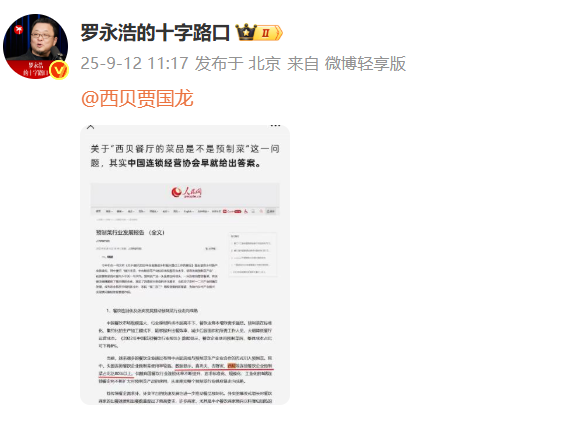
罗永浩晒出《预制菜行业发展报告》喊话西贝,西贝直播展示袋装鸡汤
Qi Lu Wan Bao· 2025-09-12 08:22
Core Viewpoint - The discussion revolves around whether the dishes served at Xibei restaurants are considered pre-prepared meals, with the China Chain Store & Franchise Association having previously provided clarity on this matter [1][2]. Group 1: Industry Insights - According to the "2022 China Chain Catering Industry Report," the use of pre-prepared meals by catering enterprises can reduce overall costs by 8% [7]. - An increasing number of catering businesses are adopting pre-prepared meals through central kitchens or partnerships with pre-prepared meal producers, with leading chain restaurants showing a high usage rate of over 80% [7]. - The rising chain rate in China's catering industry is expected to drive B-end chain restaurants to expand their application of pre-prepared meal products, contributing to the maturation of the entire pre-prepared meal supply chain [7]. Group 2: Company Response - In response to the allegations, Xibei's management conducted a live broadcast on September 11, showcasing the entire kitchen operation process, including ingredient handling, cooking, and serving [7]. - During the live stream, Xibei's team displayed various ingredients and packaging, including a bagged chicken soup product, asserting that these items comply with new regulations and do not fall under the category of pre-prepared meals [10]. - Xibei's founder, Jia Guolong, emphasized that according to national regulations, none of their dishes are classified as pre-prepared meals, asserting that they are 100% freshly made [10]. Group 3: Company Background - Xibei, originally known as "Xibei Youmian Village," was founded by Jia Guolong in November 2001 and is headquartered in Beijing, specializing in Chinese casual dining and Northwest cuisine [13]. - The brand traces its origins back to a small eatery in Inner Mongolia in 1988, with formal registration occurring in 1993 [13]. - Xibei plans to complete an IPO by 2026, aiming to achieve a market value exceeding 100 billion [13].
“827新政”发布两周年,A股IPO“蜕变成蝶”,多少家公司主动撤单
Hua Xia Shi Bao· 2025-08-29 11:00
Group 1 - The core viewpoint of the article is that the "827 New Policy" implemented by the China Securities Regulatory Commission (CSRC) has led to a significant transformation in the IPO market, focusing on quality over quantity, resulting in a notable wave of IPO withdrawals [2][3]. - As of August 27, 2025, approximately 560 companies have voluntarily withdrawn their IPO applications in the past two years, indicating a substantial "withdrawal tide" in the market [2][3]. - The tightening of IPO regulations has been reflected in the increased scrutiny of companies, with many firms adjusting their strategies in response to the higher standards set by regulators [2][3]. Group 2 - The pace of withdrawal has slowed down, with 400+ companies withdrawing in 2024, while only 78 companies did so in 2025, indicating a shift in the market dynamics [3]. - Regulatory inspections have played a crucial role in enhancing the quality of listed companies, revealing significant issues within prospective IPO firms [3][4]. - Notable cases include New Dawn and Xiangnian Food, which faced severe penalties for failing to disclose critical information and obstructing inspections, highlighting the stringent regulatory environment [4]. Group 3 - In response to the tightening IPO environment in A-shares, some companies have turned to the Hong Kong market for listings, with notable examples including Laoxiangji and Shuangdeng Co., which withdrew their A-share applications to pursue IPOs in Hong Kong [5][6]. - The Hong Kong market has introduced policies to facilitate listings for technology and biotech companies, aligning with the industry distribution of companies withdrawing from A-shares [6]. - However, competition in the Hong Kong IPO market remains fierce, with over 200 companies waiting to go public as of August 27, 2025 [6]. Group 4 - The tightening IPO environment has also impacted the investment banking sector, with major securities firms experiencing a decline in their underwriting revenues in 2024 [7][8]. - For instance, CITIC Securities, Guotai Junan, and CICC reported declines in their investment banking revenues by 35.43%, 19.72%, and 20.33% respectively compared to 2023 [8]. - Regulatory scrutiny has intensified, with multiple penalties issued to securities firms for various compliance failures, emphasizing the ongoing challenges within the investment banking industry [9]. Group 5 - The future of the IPO market is expected to continue prioritizing quality while adapting to market demands, with regulators focusing on financial authenticity and information disclosure [9]. - There is an anticipation of a more stable monthly average of listed companies in 2025 compared to 2024, with potential green channels for semiconductor and new energy firms [9].

餐饮生死局,云贵菜却杀疯了!
Jin Tou Wang· 2025-08-28 09:29
Core Insights - The restaurant industry is facing a severe crisis, with an average of 6 restaurants closing every minute, totaling 1.61 million closures in the first half of the year, potentially surpassing last year's record of 3 million closures [1] - Major industry players are also struggling, with the leading A-share restaurant company Quanjude experiencing a net profit drop of over 50% in the first half of the year [1] - Despite the overall downturn, Yunnan-Guizhou cuisine has emerged as a surprising success, entering the top 10 in the number of Chinese dining establishments nationwide, with over 40,000 locations [1] Industry Trends - The decline in the restaurant sector is attributed to a focus on cost-effectiveness, with over 60% of Yunnan-Guizhou restaurants having an average per capita spending of less than 80 yuan, appealing to budget-conscious consumers [2] - The aesthetic appeal and bold flavors of Yunnan-Guizhou dishes, such as Passion Fruit Sour Soup Fish and various unique snacks, have made them popular on social media platforms [2][5] - The rise of social attributes and emotional value in consumer spending is exemplified by the popularity of Yunnan-Guizhou cuisine, which has successfully tapped into the social media-driven dining experience [3] Consumer Preferences - Yunnan-Guizhou cuisine offers distinct flavors that cater to consumer curiosity, with its rich and diverse ingredients from the region, fulfilling health and wellness trends [4] - The cuisine's focus on high-quality, visually appealing desserts and unique small dishes has contributed to its popularity, especially among younger consumers [5] - The trend towards sour flavors has seen a growth rate of over 40% in sour-flavored establishments, positioning Yunnan-Guizhou cuisine favorably within the market [3] Market Dynamics - The rapid expansion of Yunnan-Guizhou cuisine across the country raises questions about the sustainability of sourcing local ingredients, such as wild mushrooms and free-range chickens [6] - The restaurant industry is experiencing a shift where rapid growth and supply chain issues are becoming critical challenges, as seen in the decline of other popular dining concepts [6] - The industry is witnessing a trend of standardization and replication, which may lead to diminishing returns as consumers become more discerning and selective [6]
中餐界「爱马仕」,狂赚美国人29亿?
36氪· 2025-08-28 00:09
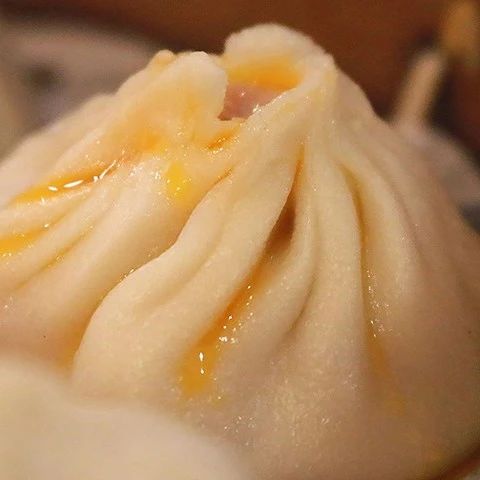
Core Viewpoint - Din Tai Fung, a Taiwanese restaurant chain, is experiencing contrasting fortunes in the U.S. and China, with significant success in the U.S. and a decline in China due to changing consumer preferences and increased competition [5][35][66]. Group 1: Performance in the U.S. - Din Tai Fung has opened 17 locations in the U.S., with each restaurant achieving an average annual revenue of $27.4 million, making it the highest-grossing restaurant chain in the country [10][28]. - The brand has become a cultural phenomenon, with long queues at its locations, where customers often wait two to three hours for a meal [11][12]. - Unique menu items, such as chocolate-filled soup dumplings, have gained popularity among American consumers, showcasing a successful adaptation to local tastes [19][76]. Group 2: Performance in China - In contrast, Din Tai Fung has faced a significant decline in China, reducing its number of locations from 32 to 14 due to a wave of store closures [5][46]. - The brand's pricing strategy has become a point of contention, with many consumers finding its offerings too expensive compared to competitors [41][62]. - Service quality has also been criticized, with reports of poor customer service leading to a decline in customer loyalty [43][44]. Group 3: Market Trends - The rise of Asian cuisine in the U.S. has been fueled by social media platforms like TikTok, which have reshaped consumer perceptions and preferences [71][78]. - The overall sales of Asian chain restaurants in the U.S. have increased by 7.6%, indicating a growing interest in Asian culinary offerings [79]. - In China, however, there is a retreat from "Hong Kong-style" dining experiences, impacting Din Tai Fung's traditional market [52][60]. Group 4: Brand Evolution - Din Tai Fung's initial success was built on high-quality service and a unique dining experience, which has since been replicated by competitors [57][61]. - The brand's adaptation to local tastes in the U.S. has been crucial for its success, while its traditional model has struggled to resonate with modern Chinese consumers [66][87]. - The contrasting fortunes of Din Tai Fung in the U.S. and China highlight the importance of market adaptation and consumer trends in the restaurant industry [66][88].
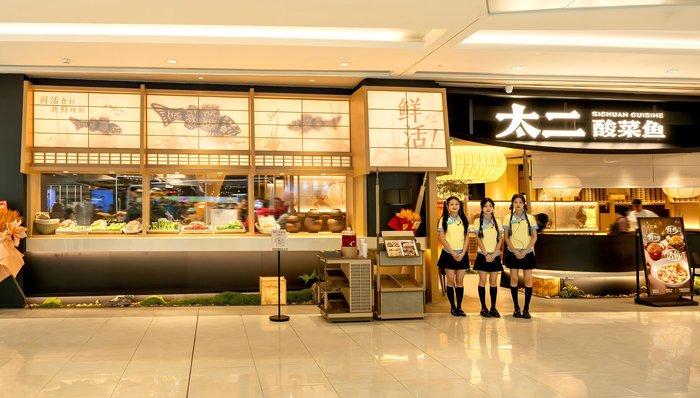
太二酸菜鱼全面“爆改”自救
Xin Lang Cai Jing· 2025-08-27 10:09
Core Insights - The core focus of the article is on the transformation of the brand Tai Er, which is undergoing a significant upgrade to its business model and store design to enhance customer experience and address previous challenges in the competitive market [1][6]. Company Overview - Tai Er, under the parent company Jiu Mao Jiu Group, is launching a new store model called "Fresh Active Mode" to revitalize its brand image and product offerings, with plans to expand from 64 to over 150 new stores by the end of the year [1][3]. - The new store model shifts from a focus on the signature dish of sauerkraut fish to a broader menu that includes live fish, fresh chicken, and beef, along with a more diverse range of hot dishes [1][3]. Financial Performance - As of the first half of 2025, Jiu Mao Jiu Group reported a revenue of 2.753 billion yuan, a decline of 10.1% year-on-year, with Tai Er's revenue dropping by 13.3% to 1.949 billion yuan [6][9]. - The average daily dining revenue of the new store model has increased by approximately 15% compared to the conventional model, with an average increase in customer spending of around 4 yuan [3][9]. Market Challenges - The company faces significant challenges, including a saturated market for sauerkraut fish, with a reported total of 25,781 stores nationwide and a net decrease of 3,164 stores in the past year [9][10]. - The rise of pre-packaged food options is also impacting Tai Er's market share, with the pre-packaged sauerkraut fish market expected to reach 20.47 billion yuan this year [10]. Store Operations - The new store design features a fresh ingredient display area and aims to attract young families by increasing seating capacity from 2-4 to 2-6 people [3][4]. - The renovation costs for larger stores are estimated between 1.8 million to 2 million yuan, while smaller stores cost around 200,000 to 300,000 yuan, with expectations that a 12% increase in sales will cover the additional costs [4][6]. Competitive Landscape - Competitors in the sauerkraut fish segment are also diversifying their menus to enhance competitiveness, with brands like "Fish You Together" and "Yu Shi Hu" introducing new dishes [9][10]. - Despite the challenges, Tai Er's operational profit margin remains relatively stable at 13.4%, indicating some resilience in its business model [9].