
外汇

Search documents
新华鲜报丨多个新高!2025年外汇市场保持韧性与活力
Xin Hua Wang· 2026-01-15 11:38
Core Insights - The foreign exchange market in China reached a record trading volume of $42.6 trillion in 2025, with the corporate foreign exchange hedging ratio rising to 30%, both marking historical highs [1][3] - By the end of September 2025, China's foreign assets and liabilities reached $11.5 trillion and $7.5 trillion respectively, with net foreign assets surpassing $4 trillion for the first time [1][3] Group 1: Market Performance - The foreign exchange market supply and demand remained balanced over the past year, with overall expectations stable, showcasing strong resilience and vitality [3] - The trading volume increased from $34.5 trillion in 2022 to $42.6 trillion in 2025, indicating significant market resilience and vitality [3] Group 2: Economic Growth - China's GDP is projected to reach approximately 140 trillion yuan by 2025, a 40% increase compared to five years ago, providing a robust foundation for the foreign exchange market [4] - The high-tech industry saw a 9.2% year-on-year increase in value added from January to November 2025, highlighting the substantial growth potential of the Chinese economy [4] Group 3: Policy and Reform - The foreign exchange management department has implemented a series of reforms to enhance the convenience of foreign exchange transactions, significantly supporting the growth of foreign-related economic activities [5] - In 2025, the foreign exchange management department introduced 28 measures across three key areas: supporting stable foreign trade development, deepening cross-border investment and financing reforms, and supporting free trade zone construction [5] Group 4: Market Participation and Risk Management - The foreign exchange market now includes a diverse range of participants, including both domestic and foreign institutions, which enhances its ability to absorb external changes [5] - The proportion of corporate foreign exchange hedging reached 30% in 2025, indicating improved capabilities for foreign-related enterprises to manage international exchange rate fluctuations [5] - The share of the renminbi in global foreign exchange transactions rose to 8.6%, an increase of 1.6 percentage points from 2022, making it the fastest-growing currency in terms of global trading share [5] Group 5: Stability Measures - The market-oriented mechanism for the renminbi exchange rate has been continuously improved, effectively serving as a stabilizer for supply and demand balance [6] - The authorities will continue to enhance monitoring of cross-border capital flows and improve macro-prudential management to maintain stability in the foreign exchange market [6]

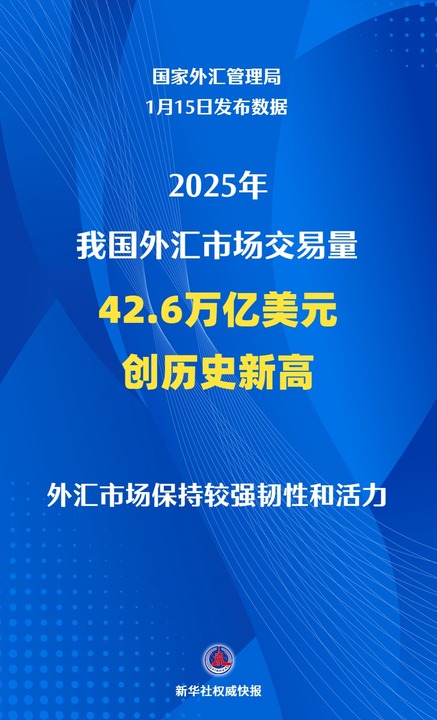
黄金碾压美元登顶,全球金融迎百年巨变,普通人的财富逻辑要变了
Sou Hu Cai Jing· 2026-01-15 10:34
Core Viewpoint - The global financial landscape is undergoing a significant transformation, with gold reserves surpassing U.S. Treasury holdings for the first time in 30 years, indicating a shift in the perception of "safe assets" [1][3]. Group 1: Gold as a Safe Asset - The total value of global official gold reserves has reached $3.93 trillion, exceeding the $3.88 trillion in U.S. Treasury holdings [1]. - The perception of safety in assets has changed, especially after the U.S. froze Russian central bank reserves, leading many countries to reconsider their reliance on U.S. dollar-denominated assets [1][3]. - Central banks, particularly in emerging markets, have significantly increased their gold purchases, with 2023 seeing record levels of gold buying [3][5]. Group 2: Emerging Markets' Role - Emerging markets contributed 75% of the increase in gold purchases, with China’s central bank increasing its gold reserves to 74.15 million ounces over 14 consecutive months [5]. - Countries like Poland and Turkey are actively increasing their gold reserves and implementing innovative policies to encourage gold savings among citizens [6][8]. Group 3: Changing Reserve Composition - The current global reserve composition is approximately 46% in U.S. dollars, 23% in gold, and 16% in euros, indicating a more balanced structure [6]. - Countries are repatriating gold reserves from Western financial centers back to Asia, reflecting a shift in the perceived safety of gold storage locations [8]. Group 4: Investment Strategies - Financial advisors are recommending that clients allocate a portion of their assets to gold, with options like gold ETFs being more accessible and flexible compared to physical gold [10]. - The potential for the U.S. dollar to depreciate and the uncertainty surrounding U.S. Treasury yields against inflation are prompting a reevaluation of asset allocation strategies [10][12]. Group 5: Future Outlook - The trend towards a multipolar financial system is emerging, with predictions of gold prices potentially reaching $5,000 per ounce by 2026, although this should be viewed with caution [12]. - The transition from paper to gold signifies a global redefinition of safety and credit, emphasizing the importance of incorporating "hard assets" into investment strategies [12][14].
创历史新高!达42.6万亿美元
中国能源报· 2026-01-15 09:53
Core Insights - In 2025, China's foreign exchange market transaction volume reached a historic high of 42.6 trillion USD, indicating strong resilience and vitality in the market [1][2][3] - The foreign exchange hedging ratio for enterprises increased to 30%, also a record high [3] - Total cross-border income and expenditure for enterprises and individuals amounted to 15.6 trillion USD, reflecting a nearly 10% growth compared to the previous year [3] - The net capital flow shifted from a net outflow at the beginning of the year to a net inflow of 302.1 billion USD by year-end, with a bank settlement surplus of 196.6 billion USD [3] - The supply and demand in the foreign exchange market remained fundamentally balanced, with overall expectations stable [3]
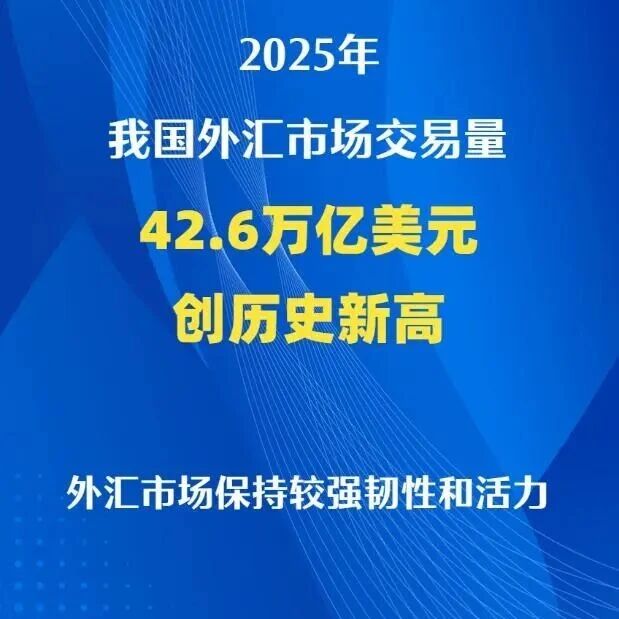
国家外汇局:2025年外汇市场交易量达42.6万亿美元
Ren Min Wang· 2026-01-15 08:03
Core Viewpoint - The press conference highlighted the achievements of monetary and financial policies in supporting the high-quality development of the real economy, with a focus on the foreign exchange market and regulatory measures [1] Group 1: Foreign Exchange Market Developments - By 2025, the foreign exchange market transaction volume is projected to reach $42.6 trillion, marking a historical high [1] - The corporate foreign exchange hedging ratio is expected to rise to 30%, also a record level [1] Group 2: Regulatory Actions - Over 1,100 cases of foreign exchange violations, including underground banks and illegal cross-border fund transfers through false transactions, were addressed throughout the year [1] - These regulatory actions effectively maintained the order of foreign exchange transactions [1]
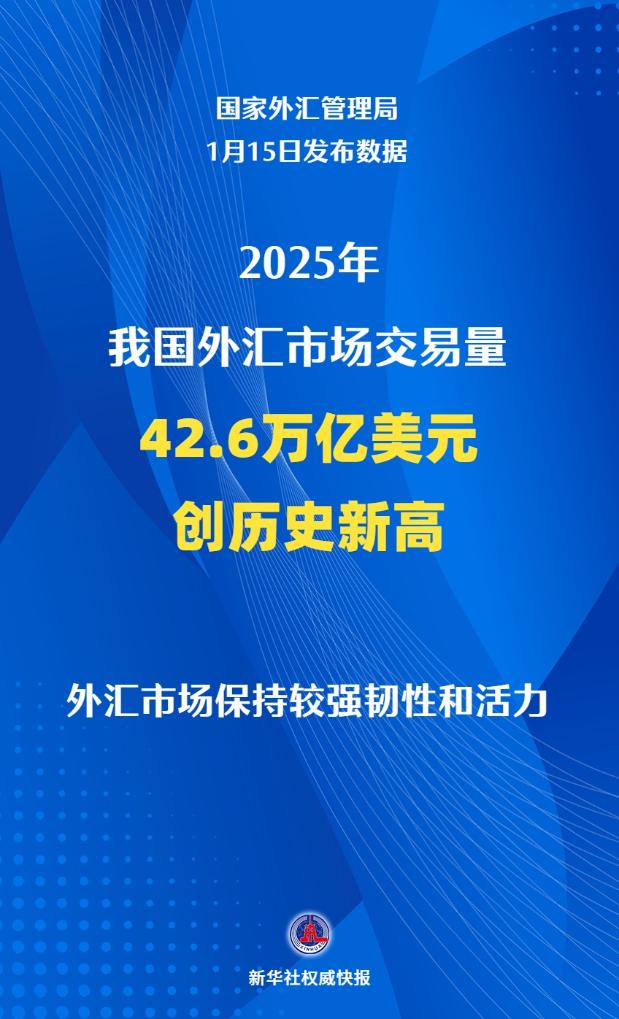
新华社权威快报丨创历史新高!2025年我国外汇市场交易量达42.6万亿美元
Xin Hua Wang· 2026-01-15 07:21
2025年 我国外汇市场交易量 42 6万亿美元 创历史新高 外汇市场保持较强韧性和活力 国家外汇管理局 1月15日发布数据 新华社权威快报 国家外汇管理局1月15日发布数据显示,2025年,我国外汇市场交易量达42.6万亿美元,企业外汇 套期保值比率升至30%,均为历史新高。2025年,企业、个人等跨境收入和支出总计15.6万亿美元,较 上年增长近10%。跨境资金由年初的净流出转为净流入,全年净流入3021亿美元,银行结售汇顺差1966 亿美元。外汇市场供求基本平衡,预期总体平稳,保持较强韧性和活力。 记者:刘开雄、吴雨 海报制作:刘开雄 新华社国内部出品 【纠错】 【责任编辑:施歌】 ...
商品集体回调,原油跌3%,白银暴跌7%
Hua Er Jie Jian Wen· 2026-01-15 03:29
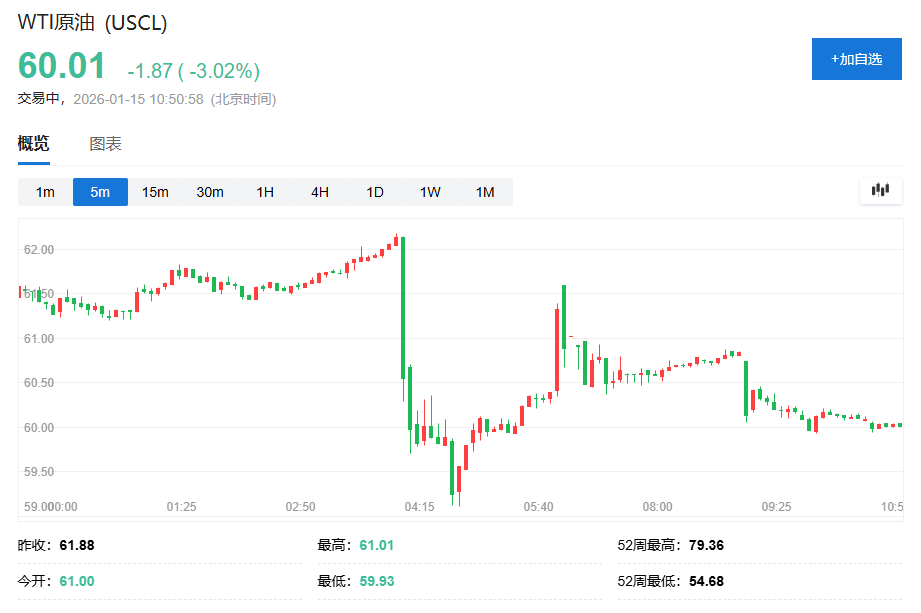
特朗普称将"观望"伊朗局势发展,避险情绪消退打压原油价格,贵金属价格也从历史高位回落。 据央视新闻,当地时间1月14日下午,美国总统特朗普在白宫谈及伊朗局势时表示,"我们要先观望局势发展"。他同时指出美国政府收到了"来自伊朗非 常积极的声明"。WTI原油下挫、较高点跌超3%。 贵金属市场同样剧烈波动。白银价格一度暴跌7.3%,成为当日表现最差的大宗商品之一。特朗普推迟对关键矿产进口征收新关税的决定,导致金、 银、铂、钯等贵金属集体回调。 外汇市场方面,韩元周四在亚洲交易时段小幅走低,此前一日因美国财政部长贝森特提及该货币"过度下跌"而大幅反弹。贝森特的言论为韩元提供了罕 见的口头支持,当前该货币正滑向2009年以来最弱水平。 Wells Fargo驻纽约策略师Brendan McKenna表示: 贝森特的评论能在短期内支撑韩元,但如果市场认为基本面和政治形势仍在恶化,市场影响力可能更大。 韩国央行周四维持基准利率不变,符合市场普遍预期,韩元兑美元下跌0.2%。 货币: ICE美元指数反弹0.02%,报99.13。 日元方面同样受到关注。贝森特周四与日本财务大臣片山皋月通话,指出"过度汇率波动本质上是不可取的" ...
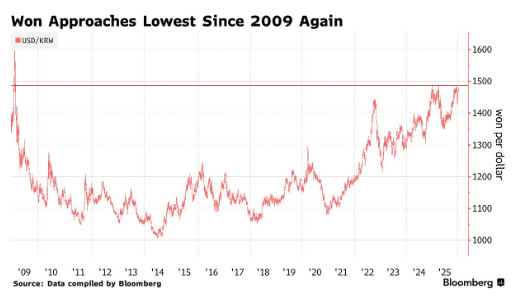
韩元连跌十日、逼近金融危机边缘 韩国汇率“保卫战”压力骤增
Zhi Tong Cai Jing· 2026-01-14 06:37
Core Viewpoint - The South Korean won is experiencing significant depreciation, nearing its lowest level since the global financial crisis, primarily due to accelerated capital outflows by domestic investors and strong demand for US dollars [1][3]. Group 1: Currency Performance - The won has depreciated against the US dollar, reaching 1,479.3 won per dollar, marking a 0.25% drop and continuing a ten-day decline [1]. - The year-to-date decline of the won against the dollar exceeds 2.6%, making it the worst-performing currency in Asia and placing it among the weakest globally [3]. Group 2: Market Dynamics - Domestic investors have significantly increased their investments in US stocks, with approximately $2.2 billion purchased by retail investors as of January 13 [1]. - Foreign investors are accelerating their sell-off of South Korean stocks, further intensifying the downward pressure on the won [1]. Group 3: Government Response - The South Korean authorities have implemented measures such as verbal interventions and the exemption of foreign exchange stability taxes to support the won, but these efforts have not effectively halted its decline [3]. - There is growing concern that the continued depreciation of the won may exacerbate imported inflation and suppress consumer demand, prompting the need for stronger policy responses [3].
韩国将利用市场和资金流动措施来抑制汇率单边波动
Xin Lang Cai Jing· 2026-01-14 05:19
本地投资者对海外证券投资的快速增长,加剧了外汇市场供需失衡。 责任编辑:王永生 韩国企划财政部长官表示,政府将着重改善经济基本面,同时采取短期市场措施和资金流动管理措施, 以缓解该国货币过度单向波动。 韩国企划财政部长官表示,政府将着重改善经济基本面,同时采取短期市场措施和资金流动管理措施, 以缓解该国货币过度单向波动。 具润哲周三在外汇市场研讨会开幕致辞中表示,尽管韩国录得创纪录的经常账户盈余,但韩元波动性却 有所增强,出现了单边市场走势,这表明外汇市场资金流动存在失衡。 具润哲周三在外汇市场研讨会开幕致辞中表示,尽管韩国录得创纪录的经常账户盈余,但韩元波动性却 有所增强,出现了单边市场走势,这表明外汇市场资金流动存在失衡。 本地投资者对海外证券投资的快速增长,加剧了外汇市场供需失衡。 责任编辑:王永生 ...
贵金属早报-20260114
Yong An Qi Huo· 2026-01-14 02:06
Price Performance - London Gold latest price is 4623.05, with a change of 10.10 [1] - London Silver latest price is 85.82, with a change of 1.75 [1] - London Platinum latest price is 2374.00, with a change of 92.00 [1] - London Palladium latest price is 1865.00, with a change of 32.00 [1] - WTI Crude latest price is 61.15, with a change of 1.65 [1] - LME Copper latest price is 13067.50, with a change of -125.50 [1] - US Dollar Index latest is 99.18, with a change of 0.29 [1] - Euro to US Dollar latest is 1.16, with a change of -0.00 [1] - British Pound to US Dollar latest is 1.34, with a change of -0.00 [1] - US Dollar to Japanese Yen latest is 159.17, with a change of 1.00 [1] Trading Data - COMEX Silver inventory latest is 13550.90, with a change of -56.41 [1] - SHFE Silver inventory latest is 630.07, with a change of -19.57 [1] - Gold ETF holdings latest is 1074.23, with a change of 3.43 [1] - Silver ETF holdings latest is 16321.16, with a change of -26.79 [1] - SGE Gold deferred fee payment direction latest is 2, with a change of 0.00 [1] - SGE Silver deferred fee payment direction latest is 2, with a change of 0.00 [1]
大类资产早报-20260114
Yong An Qi Huo· 2026-01-14 01:51
Group 1: Global Asset Market Performance - The latest yields of 10 - year government bonds in major economies: US 4.180, UK 4.398, France 3.521, Germany 2.846, Italy 3.478, Spain 3.241, Switzerland 0.238, Greece 3.339, Japan 2.165, Brazil 6.217, China 1.849, Australia 4.708, New Zealand 4.430 [1] - The latest yields of 2 - year government bonds in major economies: US 3.535, UK 3.651, Germany 2.091, Japan 1.156, Italy 2.192, China (1Y yield) 1.238, Australia 4.035 [1] - The latest exchange rates of the US dollar against major emerging - economy currencies: Brazil 5.374, South Africa zar 16.402, Korean won 1475.800, Thai baht 31.470, Malaysian ringgit 4.058 [1] - The latest values of on - shore RMB 6.978, off - shore RMB 6.974, RMB central parity rate 7.010, RMB 12 - month NDF 6.853 [1] - The latest values of major economies' stock indices: S&P 500 6963.740, Dow Jones Industrial Index 49191.990, Nasdaq 23709.870, Mexican stock index 66337.420, UK stock index 10137.350, France CAC 8347.200, Germany DAX 25420.660, Spanish stock index 17687.100, Japanese Nikkei 53549.160, Hong Kong Hang Seng Index 26848.470, Shanghai Composite Index 4138.758, Taiwan stock index 30707.220, Korean stock index 4692.640, Indian stock index 8948.303, Thai stock index 1235.300, Malaysian stock index 1708.200, Australian stock index 9138.494, emerging - economy stock index 1472.290 [1] - The latest values of credit - bond indices: US investment - grade credit - bond index 3551.450, euro - zone investment - grade credit - bond index 266.768, emerging - economy investment - grade credit - bond index 290.510, US high - yield credit - bond index 2929.010, euro - zone high - yield credit - bond index 412.600, emerging - economy high - yield credit - bond index 1827.282 [1] Group 2: Stock Index Futures Trading Data - Index performance: A - share closing price 4138.76, down 0.64%; CSI 300 closing price 4761.03, down 0.60%; SSE 50 closing price 3132.93, down 0.34%; ChiNext closing price 3321.89, down 1.96%; CSI 500 closing price 8143.28, down 1.28% [2] - Valuation: PE(TTM) of CSI 300 is 14.46 with a - 0.02环比 change, SSE 50 is 12.06 with a 0.02环比 change, CSI 500 is 36.99 with a - 0.30环比 change, S&P 500 is 27.81 with a - 0.06环比 change, Germany DAX is 19.72 with a 0.01环比 change [2] - Risk premium: 1/PE - 10 - year interest rate of S&P 500 is - 0.58 with a 0.01环比 change, Germany DAX is 2.22 with a - 0.01环比 change [2] - Fund flow: The latest value of A - share fund flow is - 1924.09, main - board is - 1247.76, ChiNext is - 520.43, CSI 300 is - 396.75; the 5 - day average values are - 535.55, - 523.98, - 16.96, - 212.50 respectively [2] Group 3: Other Trading Data - Transaction amount: The latest transaction amount of Shanghai and Shenzhen stock markets is 36509.85 with a 496.09环比 change, CSI 300 is 8010.55 with a 11.01环比 change, SSE 50 is 1888.53 with a - 9.49环比 change, small - and - medium - sized board is 7490.48 with a 266.95环比 change, ChiNext is 10777.19 with a - 81.07环比 change [3] - Main contract basis: IF basis is - 2.43 with a - 0.05% amplitude, IH basis is 4.67 with a 0.15% amplitude, IC basis is - 12.08 with a - 0.15% amplitude [3] - Treasury futures: T2303 closing price is 107.85 with 0.00% change, TF2303 closing price is 105.63 with 0.00% change, T2306 closing price is 107.78 with 0.02% change, TF2306 closing price is 105.61 with - 0.01% change [3] - Fund interest rates: R001 is 1.4719% with a - 5.00 BP daily change, R007 is 1.5746% with a 5.00 BP daily change, SHIBOR - 3M is 1.6000% with a 0.00 BP daily change [3]