猪肉

Search documents
中国反制生效之前,欧盟干脆对华强硬到底,不准备给自己留退路
Sou Hu Cai Jing· 2025-09-12 22:38
Core Viewpoint - The EU is intensifying its sanctions against Russia by targeting countries that engage in energy trade with Russia, indicating a commitment to increase pressure amid the ongoing Russia-Ukraine conflict [1][2] Group 1: EU's Sanction Strategy - The EU plans to expand sanctions to include secondary sanctions against countries trading with Russia, reflecting a shift in its approach to the geopolitical landscape [1] - The EU has previously implemented multiple rounds of sanctions focused on Russia's energy revenues and has strengthened anti-circumvention clauses, paving the way for exploring secondary sanctions [2][4] - The EU's decision to coordinate with the US on secondary sanctions highlights its desire to play a more active role in international discourse, rather than remaining a passive observer [2][6] Group 2: Challenges and Internal Dynamics - The implementation of the EU's ambitious sanctions plan faces significant hurdles, including the need for unanimous agreement among member states and the capacity of industries to absorb the impact [4][11] - Slovakia's Prime Minister has publicly stated conditions for supporting new sanctions, emphasizing the need for solutions that balance industrial development and energy prices [4][11] - The complexity of the energy market, including price fluctuations and long-term contracts, poses additional challenges for enforcing sanctions against third countries [7][11] Group 3: US-EU Coordination - There is a notable divergence in the approach between the EU and the US, with the EU moving quickly to implement secondary sanctions while the US remains cautious, focusing on urging the EU to phase out Russian oil and gas by 2028 [6][12] - The US has not prioritized punishing China for purchasing Russian oil, which adds uncertainty to the EU's plans for secondary sanctions [6][12] Group 4: China's Response and Trade Dynamics - China has adopted a more targeted approach in its trade responses, such as imposing temporary anti-dumping duties on EU pork products, which could significantly impact the European pork industry [8][10] - The EU's trade tensions with China have escalated beyond single product disputes to broader trade friction, particularly in the electric vehicle sector [10][11] Group 5: Economic Considerations and Strategic Choices - The EU must weigh the potential economic costs of secondary sanctions against the benefits, particularly in light of China's possible retaliatory measures in key sectors [11][17] - The EU's strategy should involve a more nuanced approach, focusing on high-evidence cases for sanctions while avoiding broader trade disruptions [14][18] - A more pragmatic internal assessment is necessary for the EU to align its energy transition goals with its sanctions strategy, ensuring cost stability and reducing the risk of economic backlash [16][17]


机票价格回落明显 四川猪肉价格再度走弱
Sou Hu Cai Jing· 2025-09-11 23:19
Group 1 - In August, the Consumer Price Index (CPI) in Sichuan experienced a month-on-month decrease of 0.1%, reversing from a 0.4% increase in the previous month, and a year-on-year decline of 0.9%, with the decline rate widening by 0.5 percentage points compared to the previous month [1] - The month-on-month decline in CPI was influenced by three main factors: the end of the summer travel peak leading to a significant drop in air ticket prices by 11.9%, a reduction in refined oil prices, and seasonal discounts on certain clothing items [1] - The year-on-year decline in CPI was primarily driven by decreases in the prices of pork, fresh vegetables, and gasoline [1] Group 2 - In August, the price of pork decreased by 0.4% month-on-month and by 20.1% year-on-year, attributed to the concentrated market release of pigs and the off-peak consumption season [1] - Fresh vegetable prices increased by 3.4% month-on-month but decreased by 17.2% year-on-year, while fresh fruit prices fell by 3.7% month-on-month and by 4.6% year-on-year [1] - The effects of policies aimed at expanding domestic demand and promoting consumption are becoming evident, with household appliance prices rising by 3.1% year-on-year and durable entertainment goods increasing by 2.4% year-on-year [2]
顺鑫农业(000860) - 顺鑫农业2025年09月11日投资者关系活动记录表
2025-09-11 10:56
Business Overview - The company primarily engages in the production and sale of liquor and pork products, with key brands including "Niulanshan" and "Ningcheng" [2][4] - The liquor segment includes five major product series under the "Niulanshan" brand, while the pork segment features "Xiaodian" breeding pigs and "Pengcheng" fresh and processed meat products [4] Industry Evaluation - The liquor industry is experiencing a contraction in production and a shift towards value-driven growth, with increased competition and changing consumer preferences [5] - Companies need to focus on product innovation, channel optimization, and brand promotion to navigate the current market challenges [5] Financial Performance - In the first half of 2025, the company reported a revenue of CNY 4.593 billion, with a net profit of CNY 173 million [6] - The liquor business generated CNY 3.606 billion in revenue, while the pork segment achieved CNY 889 million, with the slaughtering business contributing CNY 782 million and breeding operations CNY 107 million [6] Brand Strategy - The "Niulanshan" brand is focusing on brand upgrades, strategic product promotion, and cultural marketing to enhance consumer engagement [7] - Innovative marketing strategies include collaborations with popular media and interactive consumer activities to strengthen brand presence [7] Future Outlook - The liquor industry is in a deep adjustment phase, with a trend towards consolidation and a focus on brand strength and innovation [8] - Companies must balance short-term inventory pressures with long-term brand value development to remain competitive [8] Pork Business Developments - The company has adjusted its operational strategies in response to market dynamics and pork price trends, ensuring stable supply in Beijing [8] - Product innovation and brand marketing efforts have been intensified, including the establishment of a new retail model for meat products [8]

收评:创业板指大涨5%续创3年多新高,AI算力、卫星通信等科技股全线大涨
Xin Lang Cai Jing· 2025-09-11 07:09
Market Overview - The A-share market experienced a significant rally, with the Shanghai Composite Index rising by 1.65%, the Shenzhen Component increasing by 3.36%, the ChiNext Index up by 5.15%, and the North China 50 gaining 1.59% [1] - The total trading volume across Shanghai, Shenzhen, and Beijing reached 24,646 billion yuan, an increase of 4,606 billion yuan compared to the previous day [1] - Over 4,200 stocks in the market saw an increase [1] Sector Performance - Technology stocks, particularly in CPO, copper cable high-speed connections, semiconductors, photolithography machines, and satellite communications, led the gains [1] - Conversely, sectors such as precious metals, oil and gas, film and television, tourism, dairy, and CRO concept stocks lagged behind [1] Notable Stocks - The computing hardware sector, including CPO and semiconductors, saw widespread gains, with Haiguang Information hitting a 20% limit up and achieving a new high [1] - Industrial Fulian experienced consecutive limit-up days, while stocks like Zhongji Xuchuang, Shenghong Technology, Xinyisheng, and Tianfu Communication surged over 10% [1] - More than 20 stocks in the computing hardware sector reached their daily limit [1] - Pork stocks showed high volatility, with Jin Xin Nong, Bang Ji Technology, and Tian Kang Biological hitting the limit up [1] - The securities sector rebounded, with Guohai Securities reaching the limit up [1] - On the other hand, the precious metals sector saw most stocks adjust, including Western Gold and Sichuan Gold [1] - Innovative drug concept stocks experienced a sharp decline in the morning, with stocks like Tigermed, Zhaoyan New Drug, and Hengrui Medicine falling [1]

超3300只个股上涨
第一财经· 2025-09-11 03:50
Core Viewpoint - The A-share market shows a strong upward trend, with significant gains in sectors such as computing hardware, semiconductors, and liquid-cooled servers, while sports and precious metals sectors remain sluggish [3][4]. Market Performance - The Shanghai Composite Index rose by 1.12%, the Shenzhen Component Index increased by 2.63%, and the ChiNext Index surged by 4.31% [3]. - The total trading volume in the Shanghai and Shenzhen markets reached 1.48 trillion yuan, an increase of 193.8 billion yuan compared to the previous trading day, with over 3,300 stocks rising [4]. Sector Highlights - Notable sectors with significant gains include: - Components: +6.54% - Co-packaged optics (CPO): +6.13% - AI 50 Index: +4.83% - PCB concept: +4.40% - Fiber optic concept: +4.11% [4]. - Semiconductor stocks, particularly computing chips, experienced a notable surge, with companies like Haiguang Information nearing a 20% limit up [6][13]. Individual Stock Movements - Industrial Fulian reached a new historical high, increasing by 8.78% to 58.38 yuan [9]. - In the pork sector, stocks such as Bangji Technology and Lihua Shares saw significant increases, with Bangji Technology hitting the daily limit up [11][12]. International Market Influence - OpenAI reportedly signed a deal to purchase $300 billion worth of computing power from Oracle over five years, leading to a 36% surge in Oracle's stock, which added approximately $250 billion to its market capitalization in a single day [13].




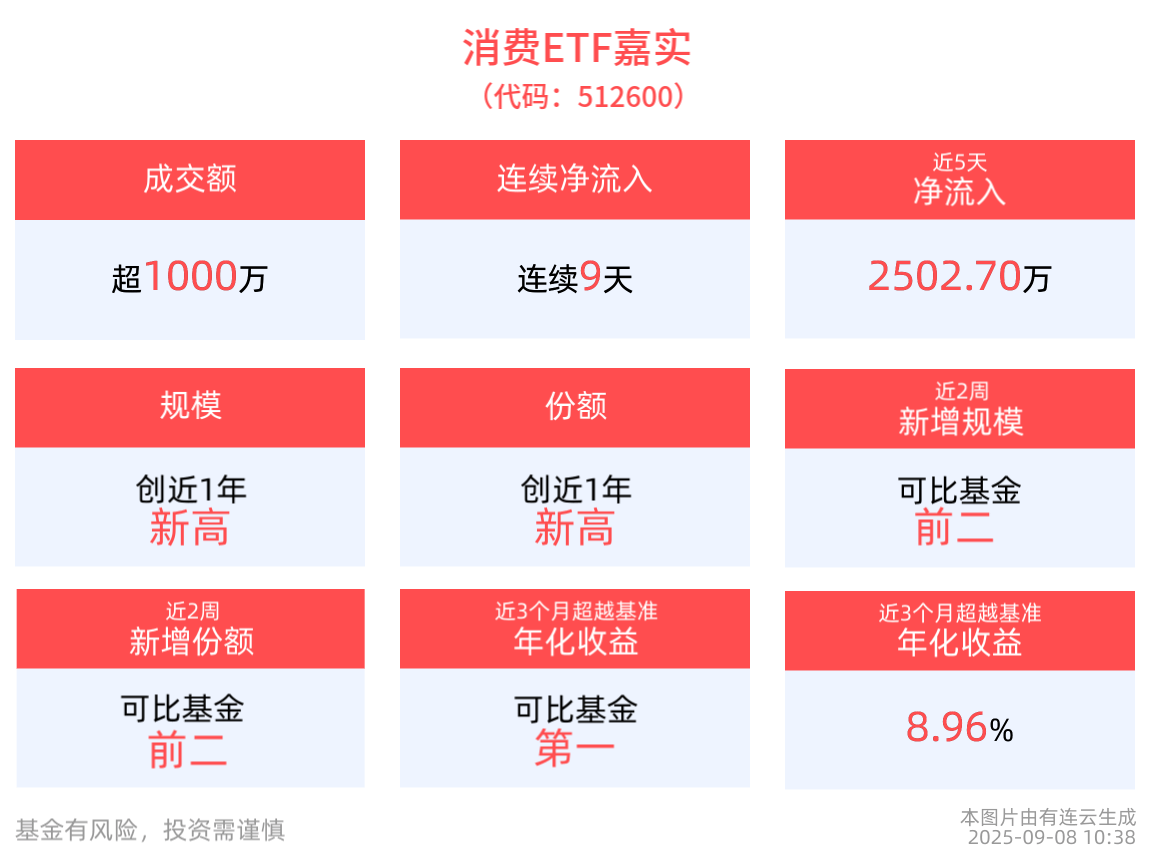
消费ETF嘉实(512600)连续9天净流入近亿元,机构:关注白酒板块估值修复机会
Sou Hu Cai Jing· 2025-09-08 03:05
Core Viewpoint - The consumer sector is showing resilience with significant gains in key stocks and a strong performance of the consumption ETF, indicating potential investment opportunities in the market [1][3][4]. Group 1: Market Performance - The CSI Major Consumer Index rose by 1.04%, with notable increases in stocks such as Beitaini (+6.41%), Huaxi Biological (+4.67%), and New Hope (+3.69%) [1]. - The Consumption ETF (512600) experienced a trading volume of 16.28 million yuan, with a turnover rate of 2.29% [3]. - The Consumption ETF's latest scale reached 702 million yuan, marking a one-year high, and its shares totaled 955 million, also a one-year high [3]. Group 2: Fund Performance - Over the past six months, the Consumption ETF has seen a net value increase of 9.74%, ranking in the top two among comparable funds [3]. - Since its inception, the ETF has recorded a maximum monthly return of 24.50% and a longest consecutive monthly gain of 66.83% [3]. - The ETF's annualized return over the past three months surpassed the benchmark by 8.96%, ranking first among comparable funds [3]. Group 3: Valuation Insights - The latest price-to-earnings ratio (PE-TTM) for the CSI Major Consumer Index is 19.85, which is in the 11.11% percentile over the past three years, indicating a valuation lower than 88.89% of the historical period [3]. Group 4: Sector Analysis - The CSI Major Consumer Index includes leading consumer stocks across various sectors, with liquor accounting for 45% of the index weight [4]. - Despite weak demand in the consumer goods sector, leading companies are showing strong operational resilience and gaining market share [6]. - Analysts suggest that positive policy guidance and healthy supply-demand interactions will improve the supply-demand landscape, particularly in the liquor sector [7].
加拿大财长办公室:将评估对华电动车、钢铝关税是否适用
Sou Hu Cai Jing· 2025-09-05 13:57
Core Viewpoint - Canada is reviewing tariffs imposed on Chinese electric vehicles, steel, and aluminum, following a year of significant trade tensions between Canada and China, particularly regarding canola products [1][2]. Group 1: Tariff Review and Government Actions - The Canadian government has initiated a review of the tariffs on Chinese electric vehicles, steel, and aluminum to assess the current tax rates' validity [1]. - The review is expected to officially start next month, with updates to be provided at appropriate times [1]. - Since the implementation of these tariffs, the import volume of the affected products has significantly decreased [1]. Group 2: Trade Delegation to China - A parliamentary secretary will accompany a trade delegation to China, indicating a potential shift in the Canadian government's approach to trade relations with China [2][8]. - The delegation, led by Saskatchewan Premier Scott Moe, aims to negotiate the canola import guarantee issue and foster dialogue for a closer trade relationship [3][6]. - This visit marks the first time in six years that a Canadian provincial leader has led a delegation to China [6]. Group 3: Broader Trade Implications - The Saskatchewan government is seeking to address not only canola but also tariffs on other Canadian products such as peas, pork, and seafood during the visit [6]. - The Canadian government is also taking measures to protect jobs in the canola industry and plans to announce additional support for Canadian producers [8][10]. - There is an acknowledgment from Canadian officials that there is still room for growth in trade with China, particularly in the agricultural sector [10].

顺鑫农业白酒营收降逾23% 产能利用率不足28%急需提振
Chang Jiang Shang Bao· 2025-09-04 23:42
Core Viewpoint - Shunxin Agriculture's white liquor industry is experiencing significant revenue decline and low capacity utilization, indicating a need for strategic revitalization [1][4]. Financial Performance - In the first half of 2025, Shunxin Agriculture reported total revenue of 4.593 billion yuan, a year-on-year decrease of 19.24%, and a net profit of 173 million yuan, down 59.09% [1][4]. - The white liquor segment generated revenue of 3.606 billion yuan, reflecting a 23.25% decline compared to the previous year [2][4]. Capacity Utilization - As of the end of the first half of 2025, Shunxin Agriculture had a total capacity of 825,500 kiloliters, with actual production of 113,822 kiloliters, resulting in a capacity utilization rate of only 27.58% [2][9]. Regional Performance - Revenue from the Beijing region reached 1.394 billion yuan, down 12.97% year-on-year, while revenue from other regions was 3.199 billion yuan, a decline of 21.69% [2][8]. Product Segmentation - The company categorizes its liquor products into three segments: high-end, mid-range, and low-end, with all segments experiencing revenue declines in the first half of 2025 [5]. - High-end liquor revenue was 529 million yuan (down 12.32%), mid-range liquor revenue was 498 million yuan (down 21.87%), and low-end liquor revenue was 2.578 billion yuan (down 25.41%) [5]. Profit Margins - The gross profit margins for high-end, mid-range, and low-end liquors were 69.32%, 42.12%, and 36.91%, respectively, all showing declines compared to the previous year [5]. Industry Challenges - The white liquor business faces risks including intensified industry differentiation, shrinking consumption scenarios, challenges in new product market development, and intellectual property infringement [3][9]. - The overall white liquor industry is shifting from "scale expansion" to "value cultivation," indicating a more competitive market landscape [4]. Strategic Initiatives - Shunxin Agriculture plans to enhance marketing efforts and product innovation, focusing on market insights and consumer demand to improve competitiveness [9]. - The company aims to optimize its pork business by increasing the proportion of high-margin products and reducing production costs to mitigate price volatility risks [9].
顺鑫农业白酒产业半年营收降逾23% 产能利用率不足28%急需提振
Chang Jiang Shang Bao· 2025-09-03 23:58
Core Viewpoint - Shunxin Agriculture is experiencing significant challenges, with a notable decline in both revenue and profit in the first half of 2025, primarily due to pressures in the white liquor industry and changing market dynamics [1][4]. Financial Performance - In the first half of 2025, Shunxin Agriculture reported a revenue of 4.593 billion yuan, a year-on-year decrease of 19.24%, and a net profit of 173 million yuan, down 59.09% [1][4]. - The white liquor segment generated 3.606 billion yuan in revenue, reflecting a 23.25% decline compared to the previous year [2][4]. - The company's overall capacity utilization rate was only 27.58%, with a total capacity of 825,500 kiloliters and actual production of 113,822 kiloliters in the first half of 2025 [2][9]. Market Dynamics - Revenue from the Beijing region was 1.394 billion yuan, down 12.97%, while revenue from other regions was 3.199 billion yuan, a decrease of 21.69% [2][8]. - The white liquor business is facing intensified industry differentiation, shrinking consumption scenarios, and challenges in new product market development [3][9]. Product Performance - Revenue from high-end liquor decreased by 12.32% to 529 million yuan, mid-range liquor fell by 21.87% to 498 million yuan, and low-end liquor saw a 25.41% drop to 2.578 billion yuan [5]. - The gross profit margins for high, mid, and low-end liquors were 69.32%, 42.12%, and 36.91%, respectively, all showing declines compared to the previous year [5]. Operational Challenges - The company reported a 33.47% decrease in contract liabilities, amounting to 385 million yuan, indicating potential ongoing revenue declines [6][7]. - The company is facing four major risks in its white liquor business: industry differentiation, shrinking consumption scenarios, new product market development, and intellectual property infringement [9]. Strategic Initiatives - Shunxin Agriculture plans to enhance its marketing strategies, focusing on key markets such as Beijing and the Yangtze River Delta, while also upgrading its product structure [8][9]. - The company aims to optimize its pork business by increasing the proportion of high-margin products and reducing production costs to mitigate price volatility risks [9].

大盘震荡回调,关注A500ETF易方达(159361)、沪深300ETF易方达(510310)等产品后续走势
Mei Ri Jing Ji Xin Wen· 2025-09-03 05:20
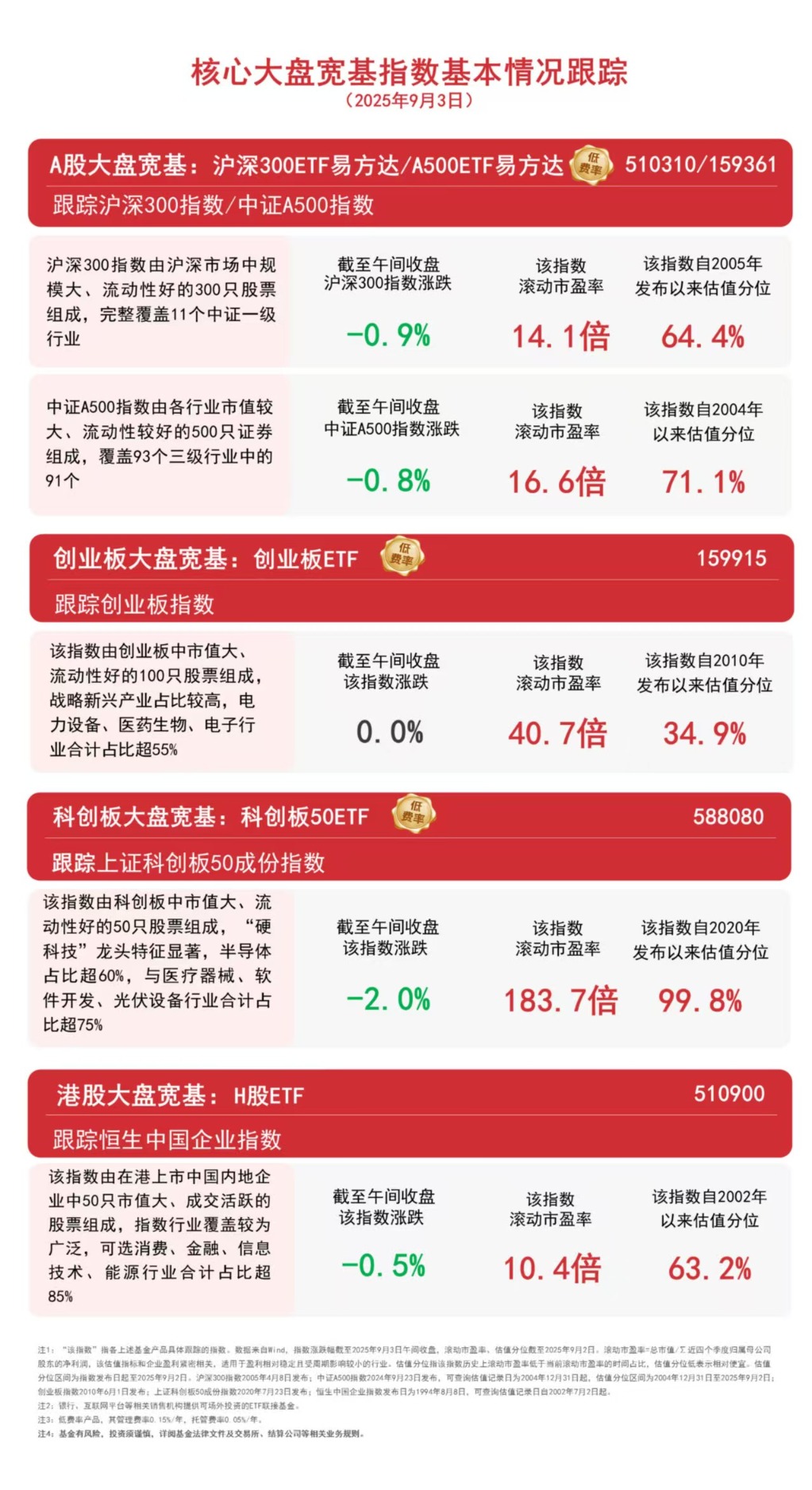
Market Overview - The A-share market experienced a collective adjustment in the morning session, with a total market turnover of 1.47 trillion yuan [1] - The major indices showed declines: the CSI 500 index fell by 0.8%, the CSI 300 index decreased by 0.9%, and the STAR Market 50 index dropped by 2.0% [1][2] - The Hang Seng Index opened high but closed lower, with the innovative drug sector showing strength against the trend [1] Sector Performance - The gaming, photolithography, film and television, semiconductor, and precious metals sectors saw the largest gains [1] - Conversely, the military equipment, securities, insurance, dairy, and pork sectors experienced the most significant declines [1] Index Details - The CSI 300 index consists of 300 stocks from the Shanghai and Shenzhen markets, covering 11 primary industries, with a rolling P/E ratio of 14.1 times and a valuation percentile of 64.4% since its inception in 2005 [2] - The CSI 500 index includes 500 stocks from various industries, covering 91 out of 93 tertiary industries, with a rolling P/E ratio of 16.6 times and a valuation percentile of 71.1% since 2004 [2] - The ChiNext index, tracking the top 100 stocks in the ChiNext market, remained nearly flat with a rolling P/E ratio of 40.7 times and a valuation percentile of 34.9% since 2010 [2] - The STAR Market 50 index, consisting of 50 large-cap stocks, has a rolling P/E ratio of 10.4 times and a valuation percentile of 63.2% since its inception in 2002 [3]