
债券

Search documents
中国抛40亿美元债,华尔街急了!不是缺钱,是拆美元霸权“戏台”
Sou Hu Cai Jing· 2025-11-06 09:42
Core Viewpoint - The issuance of USD-denominated sovereign bonds in Hong Kong by China is a strategic move that goes beyond mere borrowing, aiming to reshape international financial discourse, challenge USD hegemony, and diversify funding channels [1][3][24] Group 1: Strategic Implications - The issuance is not primarily about lacking USD but is a strategic action to enhance China's role in the global financial system [3][4] - By issuing bonds in USD, China aims to establish a pricing and credit benchmark that signals its creditworthiness comparable to the US [4][10] - This move could challenge the long-standing dominance of the USD in global capital flows and bond pricing [4][15] Group 2: Timing and Location - The announcement coincides with high-level US-China negotiations, suggesting a strategic timing to enhance China's negotiating position [6][9] - Hong Kong is chosen as the issuance location due to its status as an international financial center with a mature USD bond market [6][10] Group 3: Market Dynamics - The interest rate on the bonds will be a critical indicator of China's creditworthiness; a lower rate compared to US Treasury bonds would send a strong signal to the market [8][22] - The issuance is expected to attract global institutional investors, potentially altering traditional capital flows that favor US assets [10][19] Group 4: Long-term Vision - This bond issuance may serve as a precursor to future RMB-denominated bonds, laying the groundwork for the internationalization of the RMB [4][17] - The action reflects a broader strategy to transition from being a passive borrower of USD to an active participant in the USD market [21][24] Group 5: Potential Challenges - The issuance faces challenges such as high interest rates in the US, which could affect borrowing costs and investor appetite [13][19] - Geopolitical risks and market perceptions will play a significant role in the success of this bond issuance [12][19]


债市日报:11月6日
Xin Hua Cai Jing· 2025-11-06 08:16
Core Viewpoint - The bond market is currently in a consolidation phase, with long-end varieties remaining weak, and the focus is shifting back to fundamentals and equity market performance, requiring renewed policy easing expectations for further strengthening [1][6]. Market Performance - On November 6, the main contracts for government bond futures mostly closed lower, with the 30-year contract down 0.28% at 116.11, the 10-year contract down 0.09% at 108.535, and the 5-year contract down 0.03% at 105.965 [2]. - The interbank yield on major bonds generally rose, with the 10-year China Development Bank bond yield increasing by 0.2 basis points to 1.866%, and the 10-year government bond yield rising by 0.2 basis points to 1.7945% [2]. International Bond Market - In North America, U.S. Treasury yields rose across the board, with the 10-year yield increasing by 7.78 basis points to 4.159% [3]. - In Asia, Japanese bond yields also saw an increase, with the 10-year yield rising by 1.6 basis points to 1.68% [3]. - In the Eurozone, 10-year French, German, Italian, and Spanish bond yields all increased, with the French yield rising by 1.9 basis points to 3.455% [3]. Primary Market - The China Development Bank's 3-year and 7-year financial bonds were issued at yields of 1.6605% and 1.8685%, respectively, with bid-to-cover ratios of 3.35 and 5.62 [4]. Liquidity Conditions - The People's Bank of China conducted a 7-day reverse repurchase operation of 928 billion yuan at a rate of 1.40%, resulting in a net withdrawal of 249.8 billion yuan for the day [5]. - Short-term Shibor rates fell across the board, with the overnight rate down 0.2 basis points to 1.313% [5]. Institutional Perspectives - Institutions suggest that in a tightening monetary environment, floating-rate bonds may outperform other fixed-income assets, with expectations for further expansion in the floating-rate bond market [7]. - The overall stability of the liability side is expected to limit disturbances in the bond market, with a continued recovery anticipated in the fourth quarter [7]. - The bond market has entered a phase of information vacuum, with risk preferences becoming the main reference for interest rate pricing [7].
“从债券市场视角看“十五五”规划建议
Zhong Cheng Xin Guo Ji· 2025-11-06 05:03
1. Report Industry Investment Rating - No information provided in the content 2. Core Viewpoints of the Report - The "15th Five-Year Plan" proposal emphasizes actively developing direct financing such as equity and bonds, which points out the core direction for the future development of the bond market. The bond market needs to balance "scale growth" and "structural optimization" and deepen its pricing function to support the high - quality development of the real economy [2][5] - The release of the "15th Five - Year Plan" proposal has both short - term and long - term impacts on bond market interest rates. Short - term emotional fluctuations will gradually subside, and credit bond yields may continue to fluctuate within a range [7][9][10] - The bond market should focus on supporting key areas such as science and technology innovation, consumption, rural revitalization, green transformation, and private economy, and promote product innovation and mechanism optimization [11][12][13] - China's bond market will speed up the two - way opening process, expanding the scope of participants and deepening infrastructure construction [17][18][19] - The bond market should continue to strengthen risk prevention in key areas such as real estate, local debt, and small and medium - sized financial institutions, and improve the risk disposal mechanism [20][21][22] - In the credit bond market, a strategy of combining stable allocation and careful bond selection should be adopted, focusing on high - growth industries in line with the "15th Five - Year Plan" direction and paying attention to tail risks [24][25] 3. Summary by Relevant Catalogs 3.1 Question 1: What new requirements does the re - mention of "accelerating the construction of a financial power" in the "15th Five - Year Plan" proposal put forward for the development of the bond market? - The "15th Five - Year Plan" proposal continues the policy tone of "accelerating the construction of a financial power", with more in - depth requirements than the "14th Five - Year Plan". It aims to promote the financial system to a higher - quality development stage [2] - As of October 2025, China's bond market has become the world's second - largest and Asia's largest, with a stock size of about 194.25 trillion yuan and a credit bond stock size of about 39.25 trillion yuan [2] - The bond market needs to balance "scale growth" and "structural optimization" and deepen its pricing function to support the high - quality development of the real economy [5] - Credit rating is an important infrastructure in the bond market. In the future, it needs to strengthen the construction of risk identification and early - warning capabilities to help the high - quality development of the bond market [6] 3.2 Question 2: How to view the interest rate trend of the bond market after the release of the "15th Five - Year Plan" proposal? - Historically, before the release of long - term plans, bond market interest rates may fluctuate greatly due to policy uncertainty. After the policy is clear, market sentiment stabilizes and interest rate fluctuations narrow [8] - Before the 20th Fourth Plenary Session, credit bond yields were volatile. After the release of the "15th Five - Year Plan" draft, market sentiment gradually stabilized, and credit spreads narrowed [9] - In the future, credit bond yields may continue to fluctuate within a range. Short - term emotional fluctuations will gradually subside, and long - term interest rate trends will be affected by the overall economic deployment and policy orientation of the meeting [9][10] 3.3 Question 3: Which key areas of financing development does the "15th Five - Year Plan" proposal support for the bond market? - Science and technology innovation: The "15th Five - Year Plan" emphasizes the core position of science and technology innovation. As of October 28, 2025, the cumulative issuance of science and technology innovation bonds was about 1.7 trillion yuan, and the scale is expected to continue to expand [11][13] - Consumption: The proposal deploys to boost consumption. The bond market has begun to support the consumption field, and consumer - related ABS is expected to expand [12][13] - Rural revitalization: The bond market should support rural development. As of 2025, the issuance of rural revitalization bonds was 818 million yuan, and more policy support is needed [14] - Green transformation: The green bond market has the largest scale in the world. In 2025, the issuance of green bonds was 493.2 billion yuan, and the stock size was about 2.7 trillion yuan. The scale is expected to continue to increase [15] - Private economy: Although policies support the private economy, it still takes time to see the effect. In 2025, the proportion of private enterprise bond issuance in credit bonds was only 2% [15][16] 3.4 Question 4: How will the opening pattern of the bond market evolve under the requirement of high - level opening up? - China's bond market has improved its opening - up level through "bringing in" and "going out". As of September 2025, overseas institutions held 3.78 trillion yuan of inter - bank market bonds, accounting for 2.2% of the total custody volume [17][18] - In the future, the two - way opening of the bond market may be accelerated, including expanding the scope of participants and deepening infrastructure construction [19] 3.5 Question 5: How will bond risk prevention work be carried out under the continuation of the risk - prevention tone? - The "15th Five - Year Plan" proposal emphasizes effectively preventing and resolving various risks, mainly focusing on real estate, local debt, and small and medium - sized financial institutions [20] - As of September 2025, the scale of defaulted bonds in the bond market was 739.406 billion yuan, and the proportion of publicly disclosed completed disposal was 22.8%. The risk disposal mechanism needs to be improved [22] - The "15th Five - Year Plan" mentions the role of the risk - sharing mechanism in supporting venture capital. Currently, the participation of venture capital institutions in the bond market is limited, and more support measures may be introduced in the future [23] 3.6 Question 6: What investment opportunities does the "15th Five - Year Plan" proposal bring to the credit bond market? - A strategy of combining stable allocation and careful bond selection should be adopted, focusing on high - growth industries in line with the "15th Five - Year Plan" direction and paying attention to tail risks [24] - Industries such as science and technology innovation, advanced manufacturing, and green low - carbon have strong bond attractiveness. Some state - owned real estate enterprise bonds and certain urban investment bonds also have certain investment value [25]
“十五五”规划为债市提供宏观支撑
Mei Ri Jing Ji Xin Wen· 2025-11-06 02:25
Group 1 - The core focus of the 20th Central Committee's Fourth Plenary Session and the "14th Five-Year Plan" is on enhancing economic strength and building a technology-driven nation, with a strong emphasis on domestic development and security [1][2] - The frequency of terms such as "development," "economy," "construction," and "technology" has increased compared to the 19th Central Committee's Fifth Plenary Session, indicating a stronger focus on domestic market construction and people's livelihoods [1][2] - The "14th Five-Year Plan" emphasizes the importance of achieving a GDP per capita level comparable to that of moderately developed countries by 2035, with a required economic growth rate of no less than 5% during the "14th Five-Year Plan" period to meet this goal [2][3] Group 2 - The meeting highlights the need for a stable economic growth policy, with a focus on "self-reliance in technology" and "expanding domestic demand," which provides macroeconomic support for the bond market [3] - The 10-year government bond ETF (511260) is identified as a core tool for bond market allocation, with advantages such as low fees, high transparency, and flexible trading options [3]
四季度债券市场或更乐观
Mei Ri Jing Ji Xin Wen· 2025-11-06 02:20
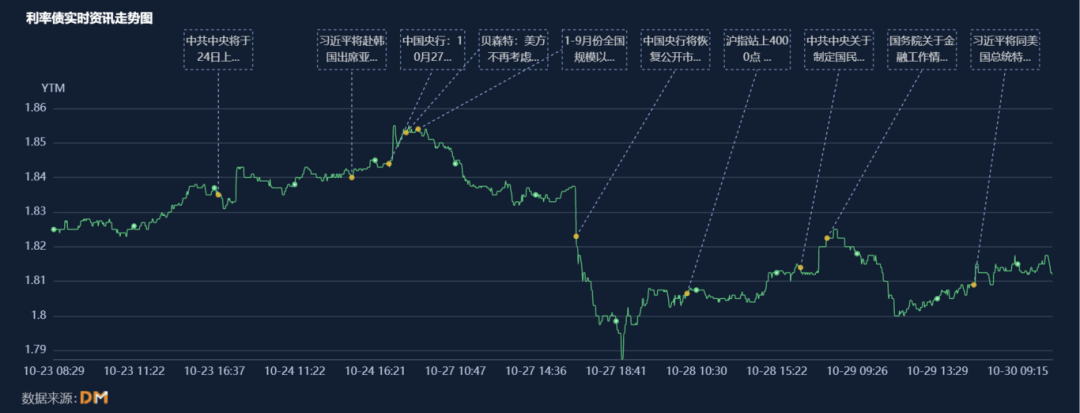
Core Insights - The bond market is relatively efficient, primarily driven by large institutional investors, with individual investors participating through funds and wealth management products. Recent significant events have led to notable fluctuations in bond yields [1] Market Trends - Positive signals from the US-China competition and a 3% year-on-year growth in industrial added value from January to September have caused bond yields to rise, with the ten-year government bond yield reaching approximately 1.85% [1] - Following the peak at 1.85%, the market saw a decline in yields as institutions recognized the value of ten-year bonds, pushing yields down to around 1.82% [1] - A significant drop in yields occurred after the People's Bank of China (PBOC) announced the resumption of government bond operations, leading to a further decrease to about 1.80% [1] Investment Strategy - The bond market is expected to be more optimistic in the fourth quarter due to the PBOC's actions and historical performance trends, with a focus on the ten-year government bond ETF (511260) [5][8] - The current yield range of 1.75%-1.85% is considered a suitable investment zone, and the ten-year bond yield at around 1.8% presents a good opportunity for allocation [3][8] - Investors are advised to adopt a buy-and-hold strategy, as short-term trading may incur transaction costs due to low volatility in the bond market [4] Historical Context - The ten-year bond yield has fluctuated significantly throughout the year, with a notable peak above 2% at the end of last year, followed by a downward trend [3] - The yield curve is currently steeper compared to previous periods, with the ten-year and five-year bond yield spread reaching a historically attractive level [5][7] Future Outlook - The fourth quarter is anticipated to show strong performance in the bond market, driven by expectations of policy easing and proactive positioning by institutions [8] - The CPI indicator is highlighted as a key metric to monitor for potential upward pressure on yields, although current inflation expectations remain subdued [4]
大类资产早报-20251106
Yong An Qi Huo· 2025-11-06 01:05
1. Report Industry Investment Rating - No relevant information provided 2. Core Viewpoints - No clear core viewpoints are presented in the given content 3. Summary According to Related Catalogs Global Asset Market Performance - **10 - year Treasury Bonds**: Yields of 10 - year Treasury bonds vary across major economies, e.g., the US is 4.160, the UK is 4.462, and Japan is 1.657 [2] - **2 - year Treasury Bonds**: The latest yields of 2 - year Treasury bonds are different, such as the US at 3.632, the UK at 3.797, and Japan at 0.926 [2] - **Exchange Rates**: The dollar exchange rates against major emerging - economy currencies are presented, like the dollar - Brazilian real at 5.357, and the dollar - South African rand at 17.418 [2] - **Stock Indices**: The latest values of major economy stock indices are given, including the S&P 500 at 6796.290, the Dow Jones Industrial Index at 47311.000, and the Nikkei at 50212.270 [2] - **Credit Bond Indices**: The latest values of credit bond indices are shown, for example, the US investment - grade credit bond index is 3514.990, and the emerging - economy high - yield credit bond index is 1789.668 [2] Stock Index Futures Trading Data - **Index Performance**: The closing prices and percentage changes of A - shares, CSI 300, SSE 50, ChiNext, and CSI 500 are provided. For example, the A - share closing price is 3969.25 with a 0.23% increase [3] - **Valuation**: PE (TTM) and their环比changes of CSI 300, SSE 50, CSI 500, S&P 500, and German DAX are presented. For instance, the PE (TTM) of CSI 300 is 14.18 with a 0.01 change [3] - **Risk Premium**: Risk premiums and their环比changes of S&P 500 and German DAX are given. The risk premium of S&P 500 is - 0.62 with a - 0.09 change [3] - **Fund Flows**: The latest values and 5 - day average values of fund flows in A - shares, the main board, ChiNext, and CSI 300 are shown. The latest A - share fund flow is 243.29, and the 5 - day average is - 666.83 [3] Other Trading Data - **Transaction Amount**: The latest values and环比changes of the transaction amounts in the Shanghai and Shenzhen stock markets, CSI 300, SSE 50, small - and medium - sized boards, and ChiNext are provided. The latest Shanghai and Shenzhen stock market transaction amount is 18723.41 with a - 434.17 change [4] - **Main Contract Basis**: The basis and basis percentage of IF, IH, and IC are presented. For example, the IF basis is - 30.66 with a - 0.66% basis percentage [4] - **Treasury Bond Futures**: The closing prices and percentage changes of T2303, TF2303, T2306, and TF2306 are given. The closing price of T2303 is 108.62 with a - 0.04% change [4] - **Funding Rates**: The latest values and daily changes of R001, R007, and SHIBOR - 3M are shown. The latest R001 is 1.3615% with a - 10.00 BP change [4]
你家的资金,放多少在股市才合适?
吴晓波频道· 2025-11-06 00:30
Core Insights - The article discusses the recent surge in the A-share market, with the Shanghai Composite Index surpassing 4000 points for the first time in ten years, leading to increased public interest in stocks and funds [3][4] - It emphasizes the importance of understanding personal financial situations and investment choices rather than simply following market trends [4][6] - The three core asset classes—stocks, bonds, and real estate—are highlighted as foundational to modern economic operations, with each serving distinct roles in wealth creation, preservation, and security [5][8] Investment Strategies - The article outlines the critical decision of how much money to allocate to stocks, which should be based on individual family financial structures rather than market conditions [10][11] - It provides guidelines for investment proportions based on risk tolerance and experience, suggesting that families with no prior investment experience should start with a lower percentage of stock investments [16][17][18] - Strategies for navigating market volatility include monitoring valuation metrics like historical PE ratios and observing market sentiment through social discussions and media coverage [21][22] Asset Allocation - A balanced investment approach is recommended, combining stocks, bonds, and real estate to create a robust portfolio that can withstand market fluctuations [24] - Bonds are suggested as a safe haven during high market valuations, providing stable income and acting as a hedge against stock market downturns [25] - Real estate investment is discussed in terms of identifying value opportunities and managing cash flow to optimize returns while minimizing financial burdens [26][28] Educational Initiatives - The article promotes a new investment strategy course focusing on the three core asset classes, aiming to provide practical knowledge tailored to the current Chinese investment landscape [29][30] - The course will cover essential topics such as stock investment strategies, bond advantages, and real estate value retention, led by experienced industry professionals [31][36]

经济数据优于预期 美债收益率普遍回升
Xin Hua Cai Jing· 2025-11-05 23:52
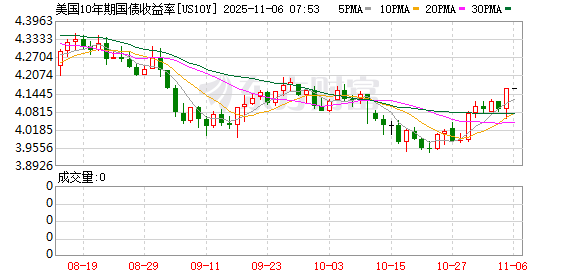
Group 1 - The overnight rise in U.S. Treasury yields was driven by strong economic data, with all maturities experiencing increases [2] - The latest non-farm payroll data showed an increase of 206,000 jobs in June, surpassing economists' expectations of 190,000, while the unemployment rate remained steady at 4.1% and average hourly earnings rose by 3.9% year-on-year, above the expected 3.8% [2] - The Federal Reserve's policy path remains unclear, with Powell emphasizing that a rate cut in December is not guaranteed, which could lead to further rebounds in Treasury yields if the Fed slows its rate-cutting pace [2] Group 2 - Despite strong economic data, inflation pressures continue to be a focal point for the market, with the U.S. Consumer Price Index rising by 3% year-on-year in September and 0.3% month-on-month, driven by a 4.1% increase in energy prices and rapid food price increases [3] - The U.S. Treasury has alleviated long-term Treasury supply pressures through increased short-term bond issuance and adjustments in financing strategies, contributing to a decline in "term premium" [3] Group 3 - Columbia Threadneedle bond manager Ed Al-Hussainy noted that the core issue is not whether to buy U.S. Treasuries, but rather if there are better alternatives available, highlighting the challenges faced by those who shorted Treasuries earlier in the year [4]
流动性预期改善,债券市场情绪转暖
Sou Hu Cai Jing· 2025-11-05 23:34
Core Viewpoint - The monetary market continues a loose tone into November, with the bond market sentiment gradually recovering, indicating a stable and loose funding environment ahead [1] Group 1: Monetary Market - Multiple institutions believe that as the pace of fiscal spending stabilizes and medium to long-term liquidity pressure eases, the funding environment is expected to remain stable and loose [1] - The central bank has resumed operations for government bond purchases, which has led to an increase in market expectations for loose monetary policy [1] Group 2: Bond Market - There are clear signs of recovery in the bond market, with short-term interest rates remaining low and long-term yields stabilizing and declining [1] - Institutions generally anticipate that by year-end, the bond market will exhibit a pattern of "stable funding, declining interest rates, and warming sentiment" [1]
欧债收益率集体上涨,英国10年期国债收益率涨3.8个基点
Sou Hu Cai Jing· 2025-11-05 22:08
Core Viewpoint - European bond yields have collectively risen, indicating a potential shift in market sentiment and investor expectations regarding interest rates and economic conditions [1] Group 1: Bond Yield Changes - The UK 10-year government bond yield increased by 3.8 basis points to 4.461% [1] - The French 10-year government bond yield rose by 1.9 basis points to 3.455% [1] - The German 10-year government bond yield also saw an increase of 1.9 basis points, reaching 2.671% [1] - The Italian 10-year government bond yield went up by 2.2 basis points to 3.420% [1] - The Spanish 10-year government bond yield increased by 2.2 basis points to 3.179% [1]