
农产品加工

Search documents
油脂日报:马棕库存连升,油脂震荡运行-20251111
Hua Tai Qi Huo· 2025-11-11 03:03
Group 1: Report Industry Investment Rating - The investment rating for the industry is neutral [4] Group 2: Core View of the Report - The prices of the three major oils oscillated. Although the inventory of Malaysian palm oil increased, the export data was better than expected, resulting in a mixed situation of long and short factors, causing the oils to oscillate [3] Group 3: Market Analysis Futures - The closing price of the palm oil 2601 contract was 8690.00 yuan/ton, with a month-on-month change of +30 yuan and a range of +0.35% - The closing price of the soybean oil 2601 contract was 8228.00 yuan/ton, with a month-on-month change of +44.00 yuan and a range of +0.54% - The closing price of the rapeseed oil 2601 contract was 9587.00 yuan/ton, with a month-on-month change of +54.00 yuan and a range of +0.57% [1] Spot - The spot price of palm oil in Guangdong was 8600.00 yuan/ton, with a month-on-month change of +80.00 yuan and a range of +0.94%, and the spot basis was P01 + -90.00, with a month-on-month change of +50.00 yuan - The spot price of first-grade soybean oil in Tianjin was 8390.00 yuan/ton, with a month-on-month change of +100.00 yuan/ton and a range of +1.21%, and the spot basis was Y01 + 162.00, with a month-on-month change of +56.00 yuan - The spot price of fourth-grade rapeseed oil in Jiangsu was 9940.00 yuan/ton, with a month-on-month change of +60.00 yuan and a range of +0.61%, and the spot basis was OI01 + 353.00, with a month-on-month change of +6.00 yuan [1] Recent Market Information - As of the end of October, Malaysian palm oil inventory increased for the eighth consecutive month, reaching a six-and-a-half-year high. The export volume from November 1 - 10 decreased compared to the same period last month - In the 2024/25 fiscal year, China's total soybean imports were 10937 million tons, and exports were 8 million tons. The autumn harvest of soybeans in the 2025/26 fiscal year is almost over, and the global soybean supply is abundant - As of last Thursday, the sowing rate of soybeans in Brazil's 2025/26 fiscal year reached 61% of the expected level, and the sowing area of the first crop of corn reached 72% of the planned planting area in the central and southern regions - Brazil's soybean, soybean meal, and corn exports last week and this week's planned exports are as follows: last week, 1107941 tons of soybeans, 279113 tons of soybean meal, and 839991 tons of corn were exported; this week, the planned exports are 1555625 tons of soybeans, 810210 tons of soybean meal, and 1871269 tons of corn [2] MPOB Report - Due to the continuously high production, Malaysian palm oil production in October increased by 11.02% month-on-month to 2.0439 million tons, and the export volume was 1.6929 million tons, a month-on-month increase of 18.58%. However, the growth rate was lower than that of production, so the ending inventory increased by 4.44% month-on-month to 2.44 million tons, rising for six consecutive months [3] Group 4: Charts - The report includes 30 charts related to the prices, production, exports, inventory, and other aspects of palm oil, soybean oil, and rapeseed oil [5]
铜冠金源期货商品日报-20251111
Tong Guan Jin Yuan Qi Huo· 2025-11-11 02:03
Report Summary 1. Investment Rating The provided content does not mention the industry investment rating. 2. Core Views - **Macro**: The potential end of the US government shutdown boosts risk appetite. Domestically, policies encourage private investment, with the A - share market showing a narrow - range upward trend. The short - term market may reach new highs but needs to be cautious about subsequent adjustments. The bond market is expected to maintain a relatively strong and volatile pattern in the short term [2][3]. - **Precious Metals**: Weak US economic data strengthens the market's expectation of a Fed rate cut in December, leading to a strong rebound in gold and silver prices. There is a possibility of continued short - term rebounds, but caution is still needed [4][5]. - **Copper**: The expected reopening of the US government boosts market sentiment. With a tight global copper mine supply pattern and continuous decline in domestic refined copper production, copper prices are expected to maintain a high - level volatile trend [6][7]. - **Aluminum**: The progress of the US Senate in restarting the federal government increases market risk appetite. Although there is a slight accumulation of domestic aluminum ingot inventory, supply disturbances overseas and capital inflows support the upward trend of aluminum prices [8][9]. - **Alumina**: The market supply is relatively abundant, and the social inventory continues to increase, so alumina prices continue to be weak [10]. - **Cast Aluminum**: The cost support is strong, and the supply and demand are in a good state. It is expected to follow the upward trend of aluminum prices [11]. - **Zinc**: The possible resumption of the US government operation boosts market sentiment. Although the supply is limited due to refinery overhauls, weak consumption restricts the upward space of zinc prices. It is expected to be volatile and slightly stronger in the short term [12]. - **Lead**: The upward breakthrough of LME lead and the increase in domestic inventory due to delivery support lead prices. It is expected to remain at a high level in the short term [13][14]. - **Tin**: The expected end of the US government shutdown is beneficial to tin prices, but the marginal weakening of the fundamentals restricts the upward space. It is expected to be volatile and slightly stronger in the short term [15]. - **Industrial Silicon**: Entering the dry season in the southwest, production decreases. With the improvement of market sentiment, industrial silicon prices are expected to be strong in the short term [16][17]. - **Lithium Carbonate**: The short - term supply increase is limited, and the inventory is being depleted, driving up prices. However, the risk of a weakening long - term fundamental needs to be noted, and the price is expected to fluctuate widely [18][19]. - **Nickel**: The expected end of the US government shutdown may boost market sentiment. With strong cost support and signs of bottom - building, nickel prices may rebound [20]. - **Soda Ash and Glass**: Both face weak demand pressure, and prices may fluctuate at a low level [21]. - **Steel (Screw and Coil)**: Due to the weakening demand in the north, steel prices are expected to fluctuate and adjust [22][23]. - **Iron Ore**: With a decrease in arrivals and shipments and weak downstream demand, iron ore prices are expected to fluctuate at a low level [24]. - **Coking Coal and Coke**: The supply of coking coal is shrinking, and the fourth round of coke price increases has not been implemented. Affected by the weak steel market, the price increase space is limited, with short - term minor adjustments and medium - term expected to be volatile and slightly stronger [25]. - **Soybean and Rapeseed Meal**: The possible end of the US government shutdown may lead to the adjustment of soybean meal futures. Short - term fluctuations are expected [27][28]. - **Palm Oil**: The MPOB report shows an increase in inventory, and the high - frequency export data in early November decreases. It is expected to fluctuate in the short term [29][30]. 3. Summary by Catalog 3.1 Metal Main Varieties Trading Data - **Copper**: SHFE copper closed at 86,480 yuan/ton, up 0.63%; LME copper closed at 10,875 dollars/ton, up 1.68% [31]. - **Aluminum**: SHFE aluminum closed at 21,725 yuan/ton, up 0.46%; LME aluminum closed at 2,881 dollars/ton, up 0.65% [31]. - **Alumina**: SHFE alumina closed at 2,829 yuan/ton, up 1.65% [31]. - **Zinc**: SHFE zinc closed at 22,670 yuan/ton, down 0.22%; LME zinc closed at 3,086 dollars/ton, up 0.62% [31]. - **Lead**: SHFE lead closed at 17,505 yuan/ton, up 0.49%; LME lead closed at 2,057 dollars/ton, up 0.56% [31]. - **Nickel**: SHFE nickel closed at 119,680 yuan/ton, up 0.20%; LME nickel closed at 15,100 dollars/ton, up 0.53% [31]. - **Tin**: SHFE tin closed at 286,560 yuan/ton, up 1.08%; LME tin closed at 36,180 dollars/ton, up 1.01% [31]. - **Precious Metals**: COMEX gold closed at 4,123.40 dollars/ounce, up 2.88%; SHFE silver closed at 11,719.00 yuan/kilogram, up 2.05%; COMEX silver closed at 50.41 dollars/ounce, up 4.52% [31]. - **Steel**: SHFE rebar closed at 3,044 yuan/ton, up 0.33%; SHFE hot - rolled coil closed at 3,252 yuan/ton, up 0.22% [31]. - **Iron Ore**: DCE iron ore closed at 765.0 yuan/ton, up 0.59% [31]. - **Coking Coal and Coke**: DCE coking coal closed at 1,265.5 yuan/ton, down 0.35%; DCE coke closed at 1,743.5 yuan/ton, down 0.74% [31]. - **Industrial Silicon**: GFEX industrial silicon closed at 9,290.0 yuan/ton, up 0.76% [31]. - **Soybean and Rapeseed Meal**: CBOT soybeans closed at 1,127.5 yuan/ton, up 0.92%; DCE soybean meal closed at 3,063.0 yuan/ton, up 0.16%; CZCE rapeseed meal closed at 2,527.0 yuan/ton, down 0.47% [31]. 3.2 Industrial Data Perspective - **Copper**: SHFE copper main contract price increased from 85,940 yuan/ton on November 7th to 86,480 yuan/ton on November 10th; LME copper inventory increased by 375 tons to 136,275 tons [32]. - **Nickel**: SHFE nickel main contract price increased from 119,440 yuan/ton on November 7th to 119,680 yuan/ton on November 10th; LME nickel inventory increased by 300 tons to 253,404 tons [32]. - **Zinc**: SHFE zinc main contract price decreased from 22,720 yuan/ton on November 7th to 22,670 yuan/ton on November 10th; LME zinc inventory remained at 34,900 tons [35]. - **Lead**: SHFE lead main contract price increased from 17,420 yuan/ton on November 7th to 17,505 yuan/ton on November 10th; LME lead inventory decreased by 1,500 tons to 202,200 tons [35]. - **Aluminum**: SHFE aluminum continuous third - month contract price increased from 21,630 yuan/ton on November 7th to 21,725 yuan/ton on November 10th; LME aluminum inventory decreased by 2,000 tons to 547,225 tons [35]. - **Alumina**: SHFE alumina main contract price increased from 2,783 yuan/ton on November 7th to 2,829 yuan/ton on November 10th; the national average spot price of alumina decreased by 2 yuan/ton to 2,871 yuan/ton [35]. - **Tin**: SHFE tin main contract price increased from 283,510 yuan/ton on November 7th to 286,560 yuan/ton on November 10th; LME tin inventory remained at 3,035 tons [35]. - **Precious Metals**: There was no change in the prices of SHFE gold, COMEX gold, SHFE silver, and COMEX silver on November 10th compared to November 7th [35]. - **Steel**: SHFE rebar main contract price increased from 3,034 yuan/ton on November 7th to 3,044 yuan/ton on November 10th; SHFE hot - rolled coil main contract price increased from 3,245 yuan/ton on November 7th to 3,252 yuan/ton on November 10th [37]. - **Iron Ore**: DCE iron ore main contract price increased from 760.5 yuan/ton on November 7th to 765.0 yuan/ton on November 10th; the price of PB powder at Rizhao Port increased from 773 yuan/ton on November 7th to 775 yuan/ton on November 10th [37]. - **Coking Coal and Coke**: DCE coking coal main contract price decreased from 1,270.0 yuan/ton on November 7th to 1,265.5 yuan/ton on November 10th; DCE coke main contract price decreased from 1,756.5 yuan/ton on November 7th to 1,743.5 yuan/ton on November 10th [37]. - **Lithium Carbonate**: The main contract price of lithium carbonate increased from 8,046 yuan/ton on November 7th to 8,450 yuan/ton on November 10th [37]. - **Industrial Silicon**: The main contract price of industrial silicon increased from 9,220 yuan/ton on November 7th to 9,290 yuan/ton on November 10th [37]. - **Soybean and Rapeseed Meal**: CBOT soybean main contract price increased from 1,117.25 yuan/ton on November 7th to 1,127.5 yuan/ton on November 10th; DCE soybean meal main contract price increased from 3,058 yuan/ton on November 7th to 3,063 yuan/ton on November 10th; CZCE rapeseed meal main contract price decreased from 2,539 yuan/ton on November 7th to 2,527 yuan/ton on November 10th [37].
多元破瓶颈 为红枣产业创新赋能
Sou Hu Cai Jing· 2025-11-11 01:08
Group 1 - The core viewpoint is that the red date processing industry is experiencing growth due to improved product quality and diversification of processing capabilities [1][2] - The company expects to increase red date processing from 25,000 tons last year to 30,000 tons this year, indicating a significant potential in the red date industry [1] - The introduction of a new cumin processing line has allowed the company to operate year-round, addressing previous seasonal production bottlenecks and enhancing resource utilization [1] Group 2 - Innovative marketing strategies have been implemented, moving away from traditional methods of selling dried red dates, with live streaming sales achieving significant success [2] - In September, the company sold a record 20 tons of fresh dates in a single day, with a total of 180 tons sold over 15 days, creating flexible employment for over 20 local residents daily [2] - The adoption of a "futures + orders" model has helped the company lock in prices and channels, effectively mitigating market volatility and establishing a comprehensive production and sales loop [2]
延安精神润初心 革命圣地换新颜
Jin Rong Shi Bao· 2025-11-11 01:05
Core Viewpoint - The article highlights the integration of red culture and financial innovation in Yan'an, showcasing how historical financial practices are revitalizing local industries and tourism, ultimately contributing to high-quality development in the region [1][2][8]. Financial Support and Development - The People's Bank of China Yan'an Branch has leveraged red financial history to enhance local financial services, creating a "red financial study route" that connects over 20 red tourism sites, thus supporting the development of diverse financial service scenarios [2][3]. - As of June 2025, the loan balance for the cultural and tourism industry cluster in Yan'an reached 38.2 billion, marking a year-on-year increase of 7.2%, indicating a significant boost in the red tourism sector [3]. Agricultural Development - The apple industry in Yan'an has transformed from a scattered "lifesaving tree" to a large-scale "money tree," supported by financial initiatives. The loan balance for the apple industry surpassed 10 billion, with a year-on-year growth of 22.49% [4]. - The People's Bank of China Yan'an Branch has implemented policies to support the apple industry's high-quality development, resulting in a total of 42 billion in loans issued for apples in the current year [4]. Technological Integration - The bank has utilized financial information technology, including big data and blockchain, to enhance service levels, collecting over 596.25 million rural resident records and 51,600 new agricultural operator records, improving credit assessment and agricultural productivity [5][6]. Diverse Industrial Growth - Financial support is driving a comprehensive industrial transformation in Yan'an, with significant growth in technology enterprises, inclusive small and micro businesses, and consumer loans, which increased by 22.7%, 19.1%, and 9.45% respectively [7]. - The introduction of "trademark pledge loans" has enabled local products like "Yan'an rice" and "Yanchuan red dates" to gain market traction, with successful examples of businesses expanding production lines and achieving substantial sales [7].


瑞达期货红枣产业日报-20251110
Rui Da Qi Huo· 2025-11-10 10:33
Report Summary 1) Report Industry Investment Rating - Short - term bearish [2] 2) Core View - New - season red dates in Xinjiang's main production areas: Acquisition in areas like Hotan has ended, while the picking progress in areas such as Alar and Aksu is 30% - 40%. The enthusiasm of buyers has weakened. As of November 6, 2025, the physical inventory of 36 sample points this week was 9,541 tons, an increase of 193 tons from last week, a 2.06% week - on - week increase and a 131.35% year - on - year increase. Buyers are more interested in old goods with high cost - performance and less enthusiastic about purchasing new - season raw materials. In the sales areas, prices have slightly decreased, and downstream customers are mostly observing and purchasing as needed. [2] 3) Summary by Directory Futures Market - The closing price of the main futures contract for red dates was 9,585 yuan/ton, a decrease of 5 yuan; the main contract's open interest was 150,227 lots, a decrease of 2,353 lots; the net long position of the top 20 futures holders was - 5,456 lots, an increase of 5,826 lots; the number of warehouse receipts was 0, with no change; the total number of valid warehouse receipt forecasts was 0, with no change. [2] 现货市场 - The price of Kashgar red date bulk goods was 7.35 yuan/kg, with no change; the wholesale price of first - grade grey dates in Hebei was 4.5 yuan/jin, with no change; the price of Alar red date bulk goods was 6.65 yuan/kg, a decrease of 0.25 yuan; the wholesale price of first - grade grey dates in Henan was 4.6 yuan/jin, a decrease of 0.05 yuan; the price of Aksu red date bulk goods was 6.6 yuan/kg, with no change; the price of special - grade red dates in Henan was 10.3 yuan/kg, with no change; the price of special - grade red dates in Hebei was 10.09 yuan/kg, a decrease of 0.09 yuan; the price of special - grade red dates in Guangdong was 11.5 yuan/kg, with no change; the price of first - grade red dates in Guangdong was 10.3 yuan/kg, a decrease of 0.2 yuan. [2] Upstream Market - The annual red date production was 6.069 million tons, an increase of 3.187 million tons; the planting area was 1.993 million hectares, a decrease of 41,000 hectares. [2] Industry Situation - The national red date inventory was 9,541 tons this week, an increase of 193 tons; the monthly red date export volume was 2,283,671 kg, a decrease of 81,222 kg; the cumulative monthly red date export volume was 23,548,402 kg, an increase of 2,283,671 kg. [2] Downstream Situation - The cumulative quarterly sales volume of red dates by Hao Xiang Ni was 36,480.43 tons, and the cumulative quarterly production year - on - year growth rate was 1.47%, a decrease of 34.59 percentage points. [2] Industry News - In Hebei's Cui'erzhuang market, 10 trucks of red dates arrived. The reference price for special - grade was 9.80 - 10.50 yuan/kg, first - grade was 8.80 yuan/kg, and second - grade was 7.60 - 7.80 yuan/kg. Old goods were more popular than new goods, and the trading volume was small. In Guangdong's Ruyifang market, 6 trucks of red dates arrived. The market supply was sufficient. The price of new goods was higher, and the market acceptance was low. Prices were weakly stable, and buyers purchased as needed. [2]
玉米淀粉日报-20251110
Yin He Qi Huo· 2025-11-10 09:16
研究所 农产品研发报告 玉米淀粉日报 2025 年 11 月 10 日 玉米淀粉日报 第一部分 数据 收盘价 涨跌 涨跌幅 成交量 增减幅 持仓量 增减幅 2164 15 0.69% 549,821 20.06% 966,186 -1.11% 2250 9 0.40% 44,195 39.66% 245,033 3.74% 2274 11 0.48% 3,078 66.38% 13,425 2.29% 2479 17 0.69% 119,334 57.02% 226,343 0.12% 2572 12 0.47% 711 199.02% 6,126 1.32% 2618 12 0.46% 148 1245.45% 518 9.05% 青冈 松原嘉吉 诸城兴贸 寿光 锦州港 南通港 广东港口 1960 2030 2290 2226 2160 2270 2270 0 20 -10 28 10 10 20 -314 -244 16 -48 - 4 -4 -4 龙凤 中粮 嘉吉 玉峰 金玉米 诸城兴贸 恒仁工贸 2650 2650 2800 2890 2800 2900 2800 玉米&玉米淀粉数据日报 基差 淀粉 ...
(乡村行·看振兴)福建永定:柿饼正飘香 农户笑开颜
Zhong Guo Xin Wen Wang· 2025-11-10 09:09
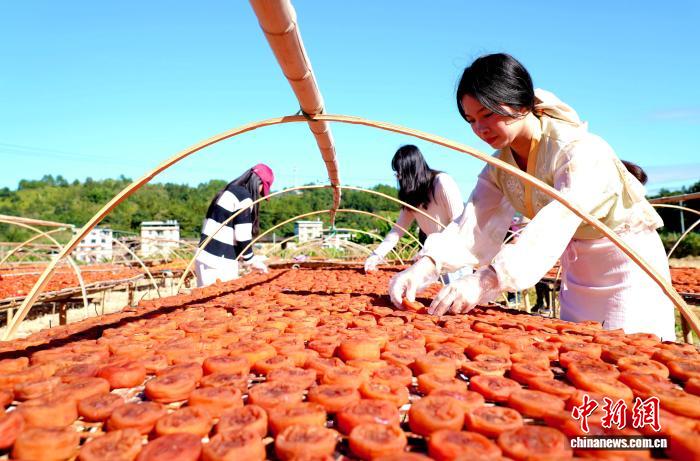
Core Viewpoint - The production of persimmons in Yongding District, Fujian Province, is thriving, contributing significantly to local economic development and rural revitalization through traditional craftsmanship and tourism integration [1][4]. Group 1: Production and Economic Impact - Yongding District is known as the "Hometown of Persimmons" in East China, with 68,000 acres of persimmon orchards producing over 60,000 tons annually, generating an output value exceeding 120 million yuan [4][7]. - The processing of persimmons into dried fruit involves a labor-intensive process where 4 kilograms of fresh persimmons yield 1 kilogram of dried persimmons, with local farmers reporting that their entire harvest of 300,000 kilograms has already been sold out [4][6]. - The income from persimmon-related industries in the village reached over 10 million yuan last year, tripling compared to 2022 [7]. Group 2: Cultural and Tourism Integration - The local community has successfully integrated persimmon production with Hakka culture and tourism, hosting events like the "Persimmon Harvest Festival" and "Persimmon Carnival" to attract visitors [4][5]. - Tourists can engage in hands-on experiences such as DIY persimmon drying and tasting traditional Hakka cuisine, enhancing the appeal of the region [4][7]. - The establishment of 20 farmhouses and 10 guesthouses in the village indicates a growing tourism sector, with persimmons becoming a popular souvenir for visitors [7].
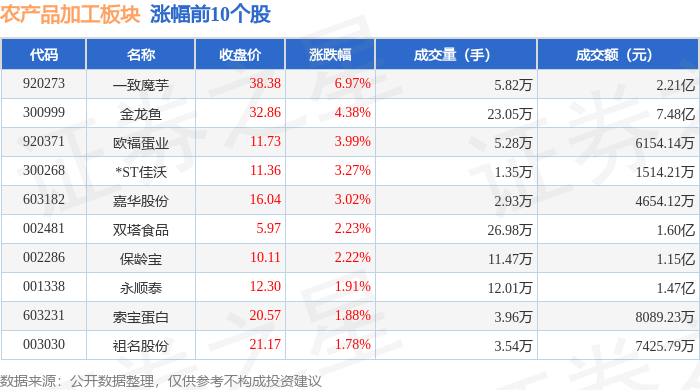
农产品加工板块11月10日涨1.05%,一致魔芋领涨,主力资金净流入3035.44万元
Zheng Xing Xing Ye Ri Bao· 2025-11-10 08:42
Group 1 - The agricultural processing sector increased by 1.05% on November 10, with Yichang Magic leading the gains [1] - The Shanghai Composite Index closed at 4018.6, up 0.53%, while the Shenzhen Component Index closed at 13427.61, up 0.18% [1] - Key stocks in the agricultural processing sector showed significant price increases, with Yichang Magic rising by 6.97% to a closing price of 38.38 [1] Group 2 - The agricultural processing sector saw a net inflow of 30.35 million yuan from main funds, while retail investors experienced a net outflow of 48.61 million yuan [2] - Major stocks like COFCO Sugar and Jinlongyu attracted significant main fund inflows of 59.89 million yuan and 36.12 million yuan, respectively [3] - Retail investors showed a negative trend in several stocks, with notable outflows from COFCO Sugar and Jinlongyu [3]



广东“三农”领域广大党员干部群众干劲倍增、信心满满推进乡村全面振兴 促进城乡融合发展
Nan Fang Ri Bao Wang Luo Ban· 2025-11-10 08:08
Group 1 - The core message emphasizes the importance of developing rural specialty industries as a foundation for comprehensive rural revitalization, with a focus on technology application and the integration of agriculture, culture, and tourism [1][5] - The "Hundred Counties, Thousand Towns, and Ten Thousand Villages High-Quality Development Project" (referred to as "Hundred Thousand Project") is being implemented to promote rural revitalization and enhance regional coordination and urban-rural integration [1][2] - The development of local agricultural products, such as the Meizhou pomelo, is highlighted as a key driver for increasing farmers' income, with the pomelo planting area in Meizhou expected to reach 649,500 acres in 2024, accounting for 90% of Guangdong's total and one-fifth of the national total [2][3] Group 2 - The integration of agriculture, culture, and tourism is seen as a vital strategy for stimulating rural vitality and promoting the realization of rural value [5][6] - The "Five Gold" model, which includes rent, salary, goods, shares, and creation, is being implemented in villages to broaden income channels for villagers, with an expected average annual income increase of over 24,000 yuan per household [6][7] - The development of modern rural industrial systems is being prioritized, with a focus on enhancing the value chain and increasing the added value of agricultural products [2][4] Group 3 - The emphasis on regional coordinated development and urban-rural integration is identified as a critical area for improving Guangdong's high-quality development [8][10] - The industrial transfer from the Pearl River Delta to the eastern, western, and northern regions of Guangdong is being facilitated to promote economic collaboration and enhance the resilience of the industrial supply chain [8][9] - The introduction of significant investment projects, such as the 18 projects with over 1 billion yuan in total investment in the Heshan Industrial City, is aimed at fostering new industries and contributing to regional development [9][10]
国富期货早间看点-20251110
Guo Fu Qi Huo· 2025-11-10 06:09
Report Industry Investment Rating - No information provided in the content Core Viewpoints - The report presents a comprehensive overview of the futures market, including overnight and spot prices, important fundamental information, macro news, fund flows, and arbitrage tracking. It covers various commodities such as soybeans, palm oil, and crude oil, as well as international and domestic economic and political events that may impact the market. Summary by Relevant Catalogs Overnight行情 - Overnight closing prices and percentage changes are reported for various futures contracts, including palm oil, Brent crude, and soybeans. Currency exchange rates and their percentage changes are also provided [1]. Spot行情 - Spot prices, basis, and basis changes for DCE palm oil, DCE豆油, and DCE豆粕 are presented for different regions [2]. Important Fundamental Information 产区天气 - Rain is expected in central and southern Brazil this week, which is beneficial for soybean crops. In Argentina, soybean sowing is expected to accelerate this month, but long - term weather may turn dry [5]. 国际供需 - Sabah in Malaysia is the biggest beneficiary of the oil palm replanting financing incentive plan, receiving 61 million Malaysian ringgit in grants. The US EPA will decide on small refineries' exemption applications. Brazilian soybean sowing progress and Canadian rapeseed export data are also reported [7][8]. 国内供需 - On November 7, the total trading volume of soybean oil and palm oil decreased. The trading volume of soybean meal increased, and the oil mill's operating rate decreased. China's soybean and edible vegetable oil import data are provided, along with pig - raising profits and agricultural product price indices [11][12]. Macro要闻 国际要闻 - The US Senate failed to pass a motion on a federal employee appropriation bill, and the government "shutdown" persists. US consumer confidence and inflation expectations are reported [15]. 国内要闻 - The US dollar/Chinese yuan exchange rate decreased, and the central bank conducted reverse repurchase operations with a net withdrawal of funds. China's CPI and foreign trade data are reported, and the import qualification of US soybean enterprises is restored [17][18]. 资金流向 - On November 7, 2025, the futures market had a net capital outflow of 1.017 billion yuan, with different flows in commodity, stock index, and bond futures [21]. 套利跟踪 - No specific information provided in the content