电子

Search documents
如何从一二级市场联动寻找产业债交易信号?(行业篇)
Soochow Securities· 2026-01-20 09:28
Report Industry Investment Rating No information provided in the content. Core Viewpoints - The secondary - market trends of industrial bond sub - industries show a divergence in the correlation between primary and secondary markets. This divergence may be due to differences in supply among industries and differences in bond liquidity and trading popularity within each industry. If an industry has many issuing entities with strong willingness and ability to issue bonds and is in a good development trend, the probability of a synchronous resonance relationship between primary - market supply and secondary - market demand is relatively high, which can improve the accuracy of judging trading signals of narrowing spreads from daily net financing [1][14]. - Most industries have trading signals transmitted from primary - market supply to secondary - market demand, including comprehensive, non - ferrous metals, and others. Some industries show a stronger negative correlation between primary - market supply and secondary - market demand, such as comprehensive and non - ferrous metals. Some industries have a weak correlation between daily net financing and daily spreads, including communication and food and beverage [2][4]. Summary by Directory 1. Industrial Bond Sub - industries Show Divergence in Primary - Secondary Market Trend Correlation - **Research Method**: Classify industrial bond issuers by Shenwan primary industries, calculate the daily net financing and daily credit spreads of each sub - industry from January 1, 2025, to December 19, 2025, to observe the correlation between primary - market supply and secondary - market demand [12]. - **Divergence Performance**: Most industries have trading signals transmitted from primary - market supply to secondary - market demand, while some do not show this feature significantly [13]. - **Reasons for Divergence**: Differences in supply among industries are related to the number, size, and life - cycle stage of issuing entities. Differences in bond liquidity and trading popularity within industries are related to the scale of outstanding bonds, valuation levels, and event catalysts [14]. 1.1. Industries with Obvious Correlation - **Comprehensive Industry**: From January to March 2025, daily net financing decreased and daily spreads increased; from March to June, daily net financing increased and daily spreads decreased; from June to December, both were in a low - level oscillation [21]. - **Non - ferrous Metals Industry**: From January to July 2025, daily net financing increased and daily spreads decreased; from July to September, daily net financing decreased and daily spreads increased; from October to December, both were in a low - level oscillation [25]. - **Other Industries**: Similar analysis is conducted for industries such as pharmaceutical biology, social services, and others, with different trends in different time intervals [27][30][32]. - **Common Features**: These industries generally have a large scale of outstanding bonds and high institutional investor attention, which is conducive to the transmission of primary - market supply changes to secondary - market spread changes [3][87]. 1.2. Industries with General Correlation - **Industries Included**: Communication, food and beverage, and other industries have a weak correlation between daily net financing and daily spreads, and the linkage and transmission between primary - and secondary - market indicators are relatively weak [4][13]. - **Reasons**: These industries have low participation in the bond market, and their secondary - market trading demand is more affected by overall bond - market trends, industry risk premiums, and liquidity premiums. Different types of industries have specific reasons for the weak correlation [4][90][91].
两市主力资金净流出957.23亿元,电力设备行业净流出居首
Zheng Quan Shi Bao Wang· 2026-01-20 09:20
Market Overview - On January 20, the Shanghai Composite Index fell by 0.01%, the Shenzhen Component Index decreased by 0.97%, the ChiNext Index dropped by 1.79%, and the CSI 300 Index declined by 0.33% [1] - Among the tradable A-shares, 2,233 stocks rose, accounting for 40.85%, while 3,102 stocks fell [1] Capital Flow - The main capital experienced a net outflow of 95.723 billion yuan, marking the 11th consecutive trading day of net outflows [1] - The ChiNext saw a net outflow of 36.169 billion yuan, the Sci-Tech Innovation Board had a net outflow of 10.781 billion yuan, and the CSI 300 constituents experienced a net outflow of 24.880 billion yuan [1] Industry Performance - Among the 11 primary industries, 20 sectors saw gains, with the top performers being Oil & Petrochemicals and Building Materials, which rose by 1.74% and 1.71%, respectively [1] - The sectors with the largest declines included Communication and National Defense & Military Industry, which fell by 3.23% and 2.87%, respectively [1] Industry Capital Inflows - The Banking sector led with a net inflow of 1.472 billion yuan and a daily increase of 0.80%, followed by the Real Estate sector with a net inflow of 0.627 billion yuan and a daily increase of 1.55% [1] - The Electric Power Equipment sector had the largest net outflow of 19.054 billion yuan, with a daily decline of 1.84%, followed by the Electronics sector with a net outflow of 18.394 billion yuan and a decline of 1.23% [2] Individual Stock Performance - A total of 1,686 stocks experienced net inflows, with 693 stocks having inflows exceeding 10 million yuan, and 109 stocks with inflows over 100 million yuan [3] - Shanghai Electric saw the highest net inflow of 0.858 billion yuan, with a daily increase of 8.13%, followed by China Power Construction and Shanzhi Gaoke with net inflows of 0.644 billion yuan and 0.522 billion yuan, respectively [3] - The stocks with the largest net outflows included Xinyi Sheng, Zhongji Xuchuang, and Shenghong Technology, with outflows of 2.137 billion yuan, 2.068 billion yuan, and 1.858 billion yuan, respectively [3]
——上市公司重大资产重组、股权激励计划月度跟踪(2025年12月):系列政策协同加持,并购重组和股权激励有望激发市场活力-20260120
Shenwan Hongyuan Securities· 2026-01-20 08:59
Core Insights - The report highlights a series of policy initiatives aimed at enhancing mergers and acquisitions (M&A) and equity incentive plans, which are expected to invigorate market activity and improve resource allocation in the A-share market [1][6][10] - The report indicates that in December 2025, there were 12 major asset restructuring plans announced, predominantly in the machinery and equipment sector, with a significant number of these plans still in the board proposal stage [10][22] - The report emphasizes the importance of equity incentive plans, noting that 91% of the plans initiated in 2025 have begun implementation, with a focus on the electronics and machinery sectors [27][32] Mergers and Acquisitions Overview - In 2025, a total of 134 major asset restructuring cases were disclosed, with the electronics industry leading the count [6][10] - The December 2025 restructuring cases included significant transactions such as Minmetals Development's acquisition of 100% stakes in Minmetals Mining and Luzhong Mining, aimed at enhancing profitability through the integration of high-margin mineral resources [22][24] - Another notable case involved Mingde Biological's cash acquisition of 100% of Wuhan Bikaier, which aims to create a comprehensive "diagnosis-protection-treatment" ecosystem [23][24] Equity Incentive Plans Overview - In December 2025, 39 new equity incentive plans were announced, with the majority concentrated in the electronics and machinery sectors, and most plans representing 1% to 2% of the total share capital [32][39] - The report notes that the majority of equity incentive plans have been implemented, with a small percentage still pending approval from shareholders [27][30] - The report provides a list of noteworthy companies involved in equity incentive plans, including ShenNan Circuit and Baosteel, highlighting their respective market capitalizations and the proportion of shares involved in the incentive plans [39]




A股尾盘,多股逆势拉升封板!6股获巨额资金抢筹!
Xin Lang Cai Jing· 2026-01-20 08:47
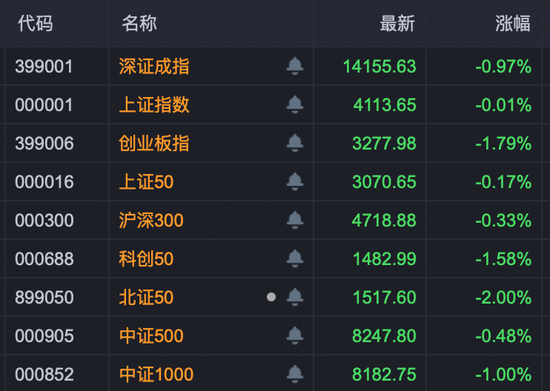
Market Overview - The A-share market experienced fluctuations with the Shanghai Composite Index barely holding above 4100 points, while the ChiNext Index fell below 3300 points. Major indices like the Shenzhen Component, CSI 300, and CSI 500 closed with small bearish candles, and the market turnover reached 2.8 trillion yuan [1][11]. Index Performance - The latest index performances are as follows: - Shenzhen Component: 14155.63 (-0.97%) - Shanghai Composite: 4113.65 (-0.01%) - ChiNext Index: 3277.98 (-1.79%) - CSI 300: 4718.88 (-0.33%) - CSI 500: 8247.80 (-0.48%) [2][12]. Sector Performance - The chemical, precious metals, real estate, and aviation sectors showed the highest gains, while aerospace equipment, photovoltaic equipment, communication devices, and glass fiber sectors faced the largest declines [2][12]. Fund Flow Analysis - The public utilities sector saw a net inflow of over 3.7 billion yuan, while the construction and decoration sector received over 3.6 billion yuan. Real estate, banking, basic chemicals, and building materials also attracted over 2 billion yuan each. In contrast, sectors like electronics, power equipment, and defense saw net outflows exceeding 10 billion yuan [3][13]. Notable Stocks - Key stocks with significant net inflows include: - China Xidian: 15.63 yuan (+8.84%) with a net inflow of 1.56 billion yuan - Shanzhi High-Tech: 5.42 yuan (+6.69%) with a net inflow of 1.42 billion yuan - Zhejiang Wenhu: 9.97 yuan (+10.04%) with a net inflow of 1.32 billion yuan [4][14]. Future Market Outlook - Yingda Securities suggests that the market is in a cooling phase, with the Shanghai Composite Index fluctuating around the 4100-point mark. This does not indicate a deep correction but rather a healthy consolidation after rapid gains. Investors are advised to take profits on overbought stocks while looking for value opportunities in underperforming sectors [5][15]. Long-term Projections - Zhongyin International forecasts that by 2026, the core broad-based index of the Chinese stock market could see an overall increase of over 40%, driven by nearly 20% profit growth and 20% valuation expansion. Key sectors expected to lead include technology manufacturing, biomedicine, and defense, while sectors like telecommunications and real estate may have potential for catch-up gains [5][15]. Precious Metals Market - The precious metals sector saw significant activity, with gold prices reaching a historical high of over 4700 USD per ounce. Domestic gold futures also surged, reflecting strong demand amid ongoing global economic uncertainties [6][16]. Chemical Industry Trends - The chemical sector is experiencing a global price surge, with major companies like BASF and Dow Chemical implementing price increases across various regions. Recent data indicates that 11 out of 16 monitored chemical products have seen price increases, with synthetic rubber rising by 11.7% [8][19]. Structural Investment Opportunities - Galaxy Securities highlights that new demand drivers are expected to accelerate a cyclical reversal in the chemical industry, suggesting a focus on structural investment opportunities as supply constraints emerge [20].

电子行业今日跌1.23%,主力资金净流出183.94亿元
Zheng Quan Shi Bao Wang· 2026-01-20 08:43
Market Overview - The Shanghai Composite Index fell by 0.01% on January 20, with 20 industries rising, led by the oil and petrochemical sector with a gain of 1.74% and construction materials at 1.71% [1] - The telecommunications and defense industries experienced the largest declines, down 3.23% and 2.87% respectively [1] - The electronic industry also saw a decrease of 1.23% [1] Capital Flow Analysis - The main capital outflow from the two markets totaled 95.723 billion yuan, with 11 industries experiencing net inflows [1] - The banking sector led the net inflow with 1.472 billion yuan, resulting in a 0.80% increase, followed by the real estate sector with a 1.55% rise and a net inflow of 627 million yuan [1] - The power equipment industry had the highest net outflow, totaling 19.054 billion yuan, followed by the electronic industry with an outflow of 18.394 billion yuan [1] Electronic Industry Performance - The electronic industry saw a decline of 1.23%, with a total net outflow of 18.394 billion yuan [2] - Out of 476 stocks in the electronic sector, 160 stocks rose, 5 hit the daily limit up, while 314 stocks fell, with 1 hitting the daily limit down [2] - Notable inflows included Tongfu Microelectronics with a net inflow of 431 million yuan, followed by Lanke Technology and Wolong Nuclear Materials with inflows of 345 million yuan and 332 million yuan respectively [2] Top Gainers in Electronic Industry - The top gainers in the electronic sector included: - Tongfu Microelectronics: +5.85%, turnover rate 13.22%, net inflow 431.18 million yuan - Lanke Technology: +2.95%, turnover rate 5.44%, net inflow 345.32 million yuan - Wolong Nuclear Materials: +3.13%, turnover rate 15.24%, net inflow 332.48 million yuan [2] Top Losers in Electronic Industry - The top losers in the electronic sector included: - Shenghong Technology: -5.07%, net outflow -1.858 billion yuan - Cambricon Technologies: -5.40%, net outflow -1.703 billion yuan - Industrial Fulian: -2.02%, net outflow -1.021 billion yuan [3]



一揽子政策公布后,财政部重磅定调:2026年财政总体支出力度“只增不减”
Hua Xia Shi Bao· 2026-01-20 08:39
Core Viewpoint - The Chinese government is implementing a series of proactive fiscal policies aimed at promoting high-quality economic and social development, with a focus on increasing overall fiscal expenditure and optimizing its structure for better efficiency and stronger economic momentum [2][14]. Fiscal Policy and Expenditure - In 2026, the overall fiscal expenditure will continue to increase, ensuring that the fiscal deficit, total debt scale, and expenditure remain at necessary levels, with a commitment to "only increase, not decrease" [2][14]. - The fiscal deficit rate for 2025 is set at around 4%, an increase of one percentage point from the previous year, with new government debt reaching 11.86 trillion yuan, up by 2.9 trillion yuan from the previous year [3][4]. Debt Management - The government maintains a relatively low debt-to-GDP ratio compared to the average of G20 countries, despite increasing deficits and debt issuance [4]. - In 2025, measures will be taken to replace 2 trillion yuan of hidden debt and allocate 800 billion yuan in new special bonds to support local government finances, thereby reducing the average interest cost of local debts by over 2.5 percentage points [6][7]. Support for Consumption and Investment - A special long-term government bond issuance of 1.3 trillion yuan in 2025 will support consumption and promote the sale of green, low-carbon, and intelligent products, with an expected sales boost of approximately 2.6 trillion yuan [5]. - Policies will be introduced to stimulate consumption through personal consumption loans and support for new consumption models, as well as adjustments to tax refund policies for duty-free shops [5]. Support for SMEs and Innovation - A new loan interest subsidy policy for small and micro enterprises will focus on 14 key industrial chains, including new energy, automotive, and medical equipment [8][9]. - The government will provide risk-sharing funds to support bond issuance for private enterprises and private equity investment institutions, mitigating investor losses [10]. Pension and Social Security - In 2025, the central government will allocate approximately 1.2 trillion yuan for basic pension insurance subsidies, with a 2% increase in pension levels for retirees [11]. Tax System and Market Development - The government aims to improve the local tax system to support the construction of a unified national market, including clarifying fiscal responsibilities and enhancing tax regulations [12]. Technological Innovation and Investment - The government will support the National Venture Capital Guidance Fund to invest in early-stage, small, long-term, and hard technology projects, promoting innovation in key industries [19]. - Financial support will be provided for technology innovation loans, with the central bank offering re-loan support to facilitate the transformation of manufacturing and digitalization of SMEs [20][21]. Export Tax Policy Changes - The cancellation of export tax rebates for solar and electronic products starting April 1, 2026, is expected to promote efficient resource utilization and address "involution" in competition [17].
广东外贸韧性突围:连续领跑40年,高技术产品出口破万亿元
2 1 Shi Ji Jing Ji Bao Dao· 2026-01-20 08:28
Core Insights - Guangdong's foreign trade is projected to reach 9.49 trillion yuan in 2025, marking a 4.4% year-on-year growth, maintaining its position as the largest in the country for 40 consecutive years, contributing 24.1% to national foreign trade growth [1][2] Group 1: Trade Performance - In 2025, Guangdong's exports are expected to be 6.03 trillion yuan, growing by 2.5%, while imports are projected at 3.46 trillion yuan, increasing by 7.8% [1] - The province's foreign trade showed resilience, with quarterly import and export values rising, achieving historical highs [1] - High-tech product exports surpassed 1 trillion yuan for the first time, growing by 15%, indicating a shift towards more innovative products [6] Group 2: Market Structure and Diversification - Guangdong is diversifying its trade markets, with imports and exports to ASEAN, Hong Kong, and the EU each exceeding 1 trillion yuan, reflecting growth rates of 5.8%, 12.5%, and 8.4% respectively [3] - Emerging markets such as Central Asia, Africa, and the Middle East are becoming new engines for trade growth, with trade with Belt and Road countries reaching 3.66 trillion yuan, a 5% increase [3] Group 3: Product Structure Optimization - The export of mechanical and electrical products reached 4.15 trillion yuan, accounting for 68.7% of total exports, showcasing the strength of the electronic industry cluster [4] - Notable growth in exports of drones (40.9%), 3D printers (37.1%), and electric vehicles (21.3%) highlights the trend towards high-end, intelligent, and green products [4] Group 4: New Trade Models and Platforms - The bonded logistics sector saw a 9.1% increase in trade, reaching 1.93 trillion yuan, with its share of total trade surpassing 20% for the first time [4] - Cross-border e-commerce exports grew by 9.8 times, driven by favorable policies for overseas warehouses [4] Group 5: Industrial Strength and Resilience - Guangdong's high-tech product exports are led by key products such as lithium batteries and medical devices, with a total export value of 1.14 trillion yuan, growing by 15% [6] - The province's manufacturing system is characterized by specialization and rapid market response, enhancing product value and competitiveness [7] Group 6: Role of Private Enterprises - The number of enterprises engaged in import and export activities in Guangdong reached 172,000, a 17.6% increase, with private enterprises accounting for 63.9% of the province's total foreign trade [7][8] - Private enterprises are noted for their adaptability and responsiveness to market changes, contributing significantly to the resilience of Guangdong's foreign trade [8]
长城基金:市场震荡上行趋势有望延续
Xin Lang Cai Jing· 2026-01-20 08:00
Core Insights - The A-share market has seen a significant increase in financing transaction activity, with the financing balance reaching 2.68 trillion yuan, a new historical record, and financing transaction volume accounting for 11.3% of total market transactions as of January 14 [1][4]. Financing Margin Adjustment - On January 14, the Shanghai and Shenzhen Stock Exchanges announced an adjustment to the financing margin ratio, increasing the minimum margin requirement for investors from 80% to 100% when buying securities on margin [1][4]. - This adjustment is a key tool for regulatory authorities to conduct counter-cyclical adjustments, aimed at preventing excessive accumulation of systemic risks [2][5]. - Historical adjustments include a previous increase from 50% to 100% in November 2015 to curb rapid financing growth and a decrease from 100% to 80% in August 2023 to enhance market liquidity [1][2][4]. Impact on Market Dynamics - The core objective of raising the margin requirement is to maintain stable capital market operations and prevent excessive concentration of leveraged trading risks, reducing the leverage from 1.25 times to 1 time for new financing contracts [2][5]. - The policy will only apply to new financing contracts, while existing contracts will continue under the previous rules, reflecting a cautious regulatory approach to mitigate market impact and systemic risks [2][5]. Market Outlook - Short-term regulatory measures may not alter the upward trend of the market, with underlying support for continued market growth expected amidst fluctuations [2][5]. - Investment focus should be on policy initiatives and industry prosperity, particularly in technology growth sectors such as semiconductors, internet, electronics, media, and computing, as well as globally competitive sectors like power and machinery [2][5]. - Non-bank financial sectors are likely to benefit from increased demand for wealth management and capital market reforms, while cyclical sectors like tourism, hospitality, and consumer goods may present marginal improvement opportunities due to expanding domestic demand policies [2][5].
今日62只个股涨停 主要集中在化工、电力设备等行业
Zheng Quan Shi Bao Wang· 2026-01-20 07:49
Group 1 - On January 20, in the Shanghai and Shenzhen stock markets, there were 2,139 stocks that rose, 2,918 stocks that fell, and 122 stocks that remained flat [1] - Excluding newly listed stocks on that day, there were 62 stocks that hit the upper limit and 24 stocks that hit the lower limit [1] - The industries with the most stocks hitting the upper limit included chemicals, electrical equipment, electronics, real estate, and non-ferrous metals [1]
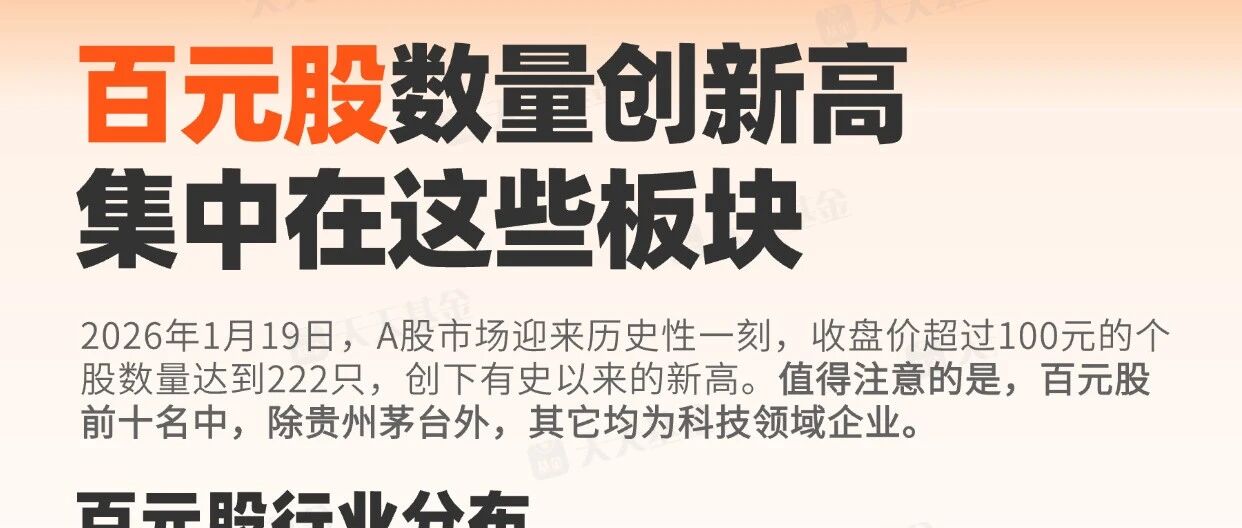
百元股数量创新高,集中在这些板块
天天基金网· 2026-01-20 07:07
Core Viewpoint - The A-share market has reached a historic milestone with the number of stocks closing above 100 yuan reaching 222, marking a new high in history, predominantly driven by technology companies, except for Kweichow Moutai [1][6]. Group 1: Distribution of Hundred Yuan Stocks - The electronic industry leads with 79 stocks, accounting for 35.59% of the total hundred yuan stocks. The machinery equipment industry has 26 stocks (11.71%), and the computer industry has 24 stocks (10.81%) [6]. Group 2: Top Ten Hundred Yuan Stocks - The top three stocks are: 1. Cambricon (寒武纪-U) with a closing price of 1419.66 yuan and a 2025 increase of 106.01% [3]. 2. Kweichow Moutai (贵州茅台) at 1376.00 yuan with a decrease of 6.29% [3]. 3. Source Code Technology (源杰科技) at 748.29 yuan with a remarkable increase of 379.34% [4]. Group 3: Market Trends and Future Outlook - The overall rise in the A-share market has led to a significant increase in the average stock price level, with the number of hundred yuan stocks surpassing 200 as of January 19, 2026 [6]. - Experts predict that the hundred yuan stock group will continue to expand due to ongoing trends in the technology industry and sustained inflow of long-term capital, although structural differentiation is expected to become more pronounced [6].