公用事业

Search documents
上证创十年新高,牛回速归还是落袋为安?| 周度量化观察
申万宏源证券上海北京西路营业部· 2025-08-25 02:44
Market Overview - A-shares continue to reach new highs this week, with daily average trading volume exceeding 20 trillion yuan for two consecutive weeks, reflecting strong market sentiment [2][10] - The bond market experienced a decline, with both interest rate bonds and credit bonds weakening, indicating a potential negative return for pure bond funds [2][29] - Gold prices remain under pressure due to the Federal Reserve's stance on interest rates and positive geopolitical developments, leading to reduced safe-haven demand [3][36] Stock Market Performance - The A-share market's rise is primarily driven by capital inflow and industry catalysts, with significant structural opportunities present [5][10] - Major indices such as the CSI 500 and CSI 300 saw substantial weekly gains, with the STAR 50 index increasing over 10% [10][11] - The trading volume for the two markets increased by 22.62% week-on-week, with the CSI 300 and CSI 500 seeing higher trading volume proportions [12][13] Bond Market Insights - The bond market is expected to remain volatile in the short term, with a focus on coupon strategies as the market dynamics shift [6][29] - The interbank funding environment has tightened, while exchange funding has loosened, contributing to the overall weakness in the bond market [29][30] Commodity Market Analysis - The Nanhua Commodity Index fell by 0.44% this week, with declines in various sectors including black and non-ferrous commodities [36][38] - Gold prices decreased by 0.23%, while crude oil prices increased by 0.81%, indicating mixed trends in the commodity market [38] Industry Performance - In the industry sector, telecommunications, electronics, and comprehensive sectors showed strong performance with weekly gains of 10.84%, 8.95%, and 8.25% respectively [19][21] - The real estate and coal sectors lagged behind, reflecting a divergence in sector performance [19][21]


基金研究周报:全球大类资产“东升西落”
Wind万得· 2025-08-24 23:09
Market Overview - The A-share market performed strongly from August 18 to August 22, with major indices generally rising. The ChiNext 50 Index surged by 6.31%, and the Sci-Tech 50 Index increased by over 13%, indicating a focus on growth stocks in this market rally [2][4] - The Shanghai Composite Index rose by 3.49%, closing above 3800 points, while the Shenzhen Index and ChiNext Index increased by 4.57% and 5.85%, respectively [2][4] Industry Performance - The average increase of Wind's first-level industry indices was over 3%, with the information technology sector leading at 8.68%. Other sectors such as telecommunications, consumer discretionary, industrials, and materials also performed well [12][14] - All sectors recorded positive returns, with telecommunications, electronics, and comprehensive sectors showing strong performance, increasing by 10.84%, 8.95%, and 8.25%, respectively. Conversely, the pharmaceutical, coal, and real estate sectors lagged behind with increases of 1.05%, 0.92%, and 0.50% [2][12] Fund Issuance and Performance - A total of 38 funds were issued last week, including 26 equity funds, 6 mixed funds, 5 bond funds, and 1 QDII fund, with a total issuance of 23.314 billion units [2][19] - The Wind All Fund Index rose by 1.98%, with the ordinary equity fund index increasing by 3.60% and the mixed equity fund index rising by 3.52% [8][19] Global Asset Review - Global asset performance showed a "rise in the East and fall in the West." U.S. indices rebounded strongly after a dovish speech by Fed Chair Powell, while European markets displayed mixed results due to economic slowdown concerns [4][5] - The Hang Seng Tech Index rose due to policy support from China and inflows of southbound capital [4] Bond Market Review - The bond market saw a decline in 30-year and 10-year government bond futures, indicating a significant "stock-bond seesaw" effect, reflecting high sensitivity of investors to long-term interest rates [15][16]

大众公用获融资买入0.17亿元,近三日累计买入0.52亿元
Jin Rong Jie· 2025-08-23 00:21
Group 1 - On August 22, the financing buy-in amount for Dazhong Public Utility was 0.17 billion, ranking 1211th in the two markets [1] - The financing repayment amount on the same day was 0.20 billion, resulting in a net sell of 3.18 million [1] - Over the last three trading days (August 20-22), Dazhong Public Utility received financing buy-ins of 0.21 billion, 0.14 billion, and 0.17 billion respectively [1] Group 2 - On the same day, the short selling amounted to 21,700 shares, with a net sell of 21,700 shares [1]

南京公用2025年中报简析:营收净利润同比双双增长,盈利能力上升
Zheng Quan Zhi Xing· 2025-08-22 22:42
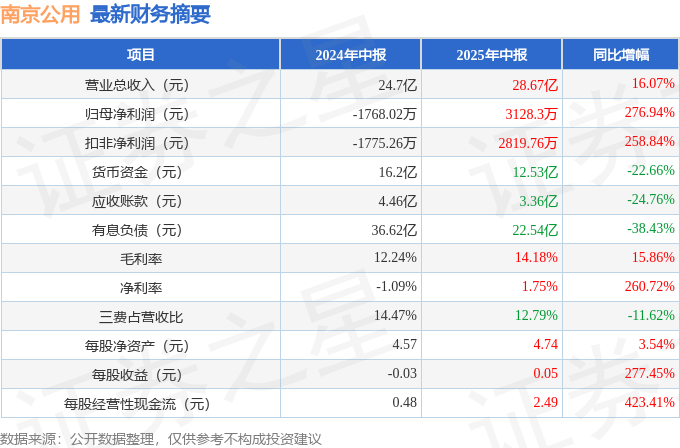
Core Viewpoint - Nanjing Public Utility (000421) reported a significant increase in revenue and net profit for the first half of 2025, indicating improved profitability and operational efficiency compared to the previous year [1][2]. Financial Performance - Total revenue reached 2.867 billion yuan, a year-on-year increase of 16.07% [1][2]. - Net profit attributable to shareholders was 31.283 million yuan, up 276.94% from the previous year [1][2]. - Gross margin improved to 14.18%, reflecting a 15.86% increase year-on-year [1]. - Net margin turned positive at 1.75%, a significant increase of 260.72% compared to the previous year [1]. Cost and Expenses - Operating costs increased by 13.5%, attributed to a higher volume of property projects delivered [3]. - Total selling, administrative, and financial expenses amounted to 367 million yuan, accounting for 12.79% of revenue, down 11.62% year-on-year [1][4]. Cash Flow and Assets - Operating cash flow per share surged to 2.49 yuan, a remarkable increase of 423.41% year-on-year [1]. - The company reported a decrease in cash and cash equivalents, with a net decrease of 128.69%, due to reduced bank loan withdrawals and increased loan repayments [6]. Liabilities and Financial Health - Interest-bearing liabilities decreased by 38.43% to 2.254 billion yuan, reflecting the company's efforts to reduce debt [1][4]. - The company's return on invested capital (ROIC) was 2.18%, indicating weak capital returns historically [6]. Business Model and Market Position - The company's performance is primarily driven by marketing efforts, necessitating a deeper analysis of the underlying factors [6]. - The historical financial performance shows a mixed track record, with two years of losses since its listing, suggesting a fragile business model [6].

长江基建集团(01038):2025年上半年业绩符合预期,股息增长节奏保持稳定
Haitong Securities International· 2025-08-22 15:23
Investment Rating - The report maintains an "Outperform" rating for CK Infrastructure Holdings [2][11]. Core Views - The performance in the first half of 2025 was in line with expectations, with a net profit attributable to shareholders of HK$4.348 billion, reflecting a 1% year-on-year increase. The company declared an interim dividend of HK$0.73 per share, a 1.4% increase from the previous year [3][9]. - The UK portfolio showed strong performance, contributing HK$2.223 billion, a 19% year-on-year increase, driven by various operational strengths. In contrast, the Australian and Canadian sectors underperformed [4][10]. - The company is undergoing a dynamic portfolio rebalancing, including the sale of UK Rails, which is expected to significantly reduce its net debt ratio [5][11]. Summary by Sections Financial Performance - For the first half of 2025, CK Infrastructure achieved a net profit of HK$4.348 billion, with cash on hand at HK$4.7 billion and a net debt to net total capital ratio of 10.6% [3][9]. - Revenue projections for 2025-2027 are estimated at HK$7.665 billion, HK$7.733 billion, and HK$7.683 billion respectively, with net profits expected to be HK$9.332 billion, HK$9.580 billion, and HK$9.688 billion [2][8]. Regional Performance - The UK infrastructure portfolio's contribution was HK$2.223 billion, up 19% year-on-year, while the Australian portfolio contributed HK$793 million, down 8% year-on-year [4][10]. - The Canadian portfolio contributed HK$275 million, a decrease of 9% year-on-year, primarily due to lower generation and prices [10]. Investment Strategy - The company plans to continue advancing various investment projects, including smart grids and renewable energy integration, while the sale of UK Rails is expected to enhance financial flexibility [5][11]. - The target price is maintained at HK$61.37, reflecting a positive outlook for the company's future performance [2][11].

情绪与估值8月第3期:沪深300成交额环比放大,消费风格PE估值分位领涨
Yong Xing Zheng Quan· 2025-08-22 13:09
Group 1 - The A-share market experienced an increase in margin trading balance and turnover rate, with a significant rise in transaction volume, particularly in the CSI 300 index, which saw a week-on-week increase of 45.82% [2][19][12] - The PE valuation percentiles for major indices increased, with the Shenzhen Component Index leading with a rise of 4.61 percentage points, followed closely by the ChiNext Index with an increase of 4.57 percentage points [23][27][32] - The consumer style led the increase in PE valuation percentiles, rising by 1.60 percentage points, while the financial style also saw a notable increase of 1.55 percentage points [35][38][39] Group 2 - The industry PE valuation percentiles showed a mixed trend, with utilities leading the increase at 3.9 percentage points, while the building materials sector experienced a decline of 1.2 percentage points [53][54] - The overall market sentiment indicated a high investment cost-effectiveness in the A-share market, with the current stock-bond yield spread at -0.90%, which is above the average since the beginning of 2025 [13][16] - The financing buy-in amount accounted for 12.45% of the total A-share transaction volume, reflecting an increase of 0.69 percentage points from the previous week [16][19][10]
中观高频景气图谱(2025.8):上游资源行业景气提振
Guoxin Securities· 2025-08-22 08:57
Group 1 - The report indicates that as of mid-August, the upstream resource industry is experiencing an upward trend in prosperity, while the midstream manufacturing sector shows a mixed performance, with sectors like non-ferrous metals, coal, basic chemicals, and oil and petrochemicals improving continuously [4] - In the downstream consumption sector, there is a divergence in performance; the social services and home appliance industries are on the rise, while the commercial retail sector is declining. In essential consumption, the agriculture, forestry, animal husbandry, fishery, food and beverage, and textile and apparel industries are generally experiencing a downturn [4] - Supportive service industries and the financial sector are overall declining, with the environmental protection industry within supportive services also showing a downturn. However, the banking sector is improving, and the non-bank financial sector is on the rise, while the computer sector within the TMT industry is declining [4] Group 2 - The report tracks excess returns in various industries, including basic chemicals, steel, non-ferrous metals, coal, oil and petrochemicals, and construction materials, providing correlation data with high-frequency indicators [5][10][17][31][36][39][46][77] - The basic chemicals industry shows a strong correlation with various commodity prices, indicating potential investment opportunities based on price movements [6][9][17] - The steel industry is closely linked to production and inventory metrics, suggesting that monitoring these indicators can provide insights into future performance [10][12][14] Group 3 - The report highlights the importance of tracking excess returns in the automotive industry, with indicators such as daily sales and production rates being critical for understanding market dynamics [48][50] - The machinery equipment sector's performance is analyzed through various price indices, indicating a need for investors to pay attention to these metrics for better investment decisions [55][58] - The report also emphasizes the significance of high-frequency indicators in the transportation sector, which can provide insights into overall economic activity and sector performance [60][62] Group 4 - The agricultural sector's excess returns are tracked against food product price indices, indicating a strong relationship between agricultural prices and overall sector performance [96][98] - The report discusses the food and beverage industry's performance in relation to various price indices, suggesting that monitoring these can help identify investment opportunities [98][99] - The pharmaceutical and biotechnology sectors are analyzed with respect to traditional Chinese medicine price indices, highlighting the importance of these metrics in understanding market trends [101][106] Group 5 - The public utilities sector's performance is linked to coal consumption metrics, indicating that energy prices and consumption patterns are critical for assessing sector health [111][114] - The real estate sector's excess returns are correlated with metrics such as transaction volumes and land prices, suggesting that these indicators are vital for understanding market conditions [115][121] - The report also examines the computer industry, focusing on the relationship between excess returns and pricing trends in electronic components, which can inform investment strategies [124][127]
半日主力资金丨加仓电子、计算机板块 抛售银行板块
Xin Lang Cai Jing· 2025-08-22 03:48
Group 1 - Main capital inflow was observed in the electronic, computer, and non-bank financial sectors, while outflows were noted in the banking, public utilities, and pharmaceutical sectors [1] - Specific stocks with significant inflows include Zhongke Shuguang, SMIC, and Northern Rare Earth, attracting net inflows of 4.529 billion, 3.295 billion, and 2.601 billion respectively [1] - Stocks experiencing notable outflows include Hanyu Pharmaceutical, Agricultural Bank, and Ping An Bank, facing sell-offs of 312 million, 287 million, and 280 million respectively [1]





港股新消费概念走强,机构称当前或已来到港股大众消费品补涨窗口,聚焦港股消费ETF(513230)布局机遇
Mei Ri Jing Ji Xin Wen· 2025-08-22 02:37
Group 1 - The Hong Kong stock market opened higher on August 22, with the Hang Seng Index rising by 0.4%, the Hang Seng China Enterprises Index increasing by 0.56%, and the Hang Seng Tech Index up by 0.99% [1] - New consumption concepts in the Hong Kong stock market showed strength, with Miniso Group rising over 13% post-earnings, and other stocks like Xiaomi Group, Gu Ming, and Mixue Group also experiencing gains [1] - The Hong Kong Consumption ETF (513230) saw a nearly 1% increase during early trading, reflecting positive market sentiment [1] Group 2 - Zheshang International maintains a cautiously optimistic outlook for the short to medium-term performance of the Hong Kong stock market, favoring sectors that are relatively prosperous and benefit from policy support, such as automotive, new consumption, innovative pharmaceuticals, and technology [1] - Shenwan Hongyuan Securities expresses continued confidence in the Hong Kong stock market as a potential leader in a bull market, noting that as the "bull market atmosphere" strengthens, investors will be more active in sector rotation within the Hong Kong market [1] - The Hong Kong Consumption ETF (513230) tracks the CSI Hong Kong Stock Connect Consumption Theme Index, encompassing leading companies in internet e-commerce and new consumption, including Pop Mart, Laopu Gold, Mixue Group, and Miniso, as well as tech giants like Tencent, Kuaishou, Alibaba, and Xiaomi, highlighting its strong tech and consumption attributes [1]




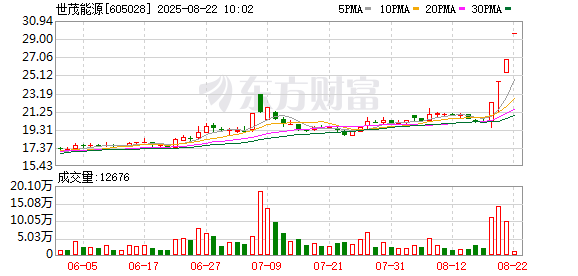
世茂能源涨10.01%,股价创历史新高
Zheng Quan Shi Bao Wang· 2025-08-22 02:02
证券时报·数据宝统计显示,世茂能源所属的公用事业行业,目前整体跌幅为0.11%,行业内,目前股价 上涨的有32只,涨幅居前的有世茂能源、华光环能、芯能科技等,涨幅分别为10.01%、7.81%、 4.40%。股价下跌的有78只,跌幅居前的有云南能投、华银电力、韶能股份等,跌幅分别为3.72%、 2.71%、2.63%。 公司发布的一季报数据显示,一季度公司共实现营业收入7727.25万元,同比下降16.14%,实现净利润 3342.38万元,同比下降3.42%,基本每股收益为0.2100元,加权平均净资产收益率2.52%。(数据宝) 注:本文系新闻报道,不构成投资建议,股市有风险,投资需谨慎。 (文章来源:证券时报网) 世茂能源股价创出历史新高,截至9:32,该股上涨10.01%,股价报29.55元,成交量108.17万股,成交金 额3196.42万元,换手率0.68%,该股最新A股总市值达47.28亿元,该股A股流通市值47.28亿元。 ...