
房地产

Search documents
股市面面观丨1123家上市公司发布2025年业绩预告 哪些赛道公司“最赚钱”?
Zhong Guo Jin Rong Xin Xi Wang· 2026-01-27 03:49
Group 1 - A total of 1123 A-share listed companies have released their 2025 performance forecasts, with 602 companies expecting profits and 521 companies anticipating losses [1][2] - Among the companies predicting profits, Zijin Mining leads with a forecasted net profit of 52 billion yuan, followed by Luoyang Molybdenum with 20.8 billion yuan [2][3] - The automotive sector, represented by SAIC Motor, is expected to see a significant profit increase of 438%-558%, the highest growth rate among the top ten profit forecast companies [2][3] Group 2 - The real estate sector dominates the list of companies forecasting significant losses, with China Fortune Land Development expected to lose between 16 billion and 24 billion yuan [3][4] - Other sectors facing losses include the photovoltaic industry, with Tongwei Co., TCL Zhonghuan, and Trina Solar among the top ten companies predicting losses [4][5] - JinkoSolar is projected to experience the largest decline in net profit, with a decrease of 6063.96%-7074.8% due to price fluctuations in the global photovoltaic industry [9][10] Group 3 - Companies like *ST Weir and Tonghua Dongbao are expected to see substantial profit growth, with *ST Weir forecasting a net profit increase of 8303.8%-9599.14% [6][8] - Approximately 260 companies are expected to have a net profit growth rate exceeding 100%, accounting for about one-fifth of the companies that have released forecasts [7][8] - The performance of companies in the photovoltaic sector is under pressure due to market conditions, impacting their profitability despite efforts to innovate and upgrade technology [9][10]







宏观点评:转型加速,内需偏弱-20260127
Minmetals Securities· 2026-01-27 03:42
Global Macro - Global manufacturing shows moderate expansion with a PMI of 50.4% in November, while the US manufacturing PMI is at 51.8% and the Eurozone at 48.8%[7] - The US manufacturing sector is benefiting from geopolitical tensions, while the Eurozone, particularly Germany, faces significant challenges with a PMI of 47%[7] Domestic Macro - China's GDP growth target for 2025 is set at 5%, with nominal GDP growth at 4%[11] - Consumption contributes 2.6% to GDP growth, investment contributes 0.77%, and net exports contribute 1.64%[11] - December data shows a 0.9% year-on-year increase in retail sales, but significant declines in sectors like construction materials (-11.8%) and home appliances (-18.7%)[17] Investment Trends - Fixed asset investment in December fell by 16%, with manufacturing investment down 10.5% and real estate investment down 36.3%[19] - The stock market outlook remains positive, driven by a rapid economic transition and significant capital inflows from under-allocated savings[33] Policy Environment - The policy focus remains on stability rather than aggressive stimulus, with measures aimed at supporting demand and managing external risks[30] - The financial cycle is in a downward trend, with inflation showing signs of recovery but lacking strong momentum[24] Risks - Potential risks include escalating geopolitical conflicts and unexpected downturns in the Chinese economy[34]
东方汇理:港股进一步催化剂来自盈利增长,短线仍以上落市为主
Jin Rong Jie· 2026-01-27 03:32
东方汇理私人银行市场及投资策略部资深投资策略师赵頴妍表示,受惠美国继续减息及弱美元,加上外 国投资者分散投资的需求持续,有助A股和港股股市继续造好。不过,她强调,港股进一步的催化剂来 自盈利增长,2月中起的业绩期及两会将是后市的关键因素,故预期港股短线仍以上落市为主。投资 上,今年看好AI相关、医疗保健及保险公司,但短线预期电力设备将相对跑出,因考虑到AI需求畅 旺,资金在AI领域轮换时受惠;亦看好建设设备及香港地产股或短线跑出。 本文源自:金融界AI电报 ...
房地产行业报告(2026.1.19-2026.1.25):小阳春提前,关注度提升
China Post Securities· 2026-01-27 03:29
Investment Rating - The industry investment rating is "Outperform" [2] Core Insights - Recent policy measures focus on "stabilizing demand and reducing inventory," including extending personal income tax refunds for home purchases until the end of 2027 and lowering the down payment ratio for commercial properties from 50% to 30%, which is expected to activate liquidity in the commercial property market. A "small spring" in the real estate market is anticipated, with core city demand showing resilience and a rebound in the second-hand housing market [5][6] Industry Fundamentals Tracking New Housing Transactions and Inventory - Last week, the new housing transaction area in 30 major cities was 119.25 million square meters, with a cumulative area of 594.21 million square meters for the year, reflecting a year-on-year decrease of 27.9%. The average transaction area over the past four weeks was 148.55 million square meters, also down 27.9% year-on-year and 23.5% month-on-month. Specifically, first-tier cities saw a 29.3% year-on-year decline, while second-tier and third-tier cities experienced decreases of 21.4% and 39.2%, respectively [6][14] Second-Hand Housing Transactions and Listings - In the last week, the second-hand housing transaction area in 20 cities was 241.17 million square meters, with a cumulative area of 871.87 million square meters for the year, showing a year-on-year decrease of 5.1%. The average transaction area over the past four weeks was 217.97 million square meters, reflecting a month-on-month increase of 1.6% [7][29] Land Market Transactions - Last week, 100 major cities saw 23 new residential land supplies and 15 residential land transactions. The average transaction price for residential land was 4,675.25 yuan per square meter, with a premium rate of 0.77%, down 0.24 percentage points month-on-month [36] Market Review - Last week, the A-share real estate index rose by 5.21%, outperforming the CSI 300 index, which fell by 0.62%, resulting in a 5.83 percentage point outperformance. The Hong Kong property service and management index increased by 1.08%, while the Hang Seng Composite Index decreased by 0.12% [40][42]
杨德龙:2026年做好大类资产配置至关重要
Xin Lang Cai Jing· 2026-01-27 03:08
Group 1 - Current international gold prices are at historical highs, and a short-term pullback is considered normal. If risk aversion decreases, some funds may exit the gold market to seek other asset allocation directions [1][8] - Compared to overvalued US stocks, A-shares and Hong Kong stocks remain undervalued in the global capital market. The CSI 300 index has a price-to-earnings ratio of only 15 times, which is below historical averages, indicating significant room for growth [1][8] - Recent technological breakthroughs in China, particularly in large models, semiconductor chips, and big data, have enhanced global capital confidence in Chinese technological innovation, reversing some pessimistic expectations about the Chinese economy [1][8] Group 2 - Since 2025, market expectations for economic recovery have increased, leading to a shift towards equity assets, which has significantly boosted the stock market. This trend is expected to continue into 2026, attracting more investors [2][9] - Approximately 50 trillion RMB of fixed deposits will mature in 2026, with previous rates around 3% now dropping to about 1%. This situation compels funds to reconsider their allocation between low-interest deposits and potentially more lucrative equity or bond markets [2][9] - In 2025, new fund sales in China exceeded 1 trillion units, with over half being equity funds, contrasting sharply with the previous year dominated by fixed-income funds, indicating a growing interest in equity asset allocation [2][9] Group 3 - The current market is characterized as a slow bull market rather than a fast bull market, suggesting that investors should maintain a stable stock-bond allocation ratio and hold positions for several years without frequent adjustments [3][10] - Equity funds are more volatile and suitable for risk-tolerant investors, while bond funds, although generally stable, can still experience fluctuations due to interest rate changes and liquidity issues [3][10] - The performance of different asset classes is showing significant divergence, with the real estate market experiencing a downturn, leading to a shift in investment strategies towards quality stocks and funds as the primary vehicles for wealth growth [4][11] Group 4 - The slow bull market provides a unique opportunity for investors to choose industries, stocks, and funds, allowing them to share in market growth without the pressure of rapid fluctuations [5][12] - Investors are advised to align their portfolios with the economic transformation and focus on sectors that align with national development strategies, avoiding industries that are gradually being phased out [6][12] - Continuous learning and improving financial literacy are essential for investors to navigate the stock market effectively, as the quality of individual stocks can vary significantly [6][12]
中国第一个40万亿大省,即将诞生
3 6 Ke· 2026-01-27 02:53
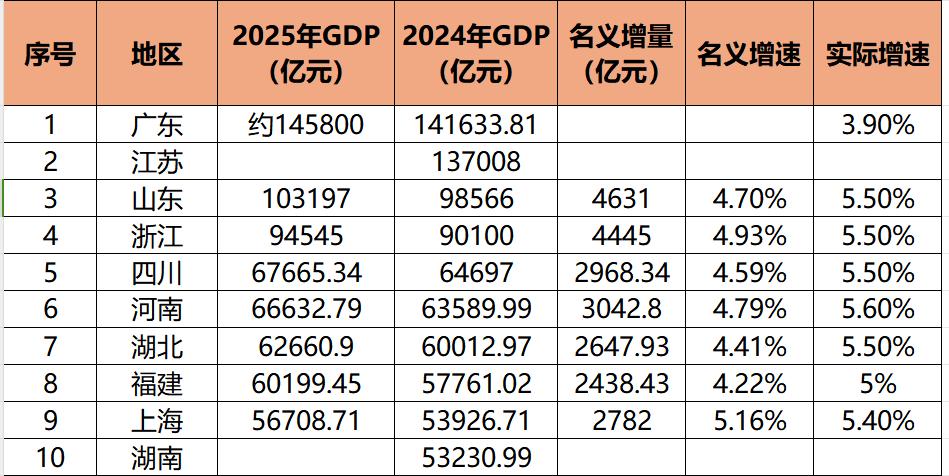
Core Insights - Guangdong's total deposits in domestic and foreign currencies are projected to reach 38.7 trillion yuan by the end of 2025, just shy of the 40 trillion mark, significantly outpacing Jiangsu by 10.82 trillion yuan [1] - The GDP of Guangdong is expected to be 14.58 trillion yuan in 2025, maintaining its position as the largest economy in China for 37 consecutive years, despite a modest growth rate of 3.9% [2][3] Economic Indicators - **Population Scale**: Guangdong has a resident population of 127 million, with a real-time population of 150 million, leading the nation. The province has over 30 million migrant workers, accounting for about 25% of its resident population [5] - **Business Environment**: By the end of 2025, Guangdong is expected to have over 20.37 million registered business entities, representing about 10% of the national total [6] - **Financial Sector**: Guangdong's financial institutions are projected to hold 38.72 trillion yuan in deposits by the end of 2025, maintaining a significant lead over other provinces [8] - **Foreign Trade**: In 2025, Guangdong's total goods trade import and export volume is expected to reach 9.49 trillion yuan, contributing 24.1% to the national foreign trade increment [9] - **Fiscal Revenue**: The local general public budget revenue for Guangdong is projected to be 1.3939 trillion yuan in 2025, marking a 3% increase and maintaining the top position in the country for 35 years [10] - **Capital Market**: Guangdong is expected to have 1,224 listed companies by the end of 2025, with a total market capitalization exceeding 30.75 trillion yuan, indicating a strong wealth creation capacity [11] - **Industry Clusters**: Guangdong has formed nine trillion-yuan industry clusters, including new-generation electronic information and green petrochemicals, showcasing its industrial strength [12][14]
半夏投资李蓓最新研判:黄金别再追了!十年一遇的地产大拐点基本确认
Sou Hu Cai Jing· 2026-01-27 02:02
Core Views - Risk control is prioritized over profit generation, emphasizing that avoiding significant drawdowns is more important than achieving returns [2][7] - The real estate sector presents a once-in-a-decade opportunity due to supply-side clearing and cyclical recovery, with a potential turning point expected within six months [2][9] - The future equity market is anticipated to be a structural bull market, with significant revaluation potential for core cyclical blue-chip stocks, indicating a return to value investing [2][10] Investment Philosophy - The investment style is defined as "classical macro," focusing on economic cycle positioning and predicting core economic variables over the next 1-2 years [5] - The strategy is based on "pure alpha," contrasting with the popular "all-weather strategy," which relies on fixed bases and market beta [5] Risk Management - The core of the risk management system is "concentration control," with strict limits on asset classes, industry holdings, and individual stock positions to avoid vulnerability [7][8] Market Outlook - The real estate market is expected to stabilize as supply-side adjustments occur, with significant declines in new construction and sales indicating a market clearing [9] - The equity market is not expected to experience a systemic bull market but rather a structural one, with significant disparities in performance among different indices [10] Gold Investment Perspective - The long-term investment value of gold is diminishing, with current high valuations and potential risks associated with currency fluctuations [12] Personal Insights - Sharing investment philosophies has led to systematic thinking and positive interactions, contributing to personal growth and community engagement [13] - Acknowledging mistakes is essential for survival in investment, with a focus on risk control to mitigate potential losses [14]
智通ADR统计 | 1月27日
智通财经网· 2026-01-26 22:46
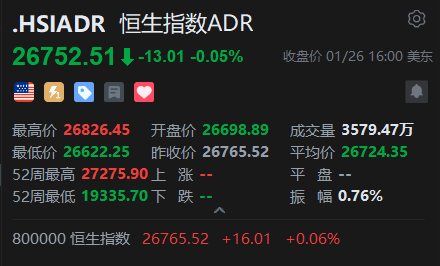
Market Overview - The Hang Seng Index (HSI) closed at 26,752.51, down by 13.01 points or 0.05% as of January 26, 16:00 Eastern Time [1] - The index reached a high of 26,826.45 and a low of 26,622.25 during the trading session, with a trading volume of 35.7947 million [1] - The 52-week high for the index is 27,275.90, while the 52-week low is 19,335.70, indicating a trading range of 0.76% [1] Blue-Chip Stocks Performance - HSBC Holdings closed at HKD 132.695, up by 1.29% compared to the Hong Kong market close [2] - Tencent Holdings closed at HKD 600.708, reflecting a slight increase of 0.2% from the Hong Kong market close [2] - Alibaba Group (BABA) saw a decline of 1.96%, closing at HKD 165.200 [3] - Xiaomi Group (01810) decreased by 2.81%, closing at HKD 35.220 [3] - AIA Group (01299) remained unchanged at HKD 83.050 [3] Notable Stock Movements - New World Development (00016) experienced a significant increase of 3.93%, closing at HKD 119.000 [3] - Kuaishou Technology (01024) fell by 3.26%, closing at HKD 78.600 [3] - JD.com (09618) rose by 1.05%, closing at HKD 116.000 [3] - Ctrip Group (09961) increased by 1.40%, closing at HKD 492.200 [3]





广东:加快提升金融业规模能级
Zhong Guo Zheng Quan Bao· 2026-01-26 20:54
Group 1 - The Guangdong provincial government aims for a GDP growth target of 4.5%-5% for the year, emphasizing the importance of a strong start to the 14th Five-Year Plan [1] - The report highlights the need to enhance the scale and capability of the financial sector, support insurance product innovation, and facilitate corporate financing and mergers [1] - By 2025, Guangdong's GDP is projected to grow by 3.9%, maintaining its position as the top province in China for 37 consecutive years, with public budget revenue increasing by 3% and goods import-export growth at 4.4% [1] Group 2 - The report emphasizes the acceleration of emerging industries such as new energy, new materials, and smart vehicles, aiming to cultivate more pillar industries [2] - It calls for strengthening original innovation and tackling key core technologies, particularly in quantum technology, artificial intelligence, and integrated circuits [2] - In the real estate sector, the focus is on stabilizing the market through targeted policies, promoting the utilization of idle commercial properties, and enhancing the quality of housing and property services [2]
2026年各部委要干哪些民生实事?
Xin Lang Cai Jing· 2026-01-26 17:57
Employment - The government will implement actions to stabilize and expand employment, focusing on key groups and enhancing service quality for high-quality employment [2] - Policies such as job retention subsidies, employment subsidies, and guaranteed loans will be reinforced, with a focus on labor-intensive industries [2] - There will be an emphasis on protecting the rights of flexible and new employment forms, ensuring their participation in social insurance [2] Housing - The real estate market will see a shift towards a "current housing sales system" to mitigate delivery risks, while also regulating pre-sale fund supervision [3] - Policies will be tailored to local conditions to control inventory and optimize supply, including the acquisition of existing homes for affordable housing [3] - The housing provident fund system will undergo reforms to enhance service quality and explore new operational models for property services [3] Fertility - The goal is to achieve "no out-of-pocket" expenses for childbirth within the policy framework by 2026, with an emphasis on enhancing prenatal care coverage [4] - As of November 2025, 259 million people were enrolled in maternity insurance, with direct disbursement of maternity benefits to participants [4] - The government will expand maternity insurance coverage to include flexible workers and migrant workers, aiming to reduce the financial burden of childbirth [4] Elderly Care - A series of measures will be implemented to build a universal and accessible elderly care service system, addressing the needs of the aging population [5][6] - Focus will be on providing care for disabled and elderly individuals living alone, and promoting the development of rural elderly care services [7] - The government will implement consumption subsidies for elderly care services and establish a professional qualification system for elderly care workers [7] Education - A new round of "Double First Class" construction will be initiated to promote high-quality development of local universities and align with regional strategies [8] - The education sector will focus on optimizing resource allocation to address changes in school-age populations and support underdeveloped areas [8] - There will be reforms in the basic education resource allocation mechanism to enhance the quality of education in towns with population inflows [8] Consumption - The government will optimize the implementation of the old-for-new consumption policy to stimulate consumer spending and upgrade products [9] - Subsidies for replacing old products will be adjusted to encourage the purchase of energy-efficient and water-efficient appliances [9] - The focus will be on supporting green and smart product consumption, expanding the market for new technologies and products [9] Agriculture - The agricultural sector aims to maintain stable production of grain and key agricultural products while enhancing overall production capacity and quality [10] - Efforts will be made to consolidate poverty alleviation achievements and establish mechanisms to prevent poverty recurrence [10] - The government will promote rural development and modernize agriculture to improve the living conditions of farmers [10]