矿业

Search documents
黑色金属日报-20260107
Guo Tou Qi Huo· 2026-01-07 11:59
Report Industry Investment Ratings - Thread steel: ★☆☆ [1] - Hot-rolled coil: ★☆☆ [1] - Iron ore: ★★★ [1] - Coke: ★☆☆ [1] - Coking coal: ★☆☆ [1] - Silicon manganese: ★★☆ [1] - Ferrosilicon: ★★☆ [1] Core Views - The steel market is expected to remain strong in the short term as the market sentiment warms up and the steel price follows the cost center upward, but the overall domestic demand is still weak [2]. - The iron ore market has a relatively loose fundamental situation, and there is a risk of increased high-level volatility in the future, although there is still some rigid replenishment demand [3]. - The coke and coking coal markets face certain fundamental pressures after the price correction, but the market has certain expectations for stimulus policies, leading to intensified capital games on the disk [4][6]. - The silicon manganese market is recommended to buy on dips, with attention paid to the "anti-involution" impact [7]. - The ferrosilicon market is relatively strong, and it is also recommended to buy on dips, with attention paid to the "anti-involution" impact [8]. Summaries by Related Catalogs Steel - The steel futures market rebounded significantly today. In the off-season, the apparent demand for thread steel declined, production increased, and inventory continued to decline. The demand for hot-rolled coil recovered, production increased synchronously, and inventory continued to decrease, but the pressure still needs to be relieved. The steel mill's profit margin has been repaired, the blast furnace production reduction has slowed down significantly, and the molten iron has stabilized and rebounded in the short term. The overall domestic demand is still weak, and steel exports remain high [2]. Iron Ore - The iron ore futures market rose significantly today. On the supply side, global shipments declined seasonally, and the domestic arrival volume increased month-on-month. The port inventory continued to accumulate. On the demand side, the terminal demand was weak in the off-season, and although the steel mill's profitability improved recently, there was no obvious resumption of production in the short term. The steel mill's imported ore inventory increased but remained at a low level, and there was still some rigid replenishment demand in the future [3]. Coke - The coke price hit the daily limit today. The coking profit is average, and the daily production decreased slightly. The coke inventory increased slightly. Currently, downstream buyers purchase on demand in small quantities, and traders have average purchasing intentions. Overall, the carbon element supply is abundant, and although the downstream molten iron is at a seasonal low, the demand for raw materials remains resilient. The steel mill still has a strong intention to suppress raw material prices [4]. Coking Coal - The coking coal price hit the daily limit today. The Mongolian coal customs clearance volume decreased, and the negative pressure on the price decreased slightly. The coking coal mine production decreased slightly. At the end of the year, some coal mines reduced or stopped production due to factors such as safety production and the completion of the annual production task. The spot auction transactions were okay, and the transaction price increased slightly. The terminal inventory increased slightly, and the total coking coal inventory increased slightly while the production-side inventory decreased slightly [6]. Silicon Manganese - The silicon manganese futures market fluctuated upward today. Driven by the rebound of the futures market, the spot price of manganese ore increased. Currently, there is a structural problem with the manganese ore port inventory, and the balance is relatively fragile. The silicon manganese smelting end pursues the most cost-effective option and changes the manganese ore formula for the furnace. The iron water production decreased seasonally on the demand side, the weekly silicon manganese production decreased slightly, and the silicon manganese inventory decreased slightly [7]. Ferrosilicon - The ferrosilicon futures market fluctuated upward today. Affected by relevant policy documents, the price was relatively strong. The market's expectation of coal mine supply guarantee increased, leading to a certain expectation of a decline in electricity costs and blue carbon prices. On the demand side, the iron water production rebounded to a high level, the export demand decreased to over 20,000 tons, and the marginal impact was not significant. The metal magnesium production increased month-on-month, and the secondary demand increased marginally. The ferrosilicon supply decreased significantly, and the inventory decreased slightly [8].
NCE外汇:金价跨越关口 重塑资产定价
Xin Lang Cai Jing· 2026-01-07 10:28
Group 1 - The current geopolitical restructuring signals the end of the post-World War II economic model focused on free trade and efficiency, with a shift towards "national activism" as indicated by the surge in commodity prices [1][2] - Traditional valuation models are struggling to explain current market volatility, as the driving forces are shifting from "capital efficiency" to "geopolitical power" [1][2] - The U.S. federal deficit is projected to reach $1.8 trillion in fiscal year 2025, with interest payments exceeding $1 trillion for the first time, prompting a redefinition of "safe assets" globally [3] Group 2 - Despite a 67% increase in gold prices over the past year, mining companies are facing rising production costs and regulatory pressures, with major miners expected to incur production costs of $1,600 per ounce by 2026 [4] - The trend of nationalization of mining rights is becoming more prevalent globally, indicating a shift in the mining investment landscape [4] - A projected copper supply deficit of over 300,000 tons in 2026 is expected to increase the strategic value of industrial metals [4]


NCE平台:黄金与实物资产迎来溢价
Xin Lang Cai Jing· 2026-01-07 10:28
Group 1 - The global macro environment is entering a high volatility cycle, with a significant paradigm shift in the international economic order established since World War II [1] - The market has entered a new era dominated by "national activism," as indicated by the recent surge in silver prices above $80 per ounce and copper prices reaching $6 per pound, reflecting deep impacts of geopolitical fractures [1] - The strong performance of commodities is essentially pricing in the collapse of the old order, with power logic replacing efficiency logic as the core driver of capital flows [1] Group 2 - The surge in sovereign credit risk is forcing capital to flow towards safe-haven assets, with the U.S. federal deficit projected to reach $1.8 trillion in fiscal year 2025 and debt-to-GDP ratio climbing to 99.8%, alongside interest payments exceeding $1 trillion for the first time [3][4] - Central banks are expected to continue strong diversification strategies in gold reserves in 2025, which not only supports gold prices but also indicates a return to a "currency-neutral" and physical asset-based global reserve system [4] - Investors are warned about the "leverage trap" in the mining sector, as rising costs and tightening regulations are squeezing the profitability of mining companies despite a projected 67% increase in gold prices in 2025 [2][4] - Production costs for major gold miners are expected to rise to $1,600 per ounce in 2026, with several resource-rich countries tightening administrative control over mining rights [2][4] - In the strategic metals sector, physical scarcity is becoming the main driver of prices, with a projected supply gap of over 300,000 tons for refined copper in 2026 due to geopolitical-driven supply chain "restructuring" [2][4] - The old investment narratives are no longer valid, and future market clarity will belong to those who can recognize the value of "resource sovereignty" and prioritize physical assets over paper derivatives [2][4]
兴业银锡,宣布赴香港IPO,冲刺A+H
Xin Lang Cai Jing· 2026-01-07 10:06
Core Viewpoint - Xingye Silver Tin (000426.SZ) is planning to issue overseas listed shares (H-shares) and apply for listing on the Hong Kong Stock Exchange to deepen its international strategic layout and create an international capital operation platform [2][7]. Group 1: Company Overview - Xingye Silver Tin was established in 1991 and has over 20 subsidiaries in regions including China, Hong Kong, Morocco, and Australia, holding more than 20 mining rights [2][7]. - The company possesses world-class silver-tin deposits in Inner Mongolia (Baiyin Chagan and Shuangjianzi Mountain), a large tin deposit in Morocco (Achmmach), and several large copper-gold deposits in Indonesia [2][7]. - The company emphasizes a corporate culture of "integrity, pragmatism, trust, and collaboration," focusing on the mining industry and gradually achieving a complete mining industry chain from geological exploration to mining, ore dressing, and smelting [2][7]. Group 2: Financial Information - Xingye Silver Tin was listed in 2011 through a reverse merger with Fulong Thermal Power, and as of January 7, 2026, its total market capitalization is approximately 76.903 billion RMB [2][7].


股市面面观丨62家公司已发2025年年报预告 13家公司预告净利有望翻番
Xin Hua Cai Jing· 2026-01-07 09:49
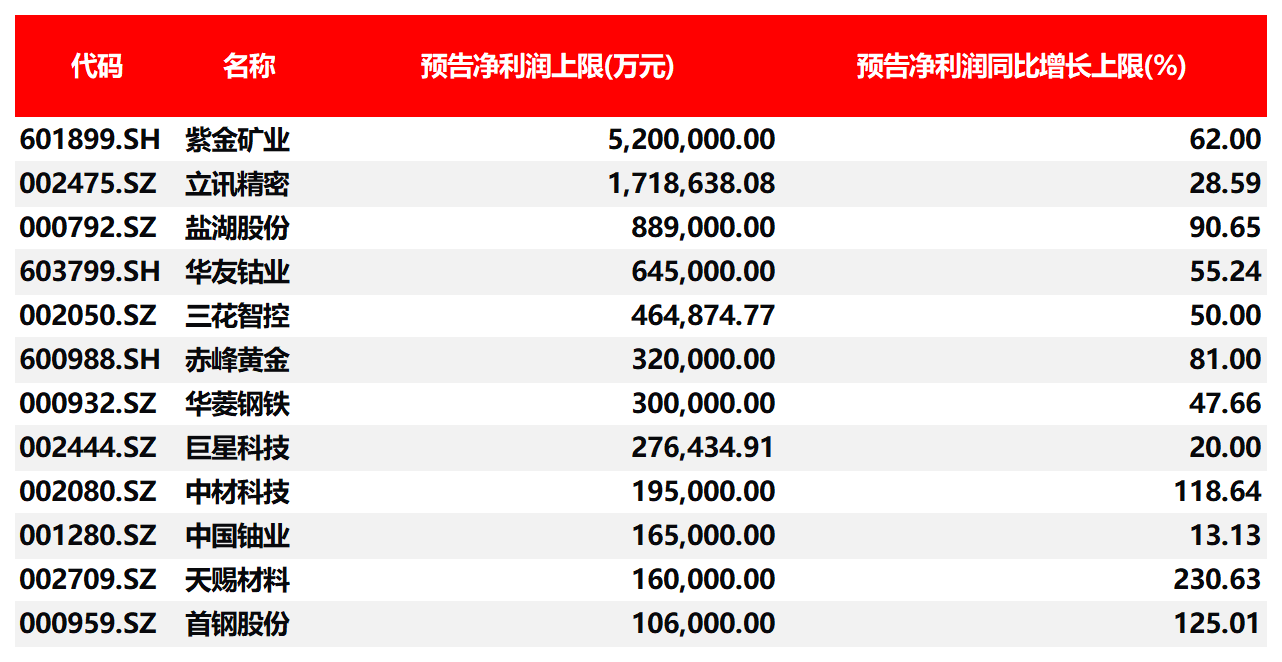
Core Viewpoint - As of January 6, 2026, a total of 62 listed companies in the A-share market have released their annual performance forecasts for 2025, with a significant majority expecting profit increases, indicating a positive outlook for the market [1][2]. Group 1: Performance Forecasts - Among the 62 companies, 55 are forecasting profit increases, while 7 expect declines, with 58 companies predicting profits and 4 anticipating losses [2]. - Notably, 12 companies have projected net profits exceeding 1 billion yuan, with Zijin Mining leading the forecast at 51-52 billion yuan, representing a year-on-year growth of approximately 59%-62% [5][6]. Group 2: Key Companies and Growth Drivers - Zijin Mining attributes its profit growth to increased production of key minerals, including gold, copper, silver, and lithium, alongside rising sales prices [5]. - Other notable companies include Luxshare Precision, which expects a net profit of 16.5-17.2 billion yuan, reflecting a year-on-year growth of about 23.59%-28.59% [6]. - Salt Lake Industry forecasts a net profit growth rate of up to 90.65%, driven by stable business operations and rising prices for potassium chloride and lithium carbonate [6]. Group 3: Exceptional Growth Rates - Thirteen companies are projecting net profit growth rates exceeding 100%, with Zhongtai Co. leading at a forecasted increase of 715.7% [8]. - Zhongtai Co. cites the stabilization of its subsidiary's operations and increased overseas orders as key factors for its significant profit growth [10]. - Other companies like Chuanhua Zhili and Bai'ao Saitu are also expecting net profit growth rates above 300%, driven by strong operational performance and market expansion [11].

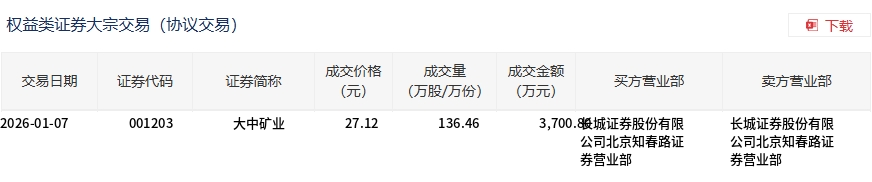
大中矿业今日大宗交易折价成交136.46万股,成交额3700.8万元
Xin Lang Cai Jing· 2026-01-07 08:56
1月7日,大中矿业大宗交易成交136.46万股,成交额3700.8万元,占当日总成交额的2.25%,成交价27.12元,较市场收盘价 29.23元折价7.22%。 | 交易日期 | 证券代码 | 证券简称 | 成交价格 | 成交星 | 成交金额 买方营业部 | | 卖方营业部 | | --- | --- | --- | --- | --- | --- | --- | --- | | | | | (元) | (万股/万份) | (万元) | | | | 2026-01-07 | 001203 | 大中矿业 | 27.12 | 136.46 | 3,700.&城证券股份有限 | | 长城证券股份有限 | | | | | | | 公司北京知春路证 | | 公司北京知春路证 | | | | | | | 券营业部 | 券营业部 | | ...
铁矿石价格创2月以来新高
Xin Lang Cai Jing· 2026-01-07 08:33
Group 1 - Iron ore prices have reached a new high since February, driven by expectations of support from China's macroeconomic policies and pre-holiday inventory replenishment demand [1][3] - Singapore iron ore futures have risen for the fourth consecutive trading day, approaching $109 per ton, with a peak increase of 2.1% to $108.90 per ton [1][3] - The People's Bank of China announced it will flexibly and efficiently use various policy tools, including potential interest rate cuts, although no specific timeline was provided [1][3] Group 2 - Analyst from CRU, Gao Li, indicated that while current iron ore supply is ample, seasonal weather could disrupt supply in the coming weeks, suggesting potential for further price increases [1][3] - Despite concerns over increased production from major global mining companies and signs of slowing steel production growth in China, iron ore prices are expected to see a slight increase throughout 2025 [1][3] - Australian mining stocks, including Rio Tinto and BHP, have also seen price increases in response to the rising iron ore prices [2][4]
南非基准股指:市值破5000亿美元,今年已涨超2%
Sou Hu Cai Jing· 2026-01-07 06:57
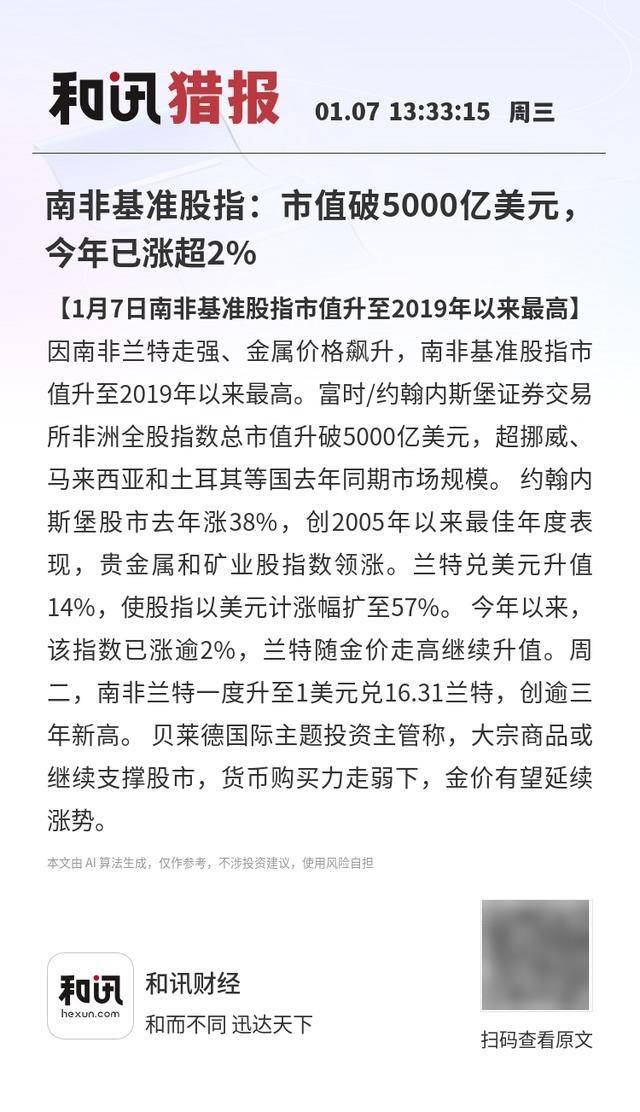
Group 1 - The core viewpoint of the article highlights that the South African benchmark stock index has reached its highest market capitalization since 2019, driven by a stronger rand and soaring metal prices [1] - The FTSE/JSE All Share Index's total market capitalization has surpassed $500 billion, exceeding the market sizes of countries like Norway, Malaysia, and Turkey compared to the same period last year [1] - The Johannesburg stock market experienced a 38% increase last year, marking its best annual performance since 2005, with precious metals and mining stocks leading the gains [1] Group 2 - The rand appreciated by 14% against the US dollar, which expanded the index's dollar-denominated gains to 57% [1] - Year-to-date, the index has risen over 2%, with the rand continuing to strengthen alongside rising gold prices [1] - On Tuesday, the rand reached a three-year high of 16.31 rand per dollar, indicating significant currency strength [1] Group 3 - The International Theme Investment Director at BlackRock suggests that commodities may continue to support the stock market, and under weakening purchasing power, gold prices are expected to maintain their upward trend [1]
投资大佬发出时代变局警告:“权力驱动市场”时代已至,战后旧秩序崩塌
Sou Hu Cai Jing· 2026-01-07 06:35
Core Viewpoint - The post-World War II economic order has effectively collapsed, replaced by a new era of "state activism" characterized by geopolitical tensions and market dynamics driven by power rather than efficiency [1] Commodity Prices - Silver prices have surpassed $80 per ounce, while copper is testing $6 per pound, indicating a significant rise in commodity prices that reflects deeper geopolitical fractures rather than merely monetary phenomena [1] - The sharp increase in precious metal prices coincides with central banks diversifying reserves away from sovereign debt, which is seen as a rational response to fiscal dominance [2] Market Signals - Traditional market signals such as yield curves and price-to-earnings ratios are becoming ineffective as the underlying drivers of capital have shifted [1] - The market is attempting to price in the reality that the U.S. Treasury and the Federal Reserve are effectively the same entity [3] Mining Sector Risks - Despite gold's 64.5% increase in 2025, there are warnings regarding mining stocks due to rising jurisdictional risks and government interventions that may hinder profitability [4] - Speculative trading in mining stocks may lead to unfavorable outcomes, as major North American miners are expected to see a 2% decline in global gold production in 2026, with all-in sustaining costs rising to $1,600 per ounce [5] Geopolitical Factors - The price of copper reflects physical scarcity, exacerbated by geopolitical realignments, with a projected refined copper shortfall of over 300,000 tons in 2026 [7] - Political instability in resource-rich countries, such as Venezuela, is increasing the risk of supply disruptions, further driving up prices [7] Investment Strategy - The transition to this new paradigm is volatile but offers clear direction for those willing to abandon outdated frameworks and recognize the importance of acquiring physical resources over holding paper derivatives [7] - The real danger lies not in volatility but in clinging to a framework that no longer exists [8]
光大期货0107热点追踪:印尼政策扰动,沪镍触及涨停
Xin Lang Cai Jing· 2026-01-07 06:33
热点栏目 自选股 数据中心 行情中心 资金流向 模拟交易 客户端 印尼镍矿商协会透露,2026年工作计划和预算中提出的镍矿石产量或将约为 2.5 亿吨,较 2025 年 RKAB 中 3.79 亿吨的产量目标大幅下降;节日期间消息,淡水河谷印尼公司暂停镍矿开采因2026年生 产计划未获政府批准;据印尼镍矿商协会最新发布,2026年1月第一期镍矿内贸基准价较2025年12月第 二期呈现微涨态势。在消息面提振的背景下,周二夜盘沪镍触及涨停,周三日盘虽开板,但日内仍维持 高位震荡。 基本面来看,镍矿内贸价格和升水基本平稳运行。周度镍铁成交价格上涨,不锈钢供给收缩叠加价格走 强带动库存加速去化。原料价格强于成品,硫酸镍理论利润转亏,镍钴锂价格均有走强,需求走弱,终 端面临成本压力。一级镍来看,上周国内社会库存小幅增加,沪镍及LME库存有所去库。综合来看, 短期印尼政策刺激镍价走强,但基本面好转程度有限,继续关注政策实际落地情况和市场情绪走向。 资料来源:Wind、光大期货研究所 撰稿:史玥明 从业资格:F03097365 责任编辑:朱赫楠 热点栏目 自选股 数据中心 行情中心 资金流向 模拟交易 客户端 印尼镍矿商协 ...