
科技

Search documents
昨晚黄金大涨,原油大跌,银行股拉升,道琼斯创新高,中概股回调
Sou Hu Cai Jing· 2025-11-13 17:07
Group 1: Market Signals - Gold prices surged to $4,200, while oil prices fell below $58, indicating conflicting market signals [1][5] - The gold-oil ratio reached a historical high of 76.15, suggesting potential economic downturns when exceeding 25 [1] - The Dow Jones index reached a record high of 48,254.82, driven primarily by bank stocks [3] Group 2: Economic Indicators - There is a strong expectation that the Federal Reserve will cut interest rates again in December, with 80% of economists predicting a 25 basis point cut [3] - The New York Fed President indicated a gradual return to asset purchases by the Fed, reinforcing market expectations for a shift in monetary policy [10] Group 3: Sector Performance - Bank stocks have become the biggest beneficiaries of the anticipated rate cuts, with hedge funds rapidly buying into global bank and insurance stocks [3] - The oil market is under dual pressure from supply and demand, with OPEC increasing production and refinery processing rates declining [5] - The U.S. Treasury market saw a rise, with the 10-year Treasury yield dropping by 4.67 basis points to 4.0693% [8] Group 4: Global Market Trends - European stock markets showed strong performance, with indices like the FTSE and DAX reaching new highs, contrasting with global risk aversion [7] - The Nasdaq China Golden Dragon Index fell by 1.27%, reflecting a pullback in Chinese stocks amid potential tariff changes affecting e-commerce exports [7] - The U.S. stock market displayed a split performance, with the Dow Jones rising while the Nasdaq declined, indicating sector-specific trends [5][10] Group 5: Credit and Risk Assessment - The U.S. subprime auto loan default rate reached a historical high, highlighting rising credit risks despite the stock market's record highs [11] - Goldman Sachs predicts that U.S. stocks will underperform compared to emerging markets over the next decade, which may influence global capital flows [11]


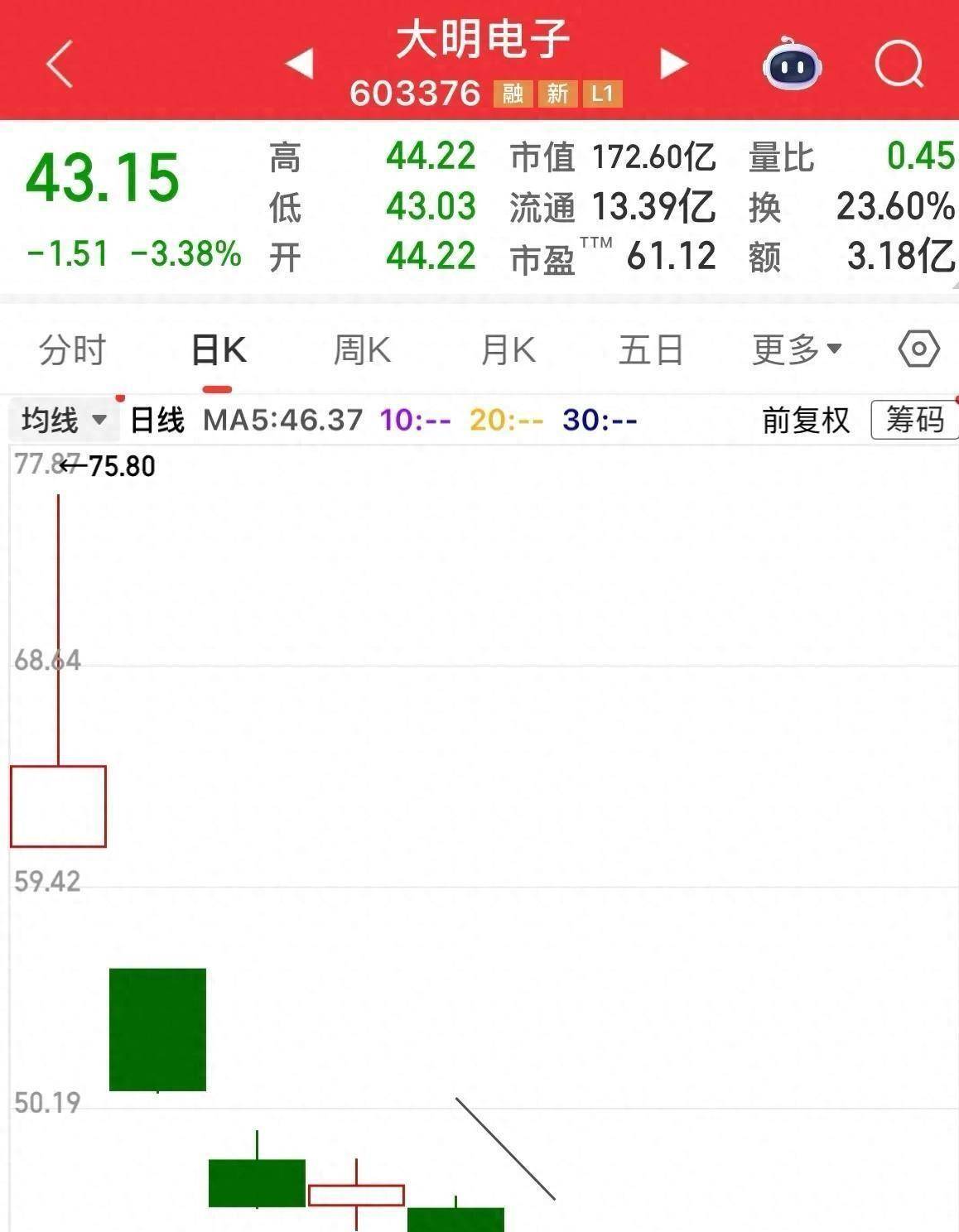
惨!上市6天下跌6天,一次都不反弹,股民:这辈子还能解套吗?
Sou Hu Cai Jing· 2025-11-13 17:05
Core Insights - The phenomenon of "listing peak" has become a norm in the A-share market, with over 70% of new stocks listed this year facing losses if investors bought at the closing price on the first day [1][6]. Group 1: Stock Performance - A stock listed for only six days has seen a continuous decline, with initial investors suffering losses exceeding 45% [1]. - The fertilizer company Hong Sifang experienced a first-day surge of 2255%, reaching a peak of 188 yuan, only to see its price halve by the next day [3][4]. - Other stocks like Changlian Technology and Qiangbang New Materials also exhibited extreme volatility, with declines of 86% and 81% respectively after initial spikes [4]. Group 2: Market Dynamics - The commonality among these new stocks is their small circulation, which allows speculative funds to easily manipulate prices, leading to significant losses for retail investors [4][9]. - The average first-day increase for new stocks has surged from 60.37% to 228.15% due to a sharp reduction in the number of new listings, which has intensified speculative trading [11]. Group 3: Valuation Issues - Despite significant price drops, many new stocks remain overvalued compared to industry averages, with some trading at price-to-earnings ratios far exceeding the sector's norms [4][5]. - For instance, Hong Sifang's price-to-earnings ratio remains at 86 times, while the industry average is only 15 times [4]. Group 4: Investor Behavior - Retail investors often exhibit a "hope" mentality, leading to further losses as they hold onto stocks in the hope of recovery, while institutional investors typically adopt a cautious approach, often selling on the first day [7][9]. - The trend of "buying high and hoping to sell higher" has resulted in many retail investors being trapped in losing positions, with some needing substantial company performance improvements to recover their investments [7][11].
加大权益资产配置、支持新质生产力,长期资金配置结构在变化
第一财经· 2025-11-13 12:39
Core Insights - Long-term capital is increasingly flowing into the capital markets, with a growing allocation towards equity assets, particularly in technology [3][10] - The discussion at the Shanghai Stock Exchange International Investors Conference highlighted the need for long-term funds to balance return growth with risk management [3][12] Group 1: Technology Assets - Technology assets have emerged as a strong investment theme in the global capital market this year, driven by significant industry transformations [4][10] - The rise of global technology stocks is primarily fueled by breakthroughs in artificial intelligence, supported by improved global liquidity and policy investments [4][5] - Different markets exhibit both synchronized trends and structural differences, impacting investment strategies [4][5] Group 2: Long-term Investment Strategies - Long-term funds should focus on three key areas: maintaining investment longevity, ensuring stability against high volatility, and achieving scale to diversify risk while generating returns [6][7] - Insurance asset management institutions emphasize a "long-term" and "diversified" approach to support technological innovation and development [6][7] Group 3: Market Dynamics and Challenges - The current macroeconomic environment and capital market demands are driving long-term funds to increase their equity asset allocations [10][11] - Challenges remain in attracting long-term capital, including the need for a mature capital market to reduce volatility and improve dividend mechanisms for listed companies [11][12] - The outlook for China's economy and capital market is optimistic, presenting significant investment opportunities for long-term investors [12]


加大权益资产配置、支持新质生产力,长期资金配置结构在变化
Di Yi Cai Jing Zi Xun· 2025-11-13 12:03
"投资者在把握共振机遇的同时,更要洞察不同市场间的结构性差异,才能在这次科技浪潮中发现独特 的投资价值。"薛捷说。 多重因素交织驱动下,长期资金加速涌入资本市场,权益资产配置占比不断提高,科技资产成为一大配 置方向。在此背景之下,长期资金如何兼顾收益增长与风险防控,"长钱长投"仍面临哪些难点,成为当 前市场热议的话题。 11月12日,在上交所国际投资者大会上,第一财经总编辑杨宇东带着上述问题与内外资机构进行了深入 探讨。全国社保基金理事会股票投资部副主任薛捷认为,为更好地践行长期资金入市,应进一步深化长 周期考核,同时,推动上市公司高质量发展,为长期资金提供优质投资标的。 今年以来,科技资产成为全球资本市场上涨行情中的最强主线。中金公司董事总经理、全球股票业务管 理委员会执行负责人张一鸣说,全球科技股的协同上涨建立在深刻的产业变革基础之上,这一趋势有望 延续,但后续行情将更加注重基本面的实质验证。 对于中国经济和资本市场的前景,毕盛投资创始人、董事长兼首席策略官王国辉认为,中国股票已经足 够便宜和有吸引力,看多中国资本市场。中国的经济发展和科技进步将由"MIT"驱动,即制造业 (Manufacturing)、 ...
This is a market that wants to trend to the upside, says BMO's Carol Schleif
Youtube· 2025-11-13 12:00
Market Overview - The S&P and NASDAQ are showing slight increases, with the NASDAQ up by about six points and the S&P performing well, being just over 2% from an all-time high [1][2] - The Dow has recently closed above 48,000, marking new record highs [1] Earnings Performance - The recent earnings season has been strong, with approximately 90% of companies reporting an average topline growth of 8% and bottom line growth of 12%, indicating robust profitability across 10 of 11 sectors [5][6] Valuation Insights - Valuations are not necessarily a barrier to bull markets, as they can remain over or undervalued for extended periods [4] - Hyperscalers are currently viewed as underlevered, with clean balance sheets allowing for some flexibility in leveraging debt [7][8] Debt and Financing - Some companies are borrowing at rates close to US government rates, providing them with financial flexibility [9] - CFOs of hyperscalers are strategically managing their balance sheets, considering the short lifespan of certain expenditures and the associated depreciation [10] Market Vulnerabilities - There is a concern regarding the interrelatedness of deals within the market, as the concentration of risk among a few companies makes it challenging to assess vulnerabilities [11] - The complexity of private contracts and potential escape clauses complicates the understanding of total commitments, which may not reflect actual activity levels [12][13]

电池相关化工赛道爆发式行情,可持续吗?
Hu Xiu· 2025-11-13 11:50
Group 1 - The battery-related chemical sector is experiencing a significant surge, raising questions about its sustainability [2] - The Shanghai Composite Index successfully challenged the 4000-point mark, indicating a recovery from previous passive fluctuations and declines [2] - Despite the overall market rebound, the enthusiasm has not significantly spread to technology sectors represented by artificial intelligence [2] Group 2 - Chemical industry stocks, particularly those linked to new energy and emerging industries, have been highlighted for potential year-end activity [2] - A major chemical company's unexpected maintenance on a key product, battery electrolyte raw materials, has led to a supply interruption, causing price surges and market excitement [2] - The market is reacting to short-term supply disruptions, which can trigger localized buying and price increases [2]
银行、科技延续分化,中概股大跳水,黄金反转走强
Ge Long Hui· 2025-11-13 05:24
持续分化,最终三大指数涨跌互现,其中道指上涨0.68%,纳指下跌0.26%、标指上涨0.06%。盘面上, 银行、科技延续分化,中概股大跳水,黄金四连涨。 中概股开盘后直线跳水,随后全天维持在低位盘整,截至收盘中国金龙下跌1.46%。其中腾讯音乐大跌 8.39%,爱奇艺、百度、小鹏汽车、蔚来等多股跌幅在2%上方,腾讯控股、哔哩哔哩、贝壳等股逆势收 红。 COMEX黄金低开高走,截至收盘上涨1.65%报4201.4美元/盎司,盘中最低报4104.4美元/盎司,最高报 4218.5美元/盎司。 银行股延续分化,其中高盛上涨3.54%,摩根士丹利上涨2.05%,花旗集团上涨2.09%,美国银行、美国 合众银行等股均小幅收涨;齐昂银行、联合银行等股均小幅收跌。 科技股分化加剧,其中超威公司大涨9%,奈飞上涨1.85%,高通上涨1.55%,英特尔、英伟达、微软等 股均小幅收涨;META逆势大跌2.88%,特斯拉下跌2.05%,亚马逊下跌1.97%。 理财就是一场修行,有人修有人度,结果就是看谁踩准了点,把握住了机会。 ...

异动盘点1113 | 光伏股回暖,储能概念股逆市走高;大型科技股普跌,美股航空服务板块盘初走强
贝塔投资智库· 2025-11-13 04:05
Group 1: Solar and Energy Stocks - Solar stocks showed recovery with New Special Energy (01799) up 4.99%, Flat Glass (06865) up 3.25%, Xinyi Solar (00968) up 3.75%, and GCL-Poly Energy (03800) up 2.27%. The China Photovoltaic Industry Association stated that rumors about a polysilicon storage platform were false, aiming to malign the industry [1][2] - Energy storage concept stocks rose against the trend, with Longpan Technology (02465) up 17.09%, Ruipu Lanjun (00666) up 15.2%, and Zhongxin Innovation (03931) up 9.22%. Lithium hexafluorophosphate prices have surged, with some market quotes reaching 150,000 yuan/ton, doubling since mid-October [1] Group 2: Oil and Gas Stocks - Oil stocks collectively declined, with CNOOC (00883) down 3.14%, CNOOC Services (02883) down 2.98%, PetroChina (00857) down 2.09%, and Sinopec (00386) down 1.79%. OPEC's monthly report indicated a slight oversupply in the oil market by 2026, contrasting previous predictions of sustained demand [2] Group 3: Steel and Mining Stocks - Steel stocks saw a midday surge, with Maanshan Iron & Steel (00323) up 7.09%, Ansteel (00347) up 2.26%, and Chongqing Iron & Steel (01053) up 2.13%. The Simandou project in Guinea, which has the potential to become the fifth-largest mine globally, has commenced production [2] Group 4: Airline and Transportation Stocks - Southern Airlines (01055) rose over 3.9% after reporting a 2.2% year-on-year increase in revenue for the first three quarters of 2025 [2] Group 5: Biotechnology and Pharmaceuticals - Gilead Sciences (01672) increased over 5.7% as it announced the clinical development of new drugs ASC36 and ASC35 [3] - Zai Lab (02509) rose over 8.4% after announcing plans for continued related transactions for the commercialization of QX001S from 2026 to 2028 [4] Group 6: Gold Stocks - Gold stocks collectively rose, with China Gold International (02099) up 5.99%, Jihai Resources (02489) up 7.3%, and Lingbao Gold (03330) up 4.47%. Gold prices have surpassed $4,100 and are testing the $4,200 resistance level [4] Group 7: US Market Movements - Major tech stocks in the US fell, with Meta Platforms (META.US) down over 2.8%, Tesla (TSLA.US) down over 2%, and Amazon (AMZN.US) down over 1.9% [5] - Eli Lilly (LLY.US) rose 2.95%, reaching a historical high, after announcing a deal to lower GLP-1 drug prices to $245 per month, potentially opening a new market of 30 million people [5] - The US airline service sector saw gains, with United Airlines (UAL.US) up 5.29% and American Airlines (AAL.US) up 3.62%, as the government is expected to reopen soon [5] Group 8: Nuclear Energy Stocks - US nuclear energy stocks rose, with Oklo (OKLO.US) up 6.67% as the government plans to finance new nuclear power plants to meet the energy demands of AI development [6] Group 9: Company-Specific Developments - On Holding (ONON.US) surged over 17.9% after reporting Q3 net sales of 794.4 million Swiss francs, exceeding market expectations [7] - AMD (AMD.US) rose 9% as it projected a 35% annual growth rate in revenue over the next three to five years, driven by AI chip demand [7]



港股午评:恒指跌0.58%,科技股、金融股弱势,黄金等有色金属股走强
Ge Long Hui· 2025-11-13 04:03
Market Overview - The Hong Kong stock market experienced a collective decline in the morning session, with the Hang Seng Index and the Hang Seng China Enterprises Index both showing a downward trend, falling by 0.58% and 0.64% respectively [1] - The Hang Seng Tech Index also dropped by 0.77%, indicating a shift in market sentiment towards pessimism [1] Sector Performance - Major technology stocks, which serve as market indicators, collectively weakened, negatively impacting overall market sentiment [1] - Financial stocks, including banks, insurance, and brokerage firms, which had shown strength previously, mostly performed poorly [1] - International oil prices saw a significant drop, leading to a collective decline in the three major oil companies [1] Industry Highlights - The paper industry is experiencing a price increase trend, with intensified efforts leading to noticeable gains in paper stocks [1] - Gold and copper stocks, along with other non-ferrous metal stocks, showed strong performance, leading the market in terms of gains [1]
景顺:美股尚未重演互联网泡沫,科技股仍有潜力再创新高
Xin Lang Cai Jing· 2025-11-13 02:28
Core Viewpoint - The current market has not entered a typical bubble phase, despite some sectors showing bubble-like characteristics, which differ significantly from the late 1990s internet bubble [1] Market Conditions - The overall industry leverage is much lower than during the 1990s bubble, with many companies still using debt financing but at a more sustainable level [1] - The estimated price-to-earnings (P/E) ratio for U.S. tech stocks over the next 12 months is approximately 32 times, indicating a connection between corporate profit growth and stock price movements [1] Historical Comparison - In contrast to the early 2000s when the MSCI U.S. Technology Index had a P/E ratio of 50 times, the current valuation levels are considered reasonable [1] Future Outlook - With the Federal Reserve initiating a rate-cutting cycle, the overall economic environment is expected to improve after 2026, and the market lacks typical conditions that would trigger a significant stock market correction [1] - U.S. tech stocks still have the potential to reach new highs [1] Investment Strategy - Maintaining a diversified investment portfolio is crucial, and the current pullback in tech stocks presents an opportunity for reallocation [1] - Investors are encouraged to expand their investments beyond large tech stocks to include U.S. cyclical stocks, small and mid-cap stocks, value stocks, and non-U.S. markets [1]