
银行

Search documents
胜遇信用日报-20260309
Si Lu Hai Yang· 2026-03-09 11:53
Company News Major Public Opinion - The Shenzhen government has received feedback on the proposed support plan for China Vanke from Beijing. After the authorities deemed the amount insufficient, the plan was expanded. The initial private share placement was set at 20 billion RMB (about $2.9 billion), but the revised scale is unknown. The government is considering introducing other local state - owned enterprises to support Vanke. After Vanke's initial attempt to extend the domestic bond term failed in December, it revised the plan in January and got approval to postpone the repayment of part of the principal of three domestic bonds for one year, with funds provided by Shenzhen Metro Group [2]. Capital Increase and Expansion - Gansu Financial Holding Group Co., Ltd. received a total of 21 billion RMB in capital increase from 15 relevant city - county financial departments. After the increase, its paid - in capital rose to 36.795 billion RMB, an increase of 20.956 billion RMB. The company has 11 outstanding bonds worth 5.5 billion RMB [2]. Involvement in Major Litigation - Zhangjiajie Economic Development Investment Group Co., Ltd. reported that its subsidiary Zhangjiajie Tourism Group Co., Ltd. and its holding subsidiaries had new, undisclosed litigation and arbitration cases with a total amount of about 37.9009 million RMB as of February 26, 2026, accounting for 13.09% of Zhangjiajie Tourism Group's latest audited net asset value [2]. Operating Loss - Longfor Group Holdings Limited issued a 2025 performance forecast, expecting a net profit attributable to the parent of about 1 billion RMB. However, after excluding fair - value changes, the core equity profit was a loss of 1.5 - 2 billion RMB due to the decline in development business settlement income and gross profit margin. The group has achieved positive operating cash flow including capital expenditures for three consecutive years, and its operation and service business is developing steadily [2]. Loan Overdue - Lingnan Ecology and Culture Tourism Co., Ltd. had a loan of about 447.0798 million RMB from Guangzhou Bank Dongguan Branch overdue. The loan was previously extended, and the company and its subsidiaries provided guarantees [2][3]. Transfer of Subsidiary Equity - Suining Fuyuan Industrial Co., Ltd. transferred 97% of the equity of Suining Fucheng Engineering Management Co., Ltd. and 3% held by its subsidiary to the State - owned Assets and Audit Center of Suining Economic and Technological Development Zone. The asset scale at the end of 2024 was 1.51 billion RMB. The company has 7 outstanding bonds worth 2.5 billion RMB [3]. Rating Outlook and Credit Rating Changes - Moody's adjusted the outlook of The Bank of East Asia, Limited from negative to stable, with a subject rating of A3. Fitch upgraded the subject rating of CK Hutchison Holdings Limited from A - to A and adjusted the outlook from positive watch to stable. Fitch also upgraded the subject rating of Schindler Technology China Co., Ltd. from BB to BB+ and adjusted the outlook from positive to stable [3].





【财闻联播】腾讯版“小龙虾”正式上线!又一家A股公司提示退市风险
券商中国· 2026-03-09 11:38
Macro Dynamics - The National Market Supervision Administration is conducting a nationwide special rectification focusing on counterfeit meat products and edible vegetable oils, with 41,700 cases investigated and fines totaling 329 million yuan in 2025 [2] - The special rectification involved inspections of 4.55 million production and operation entities and monitoring of 375,600 batches, leading to the rectification of 461,200 hidden problems [2] Company Dynamics - Shanxi Securities has received approval from the China Securities Regulatory Commission to participate in carbon emission trading [8] - Huishang Bank's stock rose over 8% after being officially included in the Hong Kong Stock Connect, with a reported revenue of approximately 37.67 billion yuan for 2025, a year-on-year increase of 1.2% [9] - Tencent's AI assistant WorkBuddy has officially launched, compatible with OpenClaw, allowing users to automate tasks and integrate with various communication tools [15] - Poly Developments reported a 36.66% year-on-year decrease in signed contracts for February 2026, with a total signed amount of 10.132 billion yuan [19]


贝莱德减持民生银行(01988)约1030.82万股 每股作价约4.04港元
Xin Lang Cai Jing· 2026-03-09 11:32
Group 1 - BlackRock reduced its stake in Minsheng Bank (01988) by 10,308,193 shares at a price of HKD 4.0415 per share, totaling approximately HKD 41.66 million [1] - After the reduction, BlackRock's latest shareholding stands at approximately 497 million shares, representing a holding percentage of 5.97% [1]


贝莱德减持民生银行约1030.82万股 每股作价约4.04港元
Zhi Tong Cai Jing· 2026-03-09 11:21
Group 1 - BlackRock reduced its stake in Minsheng Bank by 10,308,193 shares at a price of HKD 4.0415 per share, totaling approximately HKD 41.66 million [1] - After the reduction, BlackRock's latest holding in Minsheng Bank is approximately 497 million shares, representing a holding percentage of 5.97% [1]
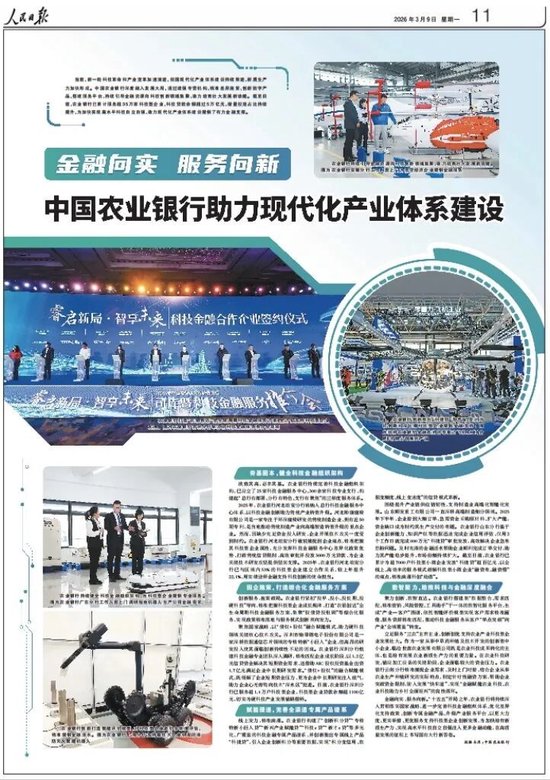
《人民日报》|金融向实 服务向新 中国农业银行助力现代化产业体系建设
Xin Lang Cai Jing· 2026-03-09 11:15
Core Viewpoint - The Agricultural Bank of China is actively integrating into the national development strategy by enhancing its financial services for technology-driven enterprises, with a focus on fostering innovation and supporting the modernization of the industrial system [1][16]. Group 1: Financial Support for Technology Enterprises - The Agricultural Bank has served over 350,000 technology enterprises, with a technology loan balance exceeding 5 trillion yuan, indicating a continuous increase in the proportion of new loans [1][16]. - The bank has established 25 technology financial service centers and over 300 specialized branches, creating a three-tiered service system to better support technology enterprises [4][18]. - The bank's Hebei Xiong'an branch provided 30 million yuan in loans to a traditional manufacturing company, enhancing its R&D capabilities and establishing partnerships with 53% of local technology enterprises, a 22.1% increase from the previous year [4][19]. Group 2: Comprehensive Financial Solutions - The Agricultural Bank has developed the "Nongyin Chuangda" full lifecycle technology financial service plan, focusing on early, small, long-term, and hard technology investments [6][21]. - A "debt-equity" fusion model was implemented to support key technology breakthroughs in hard technology sectors, exemplified by a 120 million yuan loan and 170 million yuan equity investment to a specialized micro-enterprise in the data communication chip field [8][24]. - The bank has launched various specialized financial products, including "Innovation Points Loan" and "Kejie Loan," to streamline the financing process for technology enterprises, with over 7000 small and micro technology enterprises receiving more than 10 billion yuan in "Kejie Loans" [11][26]. Group 3: Digital and Intelligent Financial Services - The Agricultural Bank has built a digital service platform that integrates data, demand matching, and risk management, facilitating a shift from single-point service to comprehensive industry coverage [13][28]. - The bank's Yunnan branch provided targeted financing solutions to an agricultural technology enterprise, helping it overcome funding challenges and contribute to rural revitalization [13][30]. - The bank aims to enhance its technology financial organization, optimize differentiated support policies, and innovate financial products to inject more financial momentum into the development of technology enterprises [15][30].

泡沫、关税与央行独立性:94 岁巴菲特留给市场的“最后遗产”
美股研究社· 2026-03-09 11:12
Group 1 - The current S&P 500 index has a price-to-earnings (PE) ratio exceeding 22, a level that has historically only occurred during the 2000 internet bubble and the 2020 liquidity-driven bull market, both of which ended in significant bear market corrections [5][6] - Berkshire Hathaway, led by Warren Buffett, holds a record cash reserve of $334 billion, surpassing the foreign exchange reserves of many countries, signaling a cautious approach amidst market exuberance [5][16] - The combination of high valuations and macroeconomic uncertainty poses a significant risk, as high valuations can persist only with ample liquidity and compelling growth narratives [7][8] Group 2 - The current market narrative has been driven by expectations of profit growth from the AI revolution and a declining inflation rate leading to a loosening monetary policy, which has led to inflated tech stock valuations [8][9] - Trade policy uncertainties have raised the average U.S. import tariff to its highest level in nearly 90 years, with over 80% of the costs expected to be borne by U.S. businesses and consumers, potentially squeezing corporate profit margins [9][10] - Concerns about the independence of the Federal Reserve are growing, as political pressures on monetary policy could undermine the foundation of asset pricing, leading to a potential spike in long-term interest rates and a compression of growth stock valuations [10][11] Group 3 - Corporate earnings growth expectations are being revised downward, indicating a dangerous phase where declining profit expectations coexist with high valuations, a scenario that historically does not last long [11][12] - The "scissors gap" between declining earnings expectations and high valuations often leads to market corrections, either through falling stock prices or valuation compression, with tech giants like Tesla and Meta Platforms being particularly vulnerable [12][13] - Investors are currently overly optimistic about AI's potential, neglecting the challenges of short-term profit realization, which could lead to significant volatility during earnings season if growth does not meet expectations [13][14] Group 4 - Buffett's cash reserve of $334 billion reflects a profound understanding of market cycles, emphasizing the importance of maintaining liquidity during periods of market optimism and fear [15][16] - Historically, Buffett's strategy has involved exercising restraint during market highs and providing liquidity during times of panic, highlighting the value of cash as a scarce asset that offers flexibility [16][17] - The key takeaway for investors is to build risk awareness and maintain cash reserves to capitalize on opportunities when they arise, rather than being fully invested at market peaks [17][18]

3月第1周立体投资策略周报:外资估算净流出,ETF转为净流入-20260309
Guoxin Securities· 2026-03-09 11:11
Group 1 - In the first week of March, the total net inflow of funds into the market was 49.3 billion, an increase from the previous week's inflow of 44.2 billion [1] - The short-term sentiment indicator is at a medium-high level since 2005, while the long-term sentiment indicator is at a medium-low level since 2005 [1][2] - From an industry perspective, the sectors with the highest trading volume share in the past week were defense and military, communication, and electric power equipment, with shares of 99%, 98%, and 97% respectively [2][14] Group 2 - In terms of fund inflows, the financing balance decreased by 24.2 billion, public fund issuance increased by 2.7 billion, ETF net subscriptions were 1.6 billion, and northbound funds estimated a net outflow of 9.2 billion [8] - The long-term sentiment indicator shows that the A-share risk premium was 2.49%, placing it at the 46th percentile historically, while the dividend yield of the CSI 300 index (excluding finance) was 1.22, at the 6th percentile historically [2][14] - The sectors with the highest financing transaction share were machinery and equipment at 89%, social services at 79%, and electric power equipment at 75%, while the lowest were banking at 7%, comprehensive at 8%, and coal at 14% [2][14]
东兴证券晨报-20260309
Dongxing Securities· 2026-03-09 10:28
Core Insights - The report highlights the significant growth in the multi-metal reserves of the company, with a notable increase in revenue and net profit for the year 2025, driven by rising metal prices and production cost advantages [5][6][7]. Company Performance - The company achieved an operating revenue of 17.1 billion yuan in 2025, representing a year-on-year growth of 25.9%, and a net profit attributable to shareholders of 2.97 billion yuan, up 36.7% year-on-year [5]. - Basic earnings per share (EPS) for 2025 reached 1.1 yuan, reflecting a 36.8% increase compared to the previous year [5]. - The company’s gold production cost advantage has strengthened, with unit production costs for gold at 142.18 yuan per gram, down 2.2% year-on-year, while the gross profit margin for gold increased by 8.09 percentage points to 81.63% [7]. Resource Exploration - The company reported a significant increase in multi-metal resources, with gold reserves rising by 9% to 149.48 tons by the end of 2025 [6]. - The exploration investment decreased by 36.4% to 112 million yuan, yet the successful exploration activities led to an increase in resource volume, including 16.62 tons of gold and 296.57 tons of silver added during the year [6][7]. - The company expanded its exploration rights area by 27% to 237.64 square kilometers, indicating potential for further resource accumulation [6]. Revenue Growth - The revenue from gold sales increased by 24% to 5.505 billion yuan, while silver sales rose by 18% to 1.16 billion yuan [7]. - Despite the revenue growth, the production volumes for gold and silver decreased by 5.47% and 16.30% respectively, indicating a potential strategic adjustment in production priorities [7]. Financial Metrics - The company has established a diversified investor return system through cash dividends and share buybacks, with a cash dividend of 4.8 yuan per 10 shares, totaling 1.332 billion yuan for 2025 [8]. - The return on equity (ROE) improved from 17.7% in 2024 to 21.3% in 2025, while the return on assets (ROA) increased from 14.1% to 16.8% [8]. - The company maintained a low debt ratio of 18.6%, ensuring strong financial flexibility [8]. Profit Forecast - The company is projected to achieve operating revenues of 20.918 billion yuan, 26.105 billion yuan, and 30.396 billion yuan for the years 2026 to 2028 respectively, with net profits expected to reach 5.033 billion yuan, 7.942 billion yuan, and 10.352 billion yuan [9].
资金跟踪系列之三十五:两融重新净流出,ETF、北上净卖出放缓
SINOLINK SECURITIES· 2026-03-09 09:47
Macro Liquidity - The US dollar index has rebounded, and the degree of inversion in the China-US interest rate differential has deepened, with inflation expectations also rising [2][14] - Offshore dollar liquidity has marginally tightened, while the domestic interbank funding environment remains balanced and relatively loose [2][20] Market Trading Activity, Volatility, and Liquidity - Market trading activity continues to rise, with trading heat in sectors such as oil and petrochemicals, military industry, public utilities, and steel exceeding the 90th percentile [3][27] - Volatility has increased across major indices, with sectors like steel, military, oil and petrochemicals, and non-ferrous metals showing volatility above the 80th percentile [3][33] - Market liquidity indicators have improved, although all sectors remain below the 70th historical percentile [3][37] Institutional Research - The banking, electronics, computing, electric new energy, and pharmaceutical sectors are leading in research activity, with construction materials, computing, media, pharmaceuticals, and textiles showing a month-on-month increase in research heat [4][43] Analyst Forecasts - Analysts have simultaneously downgraded net profit forecasts for the entire A-share market for 2026/2027 [5][51] - The proportion of stocks with upgraded net profit forecasts for 2026/2027 has decreased across the A-share market [5][51] - Sectors such as computing, transportation, machinery, electricity, and public utilities have seen their net profit forecasts for 2026/2027 upgraded [5][4] - The net profit forecasts for the CSI 500 and ChiNext indices for 2026/2027 have been upgraded [5][23] - Mid-cap/small-cap growth and large/mid/small-cap value sectors have also seen their net profit forecasts for 2026/2027 upgraded [5][25] Northbound Trading Activity - Northbound trading activity has rebounded slightly, continuing to show a small net sell-off in A-shares [6][31] - In the top 10 active stocks, the buy-sell ratio for Northbound trading in sectors like telecommunications, electric new energy, and automobiles has increased, while it has decreased in non-bank financials, non-ferrous metals, and electronics [6][32] - Northbound trading has mainly net bought in sectors such as electronics, electric new energy, and media, while net selling occurred in computing, military, and coal sectors [6][33] Margin Financing Activity - Margin financing activity has rapidly declined to the lowest point since mid-July 2025 [6][35] - The main net purchases in margin financing have been in oil and petrochemicals, transportation, and non-ferrous metals, while net selling occurred in TMT, electric new energy, and banking sectors [6][39] - Only sectors like agriculture, textiles, and transportation have seen an increase in the proportion of financing purchases [6][38] Trading Heat on the Dragon and Tiger List - The trading heat on the Dragon and Tiger list has decreased, with the total trading amount falling [7][41] - Sectors like oil and petrochemicals and agriculture have a relatively high trading amount on the Dragon and Tiger list, which is still on the rise [7][44] Active Equity Fund Positions - Active equity funds have continued to reduce their positions, while ETFs have seen a net redemption, although the pace has noticeably slowed [8][45] - After excluding price fluctuation factors, active equity funds have mainly increased positions in oil and petrochemicals, military, and media sectors, while reducing positions in electronics, telecommunications, and chemicals [8][47] - The correlation between active equity funds and small-cap growth/value has increased, while the correlation with large/mid-cap growth/value has decreased [8][48] - The scale of newly established equity funds has rebounded, with both active and passive new establishment scales increasing [8][50] - ETFs related to the CSI 500, CSI 300, and CSI 1000 have seen significant net redemptions, while ETFs tracking sectors like brokerages have been net subscribed [8][52]
过山车 | 谈股论金
水皮More· 2026-03-09 09:12
Market Overview - A-shares experienced wide fluctuations today, with the Shanghai Composite Index dropping nearly 2% at one point, closing down 0.67% at 4096.60 points. The Shenzhen Component and ChiNext Index fell 0.74% and 0.64%, closing at 14067.50 points and 3208.58 points respectively [3][5]. - The total trading volume in the Shanghai, Shenzhen, and Beijing markets reached 2.67 trillion yuan, an increase of 451.5 billion yuan compared to the previous trading day [3]. Oil and Commodity Impact - The market is closely watching former President Trump's statements regarding military actions in Iran, which could influence international oil prices and the recovery of U.S. stocks. The focus is particularly on the volatility of oil prices due to various uncertainties, including disruptions in the Strait of Hormuz and production cuts by Gulf countries [4]. - During the Asia-Pacific trading session, New York oil prices surged to $119.48, with a peak increase of 30%, before retreating to around $102, reflecting a 12% increase at the close of A-shares. In contrast, gold prices fell by approximately 1%, dropping below $5100 [4]. Stock Performance - The overall market correction was a common feature today, with technology stocks experiencing larger declines than financial stocks. Notably, "Yizhongtian" saw a drop of up to 7% during the day, closing down 4.5%. Financial stocks did not perform as expected, with bank stocks down 0.54%, securities down 1.53%, and insurance down about 2% [6]. - The Hang Seng Index and Hang Seng Tech Index were highlights of the market, showing strong recovery after a significant drop. The Hang Seng Tech Index opened at 4760 points, its lowest point of the day, and nearly turned positive by the afternoon [6]. Capital Flows - Southbound funds through the Hong Kong Stock Connect recorded a net inflow of 37.2 billion Hong Kong dollars, setting a new historical record, surpassing the previous record of 35.5 billion Hong Kong dollars [6].
