
债券

Search documents
10月30日,银行间主要利率债收益率全线下行
Xin Hua Cai Jing· 2025-10-30 14:03
Core Viewpoint - The interbank major bond yields have declined across the board as of October 30, indicating a potential shift in the interest rate environment [1] Group 1: Yield Changes - The yield on the 10-year government bond active note "250016" decreased by 1.05 basis points, reaching 1.8025% [1] - The yield on the 10-year policy bank bond active note "250215" fell by 0.7 basis points, settling at 1.882% [1] - The yield on the ultra-long bond active note "2500006" dropped by 1.25 basis points, now at 2.1635% [1]
不再盲目自信!抄主流机构和投资大师的作业,赚钱反而更简单!
雪球· 2025-10-30 13:01
Core Viewpoint - The article emphasizes the importance of asset allocation over attempting to achieve quick wealth through market timing, advocating for a disciplined investment approach that focuses on high-probability strategies rather than low-probability ones [4][6]. Group 1: Asset Allocation Strategy - The author implemented a three-part asset allocation strategy (6:3:1 for stocks, bonds, and commodities) starting with an initial investment of 50,000 yuan and a weekly investment of 1,000 yuan, achieving a cumulative return of over 16% and an annualized return exceeding 22% with a maximum drawdown of approximately 8% [4][15]. - The article argues that there is no bad time to start asset allocation, as it can yield positive results regardless of market conditions, highlighting that even during periods of high uncertainty, good returns can be achieved [6][15]. Group 2: Market Conditions and Timing - The author notes that at the time of investment, there was significant uncertainty in both domestic and international markets, with high levels of caution among investors due to macroeconomic factors and asset valuations [6][9][10]. - Despite the challenging environment, the author emphasizes that asset allocation does not require precise market timing, as there are always undervalued assets available for investment [14][15]. Group 3: Dollar-Cost Averaging - The article discusses the benefits of dollar-cost averaging, stating that consistent investments can accumulate more shares during market downturns, allowing for better positioning when the market rebounds [19]. - The author experienced significant market volatility over the past year, but through disciplined investing, was able to capture gains without needing to predict market movements [16][18]. Group 4: Adding to Positions - The author identifies specific instances where adding to positions during market downturns proved beneficial, citing three occasions where additional investments were made during significant market declines [20][23]. - The strategy of adding to positions during dips is framed as a way to smooth out costs and enhance overall returns [24][25].


中加基金配置周报|二十届四中全会召开,美国核心通胀走弱
Xin Lang Ji Jin· 2025-10-30 08:44
Economic Data Summary - China's GDP grew by 5.2% year-on-year in the first three quarters, with quarterly growth rates of 5.4%, 5.2%, and 4.8% respectively [1] - In September, industrial output increased by 6.5% year-on-year, while retail sales rose by 3% [1] - Fixed asset investment decreased by 0.5% year-on-year, but grew by 3% when excluding real estate development [1] - The average disposable income per capita for residents was 32,509 yuan, reflecting a real growth of 5.2% after adjusting for price factors [1] U.S. Economic Indicators - The U.S. CPI rose by 3% year-on-year in September, the highest since January, but below market expectations of 3.1% [1] - Core CPI showed a month-on-month increase of 0.2%, also lower than anticipated [1] - Service sector inflation reached its weakest level since November 2021 [1] - The market has largely priced in two 25 basis point rate cuts by the Federal Reserve for the remainder of the year [1] Market Performance - The S&P Global reported that the U.S. manufacturing PMI for October was 52.2, and the services PMI was 55.2, both showing improvement from September [1] - The composite PMI for October was 54.8, indicating a recovery in economic activity [1] - New orders composite index reached its highest level of the year, with manufacturing orders showing the strongest growth since February of the previous year [1] APEC Meeting and U.S.-China Relations - Chinese President Xi Jinping will attend the APEC informal leaders' meeting in South Korea from October 30 to November 1 [2] - There is ongoing communication regarding a potential meeting between the Chinese and U.S. presidents during the APEC conference [2] - Recent U.S.-China trade talks focused on key issues such as maritime logistics, tariffs, and agricultural trade, resulting in a basic consensus on addressing mutual concerns [3] Stock Market Overview - The A-share market showed a rebound, with the ChiNext Index rising by 8.05%, the largest increase among major indices [7] - The overall market sentiment improved due to expectations of easing trade tensions between the U.S. and China [7] - The S&P 500 index increased by 1.92%, while the Nasdaq index rose by 2.31%, reflecting a positive response to weaker inflation data [8] Bond Market Insights - The bond market experienced fluctuations, with credit bonds generally declining and government bonds showing slight increases [10][12] - The U.S. Treasury yields saw minor movements, influenced by mixed economic signals and trade tensions [12] - The domestic bond market is expected to remain volatile due to ongoing economic uncertainties and policy adjustments [10]
熊猫债、点心债,这些“萌萌哒”名字怎么来的?【财说明白】
Sou Hu Cai Jing· 2025-10-30 08:44
Core Viewpoint - The popularity of Panda bonds and Dim Sum bonds has been rising, with Dim Sum bonds becoming a favored option for domestic tech companies seeking overseas financing [1] Group 1: Panda Bonds - Panda bonds are foreign bonds issued by overseas institutions in China, denominated in RMB, and named after the iconic Chinese panda to enhance market recognition and respect for the issuing country's culture [2][5] - In 2024, 44 entities issued 109 Panda bonds with a total issuance scale of 194.8 billion RMB, representing a year-on-year growth of 26.1% [8] - The increase in Panda bond issuance is driven by China's ongoing opening-up policies, a large market, and the internationalization of the RMB, particularly due to the cost advantages of RMB financing amid diverging monetary policies between China and the US [8][9] Group 2: Dim Sum Bonds - Dim Sum bonds are offshore bonds issued in Hong Kong, initially characterized by their smaller scale, and have evolved significantly since their inception in 2007 [6][7] - The market for Dim Sum bonds has expanded rapidly, with a projected annual issuance growth of around 30% in 2023 and 2024, driven by changes in global interest rates and the attractiveness of RMB assets [7] - The range of issuers for Dim Sum bonds has diversified from mainly Chinese policy banks and state-owned enterprises to include local governments, commercial banks, and multinational corporations, enhancing the global acceptance of RMB bonds [9][10]

债市日报:10月30日
Xin Hua Cai Jing· 2025-10-30 07:57
Core Viewpoint - The bond market is experiencing a strong consolidation, with government bond futures mostly rising and interbank bond yields generally declining by around 1 basis point [1][2]. Market Performance - Government bond futures closed mostly higher, with the 30-year main contract up 0.19% to 116.15, and the 10-year main contract up 0.05% to 108.630 [2]. - The interbank major interest rate bond yields generally decreased, with the 10-year government bond yield down 1.05 basis points to 1.8025% [2]. Liquidity and Monetary Policy - The central bank conducted a net injection of 130.1 billion yuan in the open market on October 30, with short-term funding rates continuing to decline [1][6]. - The Shibor short-term rates collectively decreased, with the overnight rate down 9.7 basis points to 1.317% [6]. Institutional Insights - CITIC Securities noted that the central bank's influence on interest rates has increased, and the market is currently in a defensive strategy phase, with opportunities for wave trading in a range-bound market [7]. - Nanhua Research Institute indicated that the central bank's announcement to resume government bond trading has led to a strong market reaction, suggesting a potential bullish sentiment [8]. International Market Trends - In North America, U.S. Treasury yields rose across the board, with the 10-year yield increasing by 9.82 basis points to 4.074% [3]. - In Asia, Japanese bond yields mostly fell, with the 10-year yield down 0.3 basis points to 1.647% [4]. Primary Market Activity - The Export-Import Bank's 1-year and 3-year financial bonds had winning yields of 1.3571% and 1.6066%, respectively, with bid-to-cover ratios of 2.48 and 5.81 [5].
熊猫债、点心债,这些“萌萌哒”名字怎么来的?
3 6 Ke· 2025-10-30 04:35
Core Insights - The popularity of Panda bonds and Dim Sum bonds has been rising, with Dim Sum bonds becoming a favored option for domestic tech companies seeking overseas financing [1] Group 1: Panda Bonds - Panda bonds are defined as bonds issued by foreign entities in China, denominated in RMB, and are categorized as foreign bonds [2] - The name "Panda bond" was established in 2005 when the International Finance Corporation and the Asian Development Bank were approved to issue RMB bonds in China, symbolizing China's national treasure [3] - The issuance of Panda bonds has surged, with 44 entities issuing 109 Panda bonds in 2024, totaling a scale of 194.8 billion RMB, representing a year-on-year growth of 26.1% [7] - The total issuance of Panda bonds in 2023 reached 156.85 billion RMB, with total outstanding bonds increasing by 26.84% to 400.33 billion RMB [7] - The growth of Panda bonds is attributed to China's ongoing opening-up policy, a large market, and the internationalization of the RMB, alongside favorable financing costs compared to USD [7][8] Group 2: Dim Sum Bonds - Dim Sum bonds refer to RMB-denominated offshore bonds issued in Hong Kong, initially named for their small scale, akin to dim sum [5][6] - The market for Dim Sum bonds has expanded significantly over the past decade, with a notable increase in issuance and diversity of issuers, including local governments and multinational corporations [6][9] - By 2025, the issuance of Dim Sum bonds is expected to be dominated by central banks, sovereigns, and government entities, with significant contributions from the TMT sector [8] - The global issuance of Dim Sum bonds has diversified, with 45 countries and supranational organizations participating, enhancing the global acceptance of RMB-denominated assets [9]

债券回暖趋势仍在,关注十年国债ETF(511260)
Mei Ri Jing Ji Xin Wen· 2025-10-30 01:03
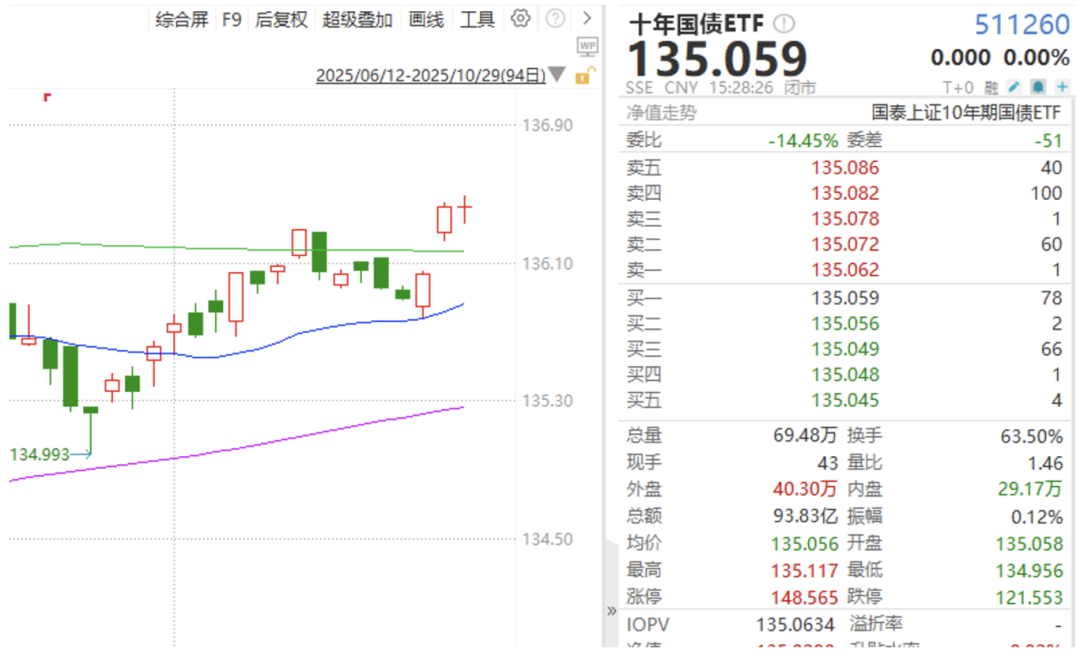
Core Viewpoint - Recent significant increase in government bonds, with the 10-year government bond ETF (511260) and government bond ETF (511010) both rising by 0.28% over the past five days, primarily driven by the central bank's resumption of government bond trading, indicating greater opportunities in the bond market for Q4 compared to Q3 [1][4] Group 1: Market Performance - The 10-year government bond ETF (511260) and government bond ETF (511010) have both seen a 0.28% increase recently [1] - The trading volume for the 10-year government bond ETF reached 69.48 million, with a turnover rate of 63.50% [3] Group 2: Macroeconomic Context - Q4 faces certain downward pressures in the macroeconomic environment, including weak demand, declining government spending, and subdued investment on the supply side, while prices are stabilizing with a slight upward trend [4] - Despite the challenges, the PMI has shown a continuous upward trend, reflecting a marginal improvement in economic outlook [4] Group 3: Policy and Institutional Behavior - The central bank has indicated a more relaxed monetary policy following the National Day and Mid-Autumn Festival holidays, with the resumption of government bond trading signaling optimism [4] - Institutional trading behavior shows a gradual increase in the duration of trading funds after a decline in Q3, suggesting a warming trend in the bond market [4] Group 4: Future Outlook - The People's Bank of China has announced the resumption of open market government bond trading, with expectations for the 10-year government bond yield to stabilize between 1.6% and 1.8% [4] - Future monitoring of the scale of central bank relending is advised, as it may indicate a continued loose monetary policy if government bond trading does not crowd out relending [4]
Municipal Bonds May Be on the Mend
Etftrends· 2025-10-29 13:43
Core Insights - The bond market is experiencing enthusiasm among fixed income investors due to Federal Reserve easing, with municipal bonds gaining significant attention this year [1]. Group 1: Municipal Bond Market Dynamics - Municipal bonds have faced challenges such as high issuance, declining demand, narrowing credit spreads, and underperformance compared to Treasuries of similar durations [2]. - Some analysts believe that the worst is over for municipal debt, indicating potential opportunities, particularly highlighted by the 30-year muni/Treasury ratio [3]. Group 2: Muni/Treasury Ratio Analysis - The 30-year muni/Treasury (M/T) ratio typically ranges from 80% to 90%, with values above 100% indicating favorable conditions for municipal bonds. Currently, the ratio is approaching 90%-95%, suggesting good value for investors willing to accept some interest rate risk [4]. Group 3: Active Management of MNBD - The ALPS Intermediate Municipal Bond ETF (MNBD) benefits from active management, providing flexibility in a market where passive funds are prevalent. This is particularly advantageous as the muni yield curve has flattened following the Fed's rate reduction [5]. - Experienced municipal bond portfolio managers see attractive values in the market, suggesting that volatility can present compelling investment opportunities, especially in underappreciated segments [6]. Group 4: Performance of MNBD - MNBD has outperformed the largest ETF in its category this year, indicating its potential to join successful active muni ETFs that have performed well across various interest rate cycles [6]. - Historical performance shows that active muni funds have fared well during periods of market volatility, with better volatility-adjusted results compared to peers over five- and ten-year periods [7].

阿联酋财政部宣布推出 “零售苏库克(Retail Sukuk)” 计划
Shang Wu Bu Wang Zhan· 2025-10-29 06:01
Core Viewpoint - The UAE Ministry of Finance has launched a "Retail Sukuk" program allowing individuals to invest in government-backed Islamic bonds (T-Sukuk) through digital banking platforms, with a minimum investment of 4,000 dirhams [1] Group 1 - The initiative reflects the spirit of financial inclusivity and social welfare, aiming to enhance citizen participation in the national financial system [1] - The program is designed to support sustainable development and promote a culture of long-term savings among the public [1]
中信期货晨报:股债商小幅波动,贵金属延续调整-20251029
Zhong Xin Qi Huo· 2025-10-29 05:15
1. Report Industry Investment Rating - The report does not provide a specific industry investment rating [1][2][3][4][6][7][9] 2. Core Viewpoints of the Report - Short - term asset allocation should be balanced. After the Fed's interest rate cut decision in the October meeting, the progress of China - US tariff talks, and the release of details from the 20th Fourth Plenary Session, it is expected to benefit overseas and domestic equity sectors (especially the science and technology innovation sector) and non - ferrous metals. Black commodities may also have a rebound opportunity due to domestic policy improvement, while precious metals may continue to adjust in the short term [6] 3. Summary According to Relevant Catalogs 3.1 Macro Highlights - **Overseas Macro**: The US government shutdown continued this week. China - US tariff expectations eased, and the CPI in September was lower than expected, strengthening the expectation of monetary easing. Reasons include the lower - than - expected September CPI, the 12th rejection of the temporary budget bill by the Senate, the increased economic downward pressure after the government shutdown, and the easing of China - US tariff expectations [6] - **Domestic Macro**: On October 28, the "Proposal of the Central Committee of the Communist Party of China for Formulating the 15th Five - Year Plan for National Economic and Social Development" and its explanatory notes were released, emphasizing the strategic position of science and technology and emerging industries, and also covering areas such as boosting consumption, expanding effective investment, and "anti - involution" [6] - **Asset Views**: Short - term balanced allocation is recommended. After the Fed's interest rate cut decision, China - US tariff talks, and the release of details from the plenary session, equity sectors and non - ferrous metals may benefit, black commodities may rebound, and precious metals may continue to adjust [6] 3.2 Market Performance of Various Assets - **Financial Market**: Stock index futures showed a shrinking - volume rebound, with the growth style being active due to technology events. Stock index options had a slightly lower trading volume. Treasury bond futures remained weak [2][7] - **Precious Metals**: Gold and silver entered a short - term adjustment phase due to the easing of geopolitical and economic and trade tensions [7] - **Shipping**: The freight rate of the European container shipping line was under pressure as the peak season in the third quarter ended [7] - **Black Building Materials**: The steel industry faced policy disturbances and inventory pressure. Iron ore was mainly affected by sentiment. Coke's price increase was about to be implemented, and coking coal prices were strong. Other related products also had their own market characteristics [7] - **Non - ferrous Metals and New Materials**: Copper prices fell in the short term due to trade frictions. Aluminum prices rose, while zinc prices were weak. Other non - ferrous metals also showed different trends [7] - **Energy and Chemicals**: The energy and chemical industry still faced a weak supply - demand situation. Most products were expected to fluctuate, with some showing a downward trend [9] - **Agriculture**: The agricultural market showed a mixed trend. Some products were affected by factors such as weather, trade relations, and supply - demand [9]