
有色金属

Search documents
港股异动 | 新疆新鑫矿业(03833)尾盘涨超7% 据报位于印尼的全球最大镍矿被要求削减产量
智通财经网· 2026-02-11 08:05
Group 1 - Xinjiang Xinxin Mining (03833) saw a significant increase in stock price, rising by 7.66% to HKD 2.67, with a trading volume of HKD 13.37 million [1] - The London Metal Exchange nickel futures rose by 2.6%, indicating a positive trend in the nickel market [1] - Indonesia has mandated a 70% reduction in ore quotas from the Weda Bay nickel mine, the largest nickel mine globally, which could impact supply dynamics [1] Group 2 - China Postal Securities noted that nickel is one of the few metals absent from the ongoing bull market in non-ferrous metals for 2024, suggesting potential for price recovery [1] - The firm believes that if Indonesian policies create a supply-demand gap, there could be a significant rebound in nickel prices [1] - Xinjiang Xinxin Mining fully owns four nickel-copper mines: Kalatongke, Huangshandong, Huangshan, and Xiangshan, positioning the company favorably in the nickel market [1]
博时市场点评2月11日:两市涨跌不一,创业板跌超1%
Xin Lang Cai Jing· 2026-02-11 08:02
Monetary Policy Insights - The People's Bank of China (PBOC) has reiterated its commitment to maintaining a moderately loose monetary policy, emphasizing the use of various tools to ensure ample liquidity in the market [2][7] - The report indicates a focus on "precision drip irrigation" in policy implementation, suggesting a reduced probability of short-term interest rate cuts [1][2] - The PBOC plans to normalize government bond trading operations, which is aimed at improving liquidity management and policy coordination rather than large-scale quantitative easing [2][7] Economic Indicators - In January, the Consumer Price Index (CPI) rose by 0.2% month-on-month and year-on-year, while the core CPI (excluding food and energy) increased by 0.8% year-on-year [2][8] - The Producer Price Index (PPI) saw a month-on-month increase of 0.4%, with a year-on-year decline of 1.4%, indicating a marginal improvement in industrial production and consumer demand [2][8] Low-altitude Economy Development - A new policy document aims to enhance the capabilities of the information and communication industry to support low-altitude infrastructure development, targeting a 90% coverage of ground mobile communication networks by 2027 [3][9] - This initiative marks a significant step towards the industrialization of the low-altitude economy, providing clear quantitative goals and implementation paths [4][9] Market Performance - As of February 11, the A-share market showed mixed results, with the Shanghai Composite Index up by 0.09% and the ChiNext Index down by 1.08% [5][10] - The market turnover was approximately 20,012.02 billion yuan, reflecting a decrease compared to the previous trading day [6][11]

收评:创业板指震荡调整 玻纤概念股大涨
Xin Hua Cai Jing· 2026-02-11 07:44
Market Performance - A-shares showed mixed performance on February 11, with the Shanghai Composite Index slightly up by 0.09% and the ChiNext Index down over 1% [1] - The trading volume in the Shanghai and Shenzhen markets fell below 2 trillion yuan for the first time in 31 trading days, decreasing by 121.3 billion yuan compared to the previous trading day [1] - The Shanghai Composite Index closed at 4131.98 points with a trading volume of 822.6 billion yuan, while the Shenzhen Component Index closed at 14160.93 points with a trading volume of 1161.6 billion yuan [1] Sector Performance - The glass fiber sector saw significant gains, with companies like Shandong Glass Fiber and China Jushi hitting the daily limit [1] - Chemical stocks were active, with Huatai and Jihua Group also reaching the daily limit [1] - The non-ferrous metals sector performed well, particularly tungsten-related stocks, with Xianglu Tungsten and Zhangyuan Tungsten hitting the daily limit [1] - Conversely, the film and television sector experienced a collective decline, with Hengdian Film and Huayi Brothers hitting the daily limit down [1] Institutional Insights - Jifeng Investment Advisory noted that the market remains on an upward trend, with precious and non-ferrous metals rebounding, and suggested investors focus on leading companies in high-demand sectors like semiconductors and AI [3] - CITIC Securities highlighted the potential for leading photovoltaic manufacturers to accelerate the replacement of raw materials due to rising silver prices, indicating a shift towards high-efficiency products [3] - The China National Development Bank plans to issue over 1.64 trillion yuan in loans by 2025 to support infrastructure projects across various sectors, including urban development and agricultural modernization [7] Automotive Industry - In January, China's automotive industry maintained stable operations, with production and sales reaching 2.45 million and 2.346 million vehicles, respectively, showing a slight production increase of 0.01% but a sales decline of 3.2% year-on-year [4] - The new energy vehicle market showed stability, with production and sales of 1.041 million and 945,000 units, reflecting year-on-year growth of 2.5% and 0.1% [4] - Exports of new energy vehicles continued to grow, reaching 302,000 units, which is a year-on-year increase of 100% [4] Financial Market Developments - Shanghai is enhancing mechanisms for financial market connectivity, including "Shanghai-Hong Kong Stock Connect" and "Bond Connect," to improve international financial services and products [5] - The city aims to increase the international influence of "Shanghai pricing" and enhance its capabilities in international reinsurance and shipping insurance [5]
A股收评 | 指数分化!沪指小幅上涨 三大涨价主题爆发
智通财经网· 2026-02-11 07:18
Market Overview - The market experienced fluctuations with the Shanghai Composite Index slightly up by 0.09% to 4131.98 points, while the ChiNext Index fell by 1.08% to 3284.74 points. The total trading volume was below 2 trillion yuan, a decrease of over 100 billion yuan compared to the previous trading day [1] - The number of declining stocks exceeded 3200, with 2050 stocks rising and 61 stocks hitting the daily limit up [1] Sector Performance - Key themes driving the market included price increases in small metals, dyes, and electronic fabrics, with the non-ferrous metals and chemical sectors leading the gains. Notable stocks included international composite materials and China Jushi, both hitting the daily limit up [1] - Resource stocks such as coal, oil and gas, and steel showed strong performance, with companies like CNOOC Engineering and Shanxi Coking rising significantly [1] Automotive Industry - The automotive industry in China maintained stable operations in January, with production and sales reaching 2.45 million and 2.346 million units, respectively. The production volume saw a slight year-on-year increase of 0.01%, while sales decreased by 3.2%. The new energy vehicle market remained stable, with production and sales of 1.041 million and 945,000 units, reflecting year-on-year growth of 2.5% and 0.1% [4] Consumer Spending Initiatives - The Ministry of Commerce announced a "New Spring Package" worth 2.05 billion yuan to benefit consumers during the Spring Festival, which includes the distribution of consumption vouchers, subsidies, and red envelopes [5] Semiconductor Industry - Semiconductor company SMIC reported an increase in orders related to AI, storage, and high-end applications, while orders for mid-to-low-end applications have decreased due to strong demand in the AI sector [6] Film Industry Outlook - China Galaxy Securities indicated that the upcoming Spring Festival holiday, lasting nine days, is expected to provide ample time for box office releases, with a high acceptance rate for quality films among audiences [7] Photovoltaic Industry - CITIC Securities projected that the photovoltaic battery component industry is likely to accelerate its "anti-involution" trend, driven by rising silver prices and a shift towards high-efficiency products. Leading manufacturers with core technologies and patent advantages are expected to stand out [8]
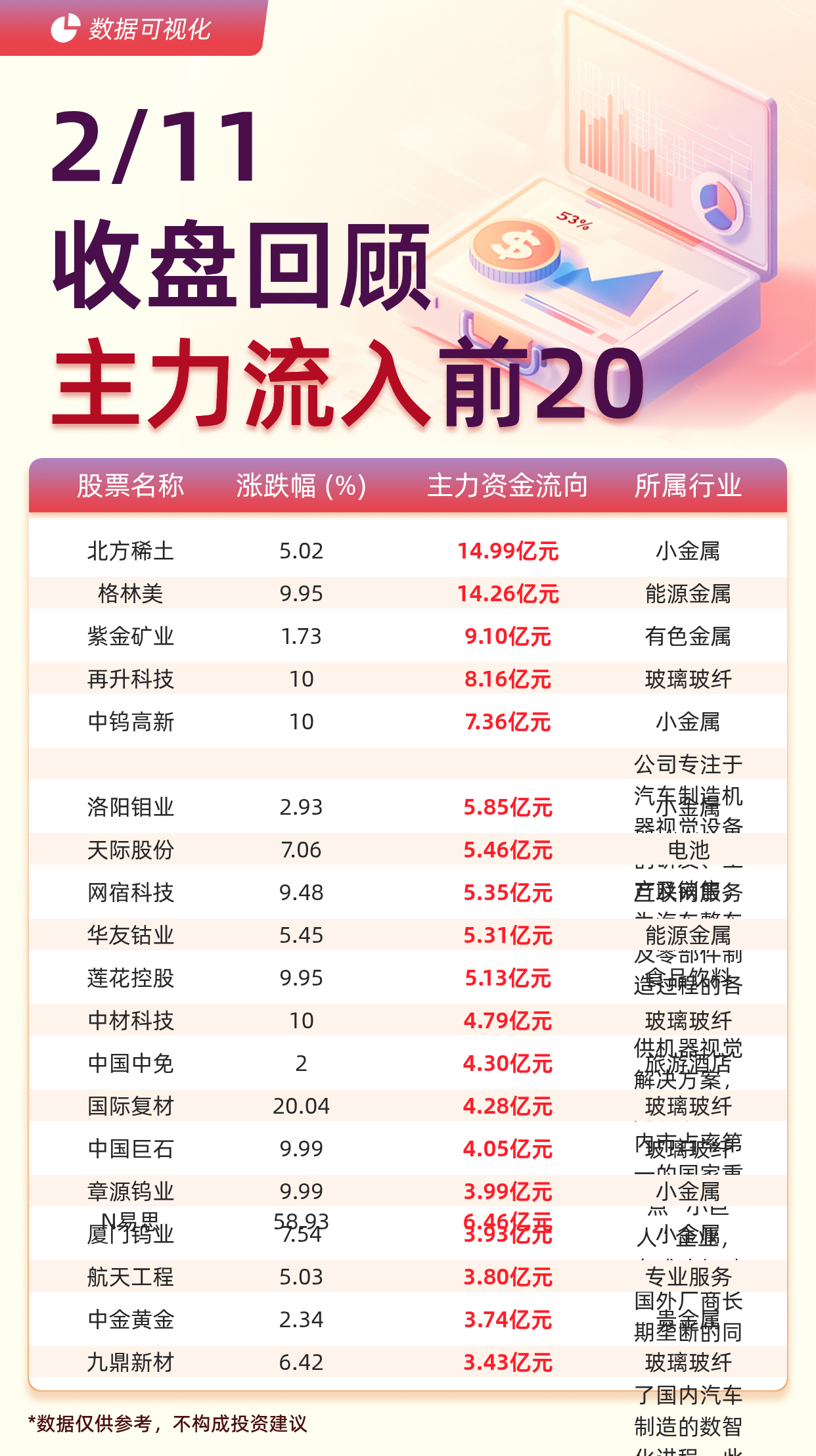
主力资金流入前20:北方稀土流入14.99亿元、格林美流入14.26亿元
Jin Rong Jie· 2026-02-11 07:17
Group 1 - The top 20 stocks with significant capital inflow as of February 11 include Northern Rare Earth (1.499 billion), Greeenmei (1.426 billion), and Zijin Mining (0.910 billion) [1] - Northern Rare Earth experienced a price increase of 5.02%, while Greeenmei saw a rise of 9.95% [2] - Other notable stocks with substantial inflows include Zai Sheng Technology (0.816 billion) and Zhongtung High-tech (0.736 billion), both showing a price increase of 10% [2][3] Group 2 - The sectors represented among the top inflow stocks include small metals, energy metals, and glass fiber [2] - Companies like Huayou Cobalt and Lianhua Holdings also reported significant inflows of 0.531 billion and 0.513 billion respectively, with price increases of 5.45% and 9.95% [2] - International Composite Materials led with a remarkable price increase of 20.04% alongside an inflow of 0.428 billion [3]





A股收评:三大指数涨跌不一,创业板指跌超1%失守3300点,两市成交额不足2万亿,全市场超3200股下跌
Jin Rong Jie· 2026-02-11 07:17
Market Overview - The A-share market showed mixed performance on February 11, with the Shanghai Composite Index closing up by 3.61 points, a 0.09% increase, while the Shenzhen Component Index fell by 49.69 points, down 0.35%, and the ChiNext Index decreased by 35.80 points, down 1.08% [1] - The total trading volume of the Shanghai and Shenzhen markets fell below 2 trillion yuan for the first time in 31 trading days, with over 3,200 stocks declining [1] Sector Performance - The chemical sector has shown strong performance recently, with stocks like Jihua Group hitting the limit up for four out of five days, and other companies such as Taihe New Materials and Baichuan Co. also reaching the limit up [1] - The glass fiber sector experienced a surge, with leading companies like International Composites and China Jushi hitting the limit up due to price increases for electronic cloth [1] - The non-ferrous metals sector was active, particularly tungsten concepts, with Xianglu Tungsten Industry hitting the limit up [1] - The tourism sector declined, with Haikan Co. dropping over 11% [1] Price Increase Themes - The strongest market theme was the "price increase," with small metals, dyes, and electronic cloth driving the surge in the non-ferrous metals and chemical sectors [2] - The non-ferrous metals sector saw significant gains, particularly in gold, zinc, and copper, driven by global supply chain restructuring and the rise of emerging industries [2] - The chemical and dye sectors continued to rise, with Zhejiang Longsheng's dye prices increasing by 5,000 yuan per ton [2] Emerging Themes - The electronic cloth theme emerged strongly, with International Composites and China Jushi both hitting the limit up [3] - The commercial aerospace sector showed signs of recovery, with companies like Zengsheng Technology hitting the limit up, supported by upcoming rocket launches and a commercial aerospace industry development conference [3] - The computing power leasing concept also saw gains, with Nanjing Xingsheng hitting the limit up, driven by positive sentiment from Cloudflare's strong performance in the US market [3] Institutional Insights - Minsheng Securities noted that the market is likely to shift towards small and medium growth stocks as the holiday effect approaches, suggesting to seize opportunities before the Spring Festival [4] - BlackRock's CIO emphasized that the continuation of the A-share bull market depends on four conditions, including liquidity, profit realization, policy support, and reduced geopolitical risks [4] - China Galaxy Securities highlighted the potential for significant box office releases during the upcoming Spring Festival, while also noting advancements in AI video tools that could empower the film industry [4]
A股指数涨跌不一,创业板指跌超1%,两市成交额不足2万亿
Feng Huang Wang Cai Jing· 2026-02-11 07:15
Market Overview - The three major indices showed mixed performance, with the ChiNext and Sci-Tech 50 indices dropping over 1% [1] - As of the market close, the Shanghai Composite Index rose by 0.09%, while the Shenzhen Component Index fell by 0.35%, and the ChiNext Index decreased by 1.08% [1] - The total trading volume of the Shanghai and Shenzhen markets fell below 2 trillion yuan for the first time in 31 trading days, decreasing by 121.3 billion yuan compared to the previous trading day [1][5] Index Performance - Shanghai Composite Index: 4131.99, up 0.09%, with 954 gainers and 1305 losers [2] - Shenzhen Component Index: 14160.93, down 0.35%, with 1061 gainers and 1745 losers [2] - ChiNext Index: 3284.74, down 1.08%, with 468 gainers and 891 losers [2] - The total trading amount for the Shanghai Composite Index was approximately 1.11 trillion yuan, while the Shenzhen Component Index recorded about 788 billion yuan [2] Sector Performance - The chemical sector showed strength, with companies like Jihua Group and Taihe New Materials hitting the daily limit [2] - The glass fiber concept surged, with stocks such as Honghe Technology and Shandong Glass Fiber reaching the daily limit [2] - The non-ferrous metals sector was active, particularly tungsten-related stocks, with Xianglu Tungsten and Zhangyuan Tungsten hitting the daily limit [2] - The computing power leasing concept also saw gains, with companies like Nanxing Co. and Dawi Technology reaching the daily limit [2] Declining Sectors - The film and cinema sector experienced a collective decline, with Hengdian Film falling to the daily limit and other companies like Huayi Brothers and China Film seeing significant drops [3]

大宗周期板块集体上涨,有色金属ETF基金(516650)、石化ETF(159731)双双涨超2%
Mei Ri Jing Ji Xin Wen· 2026-02-11 07:13
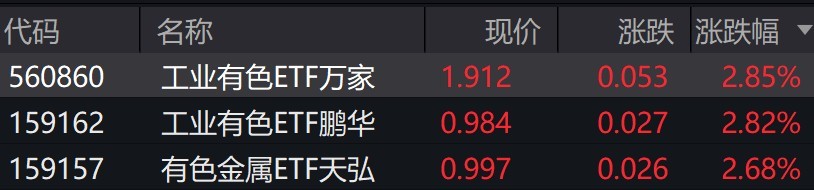
Core Viewpoint - The major indices continued to fluctuate with slight gains, driven by strong performances in the commodity cycle sectors, including precious metals, non-ferrous metals, petrochemicals, and agriculture [1] Group 1: Market Performance - As of 14:43, the following ETFs showed notable gains: Gold Stock ETF (159562) increased by 2.68%, Non-Ferrous Metals ETF (516650) rose by 2.56%, Petrochemical ETF (159731) gained 2.06%, Agricultural ETF (516810) was up by 0.7%, and Gold ETF (518850) increased by 0.62% [2] - Year-to-date performance for these ETFs includes: Gold Stock ETF up 25.50%, Non-Ferrous Metals ETF up 16.53%, Petrochemical ETF up 13.40%, Agricultural ETF up 1.76%, and Gold ETF up 15.46% [2] Group 2: Investment Insights - The strengthening of precious metals, non-ferrous metals, and oil prices has led to increased investor awareness of the appeal of cyclical markets [1] - The cyclical market logic indicates that precious metals are the first to rally, driven by their monetary and safe-haven attributes, which are sensitive to global liquidity, real interest rates, dollar trends, inflation, and risk aversion expectations [1] - Non-ferrous metals act as the "vanguard" of the cycle, being highly sensitive to liquidity and economic expectations, while petrochemicals tend to lag behind due to their dual dependence on oil prices and chemical supply-demand dynamics [1] - Agricultural products are influenced by upstream cost transmission and supply disruptions, representing the final phase of the cyclical market [1]
有色金属概念股走强,工业有色相关ETF涨超2%
Mei Ri Jing Ji Xin Wen· 2026-02-11 06:58
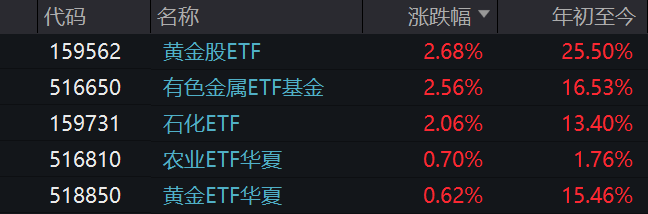
Group 1 - The core viewpoint of the news highlights a strong performance in the non-ferrous metal sector, with notable increases in stocks such as Northern Rare Earth rising over 5% and both Luoyang Molybdenum and Western Mining increasing by over 2% [1] - Industrial non-ferrous related ETFs also saw gains, with an overall increase of over 2% in the market [1] Group 2 - Specific ETF performance includes: - Industrial Non-Ferrous ETF Wanji at a price of 1.912, up by 0.053 or 2.85% - Industrial Non-Ferrous ETF Penghua at a price of 0.984, up by 0.027 or 2.82% - Non-Ferrous Metal ETF Tianhong at a price of 0.997, up by 0.026 or 2.68% [2] - Analysts indicate that despite short-term market fluctuations, the long-term outlook for cyclical resource sectors like industrial non-ferrous remains promising, driven by industrial structural optimization and sustained demand growth [2] - Based on performance trend models, the current valuation of the industrial non-ferrous sector is deemed reasonable, with potential for a rebound, suggesting investors focus on its potential performance within the industry chain to capitalize on investment opportunities from recent declines [2]


新年大吉,“红”运当头!节前轮动加速,如何跨市场构建一个攻守有道的红利组合?
Sou Hu Cai Jing· 2026-02-11 06:54
Core Viewpoint - The article emphasizes the importance of dividend strategies as a stable investment approach amidst market volatility, highlighting the "Dividend Triad" as a key framework for long-term investment planning [1]. Group 1: Dividend Strategies - The "Dividend Triad" represents a diversified investment strategy focusing on high-quality assets that provide stable growth and cash flow [1][17]. - The article suggests that dividends serve as a "ballast" in turbulent markets, allowing investors to concentrate on quality assets and pursue steady growth [1]. Group 2: Index Performance - The CSI Dividend Quality Index is characterized as an "offensive" dividend index that emphasizes dividend yield while also considering quality factors like ROE and earnings stability [3]. - The CSI Dividend Quality Index has shown superior performance compared to mainstream dividend and broad-based indices, with an annualized return of 17.97% since inception [4][10]. - The CSI Dividend All-Return Index has increased by 76.35% since its base period, with an annualized return exceeding 10%, outperforming both the CSI 300 and CSI 500 indices [11]. Group 3: Sector Distribution - The top sectors represented in the CSI Dividend Quality Index include Food & Beverage (13.8%), Pharmaceutical & Biological (10.1%), and Media (6.4%) [3]. - The index excludes banking stocks, focusing instead on sectors like non-ferrous metals, food and beverage, and pharmaceuticals, which are seen as "value growth" representatives [3]. Group 4: Comparison with Other Indices - The Hang Seng High Dividend Low Volatility Index offers a higher dividend yield (6.83%) and lower valuation (P/E of 7.46) compared to the CSI Dividend Index (5.07% yield, P/E of 8.55) [14][13]. - Since early 2020, the Hang Seng High Dividend Low Volatility Index has achieved a cumulative increase of 65.48% with an annualized return of 9.31%, indicating a favorable risk-return profile [12][13].
