
贵金属

Search documents
美联储加息下黄金为何反涨
Jin Tou Wang· 2026-01-29 02:13
Group 1 - The core logic of gold's rise during the Federal Reserve's interest rate hike cycle has shifted from being "interest rate driven" to "credit driven" [1] - Despite nominal interest rates increasing, market expectations indicate that future real interest rates will decline, with the 10-year TIPS yield dropping below 0.8% [1] - Global central banks have purchased over 1,000 tons of gold for seven consecutive years, with countries like China and Russia accelerating their diversification of reserves, positioning gold as a key vehicle for de-dollarization [1] Group 2 - There is a strong market expectation for a rate cut cycle in 2025-2026, with over 70% probability indicated by federal funds futures, creating a consensus on the nearing end of the rate hike cycle [2] - Historical data shows that gold has averaged a 15% increase within six months following the end of the last three rate hike cycles [2] - The ongoing global geopolitical conflicts and the U.S. national debt exceeding $37 trillion have led to a withdrawal from risk assets, resulting in a 23% increase in gold ETF holdings, reaching the highest level since 2021 [2] Group 3 - Central banks have net purchased gold for 15 consecutive years, with a total increase of 3,177 tons from 2022 to 2024, and emerging markets accounting for over 70% of this increase [3] - The People's Bank of China increased its gold reserves by 42 tons in 2024, raising the gold reserve ratio to 4.3%, which supports the internationalization of the renminbi [3] - Gold's share in global reserves has risen to 28.9%, while the dollar's share has fallen below 60%, indicating that gold is evolving from a safe-haven asset to a strategic anchor in the restructuring of the global monetary system [3]
万和财富早班车-20260129
Vanho Securities· 2026-01-29 01:59
Core Insights - The report highlights the structural opportunities in the semiconductor industry as leading companies issue price increase notices, indicating a potential shift in the supply chain dynamics [7] - The AI application landscape is accelerating with the release of new models, suggesting a growing market for companies involved in AI technologies [7] - The upcoming Brain-Computer Interface Developer Conference is expected to spotlight advancements in medical technology, particularly in the healthcare sector [7] Industry Updates - The National Energy Administration projects that by the end of 2025, the cumulative installed capacity of solar power in the country will reach 1.2 billion kilowatts, representing a year-on-year growth of 35.4% [5] - The State-owned Assets Supervision and Administration Commission is promoting strategic and professional restructuring and high-quality mergers and acquisitions [5] Company Focus - TaiLing Microelectronics plans to acquire 100% of Panqi Micro for 850 million yuan to enhance its position in the wireless IoT chip market [9] - Yingxin Development intends to acquire 60% of Changxing Semiconductor for 520 million yuan, entering the storage chip sector [9] - Zhongmu Co., Ltd. expects a net profit attributable to shareholders of 149 million to 192 million yuan for 2025, marking a year-on-year increase of 109.62% to 171.27% [9] - Jiangshan Co., Ltd. anticipates a net profit for 2025 of 480 million to 580 million yuan, reflecting a year-on-year growth of 113.90% to 158.47% [9] Market Review and Outlook - On January 28, the Shanghai Composite Index and Shenzhen Component Index experienced fluctuations, with a total trading volume of 2.97 trillion yuan, an increase of 704 billion yuan from the previous trading day [11] - The report notes a significant divergence in market performance, with cyclical stocks in metals, oil, and chemicals showing strong gains, while sectors like pharmaceuticals and photovoltaics faced declines [11] - The report suggests that despite the challenges in achieving broad market rallies, there remains a healthy rotation among hot sectors, with a focus on precious metals, semiconductors, commercial aerospace, and computing hardware [11]
顺周期板块后续表现或仍值得期待
British Securities· 2026-01-29 01:55
英大证券研究所证券研究报告 2026 年 1 月 29 日 顺周期板块后续表现或仍值得期待 总量视角 【A 股大势研判】 当前大宗商品的轮动行情契合"避险资产、工业需求、能源传导、民生终端" 的路径。2025 年至今,贵金属率先开启牛市,成为周期行情的先行者;随后工业 金属接棒,铜价创下历史新高,碳酸锂上演 V 型反转,背后是新能源、AI 算力等 新兴产业的刚性需求与供给端约束的共振。如今有色板块的上涨,正是这一轮动 逻辑的中期演绎,而按照传导顺序,能源化工与煤炭或将承接行情扩散。 在全球流动性宽松预期下,随着反内卷政策持续推进,国内稳增长政策持续 发力,经济供需格局有望改善,复苏预期强化,直接利好对经济敏感的板块,后 续经济数据(如 PPI)若持续改善,将验证复苏逻辑,驱动顺周期板块上行。可 逢低关注稀土、化工、煤炭、有色金属、基建、地产等板块,周期板块后续表现 或仍值得期待。 分析师:惠祥凤 执业证书编号:S0990513100001 电话:0755-83007028 请务必阅读最后一页的免责条款 1 金 点 策 略 晨 报 邮箱:huixf@ydzq.sgcc.com.cn 周三晨报提醒,依托上证 50 ...
A股早评:三大指数涨跌不一,有色金属板块再度大涨
Ge Long Hui· 2026-01-29 01:36
Group 1 - The A-share market opened with mixed performance among the three major indices, with the Shanghai Composite Index rising by 0.11% to 4155.92 points, while the Shenzhen Component Index and the ChiNext Index opened lower by 0.07% and 0.03% respectively [1] - Precious metals, including gold and silver, have reached new highs, leading to significant gains in the precious metals and other non-ferrous metal sectors, with companies like China Gold, Western Gold, and Silver Nonferrous hitting the daily limit [1] - The lithium mining and cloud computing concept stocks experienced adjustments during this trading session [1]
黄金早参 | 美联储暂缓降息,市场押注鸽派主席人选,金价日内连破3个整数关口
Sou Hu Cai Jing· 2026-01-29 01:29
Group 1 - The Federal Reserve decided to maintain the federal funds rate target range at 3.5% to 3.75%, marking the first pause in rate cuts after three consecutive reductions in the second half of 2025 [1] - Following the Fed's decision, the US dollar index experienced fluctuations, while gold prices surged, breaking through three key price levels and closing at $5,411 per ounce, a 6.46% increase [1] - The Chicago Mercantile Exchange announced an increase in margin requirements for several precious metal futures contracts, which may contribute to short-term volatility in the market [1] Group 2 - The market's expectation of future monetary easing from the Fed, combined with bets on a dovish Fed chair, has highlighted the safe-haven and anti-inflation properties of precious metals [1] - Gold ETFs, such as Huaxia (518850), rose by 3.22%, while gold stock ETFs (159562) increased by 9.25%, and non-ferrous metal ETFs (516650) gained 7.14% [1]
美联储暂缓降息,市场押注鸽派主席人选,金价日内连破3个整数关口
Mei Ri Jing Ji Xin Wen· 2026-01-29 01:22
美联储于2026年1月27~28日举行了年内首次联邦公开市场委员会(FOMC)会议,决定将联邦基金利率目 标区间维持在3.5%~3.75%不变。这是继2025年下半年连续三次降息后,美联储首次暂停降息步伐。芝 加哥商品交易所宣布,上调一系列贵金属期货合约保证金。 相关分析指出,美联储暂停降息但释放未来宽松预期,叠加市场对鸽派美联储主席人选的押注,推动贵 金属避险及抗通胀属性凸显,同时芝商所调整部分贵金属期货保证金参数也可能加剧短期波动。 1月28日,美联储议息会议暂缓降息,美元指数冲高回落,金价再度走强,日内连破3个整数关口,强势 突破5400美元,截至收盘,COMEX黄金期货涨6.46%报5411美元/盎司,黄金ETF华夏(518850)涨 3.22%,黄金股ETF(159562)涨9.25%,有色金属ETF基金(516650)涨7.14%。 ...
黄金白银持续飙涨,推动A股有色金属板块掀起涨停潮
Huan Qiu Wang· 2026-01-29 01:19
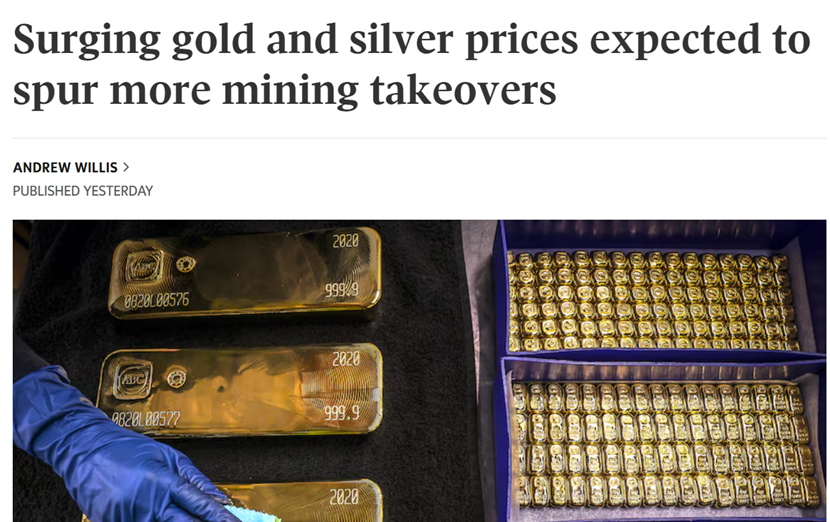
【环球网财经综合报道】北京时间1月29日凌晨,国际贵金属期货普遍收涨,COMEX黄金期货涨6.46%报5411.00美元/ 盎司,COMEX白银期货涨10.06%报116.62美元/盎司。分析人士称,美联储暂停降息但释放未来宽松预期,叠加市场 对鸽派美联储主席人选的押注,推动贵金属避险及抗通胀属性凸显,同时芝商所调整部分贵金属期货保证金参数也可 能加剧短期波动。 伴随着贵金属、有色金属行情持续爆发,A股市场上贵金属和有色金属板块掀起涨停潮,截至1月28日收盘,白银有色 7连板,中国黄金4连板。全市场涨幅前十的ETF有9只为黄金股和有色相关ETF,其中3只黄金股ETF涨停。 《环球邮报》发文称,预计在金价和银价上涨的推动下,大型黄金和白银开采商将与股东分享红利,并利用现金收购 矿产,继续进行快速的并购活动,以增加储备和地理覆盖面。Scotiabank分析师Tanya Jakusconek预计:"随着金属价格 每盎司上涨100美元,运营商的利润将提高90美元/盎司。" 值得关注的是,在贵金属行情愈演愈烈的同时,期货交易所则打出收紧风控的"组合拳"。上金所日前宣布,自1月30 日收盘清算时起,Ag(T+D)合约保证 ...


1月29日国际晨讯丨国际黄金价格突破5500美元关口 特斯拉将停产ModelS和Model X车型
Sou Hu Cai Jing· 2026-01-29 01:12
当地时间1月29日,日韩股市开盘表现分化。日经225指数开盘跌0.11%,报53301.26点;韩国综合指数 涨1.40%,报5243.42点。 美东时间1月28日,美股三大指数收盘涨跌不一。截至收盘,道指涨12.19点,涨幅0.02%,报49015.60 点;纳指涨40.35点,涨幅0.17%,报23857.45点;标普500指数盘初首次触及7000点,随后涨幅收窄, 最终收跌0.01%,报6978.03点。 欧洲三大股指1月28日全线下跌。英国伦敦股市《金融时报》100种股票平均价格指数28日报收于 10154.43点,较前一交易日下跌53.37点,跌幅为0.52%。法国巴黎股市CAC40指数报收于8066.68点,较 前一交易日下跌86.14点,跌幅为1.06%。德国法兰克福股市DAX指数报收于24822.79点,较前一交易日 下跌71.65点,跌幅为0.29%。 黄金白银涨势难挡。1月29日亚市早盘,现货黄金盘中强势站上5500美元/盎司关口,一度触及5598美 元/盎司,随后快速回落,截至8时25分报5480.33美元/盎司;现货白银一度突破119美元/盎司,现报 117.682美元/盎司。国际黄金 ...

美联储暂停降:申万期货早间评论-20260129
申银万国期货研究· 2026-01-29 00:58
Core Viewpoint - The Federal Reserve decided to maintain the federal funds rate target range at 3.5%-3.75%, marking the first pause in rate cuts after three consecutive reductions in the second half of 2025. The assessment of economic activity was upgraded to "expanding at a robust pace," indicating signs of stabilization in the unemployment rate and persistent inflation above target levels [1] Group 1: Precious Metals - Precious metals continue to rise, with international gold prices reaching historical highs due to geopolitical tensions and a loose liquidity environment. The market's concerns over U.S. debt sustainability and the independence of the Federal Reserve have led to increased demand for gold as a safe-haven asset [2][15] - The recent FOMC meeting's decision to pause rate cuts has improved concerns regarding employment risks, supporting the upward trend in precious metals. The demand for strategic allocation in precious metals is increasing, with gold and silver ETF sizes expanding [2][15] Group 2: Oil - The SC night market saw an increase of 1.54% in oil prices. The easing of tensions in Venezuela and potential diplomatic engagement between the U.S. and Iran have contributed to this rise. Venezuela is advancing a comprehensive oil law reform, allowing both foreign and local companies to independently develop oil fields [3][10] - As of January 16, the average daily U.S. crude oil production was 13.732 million barrels, a decrease of 21,000 barrels from the previous week but an increase of 255,000 barrels year-on-year [3][10] Group 3: Aluminum - The night market for aluminum saw an increase of 1.87%. However, the current upward drivers in the spot market are limited, with the aluminum water ratio declining below 75%. The operating rates of leading downstream aluminum enterprises have also decreased, reflecting weak consumption sentiment [3][19] - Despite a weak short-term fundamental outlook, long-term narratives of low inventory, supply constraints, and stable demand provide relative support for aluminum prices [19] Group 4: Economic Indicators - The U.S. stock market has shown a positive trend in 2026, driven by the technology cycle, policy benefits, economic recovery, and the return of overseas funds. The market is transitioning from valuation expansion to profit-driven growth [7] - The Federal Reserve's decision to maintain the benchmark interest rate aligns with market expectations, and the economic outlook remains uncertain with inflation still relatively high [4][9]

鸽派预期再定价,?价加速创历史新
Zhong Xin Qi Huo· 2026-01-29 00:55
Report Summary 1. Report Industry Investment Rating No information provided. 2. Core Viewpoints - The expectation of a more dovish and marginally less independent Federal Reserve is rising, and the spillover of sovereign debt and currency hedging demand has pushed precious metals to accelerate their upward movement. Gold has broken through key integer levels and risen with increasing volume under the dominance of allocation funds, while silver has followed with amplified elasticity, but trading and volatility risks have also increased, and structural differentiation has become more apparent [1]. - Gold's upward trend continues and hits a new high. The resonance of monetary policy expectations and hedging allocation is formed. In the short term, attention should be paid to the increase in volatility. Silver's high - elasticity rise continues, but the volatility is significantly amplified, and trading - level constraints increase. In the short term, it is more likely to fluctuate and digest [2]. 3. Summary by Related Catalogs Gold - **Viewpoint**: The upward trend continues and hits a new high. The resonance of monetary policy expectations and hedging allocation is formed. In the short term, attention should be paid to the increase in volatility [2]. - **Logic**: The market's repricing of looser future monetary policy continues. The dovish expectation around the next Federal Reserve Chairman is rising, which strengthens the attractiveness of non - interest - bearing assets. At the same time, sovereign debt and currency are under pressure, and geopolitical uncertainties are rising. Funds are flowing to safe - haven assets such as gold, pushing the gold price to break through $5400 per ounce and rise with increasing volume. The allocation and options sides both reflect the willingness to price the upward risk. Gold continues to show the characteristics of low volatility and strong trend among precious metals [2]. - **Outlook**: In the medium term, the logic is solid under the resonance of monetary policy expectations, hedging allocation, and de - credit narrative. In the short term, there may be an increase in volatility and profit - taking, but it is still attractive for allocation during the回调 [2]. Silver - **Viewpoint**: The high - elasticity rise continues, but the volatility is significantly amplified, and trading - level constraints increase. In the short term, it is more likely to fluctuate and digest [2]. - **Logic**: Silver strengthens with the overall precious metals, and the stage increase continues to expand, but the price volatility is significantly higher than that of gold. In the context of rapid upward movement, the requirements for risk management on the trading side increase, and the marginal impact of capital and sentiment changes on the silver price is enhanced. Compared with gold, silver is more sensitive to liquidity and speculative sentiment, and the risk of retracement at high levels is also accumulating [2]. - **Outlook**: In the medium term, it is still supported by the macro - logic dominated by gold, but in the short term, it needs to release the volatility pressure through high - level fluctuations. Attention should be paid to the impact of capital re - balance and volatility changes on the rhythm [2]. Commodity Index - **Special Index**: The commodity index is 2529.70, up 1.21%; the commodity 20 index is 2919.66, up 1.52%; the industrial products index is 2378.08, up 0.89%; the PPI commodity index is 1474.48, up 1.29% [45]. - **Plate Index**: The precious metals index on January 28, 2026, is 5155.66, with a daily increase of 3.28%, a 5 - day increase of 13.83%, a 1 - month increase of 29.58%, and a year - to - date increase of 34.82% [46].