
传媒

Search documents
国泰海通 · 策略 |投资中国:稳中求进是中国经济和股市的底色——2026年政府工作报告解读与投资展望
国泰海通证券研究· 2026-03-05 09:52
Core Viewpoint - The 2026 government work report aims to optimize economic growth targets, focusing on structural adjustment, risk prevention, and reform to stabilize investment and enhance market expectations, with emerging technologies as a key theme [2]. Summary by Sections Economic Growth Targets - The GDP growth target has been adjusted from "around 5%" to "4.5%-5.0%", reflecting a more pragmatic approach to economic growth [3]. - The increase in the scale of policy financial tools is expected to help stabilize investment [3]. Domestic Demand and Investment - The focus of China's economic policy is on domestic demand, with a goal to stabilize and revitalize investment, especially as fixed asset investment has turned negative in recent years [4]. - Key measures include a fiscal deficit rate of 4%, special government bonds of 1.6 trillion, local government special bonds of 4.4 trillion, and new debt of 11.89 trillion [4]. - An additional 800 billion in new policy financial tools is expected to leverage around 11 trillion in investment, aiding in stabilizing investment [4]. Technological Advancement and Structural Transformation - The report emphasizes high-quality development and the importance of new productive forces, with a focus on industrial innovation and structural transformation [5]. - New emerging industries will include integrated circuits and biomedicine, while future industries will focus on future energy and brain-computer interfaces [5]. - The digital economy's value-added target has been raised from 10% to 12.5% by 2025 [5]. Capital Market Reforms - Recent improvements in the Chinese stock market have shifted policy focus from market stabilization to foundational institutional building [6]. - Emphasis is placed on improving mechanisms for long-term capital entry into the market and enhancing investor protection [6]. - New channels for private equity and venture capital fund exits are proposed to facilitate capital circulation and support the real economy [6]. Investment Recommendations - The government’s pragmatic approach aims to stabilize and expand domestic demand, which is expected to improve public confidence in economic prospects [7]. - Sectors likely to benefit include construction materials, chemicals, real estate, and consumer goods, as well as financial sectors like banks and non-banks [7]. - Emerging technologies, particularly in AI and self-sufficiency, are recommended for investment, including sectors like electronics, machinery, and aerospace [7].


2026年政府工作报告解读与投资展望:投资中国:稳中求进是中国经济和股市的底色
GUOTAI HAITONG SECURITIES· 2026-03-05 08:57
Group 1 - The core viewpoint of the report emphasizes that the Chinese government's focus is on stabilizing expectations, adjusting structures, preventing risks, and promoting reforms to drive investment recovery [5] - The GDP growth target has been adjusted from "around 5%" to "4.5%-5.0%", indicating a more pragmatic approach to economic growth [5] - The report highlights the importance of expanding domestic demand and stabilizing development confidence, suggesting that the Chinese market is expected to maintain an upward trend [5] Group 2 - The report outlines a stronger policy focus on expanding domestic demand, with an increase of 300 billion yuan in new policy financial tools, which is expected to leverage social capital significantly [5] - It emphasizes the need to stimulate consumer spending by increasing residents' income and expanding support for service industry loans [5] - Investment strategies are becoming more focused, with a clear direction towards high-tech sectors and new quality productivity [5] Group 3 - The report identifies three key areas for industrial development: expansion of emerging industries, deepening AI initiatives, and promoting green and intelligent upgrades in traditional sectors [5] - It states that the digital economy's value-added target has been raised from 10% to 12.5% for the 14th Five-Year Plan [5] - The report suggests that the government will lead the way in opening up new markets for emerging technologies, fostering new growth drivers [5] Group 4 - The report indicates a shift in focus for capital market reforms, emphasizing investor protection and the balance of investment and withdrawal [5] - It highlights the importance of creating a market ecosystem that facilitates long-term investments and addresses institutional barriers [5] - The report also mentions the need to expand exit channels for private equity and venture capital funds to enhance capital circulation [5] Group 5 - Investment recommendations suggest a positive outlook for the Chinese stock market, driven by government policies aimed at stabilizing and expanding domestic demand [5] - The report identifies sectors such as construction materials, chemicals, and traditional industries as beneficiaries of the investment recovery [5] - It also highlights the potential of the financial sector and emerging technologies, particularly in AI applications, as key areas for investment [5]

百度集团-SW(09888):25Q4业绩点评:广告业务有望迎来拐点,看好云业务高增
Orient Securities· 2026-03-05 08:19
Investment Rating - The report maintains a "Buy" rating for the company with a target price of 141.85 HKD per share, based on a PE valuation method [4][7]. Core Insights - The company's traditional online marketing business is experiencing a decline, while AI new business is still in the cultivation phase. The adjusted net profit forecast for 2025-2027 is 189/191/221 billion CNY [3][7]. - The advertising business is expected to see a narrowing of its decline, with AI search commercialization accelerating the potential recovery. The report estimates Q4 2025 advertising revenue at 150 billion CNY, down 16% year-on-year but with a slight improvement from Q3 [6]. - Cloud business is becoming a significant driver of revenue growth, with Q4 2025 intelligent cloud revenue reaching 58 billion CNY, a 38% quarter-on-quarter increase [6]. Financial Information - The company's revenue for 2023 is reported at 134,598 million CNY, with a projected decline to 129,079 million CNY in 2025, followed by a slight recovery to 137,623 million CNY in 2027 [3][10]. - The adjusted net profit for 2023 is 28,747 million CNY, expected to decrease to 18,941 million CNY in 2025, before recovering to 22,052 million CNY in 2027 [3][10]. - The gross margin is projected to decline from 52% in 2023 to 44% in 2025, with a slight recovery to 47% by 2027 [3][10].

ETF资金流向视角下的行业轮动配置
Huafu Securities· 2026-03-04 13:27
Quantitative Models and Construction Methods 1. Model Name: Industry Allocation Model Based on ETF Fund Flows - **Model Construction Idea**: The model leverages ETF fund flow data to identify industry rotation opportunities. It incorporates short-term fund inflows/outflows, style-adjusted holding levels, marginal changes in holdings, and the divergence between ETF and active equity fund holdings to construct an industry allocation strategy[3][69][72] - **Model Construction Process**: 1. **Short-term Fund Flows**: Calculate the first-order difference of weekly ETF holdings to identify industries with significant inflows or outflows[40][44] 2. **Style-Adjusted Holdings**: Adjust industry holdings based on market style (e.g., large-cap vs. small-cap, growth vs. value) using a single-sided HP filter and factor momentum to determine style trends[49][50][57] 3. **Marginal Changes in Holdings**: Analyze the marginal changes in ETF holdings by ranking industries into five groups based on their monthly holding changes[22][25] 4. **Divergence with Active Equity Funds**: Compare ETF holdings with active equity fund holdings to identify industries with higher or lower relative allocations. Use regression-based methods to estimate active fund holdings when real data is unavailable[27][28][31] 5. **Final Strategy**: Combine the above factors equally, select the top six industries, and rebalance the portfolio bi-weekly[72] - **Model Evaluation**: The model effectively captures industry rotation opportunities by integrating multiple dimensions of ETF fund flow data and market style trends[72] --- Model Backtesting Results 1. Industry Allocation Model Based on ETF Fund Flows - **Annualized Return**: 15.57% - **Excess Annualized Return**: 7.56% (compared to equal-weighted industry benchmark) - **Information Ratio (IR)**: 0.93 - **Maximum Drawdown**: 8.30% - **Monthly Excess Win Rate**: 64% - **Payoff Ratio**: 1.38x[72] --- Quantitative Factors and Construction Methods 1. Factor Name: Short-term Fund Flows - **Factor Construction Idea**: Identify industries with significant short-term fund inflows or outflows to capture immediate price impacts[40][44] - **Factor Construction Process**: 1. Calculate the first-order difference of weekly ETF holdings 2. Rank industries based on the magnitude of fund flow changes[40][44] - **Factor Evaluation**: Demonstrates strong monotonicity in short-term returns, with industries experiencing inflows showing higher returns[44] 2. Factor Name: Style-Adjusted Holdings - **Factor Construction Idea**: Adjust industry holdings based on prevailing market styles (e.g., large-cap vs. small-cap, growth vs. value)[46][49] - **Factor Construction Process**: 1. Use a single-sided HP filter to smooth market style data (e.g., CSI 300/CSI 1000 index ratios) 2. Define factor momentum as the difference between the current value and the average of the previous two periods 3. Classify industries into five groups based on their adjusted holdings[49][50][57] - **Factor Evaluation**: Captures the relationship between industry holdings and market style trends, effectively identifying style-driven opportunities[47][57] 3. Factor Name: Marginal Changes in Holdings - **Factor Construction Idea**: Analyze the marginal changes in ETF holdings to identify industries with increasing or decreasing allocations[22][25] - **Factor Construction Process**: 1. Calculate the monthly difference in ETF holdings for each industry 2. Rank industries into five groups based on the magnitude of changes[22][25] - **Factor Evaluation**: Demonstrates a strong correlation with growth and value style trends, providing insights into industry rotation opportunities[47] 4. Factor Name: Divergence with Active Equity Fund Holdings - **Factor Construction Idea**: Compare ETF holdings with active equity fund holdings to identify industries with higher or lower relative allocations[27][28] - **Factor Construction Process**: 1. Use regression-based methods to estimate active fund holdings when real data is unavailable 2. Calculate the difference between ETF and active fund holdings and rank industries into three groups based on the magnitude of divergence[27][28][31] - **Factor Evaluation**: Highlights the pricing power of ETF flows relative to active funds, especially post-2021[31][65] --- Factor Backtesting Results 1. Short-term Fund Flows - **Absolute Return**: 6.17% (highest group) - **Annualized Volatility**: 21.22% - **Sharpe Ratio**: 0.29 - **Maximum Drawdown**: -37.61%[42] 2. Style-Adjusted Holdings - **Annualized Return**: 9.66% - **Excess Annualized Return**: 5.82% - **Information Ratio (IR)**: 0.75 - **Maximum Drawdown**: -29.11%[55] 3. Marginal Changes in Holdings - **Annualized Return**: 7.80% (highest group) - **Excess Annualized Return**: 6.91% - **Information Ratio (IR)**: 1.13 - **Maximum Drawdown**: -16.10%[71] 4. Divergence with Active Equity Fund Holdings - **Annualized Return**: 14.01% - **Excess Annualized Return**: 6.11% - **Information Ratio (IR)**: 0.76 - **Maximum Drawdown**: -28.80%[64][65]
量化点评报告:三月配置建议:关注顺周期主线
GOLDEN SUN SECURITIES· 2026-03-04 11:57
- The "Six-Cycle Model" identifies economic phases using the three-month difference in medium- and long-term loan pulses (TTM YoY). As of January, the model entered Phase 6, "Monetary Expansion," indicating a defensive allocation strategy[7][11] - The "Analyst Industry Prosperity Index" evaluates industry performance expectations. The index shows that the cyclical and growth sectors are in an expansion phase, with the cyclical sector entering this phase in January 2025[12][13] - The "Industry Relative Strength Index (RS)" ranks industries based on cross-sectional returns. Industries with RS > 90% by April are likely to lead the market. As of February 2026, seven industries, including non-ferrous metals and petrochemicals, showed RS > 90% signals[15][16] - The "Style Factor Analysis" evaluates factors like small-cap, value, quality, and growth based on three metrics: odds, trend, and crowding. Small-cap and value factors scored highest, while growth and quality factors showed weaker trends[30][32][36][39] - The "Industry Configuration Model" uses two approaches: the "Industry Prosperity Model" (high prosperity + strong trend, avoiding high crowding) and the "Industry Trend Model" (strong trend + low crowding, avoiding low prosperity). March recommendations include cyclical sectors like chemicals and coal[46][48][50] - The "Inventory Cycle Reversal Model" identifies industries in recovery phases with low inventory pressure. Current recommendations include oil services, coal chemicals, and rare metals. Historical backtests show strong absolute and excess returns[55][56][57] - The "Odds and Win Rate Strategies" include three models: "Odds-Enhanced," "Win Rate-Enhanced," and "Odds + Win Rate." These models optimize asset allocation based on risk budgets. Historical performance shows annualized returns of 6.7%-7.9% with low drawdowns[58][61][64]
2026年3月核心荐股
Guoyuan International· 2026-03-04 11:24
Group 1: Company Performance and Market Trends - 和誉-B (2256.HK) has a total market value of HKD 76 million, with a current price of HKD 11.15, showing a price increase of 158.7% since its inclusion on November 1, 2024[3] - 基石药业-B (2616.HK) has a market value of HKD 92 million, with a current price of HKD 6.26, reflecting a price drop of 24.7% since February 2, 2026[3] - 宜明昂科-B (1541.HK) has a market value of HKD 15 million, with a current price of HKD 3.55, down 48.6% since April 2, 2025[3] - 石药集团 (1093.HK) has a market value of HKD 1,062 million, with a current price of HKD 9.22, showing a slight increase of 3.0% since September 26, 2025[3] Group 2: Financial Metrics and Projections - 和誉-B (2256.HK) has an EPS of HKD 0.04 for 2024, with a PE ratio of 258.13 and a PB ratio of 3.59[3] - 基石药业-B (2616.HK) has an EPS of -0.07 for 2024, with a PE ratio of -89.43 and a PB ratio of 23.52[3] - 宜明昂科-B (1541.HK) has an EPS of -0.91 for 2024, with a PE ratio of -3.91 and a PB ratio of 2.09[3] - 石药集团 (1093.HK) has an EPS of 0.40 for 2024, with a PE ratio of 23.16 and a PB ratio of 3.05[3] Group 3: Strategic Insights - 和誉-B has a strong pipeline of 16 oncology drug candidates, with 10 in clinical stages, and a licensing agreement with Merck worth USD 605.5 million[3] - 基石药业-B has successfully launched 4 innovative drugs and is conducting global clinical trials for its core product CS2009, a tri-specific antibody[3] - 宜明昂科-B's core product IMM01 is the first SIRPα-Fc fusion protein in clinical stages in China, with promising clinical data and a rich pipeline[3] - 石药集团 is focusing on oncology, neuropsychiatric, and cardiovascular treatments, with over 60 key drugs in clinical or application stages, expecting a recovery in performance post-2025[3]
从MiniMax首份财报看AI产业趋势:技术迭代推动Token和商业化上量,26年重点看全模态融合
Orient Securities· 2026-03-04 05:28
Investment Rating - The industry investment rating is maintained as "Positive" for the media sector in China [6] Core Insights - MiniMax's 2025 financial report shows a year-over-year revenue increase of 159%, reaching $79.04 million, with a gross margin improvement of 13 percentage points to 25.4%. The adjusted net loss was $250 million. In Q4 2025, revenue increased by 131% year-over-year to $25.6 million, with AI-based enterprise services growing by 278% to $10.55 million, accounting for 41% of total revenue [2][3] - The report emphasizes the importance of full-modal integration in AI development, highlighting that the accumulation of each modality's research is a lengthy process. The ability to synergize modalities requires massive data processing and infrastructure redesign [3] - The report suggests that the AI industry is experiencing a trend of exponential growth, favoring companies with unique technology, strategic focus, and efficient R&D. MiniMax's strategic positioning avoids direct competition with larger firms by focusing on model development and innovative agent products [3] Summary by Sections Financial Performance - MiniMax's Q4 2025 revenue reached $25.6 million, with a gross margin of 29.7% and an adjusted net loss of $64.58 million. The company's annual revenue for 2025 was $79.04 million, with significant growth in AI enterprise services [2][9] Market Opportunities - The report identifies investment opportunities in technology giants with a full-stack AI approach and model vendors with full-modal technology layouts, including Alibaba, Google, MiniMax, and Zhizhu [4] - Other companies with model capabilities and those benefiting from foundational model iterations and improved downstream application experiences are also highlighted, such as Tencent and Kuaishou [4] Industry Trends - The AI industry is characterized by rapid model capability iterations leading to significant growth opportunities. MiniMax's recent model releases have resulted in a substantial increase in usage and revenue, with February's ARR reaching $150 million, a 46% increase from Q4 2025 [9] - The report anticipates that the upcoming M3 series release will enhance model intelligence through full-modal integration, benefiting various applications such as programming and office productivity [9]
三重压力,恒生科技继续回调,南向资金逆势“抄底”,机构:互联网龙头静待修复
Xin Lang Cai Jing· 2026-03-04 03:00
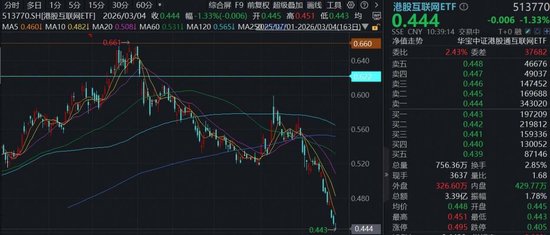
Core Viewpoint - The Hong Kong stock market is experiencing a significant adjustment, particularly in the technology sector, driven by concerns over high expenditures, competition from new AI players, and liquidity pressures due to changing Federal Reserve interest rate expectations [3][11]. Market Performance - On March 4, the Hong Kong stock market opened lower, with the Hang Seng Index and Hang Seng Tech Index both dropping over 1%. The Hong Kong Internet ETF (513770) fell by 1.33%, reaching a new low since July 2025. Major internet companies like Alibaba-W, Meituan-W, and Tencent Holdings saw declines of over 3%, nearly 2%, and 0.88%, respectively [1][9]. Investment Trends - Despite the market downturn, southbound capital has been consistently increasing. As of March 3, there were 27 net inflow trading days out of 36 this year, totaling a net inflow of 181.8 billion HKD. Major internet companies have seen significant increases in holdings, with Tencent's market value exceeding 540 billion HKD and Alibaba's over 320 billion HKD [3][11]. Sector Analysis - Analysts suggest that the current deep adjustment in the Hong Kong tech sector is due to three main pressures: concerns over high spending on delivery subsidies and AI initiatives, competition from emerging AI companies, and liquidity pressures from revised Federal Reserve interest rate expectations [3][11]. - Investment opportunities are emerging in the Hong Kong Internet sector as policies supporting AI development are expected to enhance the growth of internet companies [3][11]. ETF Insights - The Hong Kong Internet ETF (513770) and its linked funds are designed to track the CSI Hong Kong Internet Index, with the top ten holdings including major players like Alibaba-W, Tencent Holdings, and Xiaomi Group, collectively accounting for over 76% of the index [4][12]. - For investors looking to reduce volatility while still gaining exposure to technology, the Hong Kong Large Cap 30 ETF (520560) is recommended, combining high-growth tech stocks with stable dividend-paying companies [14].

未知机构:东财策略每日复盘20260303一市场概况3月-20260304
未知机构· 2026-03-04 02:50
Summary of Conference Call Notes Industry Overview - The conference call discusses the A-share market performance on March 3, 2023, highlighting a significant decline across major indices. The Shanghai Composite Index fell by 1.43% to close at 4122 points, while the Shenzhen Component Index and the ChiNext Index dropped by 3.07% and 2.57%, respectively. The total trading volume reached 3.13 trillion yuan, an increase of over 100 billion yuan compared to the previous trading day [1][1][1]. Key Points on Industry Performance - **Top Performing Industries**: - Oil and Petrochemicals: +6.75% - Coal: +1.76% - Transportation: +1.13% - Banking: +1.07% - Public Utilities: +0.49% [1][1][1] - **Underperforming Industries**: - Defense and Military: -6.74% - Non-ferrous Metals: -5.61% - Electronics: -5.30% - Computers: -4.94% - Media: -4.29% [1][1][1] Market News - The Ministry of Industry and Information Technology, along with five other departments, released guidelines to promote the comprehensive utilization of photovoltaic components, aiming to enhance technology and equipment levels by 2030 [3][3][3]. - In the first week following new policies in the Shanghai real estate market, there was a rapid increase in demand-side activity, with online inquiries rising by 97.6% and conversion rates improving by 180% [3][3][3]. - Qatar Energy, the world's largest natural gas producer, announced a halt in liquefied natural gas exports due to military attacks on its facilities [3][3][3]. Market Outlook and Considerations - The Shanghai Composite Index's recent performance has created a situation of trapped capital and pessimism that will require time to resolve. If the intensity of the U.S.-Iran conflict continues, short-term risk aversion may persist. However, there is no need for excessive pessimism as the current economic resilience and cycle position have improved compared to 2022. The impact of war and high oil prices on inflation affecting AI hardware and other assets is expected to be limited [4][4][4]. - Despite the overall market decline, sectors with solid supply-demand dynamics, such as gas turbines, remain strong. Core assets with robust supply-demand support are crucial indicators. As the Two Sessions approach, the deeply corrected technology growth sector may see a rebound in funding due to policy catalysts [4][4][4]. Recommendations - It is advised to closely monitor the situation in the Middle East and oil price trends, while also paying attention to policy signals from the Two Sessions that may influence market risk appetite [5][5][5].
上海现代服务业联合会荣续智库
荣续智库· 2026-03-04 02:15
Investment Rating - The report does not explicitly provide an investment rating for the media industry Core Insights - The media industry is undergoing profound changes driven by digital transformation, with significant shifts in its structure, dissemination methods, and business models [14][16] - ESG (Environmental, Social, and Governance) principles are becoming essential for the media industry, influencing operational practices and investment decisions [6][35] - The global media industry is projected to reach a market size of $2.8 trillion by 2024, with digital media's share increasing from 54% in 2019 to 68% in 2023 [22][24] - The rise of digital advertising is notable, with a market size of $657 billion in 2023, reflecting a 19.4% growth [23] - The industry faces challenges such as declining print media revenues and increasing competition from digital platforms [21][28] Summary by Sections Chapter 1: Overview of the Media Industry - The media industry plays a crucial role in information dissemination, cultural exchange, and public opinion shaping [15] - The industry is segmented into traditional media, digital media, and supporting services, with digital media rapidly expanding [16] - Key trends include globalization of platform operations, intelligent content production, and convergence of business models [16][17] Chapter 2: ESG Practices in the Media Industry - The report highlights the importance of ESG in the media sector, with 85% of companies upgrading their ESG governance frameworks due to regulatory influences [35] - The overall ESG disclosure rate in the media industry is 78%, surpassing the global average of 64% [40] - Leading companies like Disney and Netflix are setting benchmarks in ESG reporting, with comprehensive disclosures on environmental impacts and governance practices [40][41] Chapter 3: Analysis of Sub-sectors in the Media Industry - The report discusses various sub-sectors, including print media, digital media, outdoor media, and broadcasting, each facing unique challenges and opportunities in ESG implementation [59] - Print media is adapting through digital transformation and green printing initiatives, while digital media is leveraging technology for content creation and distribution [60][62] Chapter 4: Excellent ESG Cases in Media Companies - Notable examples include Disney's virtual production technology reducing carbon emissions and Netflix's detailed carbon footprint reporting [40][51] - Companies are increasingly focusing on diversity and inclusion, with initiatives aimed at improving gender and ethnic representation in leadership roles [53] Chapter 5: Development History of the Media Industry in China - The Chinese media industry has evolved from traditional dominance to digital transformation, with significant growth in mobile internet and AI technologies [30][31] - The report outlines key phases of development, highlighting the impact of regulatory changes and technological advancements on the industry [30][31]
