
公用事业

Search documents
粤开市场日报-20250811
Yuekai Securities· 2025-08-11 12:40
Market Overview - The A-share market showed a mostly positive trend today, with the Shanghai Composite Index rising by 0.34% to close at 3647.55 points, and the Shenzhen Component Index increasing by 1.46% to 11291.43 points [1] - The total trading volume in the Shanghai and Shenzhen markets reached 182.7 billion yuan, an increase of 11.67 billion yuan compared to the previous trading day [1] Industry Performance - Among the primary industries, sectors such as power equipment, telecommunications, computers, electronics, food and beverage, and pharmaceuticals led the gains, while banking, oil and petrochemicals, coal, public utilities, transportation, and textiles faced declines [1] - The top-performing concept sectors included PEEK materials, lithium mining, stock trading software, cultivated diamonds, lithium iron phosphate batteries, circuit boards, lithium battery anodes, and power equipment [2]
【11日资金路线图】两市主力资金净流入超70亿元 计算机等行业实现净流入
Zheng Quan Shi Bao· 2025-08-11 11:53
8月11日,A股市场整体上涨。 截至收盘,上证指数收报3647.55点,上涨0.34%;深证成指收报11291.43点,上涨1.46%;创业板指收 报2379.82点,上涨1.96%。两市合计成交18269.73亿元,较上一交易日增加1167.46亿元。 1. 两市主力资金净流入超70亿元 | | | 资金净流入居前的行业 | | | --- | --- | --- | --- | | 行业 | 涨跌幅 | 净流入资金 (亿元) | 资金流入较多个股 | | 计算机 | 1.86% | 130. 51 | 同花顺 | | 电子 | 2. 23% | 122. 05 | 歌尔股份 | | 电力设备 | 2. 22% | 114. 52 | 亿纬锂能 | | 矢药生物 | 1.72% | 63. 49 | 常山药业 | | 食品饮料 | 0. 98% | 54. 93 | 贵州茅台 | | | | 资金净流出居前的行业 | | | 行业 | 涨跌幅 | 净流入资金 (亿元) | 资金流出较多个股 | | 国防军工 | 0. 77% | -41. 11 | 中国船舶 | | 银行 | -0.97% | -40. 7 ...

“著名反指”美银调查:机构对经济和AI更乐观,对中国更乐观,加密货币和黄金持仓很低
美股IPO· 2025-08-11 11:39
Core Viewpoint - The August Bank of America Fund Manager Survey (FMS) indicates a significant improvement in investor sentiment, reaching a six-month high, driven by optimism regarding AI's impact on productivity and expectations of a "soft landing" for the global economy [1][3][7] Group 1: Investor Sentiment and Economic Outlook - 68% of respondents expect a "soft landing" for the global economy, with only 5% anticipating a "hard landing," the lowest since January [9] - The net overweight ratio for equities has risen for the fourth consecutive month, reaching 14%, the highest in six months [4] - Optimism regarding future interest rate cuts has reached its highest point since December 2024 [11] Group 2: AI and Productivity - 55% of fund managers believe AI has already begun to enhance productivity, a significant increase from 42% in July [5][16] - Despite the optimism, there is a divide regarding AI stocks, with 52% believing they are not in a bubble, while 41% think otherwise [18] Group 3: Emerging Markets and China - There is a notable shift in asset allocation towards emerging markets, with the net overweight ratio for emerging market stocks rising from 22% to 37%, the highest since February 2023 [21] - A net 11% of respondents expect the Chinese economy to strengthen, the highest level since March 2025 [23] Group 4: Cryptocurrency and Gold - Interest in cryptocurrencies remains low, with only 9% of respondents holding them, and an average allocation of just 3.2% among holders [27] - Gold also sees limited interest, with 48% of investors holding it, but an overall average allocation of only 2.2% [30]

【11日资金路线图】两市主力资金净流入超70亿元 计算机等行业实现净流入
证券时报· 2025-08-11 11:28
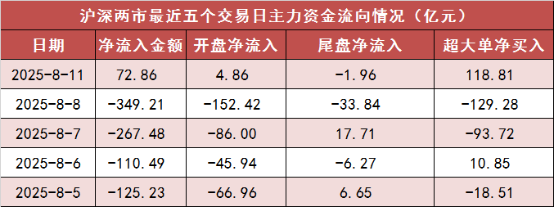
2. 沪深300主力资金净流入超110亿元 沪深300今日主力资金净流入111.81亿元,创业板净流入16.23亿元。 8月11日,A股市场整体上涨。 截至收盘,上证指数收报3647.55点,上涨0.34%;深证成指收报11291.43点,上涨1.46%;创业板指收报 2379.82点,上涨1.96%。两市合计成交18269.73亿元,较上一交易日增加1167.46亿元。 1. 两市主力资金净流入超70亿元 今日沪深两市主力资金开盘净流入4.86亿元,尾盘净流出1.96亿元,全天净流入72.86亿元。 | | | 沪深两市最近五个交易日主力资金流向情况(亿元) | | | | --- | --- | --- | --- | --- | | 日期 | | 净流入金额 开盘净流入 | 尾盘净流入 | 超大单净买入 | | 2025-8-11 | 72. 86 | 4. 86 | -1.96 | 118. 81 | | 2025-8-8 | -349. 21 | -152. 42 | -33.84 | -129.28 | | 2025-8-7 | -267. 48 | -86.00 | 17.71 | -93.72 ...

中国低碳指数报5709.54点,前十大权重包含比亚迪股份等
Jin Rong Jie· 2025-08-11 11:06
Core Points - The China Low Carbon Index is currently at 5709.54 points, reflecting a low opening and fluctuations in the Shanghai Composite Index [1] - The index has increased by 2.89% over the past month, 7.53% over the past three months, and 1.14% year-to-date [2] Index Composition - The China Low Carbon Index consists of 40 representative companies in the low-carbon economy sector, selected from domestic and international listings [2] - The top ten weighted companies in the index are: - Sungrow Power Supply (5.83%) - LONGi Green Energy (5.17%) - CATL (5.07%) - TBEA (4.83%) - China National Nuclear Power (4.56%) - China Everbright Environment (4.52%) - Yangtze Power (4.38%) - Three Gorges Energy (4.34%) - BYD Company (4.01%) - Conch Venture (3.90%) [2] Market Distribution - The market distribution of the China Low Carbon Index shows that the Shanghai Stock Exchange accounts for 43.40%, the Shenzhen Stock Exchange for 34.47%, the Hong Kong Stock Exchange for 21.52%, the Singapore Stock Exchange for 0.33%, and the Nasdaq Global Select Market for 0.28% [2] Industry Breakdown - The industry composition of the index is as follows: - Power Equipment: 55.99% - Utilities: 28.90% - Environmental Protection: 8.42% - Passenger Vehicles and Parts: 4.01% - Machinery Manufacturing: 2.06% [2] Index Adjustment - The index samples are adjusted biannually, with adjustments occurring on the next trading day after the second Friday of June and December [3] - Weight factors are generally fixed until the next scheduled adjustment, with special circumstances allowing for temporary adjustments [3]

又一险资系私募获批 超两千亿“长钱”加速入市
2 1 Shi Ji Jing Ji Bao Dao· 2025-08-11 10:56
Core Viewpoint - The recent approval for China Taiping's subsidiary to establish a private equity fund marks a significant advancement in the long-term investment reform pilot for insurance funds, accelerating their entry into the capital market [1][2]. Group 1: Investment Reform Pilot - The long-term investment reform pilot for insurance funds has seen three batches of approvals, with a total scale of 222 billion yuan (approximately 31.5 billion USD) [2][3]. - The first batch, approved in October 2023, involved China Life and Xinhua Life jointly investing 50 billion yuan (approximately 7 billion USD) to establish the Honghu Fund, which was fully invested by early March 2024 [2]. - The second batch, initiated in January 2025, allowed several insurance companies to participate with a total scale of 520 billion yuan (approximately 73.5 billion USD) [3]. Group 2: Fund Management and Strategy - Taiping Asset aims to establish a robust fund management framework and investment strategies tailored to insurance funds, emphasizing long-term capital deployment to support national strategies and the real economy [2][4]. - The types of funds have diversified, with a mix of company-type and contract-type funds, enhancing the flexibility and standardization of fund operations [4][5]. Group 3: Investment Preferences - Insurance funds are increasingly favoring large-cap blue-chip stocks with stable governance and dividends, focusing on sectors such as finance, energy, public infrastructure, and new energy transitions [6][7]. - The investment strategy includes a significant allocation towards companies with high dividend yields, with an average historical dividend yield of 5.3% for companies targeted in recent investments [7][8]. Group 4: Market Activity and Trends - There has been a notable surge in insurance capital's market activity, with 22 instances of shareholding increases recorded in 2024, surpassing the total for the previous year [7]. - The sectors attracting the most investment include public utilities and banking, characterized by stable earnings and high dividend payouts [7][8].
又一险资系私募获批,超两千亿“长钱”加速入市
2 1 Shi Ji Jing Ji Bao Dao· 2025-08-11 10:55
Core Insights - The recent approval for China Taiping's subsidiary to establish a private equity fund management company marks a significant step in the long-term investment reform pilot for insurance funds, aimed at increasing their participation in the stock market [1][2][3] - The total approved pilot scale for insurance funds has reached 222 billion yuan, with participation from major insurance companies, indicating a broadening of the investment landscape [2][3] - The trend shows a shift towards investing in large-cap blue-chip stocks with stable dividends, reflecting a strategic focus on long-term capital deployment [4][6][7] Investment Reform Pilot - The pilot program for long-term investment by insurance funds has seen three batches of approvals, with a total scale of 222 billion yuan, including 500 billion yuan from the first batch and 1.12 billion yuan from the second batch [2][3] - The third batch, approved in March 2025, included 600 billion yuan, further expanding the scope of insurance fund participation in the capital market [3] Fund Management and Strategy - Taiping Asset aims to establish a robust fund management framework, emphasizing long-term performance evaluation and investment strategies tailored to insurance capital [2] - The types of funds have diversified, with a mix of company-type and contract-type funds being utilized, enhancing operational flexibility [4] Investment Preferences - Insurance funds are increasingly favoring investments in large, well-governed companies with stable operations and dividends, such as Yili Group and China Telecom [5][6] - The focus on sectors like finance, energy, and public infrastructure aligns with national economic development goals [6] Market Activity and Trends - There has been a notable increase in insurance capital's market activity, with 22 instances of shareholding increases reported this year, surpassing the total for the previous year [7][8] - The sectors attracting the most investment include public utilities and banking, characterized by high dividend yields and stable returns [7][8]




超4100股飘红
第一财经· 2025-08-11 07:58
Core Viewpoint - The stock market is experiencing a bullish trend, with major indices reaching new highs, indicating strong investor sentiment and potential for further growth [3][4]. Market Performance - As of the close on August 11, the Shanghai Composite Index rose by 0.34%, marking six consecutive days of gains, while the Shenzhen Component Index increased by 1.46% and the ChiNext Index by 1.96% [3][4]. - The total trading volume in the Shanghai and Shenzhen markets reached 1.83 trillion yuan, an increase of over 100 billion yuan compared to the previous Friday [5]. Sector Performance - Various industry sectors showed positive performance, with PEEK materials, lithium mining, CPO, and consumer electronics leading the gains [7]. - Notable stocks in the PEEK materials sector included Shuangyi Technology and Chaojie Co., both hitting the daily limit of 20% increase, while lithium mining stocks like Shengxin Lithium Energy and Jiangte Electric also reached their daily limit [7]. - Conversely, the precious metals sector faced declines, with all stocks in the sector showing negative performance, including a drop of over 5% for Chifeng Gold [8]. Capital Flow - Main capital inflows were observed in the electronics, computer, power equipment, and pharmaceutical sectors, while there were net outflows from banking, public utilities, and oil and petrochemical sectors [10]. - Specific stocks with significant net inflows included Kweichow Moutai, Dongfang Wealth, and Zhongji Xuchuang, attracting 973 million yuan, 882 million yuan, and 822 million yuan respectively [11]. - On the other hand, China Shipbuilding, Ningbo Yunsen, and Huayin Power experienced net outflows of 932 million yuan, 687 million yuan, and 557 million yuan respectively [12]. Market Outlook - According to Guotai Junan, the market is currently in a critical phase of contention between bulls and bears, with potential for breaking previous highs if favorable policies and increased market participation occur [13]. - CITIC Securities suggests focusing on new low-position segments in rapidly rotating industries, particularly in defense, AI computing, semiconductors, humanoid robots, non-ferrous metals, transportation, brokerage, and innovative pharmaceuticals [13].

申万宏源证券晨会报告-20250811
Shenwan Hongyuan Securities· 2025-08-11 06:37
Group 1: Key Insights on Zhongshan Public Utilities (000685) - Zhongshan Public Utilities is a public utility platform under the Zhongshan State-owned Assets Supervision and Administration Commission, focusing on three main businesses: water services, solid waste management, and renewable energy [12][14] - The company has a water supply capacity of 2.65 million tons per day, with a market share of 94%. A potential water price adjustment of 20%-30% could increase net profit by approximately 120-180 million RMB, representing a 10%-15% increase compared to 2024 [12][14] - The solid waste management segment is expanding through acquisitions, with a projected capacity of 6,120 tons per day by 2025 [12][14] - The renewable energy segment is being developed through joint ventures and funds, with approximately 500 MWp of distributed solar power projects currently in operation or under construction [12][14] - The company holds a 10.55% stake in GF Securities, which is a significant source of profit. The estimated net profit for 2024 is 1.199 billion RMB, with investment income from GF Securities contributing 1.008 billion RMB, accounting for 84% of total profit [12][14] Group 2: Insights on New Tibet Railway Company - The New Tibet Railway Company was recently established with a registered capital of 95 billion RMB, fully owned by the China National Railway Group [13][25] - The railway project aims to create a convenient transportation route from Xinjiang to Tibet, covering approximately 2,000 kilometers and is expected to have a construction contract value of around 90.2 billion RMB [13][25] - The establishment of the New Tibet Railway Company is anticipated to accelerate the construction of the railway, which has been in planning since 2008 [13][25] - The project is expected to significantly increase demand for engineering machinery and rail transit equipment, benefiting companies such as XCMG, SANY, and China Railway Construction Corporation [26][25] Group 3: Insights on Bond Market and Tax Regulations - Following the new VAT regulations, the implied tax rate for bond interest is expected to be significantly lower than 6%, with estimates ranging from 0.7% to 3.2% for various types of bonds [11][9] - The bond market is anticipated to remain supported in the short term, but the potential for significant gains may be limited due to various market factors [11][9] - The government is expected to maintain a loose monetary policy to mitigate fiscal costs and enhance tax revenue effectiveness, which may provide short-term support for the bond market [11][9]
【盘中播报】54只A股封板 计算机行业涨幅最大
Zheng Quan Shi Bao Wang· 2025-08-11 03:31
(文章来源:证券时报网) 今日各行业表现(截至上午10:29) 证券时报·数据宝统计,截至上午10:29,今日沪指涨0.10%,A股成交量567.19亿股,成交金额8266.95亿 元,比上一个交易日减少0.75%。个股方面,3832只个股上涨,其中涨停54只,1375只个股下跌,其中 跌停9只。从申万行业来看,计算机、建筑材料、通信等涨幅最大,涨幅分别为1.40%、1.25%、 1.15%;石油石化、银行、公用事业等跌幅最大,跌幅分别为1.03%、0.88%、0.76%。(数据宝) | 煤炭 | | | | 陕西煤业 | | | --- | --- | --- | --- | --- | --- | | 公用事业 | -0.76 | 149.40 | -14.59 | 华银电力 | -5.82 | | 银行 | -0.88 | 125.95 | 13.77 | 南京银行 | -1.89 | | 石油石化 | -1.03 | 40.48 | 2.86 | *ST新潮 | -2.41 | | 申万行业 | 行业涨跌(%) | 成交额(亿元) | 比上日(%) | 领涨(跌)股 | 涨跌幅(%) | | --- ...