
交通运输

Search documents
【16日资金路线图】机械设备板块净流入119亿元居首 龙虎榜机构抢筹多股
Zheng Quan Shi Bao· 2025-09-16 11:11
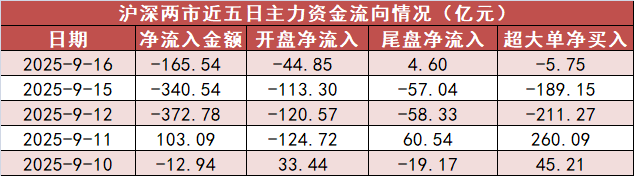
9月16日,A股市场整体上涨。 截至收盘,上证指数收报3861.87点,上涨0.04%,深证成指收报13063.97点,上涨0.45%,创业板指收报3087.04点,上涨0.68%,北证50指数上涨0.63%。 A股市场合计成交23673.04亿元,较上一交易日增加639.07亿元。 1.A股市场全天主力资金净流出165.54亿元 今日A股市场主力资金开盘净流出44.85亿元,尾盘净流入4.6亿元,A股市场全天主力资金净流出165.54亿元。 申万一级行业中,10个行业实现资金净流入,其中机械设备行业净流入118.72亿元居首。 | | | 今日资金净流入前五大行业 | | | --- | --- | --- | --- | | 行业 | 涨跌幅 | 净流入资金 (亿元) | 资金流入较多个股 | | 机械设备 | 1.81% | 118. 72 | 利欧股份 | | 计算机 | 1.56% | 105. 97 | 华胜天成 | | 汽车 | 2. 49% | 44. 30 | 拓普集团 | | 交通运输 | 1.68% | 19. 84 | 海航控股 | | 房地产 | 1.56% | 17.24 | 首开 ...

【16日资金路线图】机械设备板块净流入119亿元居首 龙虎榜机构抢筹多股
证券时报· 2025-09-16 11:02
Market Overview - The A-share market showed an overall increase, with the Shanghai Composite Index closing at 3861.87 points, up 0.04%, the Shenzhen Component Index at 13063.97 points, up 0.45%, and the ChiNext Index at 3087.04 points, up 0.68% [1][8] - Total trading volume in the A-share market reached 23673.04 billion yuan, an increase of 639.07 billion yuan compared to the previous trading day [1] Capital Flow - The A-share market experienced a net outflow of 165.54 billion yuan in main funds throughout the day, with an opening net outflow of 44.85 billion yuan and a closing net inflow of 4.6 billion yuan [2][4] - The CSI 300 index saw a net outflow of 118.94 billion yuan, while the ChiNext and STAR Market experienced net outflows of 78.46 billion yuan and 11.63 billion yuan, respectively [4] Sector Performance - The mechanical equipment sector led the net inflow of funds with 118.72 billion yuan, followed by the computer sector with 105.97 billion yuan, and the automotive sector with 44.30 billion yuan [6][7] - Conversely, the non-ferrous metals sector faced the largest net outflow of 125.95 billion yuan, followed by the electric power equipment sector with 92.85 billion yuan, and the banking sector with 81.24 billion yuan [7] Institutional Activity - Institutions showed significant interest in several stocks, with Hanwei Technology seeing a net institutional buy of 179.28 million yuan, while Sanhua Intelligent Controls experienced a net institutional sell of 91.10 million yuan [10][11] - A list of stocks with institutional ratings includes New China Life Insurance with a target price of 71.11 yuan, indicating a potential upside of 16.00% from its latest closing price [12]

“百日千万招聘专项行动”推出人工智能、新能源等专场招聘
Di Yi Cai Jing· 2025-09-16 09:55
Core Insights - The "Hundred Days, Millions of Recruitment Special Action" launched seven online recruitment events from September 15 to September 20, involving over 4,900 employers and a recruitment demand exceeding 134,000 positions [1][2] Group 1: Industry-Specific Recruitment - The Artificial Intelligence sector will have over 1,300 employers offering positions such as product managers, algorithm engineers, data development engineers, and risk modeling engineers, with a recruitment demand of 15,000 positions [1] - The Education and Training sector will feature over 1,000 employers providing roles for teachers, university counselors, course consultants, and academic administrators, with a recruitment demand of 34,000 positions [1] - The New Energy sector will include over 600 employers offering positions like wind power inspection engineers, operation and maintenance engineers, photovoltaic engineers, and equipment engineering technicians, with a recruitment demand of 17,000 positions [1] - The Electrical Machinery Manufacturing sector will have over 1,800 employers providing roles for electrical engineers, mechanical engineers, process engineers, equipment engineers, and automation technicians, with a recruitment demand of 64,000 positions [1] - The Transportation sector will feature over 150 employers offering positions such as infrastructure managers, logistics operation managers, supply chain managers, and safety managers, with a recruitment demand of over 1,700 positions [1] Group 2: Large and Social Organizations - The Large and Medium Enterprises sector will involve over 70 employers offering positions for R&D engineers, financial managers, research assistants, administrative specialists, and supply chain specialists, with a recruitment demand of over 3,000 positions [2] - The Social Organizations sector will include over 40 employers providing roles for legal specialists, academic specialists, financial specialists, and new media operators, with a recruitment demand of over 200 positions [2] Group 3: Recruitment Platforms - Employers and job seekers can access the recruitment events through various platforms including the China Public Recruitment Network, the National Talent Network, and Employment Online [2] - The initiative aims to gather and develop millions of job postings, focusing on various laborers, particularly recent graduates, over a period of approximately 100 days [2]
【数据发布】2025年1—8月份全国固定资产投资增长0.5%
中汽协会数据· 2025-09-16 07:04
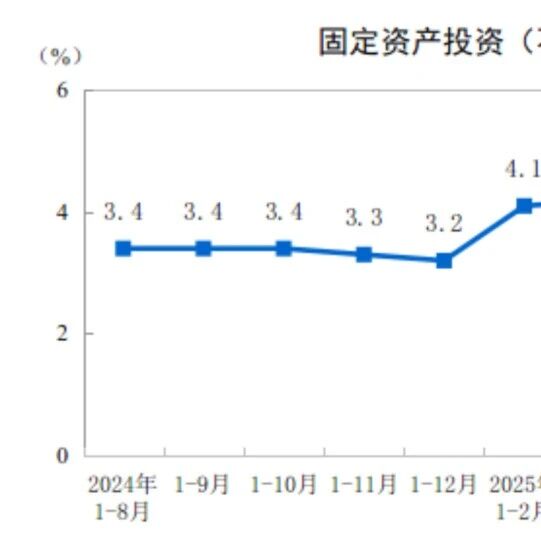
Core Viewpoint - The fixed asset investment in China from January to August 2025 shows a slight year-on-year growth of 0.5%, with a notable decline in private investment by 2.3% [1][4]. Investment by Industry - Investment in the primary industry reached 646.1 billion yuan, growing by 5.5% year-on-year [3][4]. - The secondary industry saw an investment of 1,182.46 billion yuan, with a growth rate of 7.6% [3][4]. - The tertiary industry experienced a decline in investment, totaling 2,014.04 billion yuan, down by 3.4% [3][4]. - Within the secondary industry, industrial investment grew by 7.7%, with mining investment increasing by 3.0%, manufacturing by 5.1%, and electricity, heat, gas, and water production and supply by 18.8% [3][4]. Investment by Region - Eastern region investment decreased by 3.5%, while the central region saw a growth of 2.5%, and the western region increased by 2.3%. The northeastern region experienced a decline of 6.0% [3][4]. Investment by Registration Type - Domestic enterprises' fixed asset investment grew by 0.5%, while investment from Hong Kong, Macau, and Taiwan enterprises increased by 2.3%. In contrast, foreign enterprises' investment fell significantly by 15.4% [3][4].
指数应用系列研究一:行业指数池构建、景气期限对比与三维组合策略
ZHONGTAI SECURITIES· 2025-09-16 06:36
Group 1: Industry Index Pool Construction - The report outlines the construction of an industry index pool that combines investability and representativeness, focusing on passive products tracking strong industry attributes [10][12]. - Since 2020, the scale of industry ETFs has experienced explosive growth, increasing from 85.8 billion yuan at the end of 2019 to over 310 billion yuan by the end of 2020, and approaching 900 billion yuan by August 2025 [10]. - The report categorizes various industry ETFs, highlighting that TMT, financial real estate, and pharmaceutical sectors have surpassed 100 billion yuan in ETF scale [10]. Group 2: Economic Prosperity Investment Practices - The report discusses the calculation of expected ROE growth for industries based on analysts' profit forecasts, comparing two fiscal years (FY1 and FY2) [20][21]. - It emphasizes that the FY2 grouping shows stronger monotonicity in performance compared to FY1, indicating better returns for the former [23][24]. - The backtesting period for the economic prosperity factor spans from January 1, 2018, to September 12, 2025, with a focus on marginal changes in industry index prosperity [27]. Group 3: Economic Trend Resonance Strategy - The economic trend resonance strategy combines fundamental marginal improvements with capital consensus, utilizing trend factors to quantify market sentiment [36][38]. - The constructed economic trend resonance portfolio has achieved an annualized return of 12.33% since 2018, outperforming the CSI 800 index by 11.13% [40][42]. - The portfolio's monthly excess return rate stands at 64%, with a profit-loss ratio of 1.30 [45]. Group 4: Economic Trend and Crowding Avoidance Strategy - The strategy integrates economic trend analysis with crowding avoidance to mitigate risks associated with overheated trading [49]. - The three-dimensional strategy has yielded an annualized return of 12.80% since 2018, exceeding the CSI 800 index by 11.60% [52][54]. - The portfolio's monthly excess return rate is 62%, with a profit-loss ratio of 1.47 [57]. Group 5: Current Industry Characteristics - As of August 2025, the report identifies industries that align with the economic trend resonance and crowding avoidance strategy, including the transportation index, home appliances, livestock, media, and oil and gas sectors [60]. - The expected growth rates for these sectors range from 1.1% to 9.6%, with varying levels of crowding and valuation metrics [60].
规范PPP存量项目建设运营
Jing Ji Ri Bao· 2025-09-16 00:04
Core Insights - The recent issuance of guidelines by the State Council marks a significant step towards the maturity of the Public-Private Partnership (PPP) model, with over 10 trillion yuan in existing projects expected to benefit from new opportunities and collaborative development between existing and new projects [1][2] Group 1: Government and Market Collaboration - Strengthening cooperation between government and social capital is crucial for leveraging their respective advantages to enhance infrastructure construction and public service levels [1] - The PPP model allows social capital to take on most responsibilities for infrastructure design, construction, operation, and maintenance, while the government focuses on price and quality regulation to maximize social benefits [1] Group 2: Challenges and New Mechanisms - The previous PPP model faced issues such as overgeneralization, unexpected government payments, and limited participation from the private sector, which increased government debt and credit risks [2] - The new mechanism emphasizes the use of a concession model for new projects and prioritizes collaboration with private enterprises, indicating a shift in the PPP framework [2] Group 3: Operational Changes and Future Directions - The operational goals, market environment, and participants of existing projects have undergone significant changes, presenting new opportunities and pathways for PPP projects [3] - Future efforts should focus on balancing interests, coordinating funding, and enhancing the social credit system to ensure effective implementation of the new regulations [3] Group 4: Policy Implementation and Governance - A comprehensive approach is needed to manage the relationship between government and market, as well as between new resources and existing assets, to enhance the effectiveness of PPP projects [4] - There is a call for innovative financing models and operational methods to revitalize existing assets and broaden revenue sources while managing government debt risks [4]
国泰海通 · 晨报0916|宏观
国泰海通证券研究· 2025-09-15 13:43
Group 1: Macroeconomic Insights - The U.S. labor market is showing signs of potential recession, with a significant increase in the proportion of the population considering job availability as difficult [2][5] - The current unemployment rate is rising at a historically slow pace, indicating a rare transition in the labor market from supply constraints to demand constraints [3] - A fragile balance in labor supply and demand is maintained due to simultaneous reductions in labor supply from immigration policies and retirement trends, but this balance is expected to be disrupted soon [4][7] Group 2: Employment Trends - The average monthly job creation needed to maintain the current unemployment rate is estimated to be between 150,000 and 180,000, while the recent average has dropped to 120,000 [5] - The labor market is sensitive to changes in employment demand, with a risk of rapid unemployment rate increases if demand continues to decline [7] - The impact of immigration on labor supply is diminishing, and the trend of early retirements is expected to decrease as the peak retirement year of 2025 approaches [7] Group 3: Agricultural Sector - Attention is drawn to the seed and livestock sectors as significant activities in the agricultural industry during the autumn season [8] Group 4: Research and Reports - Various industry reports and discussions are scheduled, including topics on transportation, home appliances, consumer structure changes, real estate cycles, and textiles [9][11]

2元以下低价股,仅剩24只
财联社· 2025-09-15 13:14
Core Viewpoint - The A-share market is experiencing an upward trend, with the average stock price approaching previous highs, while the number of low-priced stocks continues to decline, indicating a shift towards higher-priced stocks in the market [2][12][13]. Group 1: Market Overview - As of September 15, the average stock price in the A-share market reached 26.13 yuan, nearing the previous high of 26.27 yuan recorded on September 1 [2]. - The number of stocks priced below 2 yuan has decreased to 24, a significant drop of nearly 27% compared to the end of last year [12]. - The number of stocks priced below 5 yuan has also reduced to 525, reflecting a decline of approximately 30% since the end of last year [2]. Group 2: Low-Priced Stocks Analysis - Among the stocks priced below 2 yuan, the real estate and steel sectors have the highest proportions, accounting for 21% and 13% respectively [4]. - Compared to the end of last year, the steel and real estate sectors still dominate the low-priced stock category, with respective proportions of 18% and 15% [7]. - A total of 21 stocks have successfully risen above the 2 yuan mark since the end of last year, with notable increases in stocks like Jishi Media and ST Xintong, which saw price increases of 228.34% and 233.52% respectively [11]. Group 3: High-Priced Stocks Expansion - The number of stocks priced above 50 yuan has increased to 570, a growth of nearly 78.7% from 324 stocks at the end of last year [13]. - The number of stocks priced over 100 yuan has reached 142, marking a growth of approximately 97.2% [13]. - The electronics sector has the highest average stock price among the 31 major sectors, with an average exceeding 50 yuan, while sectors like real estate and steel have lower average prices, failing to reach 10 yuan [13].

基本面高频数据跟踪:食品价格环比回升
GOLDEN SUN SECURITIES· 2025-09-15 11:52
1. Report Industry Investment Rating No information about the report industry investment rating is provided in the given content. 2. Core Viewpoints of the Report - The current Guosheng fundamental high - frequency index is 127.6 points (previous value was 127.5 points), with a week - on - week increase of 5.6 points (same as the previous value), and the year - on - year growth rate remains unchanged. The long - short signal for interest - rate bonds is unchanged, with a signal factor of 5.0% (previous value was 5.0%) [1][9]. - In terms of production, the industrial production high - frequency index is 126.9 (previous value was 126.7), with a week - on - week increase of 5.3 points (previous increase was 5.2 points), and the year - on - year growth rate has expanded [1][9]. - Regarding total demand, the high - frequency index for commercial housing sales is 42.8 (previous value was 42.9), with a week - on - week decrease of 6.3 points (same as the previous value), and the year - on - year decline rate remains unchanged; the high - frequency index for infrastructure investment is 121.0 (previous value was 120.8), with a week - on - week increase of 6.5 points (previous increase was 6.1 points), and the year - on - year growth rate has expanded; the high - frequency index for exports is 143.7 (previous value was 143.7), with a week - on - week increase of 2.1 points (previous increase was 2.3 points), and the year - on - year growth rate has narrowed; the high - frequency index for consumption is 120.3 (previous value was 120.2), with a week - on - week increase of 3.3 points (previous increase was 3.2 points), and the year - on - year growth rate has expanded [1][9]. - In terms of prices, the monthly环比 forecast for CPI is 0.1% (previous value was 0.4%); the monthly环比 forecast for PPI is 0.0% (previous value was 0.1%) [2][9]. - The high - frequency inventory index is 161.9 (previous value was 161.7), with a week - on - week increase of 8.8 points (same as the previous value), and the year - on - year growth rate remains unchanged. The high - frequency transportation index is 130.6 (previous value was 130.4), with a week - on - week increase of 9.6 points (previous increase was 9.5 points), and the year - on - year growth rate has expanded. The high - frequency financing index is 236.8 (previous value was 236.2), with a week - on - week increase of 30.0 points (previous increase was 29.9 points), and the year - on - year growth rate has expanded [2][10]. 3. Summary According to Relevant Catalogs 3.1 Total Index: Fundamental High - Frequency Index Remains Stable - The Guosheng fundamental high - frequency index is based on a statistical system covering various aspects such as overall, production, demand, prices, and financing. The current index is 127.6 points, with a stable year - on - year growth rate [8][9]. 3.2 Production: Electric Arc Furnace Operating Rate Rebounds - The electric arc furnace operating rate is 62.8% (previous value was 62.2%); the polyester operating rate is 87.4% (previous value was 87.1%); the semi - tire operating rate is 73.5% (previous value was 67.5%); the full - tire operating rate is 65.6% (previous value was 59.8%); the PTA operating rate is 75.0% (previous value was 69.5%); the PX operating rate is 85.9% (previous value was 84.6%); the coal dispatch at Qinhuangdao Port is 49.0 tons (previous value was 51.4 tons) [11][15]. 3.3 Real Estate Sales: Commercial Housing Transaction Area Declines - The commercial housing transaction area in 30 large and medium - sized cities is 19.6 million square meters (previous value was 22.0 million square meters); the land premium rate for land transactions in 100 large and medium - sized cities is 4.4% (previous value was 1.8%) [24]. 3.4 Infrastructure Investment: Asphalt Operating Rate Rises Significantly - The operating rate of the asphalt plant is 34.9% (previous value was 28.1%) [38]. 3.5 Exports: Export Container Freight Rate Index Continues to Decline - The CCFI index is 1125 points (previous value was 1149 points); the RJ/CRB index is 300.7 points (previous value was 301.3 points) [40]. 3.6 Consumption: Average Daily Movie Box Office Continues to Decline Significantly - The average daily movie box office is 51.14 million yuan (previous value was 81.9 million yuan) [49]. 3.7 CPI: Average Wholesale Price of White - Strip Chickens Rises Slightly - The average wholesale price of pork is 19.9 yuan/kg (unchanged from the previous value); the average wholesale price of 28 key - monitored vegetables is 5.1 yuan/kg (unchanged from the previous value); the average wholesale price of 7 key - monitored fruits is 6.9 yuan/kg (unchanged from the previous value); the average wholesale price of white - strip chickens is 17.6 yuan/kg (previous value was 17.5 yuan/kg) [56]. 3.8 PPI: Copper and Aluminum Prices Rise Slightly - The closing price of thermal coal at Qinhuangdao Port (Shanxi - produced, Q5500) is 676 yuan/ton (previous value was 682 yuan/ton); the futures settlement price of Brent crude oil is 67 US dollars/barrel (unchanged from the previous value); the spot settlement price of LME copper is 9882 US dollars/ton (previous value was 9829 US dollars/ton); the spot settlement price of LME aluminum is 2644 US dollars/ton (previous value was 2613 US dollars/ton) [58]. 3.9 Transportation: Flight Passenger Volume Drops Significantly - The subway passenger volume in first - tier cities is 37.16 million person - times (previous value was 36.26 million person - times); the road logistics freight rate index is 1050 points (previous value was 1051 points); the number of domestic flights is 11,468 (previous value was 13,157) [69]. 3.10 Inventory: Aluminum Inventory Continues to Rise - The aluminum inventory is 193,000 tons (previous value was 174,000 tons); the soda ash inventory is 1.81 million tons (previous value was 1.821 million tons) [75]. 3.11 Financing: Net Financing of Local Government Bonds Increases Significantly - The net financing of local government bonds is 192.8 billion yuan (previous value was 36.7 billion yuan); the net financing of credit bonds is 91.9 billion yuan (previous value was - 55.3 billion yuan); the 6M national - share bank acceptance bill rediscount rate is 0.8% (previous value was 0.73%); the average of the bill rate - certificate of deposit rate is - 0.8% (previous value was - 0.88%) [86].
主力资金动向 31.66亿元潜入汽车业
Zheng Quan Shi Bao Wang· 2025-09-15 09:48
Core Insights - The automotive industry experienced the highest net inflow of capital today, amounting to 3.166 billion, with a price change of 1.44% and a turnover rate of 3.72% [1] - The electronics industry faced the largest net outflow of capital, totaling 8.773 billion, with a price change of -0.04% and a turnover rate of 3.81% [2] Industry Summary - **Automotive** - Trading volume: 8.261 billion - Change in trading volume: -0.47% - Turnover rate: 3.72% - Price change: 1.44% - Net capital inflow: 3.166 billion [1] - **Electronics** - Trading volume: 10.601 billion - Change in trading volume: -13.19% - Turnover rate: 3.81% - Price change: -0.04% - Net capital outflow: -8.773 billion [2] - **Media** - Trading volume: 5.930 billion - Change in trading volume: -2.46% - Turnover rate: 4.04% - Price change: 1.94% - Net capital inflow: 0.723 billion [1] - **Agriculture, Forestry, Animal Husbandry, and Fishery** - Trading volume: 2.976 billion - Change in trading volume: 4.55% - Turnover rate: 3.12% - Price change: 1.79% - Net capital inflow: 0.436 billion [1] - **Coal** - Trading volume: 2.343 billion - Change in trading volume: 10.37% - Turnover rate: 1.79% - Price change: 1.32% - Net capital inflow: 0.334 billion [1] - **Real Estate** - Trading volume: 7.917 billion - Change in trading volume: 6.39% - Turnover rate: 3.61% - Price change: 0.49% - Net capital outflow: -2.014 billion [2] - **Banking** - Trading volume: 4.541 billion - Change in trading volume: 1.16% - Turnover rate: 0.34% - Price change: -0.90% - Net capital outflow: -3.418 billion [2] - **Telecommunications** - Trading volume: 4.114 billion - Change in trading volume: -22.56% - Turnover rate: 2.35% - Price change: -1.52% - Net capital outflow: -6.633 billion [2] - **Computer** - Trading volume: 7.596 billion - Change in trading volume: -13.89% - Turnover rate: 4.25% - Price change: -0.24% - Net capital outflow: -7.220 billion [2]