公用事业

Search documents
8月转债月报:高位之上,仍有可为-20250807
Western Securities· 2025-08-07 07:11
Report Industry Investment Rating No relevant content provided. Core Viewpoints of the Report - The current convertible bond valuation is at a high level, but compared to the previous high in 2022, the current pure bond yield is lower, and the rigid demand for fixed - income + allocation gives some upward space for convertible bond valuation. In August, the equity market still has an environment for further upward movement, supported by domestic policies and international factors [1][13] - Specific investment directions to focus on include anti - involution (Jingneng Convertible Bond, Muyuan Convertible Bond, Wens Convertible Bond), innovative drugs (Huahai Convertible Bond, Chutian Convertible Bond), and humanoid robots (Keli Convertible Bond, Zhenghai Convertible Bond) [2][18] Summary by Directory 1. August Convertible Bond Outlook: Still Promising at High Levels - In July, the equity market rose, with the Wind All - A Index rising 4.7% monthly. The convertible bond market had a double - wheel drive of underlying stocks and valuation, with the CSI Convertible Bond Index rising 2.9%. By the end of July, the convertible bond price and valuation were still at high levels [9] - Although the Politburo meeting in late July was slightly below market expectations, anti - involution policies are ongoing, and supportive policies are being implemented. The less - than - expected US non - farm data increases the expectation of a Fed rate cut in September, which is beneficial for the equity market [13] 2. Market Review in July 2.1 Equity Market - The A - share market rose in July, with the Wind All - A Index rising 4.7% again. The market traded around three main lines: anti - involution, AI, and innovative drugs. The anti - involution policy, the start of the Yajiang Hydropower Project, and continuous positive news in AI and innovative drugs drove the market [19] - In terms of structure, small - cap stocks outperformed large - cap stocks, and growth stocks outperformed value stocks. Most industries in the equity market rose, with steel, building materials, medicine, and TMT sectors leading the gains, while defensive sectors such as banks, utilities, and transportation declined [24] 2.2 Convertible Bond Market - In July, the convertible bond market had a positive sentiment, with the CSI Convertible Bond Index rising 2.9%, relatively underperforming the equity market. The trading volume increased, with an average daily turnover of 728.9 billion yuan [30] - Among industries, 28 out of 29 convertible bond industry indices rose. Public utilities, electronics, medicine, building materials, and power equipment sectors performed well. Individual bonds such as Tianlu Convertible Bond, Saili Convertible Bond, and Borui Convertible Bond led the gains [34] 3. Convertible Bond Valuation - The convertible bond valuation continued to rise to a historical high in July. The end - of - month 100 - yuan parity premium rate was 29.3%, up 1.6pp from the end of June, at the 96.5% and 94.1% quantile levels since 2018 and 2021 respectively [35] - The median convertible bond price and parity also increased, while the median conversion premium rate decreased slightly, and the median pure bond premium rate increased [40] 4. Convertible Bond Supply and Demand 4.1 Convertible Bond Supply - In July 2025, 3 new convertible bonds were issued, with a total scale of 8.452 billion yuan. Three convertible bonds obtained CSRC registration approval, with a to - be - issued scale of 2.62 billion yuan, and 2 public convertible bond board plans were added, with a to - be - issued scale of 2.496 billion yuan [48][51][53] 4.2 Convertible Bond Demand - The share of the Convertible Bond ETF increased rapidly in July, with the share increasing by 572 million to 3.549 billion and the circulation scale increasing by 8.259 billion yuan to 45.183 billion yuan [54] 5. Clause Tracking 5.1 Redemption - As of July 31, 20 convertible bonds confirmed forced redemption, 10 might be subject to forced redemption, and 19 would not be forced to redeem [55] 5.2 Downward Revision - As of July 31, 8 convertible bonds confirmed downward revision, 6 proposed downward revision, and 43 temporarily did not revise downward [58]
A股7月增持月报:哪些公司被重要股东大额增持?一公司将被最高增持近10%
Mei Ri Jing Ji Xin Wen· 2025-08-07 03:33
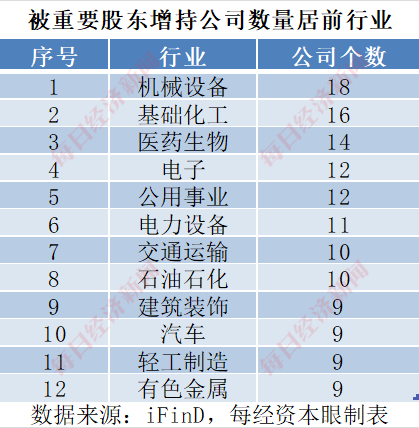
每经记者|闫峰峰 每经编辑|吴永久 值得注意的是,A股6月份重要股东的净增持金额曾创出近3年新高,而在随后的7月份,上证指数也呈 现出放量上涨的态势,7月份上证指数收盘价创出了近三年月度收盘价的新高。 每经资本眼专栏记者统计发现,截至目前,共有199家上市公司的重要股东正在进行增持计划,有1033 家上市公司正在实施减持计划。从重要股东实施增持计划的公司行业分布来看,这些公司共涉及29个同 花顺一级行业,其中机械设备行业有18家、基础化工行业有16家、医药生物行业14家、电子行业12家、 公用事业行业12家。正在进行重要股东增持计划的公司数量居前的行业如下表所示: | 3 4 5 | 行业 | 机械设备 基础化工 医药生物 电子 公用事业 | 公司个数 18 16 14 12 12 | | --- | --- | --- | --- | | 序号 1 2 | | | | | SELL . LED | | | | | | | 交通运输 石油石化 建筑装饰 汽车 轻工制造 有色金属 | | | | | | 11 10 10 19 9 9 9 -- 1-+ 1/2 - 1 . HH L.J -- | | 6 7 8 ...


523股融资余额增幅超5%
Zheng Quan Shi Bao Wang· 2025-08-07 03:16
Market Overview - On August 6, the Shanghai Composite Index rose by 0.45%, with the total margin trading balance reaching 2009.41 billion yuan, an increase of 9.155 billion yuan compared to the previous trading day [1] - The margin trading balance in the Shanghai market was 1023.066 billion yuan, up by 3.839 billion yuan; in the Shenzhen market, it was 979.971 billion yuan, up by 5.161 billion yuan; and in the Beijing Stock Exchange, it was 6.377 billion yuan, up by 0.155 billion yuan [1] Industry Analysis - Among the industries tracked by Shenwan, 21 industries saw an increase in margin trading balances, with the mechanical equipment industry leading with an increase of 2.043 billion yuan, followed by the electronics and defense industries with increases of 1.395 billion yuan and 1.338 billion yuan, respectively [1] Stock Performance - A total of 2104 stocks experienced an increase in margin trading balances, accounting for 56.70% of the total, with 523 stocks seeing an increase of over 5% [1] - Tianming Technology had the largest increase in margin trading balance, reaching 16.6608 million yuan, a rise of 111.76% from the previous trading day, and its stock price increased by 5.09% [1] - Other notable stocks with significant increases in margin trading balances included Yuanhang Precision and LIGONG Navigation, with increases of 86.49% and 65.40%, respectively [1] Top Gainers and Losers - Among the top 20 stocks with the largest increases in margin trading balances, the average increase in stock prices was 6.11%, with Huami New Materials, Riyue Ming, and Yuanhang Precision leading with increases of 29.96%, 19.99%, and 11.99%, respectively [2] - Conversely, stocks with the largest declines in margin trading balances included Baolijie, with a decrease of 34.99%, followed by Feng'an Co. and Anke Innovation, with declines of 33.76% and 25.58%, respectively [4][5]


Avista(AVA) - 2025 Q2 - Earnings Call Transcript
2025-08-06 15:30
Financial Data and Key Metrics Changes - Consolidated earnings for Q2 2025 were $1.15 per diluted share, down from $1.20 in Q2 2024, reflecting a decrease of approximately 4.17% [4] - Year-to-date results for Avista Utilities showed earnings of $1.25 per diluted share, representing a nearly 7% increase over the same period in 2024 [5] - Consolidated earnings were impacted by valuation losses of $0.12 per diluted share in Q2 2025, primarily due to investments in clean technology focused funds [11][12] Business Line Data and Key Metrics Changes - Avista Utilities' performance remained strong, supported by constructive regulatory outcomes and diligent cost management [11] - The company expects capital expenditures of $525 million in 2025, with a projected total of nearly $3 billion from 2025 to 2029, indicating an annual growth of 56% [16][17] Market Data and Key Metrics Changes - The clean energy sector faced headwinds, affecting consolidated earnings performance in Q2 2025 [5] - Valuations within the clean technology investment portfolio were significantly impacted by shifts in public policy and market sentiment [6][12] Company Strategy and Development Direction - The company is focused on serving customers and communities while ensuring reliable energy provision, as evidenced by the issuance of an RFP for 100 to 425 megawatts of generation [7] - The RFP process received over 80 bids, including various resource options such as wind, solar, and natural gas, indicating a broad approach to meeting future energy needs [8][9] Management's Comments on Operating Environment and Future Outlook - Management expressed optimism about future opportunities, particularly in relation to large load customers, with over 3,000 megawatts of requests in the pipeline [9] - The company confirmed its consolidated earnings guidance for 2025, expecting a range of $2.52 to $2.72 per diluted share, with Avista Utilities contributing toward the upper end of $2.43 to $2.61 per diluted share [18][19] Other Important Information - The company has available liquidity of $106 million under its committed line of credit and $42 million under its letter of credit facility as of June 30 [17] - S&P removed the negative watch from the company's credit rating, indicating strength in its balance sheet and business plans [18] Q&A Session Summary Question: Characterization of the 3,000 megawatts of large load in discussions - The 3,000 megawatts in the pipeline includes a variety of load types, not limited to data centers or high-tech manufacturing, and the RFP responses will help inform these discussions [25][26] Question: Potential for exit or monetization opportunities in other businesses - The company is analyzing its non-regulated businesses and considering moderation of budgets while maintaining strategic benefits from clean technology investments [28][30] Question: Outlook for wildfires in the region - Fire activity has been above normal, but the company has not seen significant starts in August and is employing mitigation tactics to minimize risks [42][44]

巴菲特谢幕在即,伯克希尔罕见大幅跑输大盘,引发段永平出手布局
Feng Huang Wang· 2025-08-06 13:54
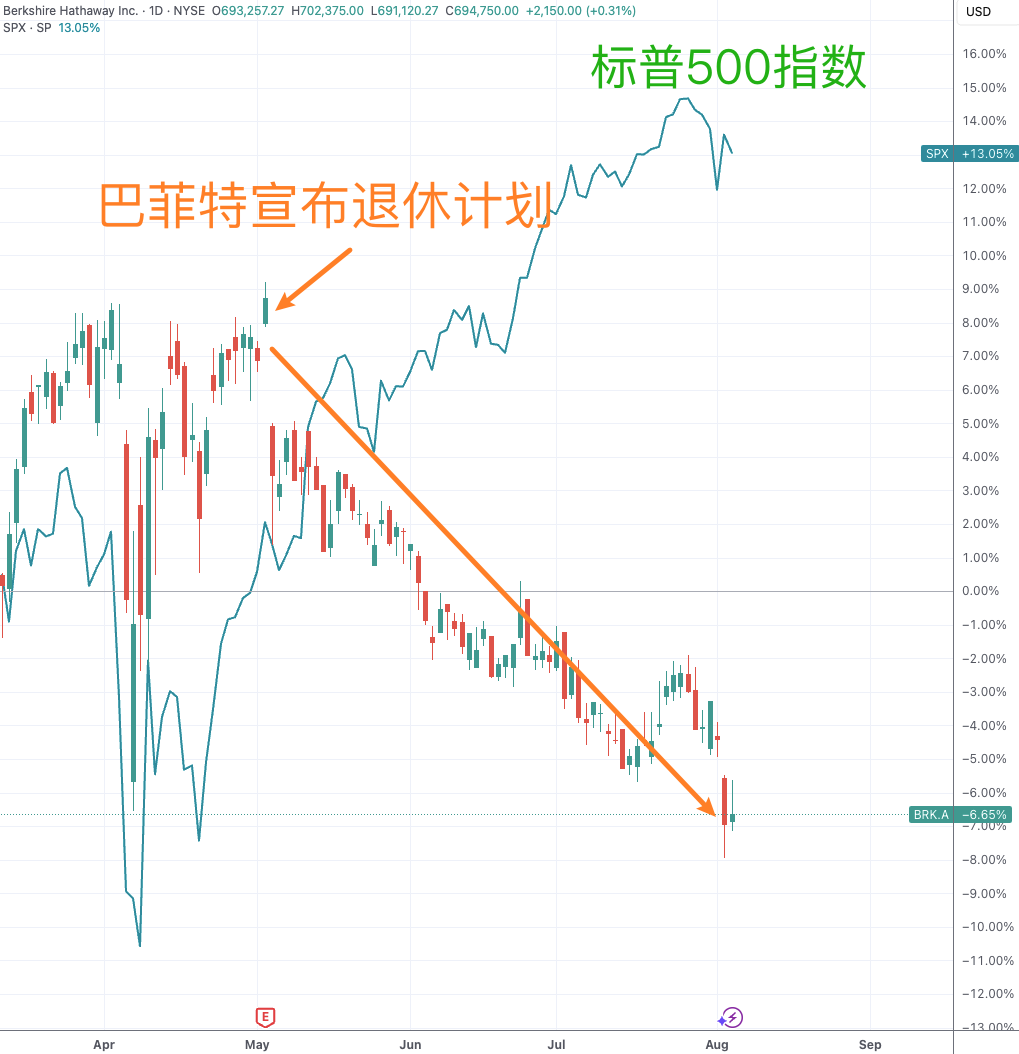
Core Viewpoint - Berkshire Hathaway has experienced a significant decline in stock price since Warren Buffett announced his retirement, with a 16% drop in A shares from $809,300 to $690,000, while the S&P 500 rose by 11% during the same period [1][3]. Group 1: Stock Performance - The stock price of Berkshire Hathaway has underperformed the market to a rare extent not seen since 1990, with only worse performance occurring during the early COVID-19 pandemic and major financial crises [3]. - The "Buffett premium" associated with Berkshire Hathaway is rapidly diminishing, as the stock was once viewed as a safe haven but has since seen a decline in investor interest [4][5]. Group 2: Business Operations - Despite the decline in stock price, Berkshire Hathaway's core businesses, including BNSF Railway and utilities, have shown profit growth in the second quarter [5]. - The company's valuation reached a rare high earlier this year, with a price-to-book ratio of 1.8, the highest since October 2008, before the recent downturn [5]. Group 3: Investor Sentiment - Investors are shifting their focus towards technology stocks, which are not a strong suit for Buffett, leading to a decrease in demand for Berkshire shares [5]. - Notable investor Duan Yongping has sold put options on Berkshire B shares, indicating a belief that this strategy will outperform the S&P 500 [6][7].
【6日资金路线图】国防军工板块净流入超98亿元居首 龙虎榜机构抢筹多股
证券时报· 2025-08-06 12:27
Market Overview - On August 6, the A-share market saw an overall increase, with the Shanghai Composite Index closing at 3633.99 points, up 0.45%, the Shenzhen Component Index at 11177.78 points, up 0.64%, and the ChiNext Index at 2358.95 points, up 0.66% [1] - The total trading volume in the A-share market reached 17595.36 billion yuan, an increase of 1434.8 billion yuan compared to the previous trading day [1] Capital Flow - The A-share market experienced a net outflow of main funds amounting to 110.49 billion yuan, with an opening net outflow of 45.94 billion yuan and a closing net outflow of 6.27 billion yuan [2][3] - The CSI 300 index saw a net outflow of 23.6 billion yuan, while the ChiNext and STAR Market experienced net outflows of 19.36 billion yuan and 21.98 billion yuan, respectively [4] Sector Performance - Among the 16 sectors tracked, the defense and military industry led with a net inflow of 98.47 billion yuan, reflecting a growth of 2.97% [6][7] - Other sectors with significant net inflows included electronics (78.44 billion yuan), machinery (73.93 billion yuan), and computer (71.84 billion yuan) [7] - Conversely, the pharmaceutical and biological sector faced the largest net outflow of 191.24 billion yuan, declining by 1.09% [7] Institutional Activity - The institutional buying activity highlighted several stocks, with Tongling Nonferrous Metals seeing a net purchase of 100.60 million yuan, and Chengyi Pharmaceutical with 88.39 million yuan [9][10] - Notable stocks with significant institutional selling included Western Materials, which faced a net sell-off of 10.68 million yuan [10] Analyst Recommendations - Analysts have recently rated several stocks with potential upside, including Jiuzhou Pharmaceutical with a target price of 29.12 yuan, representing a 57.75% upside from its latest closing price of 18.46 yuan [11] - Other stocks with favorable ratings include XGIMI Technology and SAIC Motor, with target prices indicating potential upsides of 36.20% and 35.48%, respectively [11]

中证全指公用事业指数平盘报收,前十大权重包含永泰能源等
Jin Rong Jie· 2025-08-06 11:11
Group 1 - The core viewpoint of the news is the performance of the CSI All Share Public Utilities Index, which closed at 2560.34 points with a trading volume of 12.994 billion yuan, showing a decline of 1.81% over the past month, an increase of 0.92% over the past three months, and a year-to-date decline of 3.37% [1] - The CSI All Share Public Utilities Index is composed of listed companies selected based on liquidity and market capitalization criteria, reflecting the overall performance of representative and investable securities in various industries [1] - The top ten weighted stocks in the CSI All Share Public Utilities Index include: Changjiang Electric Power (14.08%), China Nuclear Power (8.94%), Three Gorges Energy (7.3%), Guodian Power (4.83%), State Power Investment (4.43%), Huaneng International (3.95%), Yongtai Energy (3.81%), Chuanwei Energy (3.59%), China General Nuclear Power (3.43%), and Zhejiang Energy (2.49%) [1] Group 2 - The CSI All Share Public Utilities Index is primarily composed of public utility companies, with a 100% allocation to this sector [1] - The index is adjusted semi-annually, with sample adjustments occurring on the next trading day after the second Friday of June and December each year [2] - In the event of special occurrences affecting sample companies, such as delisting or changes in industry classification, the index samples will be adjusted accordingly [2]



侃股:高股息股票是长期热点
Bei Jing Shang Bao· 2025-08-06 11:08
Core Viewpoint - High dividend stocks are emerging as a stable investment choice amidst the rapid rotation of market themes, providing a safe haven for funds when other hotspots are absent [1][2][3] Group 1: Market Characteristics - The A-share market is currently exhibiting a dual-style characteristic, with thematic investments leading to rapid intra-day sector rotations while high dividend sectors like banks and utilities attract long-term capital [1][2] - High dividend stocks have shown their substitute value during market volatility, as funds quickly flow into blue-chip stocks with dividend yields exceeding 5% when thematic investments face collective pullbacks [1][2] Group 2: Economic and Regulatory Context - In the context of macroeconomic transformation, high dividend companies often operate in monopolistic industries or possess stable consumer attributes, leading to strong cash flow predictability [2] - The implementation of the registration system is shifting the A-share market from growth premium to value discovery, aligning high dividend strategies with ESG investment principles, which are favored by international capital [2] Group 3: Future Trends - The development of high dividend stocks is expected to follow three major trends: expansion from traditional sectors to stable cash flow industries like consumer goods and pharmaceuticals; the integration of dividend yield with other evaluation metrics such as price-to-earnings ratio and cash flow quality; and the growth of financial derivatives that enhance the efficiency of capital utilization through high dividend hedging strategies [2]
中证香港300基建指数报1902.97点,前十大权重包含中国联通等
Jin Rong Jie· 2025-08-06 08:36
Group 1 - The core viewpoint of the article highlights the performance of the China Securities Hong Kong 300 Infrastructure Index, which has shown a monthly increase of 2.12%, a three-month increase of 6.15%, and a year-to-date increase of 9.60% [1] - The index is composed of selected securities from the China Securities Hong Kong 300 Index, focusing on various industry themes such as banking, transportation, resources, infrastructure, logistics, and leisure [1] - The index was established on December 31, 2004, with a base point of 1000.0 [1] Group 2 - The top ten holdings of the China Securities Hong Kong 300 Infrastructure Index include China Mobile (33.23%), Cheung Kong (8.57%), CLP Holdings (8.5%), China Telecom (5.22%), Hong Kong and China Gas (4.91%), Power Assets Holdings (4.89%), China Unicom (3.7%), ENN Energy (3.2%), CK Infrastructure Holdings (2.61%), and China Resources Power (2.53%) [1] - The index's holdings are entirely composed of securities listed on the Hong Kong Stock Exchange, with a sector breakdown showing 52.30% in telecommunications services, 42.28% in utilities, 4.16% in construction and decoration, and 1.26% in transportation [1] Group 3 - The index sample is adjusted biannually, with changes implemented on the next trading day following the second Friday of June and December each year [2] - Weight factors are generally fixed until the next scheduled adjustment, with provisions for temporary adjustments in special circumstances such as delisting or corporate actions like mergers and acquisitions [2]

上海大众公用事业(集团)5 亿元 23 上海大众 MTN001 将兑付 51475 万元本息
Sou Hu Cai Jing· 2025-08-06 07:04
Group 1 - The announcement from Shanghai Clearing House indicates that Shanghai Volkswagen Public Utilities (Group) Co., Ltd. will issue its first tranche of medium-term notes for 2023, with a total issuance amount of RMB 500 million [1] - The interest start date for the bonds is set for August 15, 2023, with a maturity period of 2 years, and the total amount of principal and interest to be repaid on August 15, 2025, is RMB 514.75 million [1] - The bonds will be held in custody by the China Interbank Market Clearing House, and the issuer is responsible for transferring the payment to the designated account before the due date [1]