水泥

Search documents
水泥板块10月14日跌0.14%,天山股份领跌,主力资金净流出1.17亿元
Zheng Xing Xing Ye Ri Bao· 2025-10-14 08:41
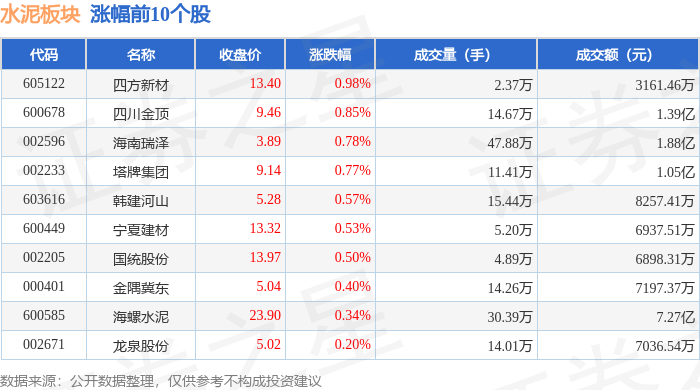
Market Overview - The cement sector experienced a decline of 0.14% on October 14, with Tianshan Shares leading the drop [1] - The Shanghai Composite Index closed at 3865.23, down 0.62%, while the Shenzhen Component Index closed at 12895.11, down 2.54% [1] Individual Stock Performance - Notable gainers in the cement sector included: - Sifang New Material: closed at 13.40, up 0.98% with a trading volume of 23,700 lots [1] - Sichuan Jinding: closed at 9.46, up 0.85% with a trading volume of 146,700 lots [1] - Hainan Ruize: closed at 3.89, up 0.78% with a trading volume of 478,800 lots [1] - Tianshan Shares saw a significant decline, closing at 6.57, down 1.05% with a trading volume of 733,000 lots [2] Capital Flow Analysis - The cement sector experienced a net outflow of 117 million yuan from institutional investors and 146 million yuan from speculative funds, while retail investors saw a net inflow of 263 million yuan [2] - Key stocks with notable capital flows included: - Conch Cement: net inflow of 66.69 million yuan from institutional investors, but a net outflow of 34.82 million yuan from speculative funds [3] - Qingsong Jianhua: net inflow of 16.60 million yuan from institutional investors, with a net outflow of 37.11 million yuan from speculative funds [3]

流动性、政策面、基本面三位一体框架:牛市走向:流动性和增量政策的博弈
Xinda Securities· 2025-10-14 06:02
Group 1: Liquidity - Institutional funds waiting to enter the market amount to several trillion yuan, with a potential inflow of 1.64 to 5.75 trillion yuan based on equity position increases[2] - As of Q2 2025, the average equity position of various institutional funds is at a historical low of 8.7%[37] - The total balance of wealth management, trust, insurance, and asset management products exceeds 100 trillion yuan, indicating significant room for future market entry[37] Group 2: Policy - The People's Bank of China has not followed the U.S. Federal Reserve's interest rate cuts, maintaining the 7-day reverse repurchase rate at 1.4% and the 1-year LPR at 3%[40] - The Q3 monetary policy meeting did not signal any new incremental policies, emphasizing continuity and stability instead[41] - The introduction of 500 billion yuan in new policy financial tools is underway, with further fiscal policy measures still to be observed[56] Group 3: Fundamentals - The Producer Price Index (PPI) is expected to turn positive by the end of Q1 or early Q2 2026, driven by capacity management measures[2] - Short-term economic pressures remain, but corporate expectations have begun to stabilize, particularly in industries affected by the "anti-involution" policy[71] - The "anti-involution" policy aims to address overcapacity and improve corporate expectations, with specific measures being implemented across key industries[72]
央企建材行业ESG评价结果分析:绿色发展与社会责任表现较强:A股央企ESG报告系列报告之八
Shenwan Hongyuan Securities· 2025-10-14 05:14
Investment Rating - The investment rating for the building materials industry is "Overweight" [70] Core Insights - The overall ESG scores for the 11 central enterprises in the building materials sector are good, with strengths in climate change response and social responsibility, while governance performance varies among companies [10][58] - The importance assessment shows that 10 companies have completed dual importance assessments, but third-party verification is lacking, with only one company introducing third-party validation [13][15] - Environmental and climate issues are prioritized, with scores ranging from 24 to 34 out of 35, indicating a strong focus on compliance and green transformation [17][18] - Social responsibility is highlighted through initiatives in rural revitalization and public welfare, with all companies demonstrating a strong commitment to social responsibility [44][47] - Governance structures are generally well-established, with most companies scoring high in governance mechanisms, although there is room for improvement in ESG information supervision [58][65] Summary by Sections Overall Performance - The ESG scores for the 11 central enterprises are generally above 70, with 2 companies scoring above 90, 5 between 80-89, 3 between 70-79, and 1 between 60-69 [10][12] Importance Assessment - 10 companies disclosed importance assessments, with a focus on financial performance-related issues, but only one company provided third-party verification [13][15] Environmental & Climate - The total scores for environmental and climate issues range from 24 to 34, with 7 companies scoring between 30-34, indicating a strong emphasis on both environmental compliance and climate disclosure [17][18] - All companies disclosed their waste management practices, with a 100% disclosure rate for waste treatment [20] Social Responsibility - All 11 companies disclosed their social responsibility initiatives, particularly in rural revitalization and public welfare, demonstrating a strong commitment to social issues [44][47] Governance - Governance scores are concentrated in the mid to high range, with 9 out of 11 companies achieving high scores in governance structure [58][65] - Most companies have established effective governance mechanisms, but there is a need for improved transparency in ESG information supervision [58][65]


A 股央企 ESG 报告系列报告之八:央企建材行业 ESG 评价结果分析:绿色发展与社会责任表现较强
Shenwan Hongyuan Securities· 2025-10-14 02:48
Investment Rating - The report rates the central state-owned enterprises in the building materials industry as "Positive" [2] Core Insights - The overall ESG scores of the 11 central state-owned enterprises in the building materials sector are good, with strengths in climate change response and social responsibility, while governance performance varies among companies [4][12] - The scoring results show that 2 companies scored above 90, 5 companies scored between 80-89, 3 companies scored between 70-79, and 1 company scored between 60-69, with no companies scoring below 60 [12] - The report emphasizes the importance of ESG performance in the context of increasing regulatory requirements and market expectations [4] Summary by Sections 1. Overall Scores and Areas for Improvement - The ESG scores of the 11 central state-owned enterprises are generally good, with climate change and social responsibility being strong points, while governance disclosures need improvement [12] 2. Importance Assessment - 10 out of 11 companies disclosed importance assessments, indicating a high level of awareness regarding issues related to their financial performance [15][17] - Only 1 company included third-party verification in their ESG report, highlighting a gap in external validation [15][17] 3. Environmental & Climate Focus - The total scores for "environment + climate change" range from 24 to 34 (out of 35), with 7 companies scoring between 30-34, indicating a strong focus on these issues [20] - All companies disclosed their waste management practices, with a 100% disclosure rate for "three wastes" [24] 4. Social Responsibility - All 11 companies disclosed their contributions to rural revitalization and social welfare, reflecting a strong commitment to social responsibility [53][56] - Most companies provided detailed accounts of their funding, project execution, and social impact [53] 5. Governance Structure - The governance scores are primarily in the mid to high range, with 9 out of 11 companies achieving full marks in three governance areas [68] - Most companies have established robust governance mechanisms, but disclosures regarding ESG information supervision are still lacking [68][71] 6. Climate Management - 8 companies have established climate management frameworks, but there is a need for improved transparency and quantification in risk management [49] - All companies disclosed their climate-related targets, focusing on carbon reduction and energy efficiency [50]
上峰水泥5000万参设基金,投资鑫华半导体切入半导体材料赛道
Xin Lang Cai Jing· 2025-10-14 02:28
Core Viewpoint - The company, Shangfeng Cement, is strategically investing in the semiconductor industry by acquiring a significant stake in Jiangsu Xinhua Semiconductor Technology Co., Ltd., positioning itself as a major player in the electronic-grade polysilicon market [1][3]. Group 1: Investment Details - Shangfeng Cement announced the establishment of Hefei Guocai No. 3 Enterprise Management Partnership (Limited Partnership) to invest in Jiangsu Xinhua Semiconductor, which is the largest domestic producer of electronic-grade polysilicon [1]. - Upon completion of the transaction, Guocai No. 3 will become the largest shareholder of Xinhua Semiconductor, allowing Shangfeng Cement to strategically position itself in the core segment of semiconductor materials [1]. Group 2: Company Profile - Jiangsu Xinhua Semiconductor is recognized as the only company in China capable of mass-producing electronic-grade polysilicon in full sizes, with a production capacity of 15,000 tons in 2024, ranking among the top globally [2]. - The company has a significant market presence, supplying major domestic silicon wafer manufacturers and exporting to international clients, achieving a revenue of 1.2 billion yuan in 2023 and holding the largest market share in China [2]. Group 3: Strategic Rationale - The investment aligns with Shangfeng Cement's strategic development plan to diversify its business and mitigate risks associated with single-industry cycles, enhancing its overall competitiveness [3]. - The involvement of national funds, such as the National Integrated Circuit Industry Investment Fund, highlights the strategic importance placed on the autonomy of semiconductor materials by the government [3]. Group 4: Industry Challenges and Opportunities - Despite Xinhua Semiconductor's technological leadership, the industry faces cyclical volatility, with projected price pressures on photovoltaic silver paste and semiconductor materials in 2025 [4]. - Shangfeng Cement must balance cash flow from its core building materials business with investments in new sectors, maintaining a healthy financial position with a debt-to-asset ratio of 45.08% and a current ratio of 1.15 as of mid-2025 [4]. - This transaction signifies a deep transformation of traditional building material companies into the "hard technology" sector, providing a model for the transition of China's manufacturing industry [4].

我国新一轮国家自主贡献目标迭代升级 为全球气候治理注入强大动力
Jin Rong Shi Bao· 2025-10-14 02:12
Group 1: NDC Goals and Climate Ambitions - The new NDC targets announced by China aim for a 7% to 10% reduction in net greenhouse gas emissions by 2035 compared to peak levels, with non-fossil energy consumption exceeding 30% of total energy consumption [1][2] - The NDC goals reflect a shift from "phase-based reduction" to "systemic transformation" in China's climate governance strategy, marking a significant evolution in its approach [2][3] - The updated NDC includes a broader scope covering all greenhouse gases, moving from relative intensity targets to absolute total emission reduction metrics [3] Group 2: Implementation and Sectoral Changes - To achieve the non-fossil energy consumption target, an annual increase of 0.94 percentage points is required, necessitating a high proportion of renewable energy supply and electrification [4] - The national carbon market is set to expand, with major industries like steel, cement, and aluminum included by 2025, increasing the controlled carbon emissions from 5 billion tons to 8 billion tons [4][6] - Different industries will face varying costs for emission reductions, with sectors like steel and electricity having lower costs compared to aviation and shipping, which may incur significantly higher costs [7] Group 3: International Context and Challenges - The global progress on emission reductions is lagging, with the UN Secretary-General warning of risks to the 1.5°C temperature goal, highlighting the importance of China's NDC commitments in this context [8][9] - The EU aims to reduce greenhouse gas emissions by 66% to 72% by 2035 based on 1990 levels, although the final commitments are still pending [8] - The absence of the U.S. at the climate summit and its historical role as a major emitter complicates international climate cooperation, emphasizing the need for responsible leadership from countries like China [9]
我国新一轮国家自主贡献目标迭代升级
Jin Rong Shi Bao· 2025-10-14 01:09
Group 1: NDC Goals and Climate Commitments - The new NDC targets announced by China aim for a 7% to 10% reduction in net greenhouse gas emissions from peak levels by 2035, with non-fossil energy consumption exceeding 30% of total energy consumption [1][2] - The NDC goals represent a shift from "phase-based reduction" to "systematic transformation," indicating a comprehensive approach to climate governance [2][3] - The updated NDC includes a broader scope covering all greenhouse gases, a shift from relative intensity targets to absolute total emission targets, and an extended timeline that includes post-peak reduction phases [3] Group 2: Industry Implications and Actions - The transition to total emissions control means that more industries must actively engage in carbon reduction efforts, with a focus on systematic management across all economic sectors [5][6] - The national carbon market is set to expand, with plans to include major industrial sectors by 2027, increasing the number of monitored entities and the total carbon emissions under management [6] - Different industries will face varying costs for carbon reduction, with some sectors like steel and electricity having higher costs compared to others, necessitating a phased approach to implementation [7] Group 3: International Context and Challenges - The global progress on emission reductions is lagging, with significant gaps between national commitments and the efforts needed to meet climate goals, particularly in light of the U.S. withdrawal from the Paris Agreement [8][9] - China's NDC commitments are seen as crucial for setting a roadmap for carbon reduction in the next five years, especially given the challenges posed by the current international climate cooperation landscape [8][9]
华新水泥拟斥最高6450万回购股份 欲更名“华新建材”推进一体化发展
Chang Jiang Shang Bao· 2025-10-14 00:02
Group 1 - Company plans to repurchase shares worth between 32.25 million and 64.5 million yuan, with a maximum price of 25 yuan per share, marking its first buyback since December 2019 [1][2] - The repurchase aims to enhance the long-term incentive mechanism for management, aligning interests between shareholders and the management team [2][3] - In the first half of 2025, the company achieved a net profit of 1.103 billion yuan, a year-on-year increase of 51.05% [1][8] Group 2 - The company announced a change of name to Huaxin Building Materials Group Co., Ltd., reflecting its diversified business beyond cement [6][7] - The new name aligns with the company's vision and better represents its comprehensive range of operations, which now includes concrete, aggregates, and environmental services [6][7] - The company has expanded its operations to cover 17 provinces in China and 20 countries overseas, evolving from a local cement factory to a global building materials group [6][7] Group 3 - The company has terminated plans for the spin-off of its overseas subsidiary due to extended timelines and stable growth in its overseas business [4] - The decision to halt the spin-off reflects a strategic focus on maintaining control over its overseas operations while ensuring compliance with regulatory requirements [4] Group 4 - The company reported a significant increase in revenue, reaching 16.047 billion yuan in the first half of 2025, driven by integrated development and cost management strategies [8] - The stock price surged to 20.22 yuan per share following the announcements, marking a year-to-date increase of 73.81% and a total market capitalization of 42.037 billion yuan [8]

【建筑建材】玻纤电子纱提价,水泥玻璃需求仍然低迷——建材、建筑及基建公募REITs周报(9月27日-10月10日)(孙伟风)
光大证券研究· 2025-10-13 23:07
Group 1: Glass Fiber Industry - The leading companies in the glass fiber sector, such as Chongqing International and Linzhou Guangyuan, have raised prices for G75 electronic yarn by 150-300 CNY/ton and for 7628 electronic cloth by 0.2 CNY/meter, indicating a positive price trend due to supply-demand dynamics [4] - The inventory in the glass fiber industry decreased to 860,000 tons by the end of September, reflecting a 5% month-on-month decline, suggesting a tightening supply situation [4] - The overall supply-demand balance for coarse yarn is expected to improve in Q4 2025, as new production capacity is limited, primarily coming online in the first half of 2025 [4] Group 2: Cement Industry - Post-National Day, the cement market has seen a decline in demand due to factors such as funding shortages and adverse weather conditions, with average shipment rates for major regions falling below 45% [5] - In East China, cement prices have decreased, with prices in Nanjing dropping by 20 CNY/ton, and the current price for P.O42.5 cement in Nanjing is between 200-210 CNY/ton [5] - Despite the current weak demand, companies are still inclined to raise prices to improve profitability, although the implementation of such price increases remains to be monitored [5] Group 3: Glass Industry - As of October 9, the total inventory of glass in monitored provinces increased by 6.96 million weight boxes, a rise of 13.71% compared to September 30, indicating a significant accumulation of stock [6][7] - The production volume was recorded at 16.88 million weight boxes, with a consumption volume of 9.92 million weight boxes, resulting in a production-sales rate of 58.78% [7] - The market has experienced a slowdown in trading activity, with many companies showing a cautious approach to pricing despite plans for potential increases [7]

重庆涪陵 一江碧水绘新景
Jing Ji Ri Bao· 2025-10-13 22:21
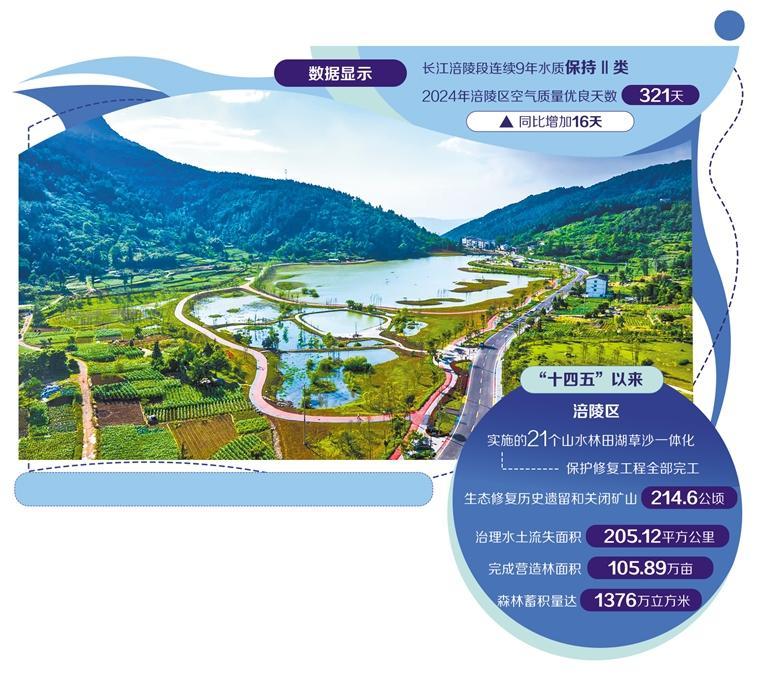
Core Viewpoint - The article highlights the successful integration of ecological protection and economic development in Fuling District, Chongqing, showcasing significant improvements in environmental quality and the promotion of green industries. Environmental Protection and Ecological Restoration - Fuling District has implemented the concept of "lucid waters and lush mountains are invaluable assets," leading to high-level ecological protection and quality development, with the Yangtze River's Fuling section maintaining Class II water quality for nine consecutive years [2] - The air quality in Fuling District improved, with 321 days of good air quality in 2024, an increase of 16 days year-on-year [2] - The Dragon Pond ecological corridor project has transformed the previously polluted Dragon Pond River into a clean waterway through various ecological restoration measures [3] - The district has completed 21 integrated protection and restoration projects, restoring 214.6 hectares of historical mining sites and treating soil erosion over 205.12 square kilometers [4] Green Industry Development - Fuling District has developed a thriving medicinal herb industry, with over 160,000 acres of medicinal herb cultivation, generating an annual output value exceeding 500 million yuan [6] - The district promotes a model of under-forest economy, cultivating medicinal herbs like Ganoderma lucidum and Huangjing, benefiting over 3,000 local farmers [5][6] - The district has established 56 national and municipal green factories, focusing on industrial green development and ecological civilization [7] Technological Innovation and Sustainable Practices - Huaxin Cement's Fuling plant utilizes industrial solid waste for resource recycling, processing over 300,000 tons of solid waste annually [7] - The company has implemented a low-temperature waste heat power generation project, reducing energy consumption and carbon emissions [7] - The district's leading enterprises, such as Fuling Pickled Vegetable Group, have adopted advanced production technologies to minimize energy consumption and pollutant emissions [8]