
建材

Search documents
多重利好共振!东方雨虹盘中涨停,建材板块复苏信号凸显
Ge Long Hui· 2026-02-25 10:25
Group 1: Market Performance - The A-share market experienced a comprehensive recovery on February 25, with all three major indices rising collectively and trading activity significantly increasing [1] - The construction and building materials sector was a focal point, with industry leader Oriental Yuhong (002271.SZ) hitting the daily limit up at 18.91 yuan, closing at 18.75 yuan, with a trading volume of 1.657 billion yuan and a market capitalization of 44.788 billion yuan [1] - Oriental Yuhong's stock performance notably outpaced the sector and market indices, becoming a key driver of the building materials sector's rise [1] Group 2: Industry Dynamics - The strong performance of Oriental Yuhong is supported by favorable macro policies in the real estate sector, including measures to stabilize expectations, sales, and project completions, as well as the optimization of purchase and loan restrictions [1] - Infrastructure investment continues to underpin the economy, with major engineering projects commencing, leading to stable demand growth for the building materials industry [1] - The decline in prices of chemical raw materials such as coal and soda ash has further enhanced the company's profit margins [1] Group 3: Company Developments - Oriental Yuhong has made significant strides in its internationalization strategy, with overseas business becoming a crucial growth engine [2] - The company completed the acquisition of 60% of Brazilian Novakem, leveraging its expertise in additives and local channels to penetrate the core Latin American building materials market [2] - The production and logistics R&D base in Dammam, Saudi Arabia, has commenced operations, enhancing the company's localized production and regional supply capabilities [2] Group 4: Domestic Market Expansion - In the domestic market, Oriental Yuhong has established a green materials technology company in Guangxi, aligning with the green building materials policy direction and enhancing its domestic capacity layout [3] - The company has diversified its operations, extending from waterproofing to various sectors including consumer building materials, coatings, and mortar [3] - With the gradual release of overseas capacity and ongoing domestic business expansion, the certainty of profit recovery for Oriental Yuhong has significantly increased [3]

2月25日盘后播报:午后上海官宣楼市新政,建材板块活跃
Mei Ri Jing Ji Xin Wen· 2026-02-25 10:25
Group 1: A-Share Market Performance - The A-share market opened high and closed higher, with the Shanghai Composite Index rising by 0.72% to 4147.23 points, the Shenzhen Component Index increasing by 1.29%, and the ChiNext Index up by 1.41% [1] - The total trading volume for the day was 2.48 trillion yuan, compared to 2.22 trillion yuan the previous day [1] Group 2: Semiconductor Equipment Sector - The Semiconductor Equipment ETF (159516) experienced a significant increase, closing up by 4.56% after an initial drop, driven by expectations of major customer orders in the storage segment [1] - This cycle of semiconductor equipment is characterized by benefits from global AI-driven high demand, differing from previous cycles focused on recovery or domestic substitution [1] Group 3: Shanghai Real Estate Policy - Shanghai introduced new real estate policies, including reducing the social security requirement for non-local families from 3 years to 1 year for purchasing homes within the outer ring, allowing an additional purchase for non-local families, and increasing the first home provident fund loan limit from 1.6 million to 2.4 million yuan [2] - The new policies are expected to stimulate demand for housing and lower financial barriers for homebuyers, potentially boosting the building materials and real estate sectors [2] Group 4: Steel Sector Insights - The steel sector saw a significant rise, with the Steel ETF (515210) increasing by 4.27%, driven by both demand-side and supply-side catalysts [2] - Demand is expected to be supported by favorable real estate policies in key cities, while supply is anticipated to contract by 2026, with low inventory levels potentially leading to upward price elasticity if demand increases [2]
中国巨石:更新报告电子布涨价杠杆,撬动公司盈利增厚-20260225
GUOTAI HAITONG SECURITIES· 2026-02-25 10:25
Investment Rating - The investment rating for the company is "Buy" [6][19]. Core Insights - The report highlights that the traditional electronic fabric prices are expected to rise significantly in February, driven by a shortage of traditional fabric due to the conversion of weaving machines to produce AI specialty fabrics. As the largest producer of traditional fabric, the company stands to benefit greatly, with every 1 yuan increase in electronic fabric prices potentially adding 1 billion yuan to the company's profits [2][12]. - The company is projected to see a significant increase in earnings per share (EPS) for 2025-2027, with estimates raised to 0.88 yuan, 1.24 yuan (+0.19), and 1.39 yuan (+0.19) respectively. The target price has been adjusted to 37.16 yuan based on a comparable company PE of 29.97 times for 2026 [12][14]. Financial Summary - Total revenue is forecasted to grow from 14,876 million yuan in 2023 to 23,351 million yuan in 2027, reflecting a compound annual growth rate (CAGR) of approximately 10.7% [4]. - Net profit attributable to the parent company is expected to recover from 3,044 million yuan in 2023 to 5,552 million yuan in 2027, with a notable increase of 44.8% in 2025 and 40.1% in 2026 [4]. - The company's earnings per share (EPS) is projected to increase from 0.76 yuan in 2023 to 1.39 yuan in 2027 [4]. - The return on equity (ROE) is expected to improve from 10.6% in 2023 to 14.6% in 2027 [4]. Market Data - The current stock price is 27.62 yuan, with a target price of 37.16 yuan, indicating a potential upside [6][7]. - The company has a total market capitalization of 110,567 million yuan and a total share capital of 4,003 million shares [7][8]. - The stock has shown a significant absolute increase of 149% over the past 12 months [11].

中国巨石(600176):更新报告:电子布涨价杠杆,撬动公司盈利增厚
GUOTAI HAITONG SECURITIES· 2026-02-25 09:39
Investment Rating - The investment rating for the company is "Buy" [6][19]. Core Insights - The report highlights that the traditional electronic fabric prices are expected to rise significantly in February, driven by a shortage of traditional fabric due to the conversion of weaving machines to produce AI specialty fabrics. As the largest producer of traditional fabric, the company stands to benefit, with every 1 yuan increase in electronic fabric prices potentially adding 1 billion yuan to the company's profits [2][12]. - The company is projected to see a substantial increase in earnings per share (EPS) for 2025-2027, with estimates raised to 0.88 yuan, 1.24 yuan (+0.19), and 1.39 yuan (+0.19) respectively. The target price has been adjusted to 37.16 yuan based on a comparable company PE of 29.97 times for 2026 [12][14]. Financial Summary - Total revenue is forecasted to grow from 14,876 million yuan in 2023 to 23,351 million yuan in 2027, reflecting a compound annual growth rate (CAGR) of approximately 10.7% [4]. - Net profit attributable to the parent company is expected to recover from 3,044 million yuan in 2023 to 5,552 million yuan in 2027, with a notable increase of 44.8% in 2025 and 40.1% in 2026 [4]. - The company's earnings per share (EPS) is projected to increase from 0.76 yuan in 2023 to 1.39 yuan in 2027 [4]. - The return on equity (ROE) is expected to improve from 10.6% in 2023 to 14.6% in 2027 [4]. Market Data - The current stock price is 27.62 yuan, with a target price of 37.16 yuan, indicating a potential upside [6][7]. - The company has a total market capitalization of 110,567 million yuan and a total share capital of 4,003 million shares [7][8]. - The stock has shown significant performance, with a 52-week price range of 11.01-28.30 yuan and an absolute increase of 149% over the past 12 months [11][12].
A股收评:超3700只个股飘红,三大指数集体收涨
Xin Lang Cai Jing· 2026-02-25 08:42
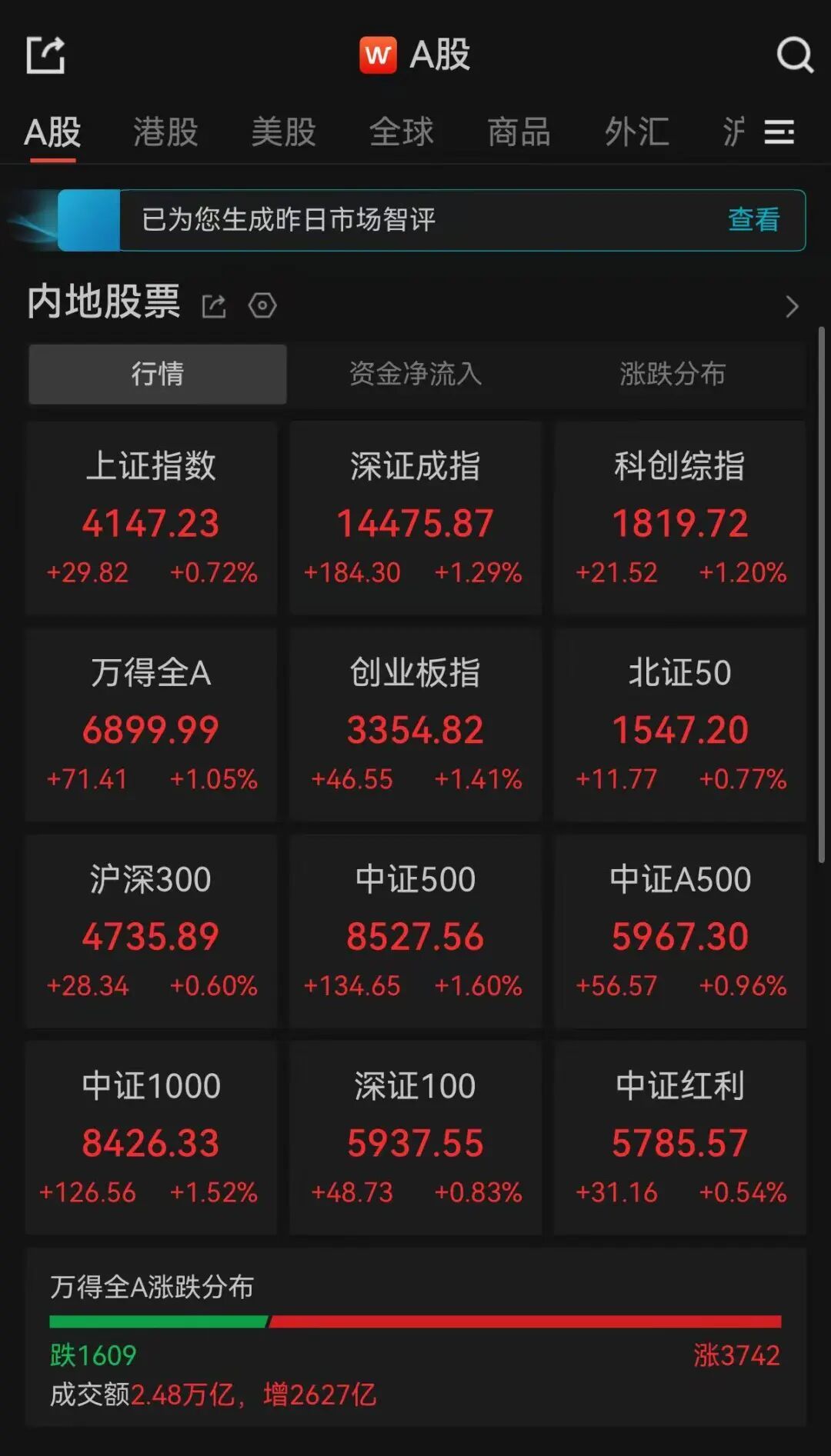
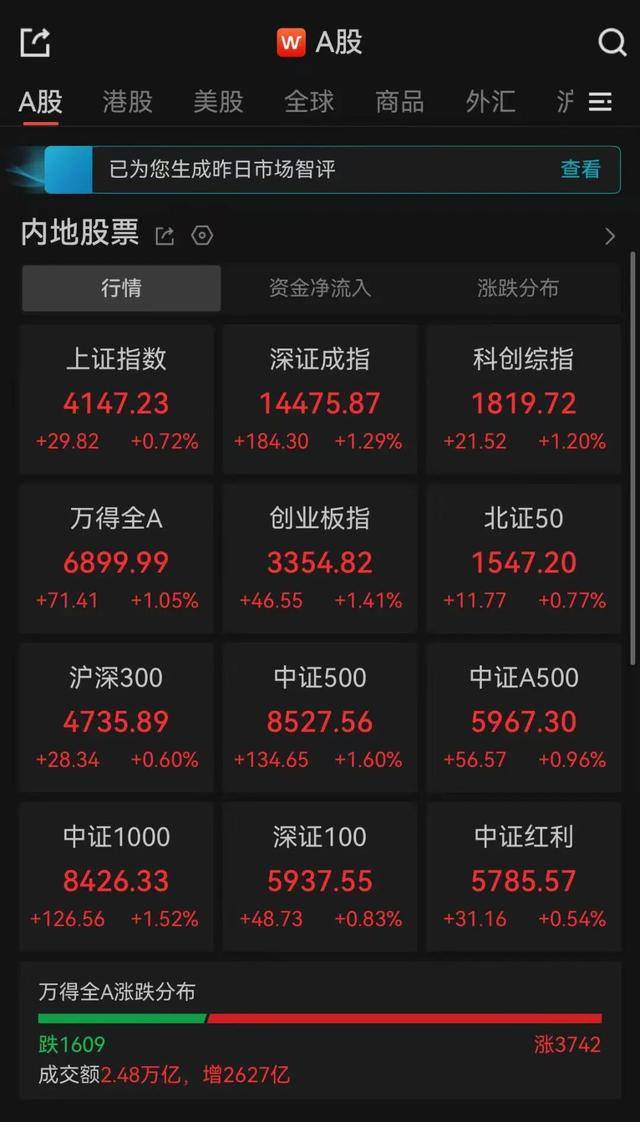
Group 1 - The A-share market experienced a positive trend with major indices rising, including the Shanghai Composite Index up by 0.72%, Shenzhen Component Index up by 1.29%, and ChiNext Index up by 1.41% [1][2] - The total trading volume in the market reached 2.48 trillion yuan, with over 3,700 stocks experiencing gains [4] - Key sectors that saw significant increases include chemicals, non-ferrous metals, steel, and building materials, while real estate, environmental protection, and semiconductor sectors also performed well [4] Group 2 - Active stocks included those in lithium batteries, commercial aerospace, and financial technology concepts, indicating a vibrant market for these sectors [4] - Conversely, AI applications and CPO themes weakened, and the banking and oil & gas sectors experienced a pullback after initial gains [4]

A股25日收评:超3700只个股飘红,三大指数集体收涨
Sou Hu Cai Jing· 2026-02-25 07:50
Market Performance - The A-share market experienced a positive trend with the Shanghai Composite Index rising by 0.72% to close at 4147.23, while the Shenzhen Component Index increased by 1.29% to 14475.87, and the ChiNext Index rose by 1.41% to 3354.82 [1][2]. Trading Volume and Stock Movement - The total trading volume in the market reached 2.48 trillion, with over 3700 stocks showing an increase in value [3]. - Sectors such as chemicals, non-ferrous metals, steel, and building materials saw significant gains, while real estate, environmental protection, and semiconductor sectors also performed well [3]. Sector Activity - Active sectors included lithium batteries, commercial aerospace, and financial technology concepts, whereas AI applications and CPO themes weakened, with banking and oil & gas sectors experiencing a pullback after initial gains [3].
港股午评:恒指涨0.75%、科指涨0.34%,内房股、有色金属股走强,科网股走势分化,半导体存储概念股普跌
Jin Rong Jie· 2026-02-25 04:10
Market Overview - On February 25, Hong Kong's three major indices opened higher, following the rebound of US tech stocks, with the Hang Seng Index rising by 0.75% to 26,790.23 points, the Hang Seng Tech Index up 0.34% to 5,288.47 points, and the Hang Seng China Enterprises Index increasing by 0.9% to 9,089.04 points [1] - The market showed significant differentiation among individual stocks, with performance varying widely; stocks with expected earnings growth attracted capital, while some consumer and real estate stocks faced adjustment pressure [1] Individual Stock Performance - Alibaba rose by 0.88%, Tencent Holdings increased by 1.25%, and JD Group gained 0.94%, while Xiaomi fell by 0.11% and NetEase dropped by 0.67% [1] - Meituan surged by 2.33%, Kuaishou increased by 0.38%, and Bilibili declined by 0.95% [1] - Real estate, building materials, and steel stocks saw significant gains, with Chongqing Steel soaring by 27% at one point and Country Garden rising over 6% [1] - The non-ferrous metals sector strengthened, with Likin Resources up over 8% and Lingbao Gold reaching a historical high [1] - Shipping stocks mostly strengthened, with COSCO Shipping rising over 7%, while semiconductor storage concept stocks that led the previous day's gains declined [1] Earnings Reports - Cat's Eye Entertainment (01896.HK) saw its stock rise as it projected a revenue of 4.6 to 4.7 billion yuan for FY2025, a year-on-year increase of 12.7% to 15.1%, and a net profit of 540 to 590 million yuan, a staggering increase of 196.9% to 224.4% [2] - Green Tea Group (06831.HK) also rose, expecting a net profit of 460 to 508 million yuan, a year-on-year increase of 31.4% to 45.1% [2] - Pacific Department Store (03368.HK) reported a loss of 186 million yuan, with same-store sales down 16.6% [2] - Chinese Estates Holdings (00127) expects a narrowed loss of 75% to 85%, but revenue is projected to decline by 5% to 15% [2] - Fengsheng Life Services (00331.HK) reported a mid-term net profit decline of 10.6% [2] AI and Pharmaceutical Sector Developments - Haizhi Technology Group (02706.HK) signed a strategic cooperation agreement with Zhipu to develop industry-level intelligent agents through model training and application [3] - Hengrui Medicine (01276.HK) had its SHR-1918 injection application included in priority review [3] - Dongyang Sunshine Pharmaceutical (06887.HK) received acceptance for its clinical trial application for a Nipah virus monoclonal antibody [3] - United Pharmaceuticals (03933.HK) completed Phase II clinical research for UBT251 injection in Chinese obese patients [3] Buybacks and Confidence Boost - Conch Cement (00914.HK) announced a share buyback plan worth 700 million to 1.4 billion yuan [5] - Xiaomi Group (01810.HK) repurchased 2.7942 million shares for approximately 9.998 million HKD [5] - Geely Automobile (00175.HK) repurchased shares worth 53.28 million HKD [5] - NetEase Cloud Music (09899.HK) and Meitu (01357.HK) also executed share buybacks in the million HKD range [6] Market Outlook - China Galaxy Securities highlighted three main lines of focus for the Hong Kong market: rising geopolitical risks in the Middle East boosting precious metals and energy sectors, consumer policies driving recovery in undervalued consumer stocks, and opportunities in the tech sector following valuation pressure relief [7] - Huatai Securities noted increased differentiation among tech stocks during the Spring Festival, with new AI players showing significant gains while traditional internet giants adjusted [7] - The market's short-term volatility does not alter the fundamentals, and the earnings disclosure wave is expected to provide solid support for market performance [7]
春节后进入开工旺季!建材ETF(516750)早盘涨4.77%,龙头股集体走强
Mei Ri Jing Ji Xin Wen· 2026-02-25 03:50
Group 1 - The core viewpoint of the article highlights the strong performance of the building materials sector, driven by the acceleration of major project commencements post-holiday and improved financing conditions for real estate companies [1] - On February 25, the building materials ETF (516750) saw a significant intraday increase of 4.77%, closing with a gain of 4.65%, indicating robust market interest [1] - Leading companies in the sector, such as Nanbo A, achieved a 10% limit-up, while Dongfang Yuhong and Keshun shares rose over 8%, and Anhui Conch Cement increased by more than 7%, showcasing a strong upward trend among industry leaders [1] Group 2 - Institutional views suggest that the demand for building materials like cement and waterproof materials is significantly rising due to the concentration of major infrastructure projects and the ongoing improvement in financing conditions for real estate firms [1] - The advancement of overseas "Belt and Road" projects is expected to open new growth opportunities for companies with a high proportion of export business in cement and related materials [1] - The building materials ETF (516750) effectively covers leading companies in segments such as cement, waterproofing, and piping, allowing investors to capture structural opportunities arising from the recovery in industry prosperity [1]
未知机构:春节后首个交易日市场普涨机构赎回含权资产202602224春-20260225
未知机构· 2026-02-25 03:45
Summary of Conference Call Notes Industry Overview - The conference call discusses the performance of the A-share market post-Spring Festival, highlighting a general upward trend with a 1.06% increase in the market on the first trading day after the holiday, outperforming the Hang Seng Tech and Nasdaq indices during the same period [1][1]. Key Points and Arguments Market Performance - The A-share market showed strong performance compared to overseas markets, with significant gains in cyclical sectors such as oil and gas, which rose by 5.53%, and other sectors like building materials, chemicals, non-ferrous metals, coal, and steel leading the gains [1][1]. - Specific sub-sectors like fiberglass and phosphorus saw increases exceeding 8% [1][1]. - In contrast, the AI software sector experienced a downturn, with notable declines in stocks like Adobe, CRM, and Autodesk, which saw maximum drawdowns of up to 30% due to the release of multiple large models [3][3]. AI Sector Insights - The hardware segment of AI remains robust despite the software downturn, with technologies like CPO (Co-Packaged Optics) expected to achieve mass production by year-end, benefiting various components such as optical engines and silicon photonics [3][3]. - The market is currently awaiting a "killer product" in AI, with uncertainty surrounding its arrival and impact on the sector [3][3]. Consumer Sector Dynamics - The decline in box office revenue during the Spring Festival period has negatively impacted film stocks, with companies like China Duty Free Group facing significant losses after losing operational rights at key airports [4][4]. - However, there was a noticeable increase in offline consumer activity during the extended holiday, with growth in foot traffic, shipping, and tourism-related spending, indicating potential for recovery despite low consumer confidence [4][4]. Additional Important Content Institutional Behavior - On the first trading day post-holiday, institutions exhibited a net redemption trend, with a subscription to redemption ratio of 45% to 55% [5][5]. - There was a net redemption in rights-embedded assets, while bond funds saw net subscriptions, indicating a shift in investment strategy among institutions [6][6]. - Active equity funds experienced a net redemption of 0.15%, primarily driven by sales from wealth management and insurance sectors, while sectors like electric new energy, chemicals, and non-ferrous metals saw increased allocations [6][6]. Debt and Bond Market - The convertible bond market faced a net redemption of 1.37%, with significant selling from brokers and trusts [7][7]. - Short-term bonds also saw a net redemption of 1.24%, reflecting a cautious approach among investors [8][8]. Overall Market Sentiment - The overall sentiment in the market appears cautious, with institutions adjusting their portfolios in response to recent market dynamics and sector performances [5][5][6][6].
券商把脉节后投资主线
Jin Rong Shi Bao· 2026-02-25 02:52
Group 1 - The Spring Festival holiday saw a record-breaking cross-regional movement of over 5 billion people, indicating strong consumer activity [1] - The average daily inbound and outbound personnel at national ports during the holiday is expected to increase by 14.1% year-on-year, reaching over 2.05 million people, nearly five times the level of the previous year [1] - The first three days of the holiday showed a year-on-year increase of 4.5% in foot traffic and 4.8% in sales for monitored pedestrian streets, reflecting a robust consumption environment [1] Group 2 - Huatai Securities noted that domestic consumption data showed an overall increase in volume with stable prices, highlighting service consumption as a new growth point [2] - Data from Meituan indicated that leisure orders in lower-tier cities grew by nearly 30% year-on-year, with a notable shift towards younger consumers [2] - The "post-Spring Festival" market outlook suggests a focus on theme investments in sectors like the export chain and service consumption, while also considering geopolitical risks [2] Group 3 - Guosheng Securities identified four key variables that may influence market trends post-holiday, including uncertainties in U.S. tariff policies and the resilience of export chain enterprises [3] - The rise of AI and robotics, validated by sales data from platforms like JD.com, is expected to attract investment in related sectors [3] - The attractiveness of assets priced in RMB is increasing, particularly in the equity market, with a trend of foreign capital inflow into Chinese assets [3] Group 4 - China Galaxy Securities recommended focusing on two main lines post-holiday: sectors benefiting from improved supply-demand dynamics and industries with structural highlights like robotics and AI [4] - Guojin Securities emphasized the importance of the "global physical assets vs. Chinese assets" theme, suggesting investment in commodities and sectors with a competitive advantage in China [4]