债券

Search documents
欧债收益率集体上涨,英国10年期国债收益率涨4.7个基点
Mei Ri Jing Ji Xin Wen· 2025-10-06 22:50
Group 1 - Eurozone bond yields collectively increased on October 6, with the UK 10-year government bond yield rising by 4.7 basis points to 4.735% [1] - The French 10-year government bond yield rose by 5.9 basis points to 3.566% [1] - The Italian 10-year government bond yield increased by 2.9 basis points to 3.538% [1] - The Spanish 10-year government bond yield rose by 2.5 basis points to 3.253% [1]
Japan Bonds Wobble on New Leader Takaichi
Barrons· 2025-10-06 16:55
Group 1 - Fixed-income investors are monitoring Japan closely due to record-high yields on longer-dated bonds following significant political changes [1] - The ruling Liberal Democratic Party has appointed Sanae Takaichi as its new leader, potentially making her the first female prime minister of Japan [1] Group 2 - Takaichi is known for her growth-oriented policies, advocating for looser monetary policy, increased fiscal stimulus, and extensive structural reforms [2] - Concerns have been raised regarding Japan's debt sustainability due to Takaichi's proposed economic strategies [2]
上任不足一月,法国新总理“闪辞”背后:马克龙的政治危机
Di Yi Cai Jing· 2025-10-06 12:32
Core Viewpoint - The resignation of French Prime Minister Leclerc has intensified the political crisis in France, leading to market volatility and concerns over the government's ability to address pressing issues [1][8]. Group 1: Political Context - Leclerc's resignation comes less than a month after his appointment, marking him as the shortest-serving Prime Minister since the establishment of the Fifth Republic in 1958 [1]. - The French political landscape has been paralyzed since the 2024 elections failed to produce a party with an absolute majority, complicating governance [1][4]. - Leclerc's cabinet appointments were criticized for lacking significant changes, reflecting a continuation of Macron's pro-business stance, which has drawn ire from both left and right political factions [3][4]. Group 2: Economic Impact - Following Leclerc's resignation, the CAC40 index fell by 1.5%, and the euro depreciated by 0.66% against the dollar, indicating market instability [1]. - The yield on 30-year French government bonds surged to 4.441%, the highest in a month, before slightly retreating, highlighting investor concerns [1]. - The spread between French and German government bond yields reached 0.88 percentage points, nearing the highest level since the eurozone debt crisis, signaling heightened market anxiety [7]. Group 3: Social Unrest - France is experiencing widespread public discontent, with significant protests against government austerity measures, exacerbated by high inflation affecting lower-income groups [6]. - The political deadlock has led to calls for reform from various political leaders, with threats of no-confidence votes if changes are not made [4][6]. Group 4: Future Outlook - Analysts suggest that Macron may have limited options, potentially leading to the dissolution of the National Assembly or triggering new presidential elections, with the former being more likely [7]. - The ongoing political uncertainty is causing investors to adopt a cautious approach, complicating the investment landscape in Europe [7].


日元重挫、日股大涨!市场开启“高市早苗交易”,应对“安倍经济学”回归
华尔街见闻· 2025-10-06 12:13
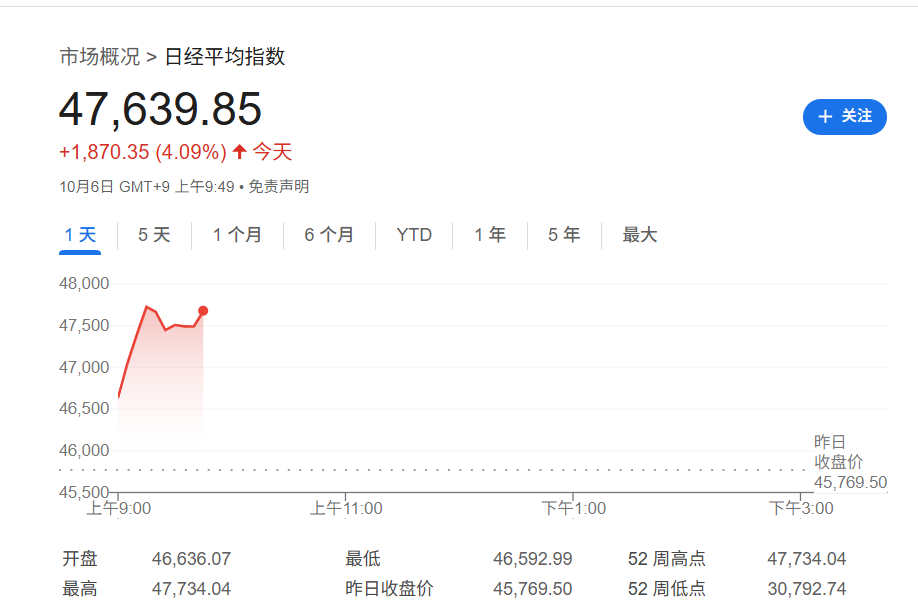
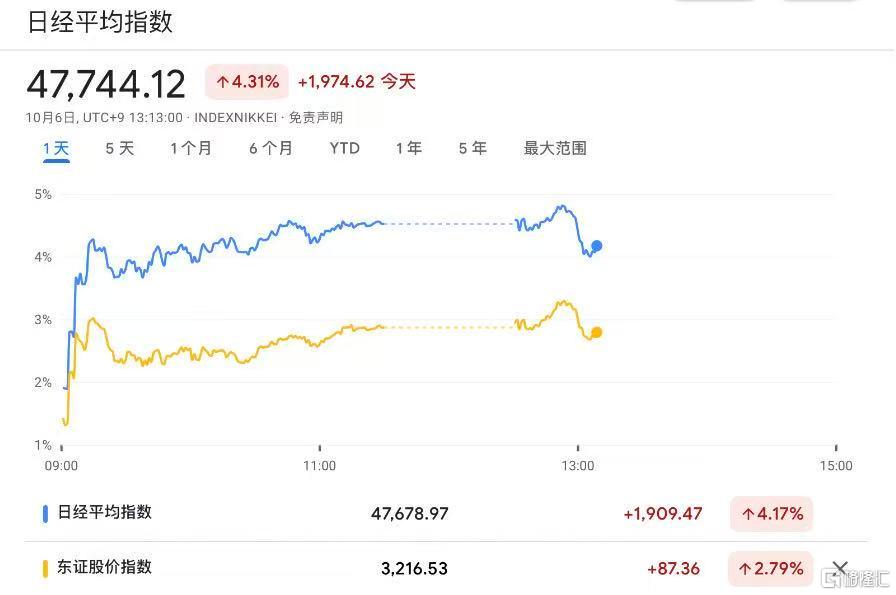
Core Viewpoint - The potential return of "Abenomics" is being priced into the Japanese financial markets following the election of Sanae Takaichi, a protégé of the late Prime Minister Shinzo Abe, as the new leader of the ruling party [1][12]. Market Reactions - The Nikkei 225 index surged over 4.7%, marking the largest single-day gain in months, while the Topix index rose by 3% [2]. - The Japanese yen weakened significantly against the US dollar by 1.9%, reaching the critical level of 150, and the yen also hit a historical low against the euro [4]. Bond Market Dynamics - The bond market experienced volatility, with long-term interest rates rising due to concerns over future fiscal expansion, as the yield on 40-year Japanese government bonds surged by 15 basis points to 3.54% [7]. Investor Sentiment - Investors are actively engaging in the "Takaichi trade," anticipating that Takaichi's policies will lead to fiscal expansion and a rightward political shift, which may further weaken the yen and boost the stock market [10]. - Analysts predict that Takaichi's victory could lead to a weaker yen and a steeper yield curve for Japanese government bonds [10]. Economic Policy Outlook - Takaichi's economic policy proposals are heavily influenced by "Abenomics," focusing on large-scale fiscal stimulus and ultra-loose monetary policy [12]. - She has committed to addressing inflation through measures such as increasing subsidies to local governments and potentially lowering consumption tax [12]. - Takaichi advocates for close coordination between the government and the Bank of Japan to achieve demand-driven economic growth [13]. Market Expectations - The market is preparing for potential fiscal expansion, with Takaichi's election seen as a surprise for investors who expected a more fiscally conservative candidate [15]. - A strategist from VanEck Australia noted that this could be a positive surprise for the stock market [16]. - However, there are concerns that increased fiscal spending may lead to a higher debt burden and potential bond market sell-offs if not managed with appropriate safeguards [19].

“高市早苗交易”引爆市场!日股狂飙、日元重挫!
Ge Long Hui· 2025-10-06 07:23
Core Viewpoint - The election of Sanae Takaichi as Japan's first female Prime Minister is expected to bring significant changes to the economic landscape, with a potential return to "Abenomics" and a focus on inflation management [5][6]. Market Reactions - The Nikkei 225 index surged over 4%, surpassing the 47,800 mark, reaching a historical high, while the Tokyo Stock Exchange index rose approximately 3%, breaking the 3,220 points barrier [1]. - The Japanese yen is under significant pressure, with the USD/JPY exchange rate exceeding 150 [2]. Economic Policies - Takaichi's administration is anticipated to prioritize inflation issues, potentially increasing subsidies to local governments and considering a reduction in consumption tax [6][7]. - She has emphasized the need for close coordination between the government and the Bank of Japan (BOJ) regarding economic policies, criticizing the BOJ's interest rate hikes as "foolish" [8]. Market Expectations - Takaichi's stance has reinforced market expectations that the BOJ will maintain its accommodative monetary policy, leading investors to reassess their strategies regarding interest rate hikes [9]. - Barclays economists predict a decreased likelihood of the BOJ raising interest rates within 2025, suggesting that Takaichi's dovish tone may strengthen in the future [11][12]. Financial Market Dynamics - The Japanese financial market is entering a phase of rapid repricing, with expectations of a positive market response to Takaichi's fiscal policies [10][13]. - Analysts believe that her proactive fiscal stance could boost market confidence, leading to a rotation towards growth stocks in the domestic market [13].
信用周报:四季度,票息性价比提升-20251006
China Post Securities· 2025-10-06 07:21
1. Report Industry Investment Rating No relevant content provided. 2. Core Views of the Report - In the fourth quarter, the cost - effectiveness of the coupon strategy is further enhanced against the backdrop of high uncertainty in the bond market direction. The 1 - 3 - year weak - qualification urban investment sinking strategy is recommended, and the yields of 1 - 2 - year AA(2), 2 - 3 - year AA, and AA(2) urban investment bonds are between 2.09% - 2.32%, with a large balance of outstanding bonds. Second, the super - decline feature of secondary perpetual (Er Yong) bonds is obvious, and the yields of 3 - year large - bank capital bonds and 2 - year AA perpetual bonds are between 2.0% - 2.07%, having fallen to a level with coupon value. The 4 - 5 - year large - bank capital bonds have a large decline in this round of adjustment, and the current yields are all above 2.1%, which are high - quality coupon assets for accounts with stable liability ends. For ultra - long - term bonds, although the cost - effectiveness of coupons continues to increase after adjustment, the liquidity has not seen marginal improvement, and it is still only recommended for allocation - type institutions to consider [3][35]. 3. Summary by Relevant Catalog Current Bond Market Situation - Last week, the bearish force in the bond market remained strong, but with the bond - buying by large banks and the central bank's liquidity support, interest rates generally stabilized, while the decline of credit bonds was relatively high, especially for Er Yong bonds and ultra - long - term credit bonds, showing an "over - decline" trend. From September 22 to September 26, 2025, the yields of 1Y, 2Y, 3Y, 4Y, 5Y treasury bonds decreased by 0.7BP, increased by 2.7BP, 2.8BP, 1.8BP, 0.5BP respectively, while the yields of AAA medium - term notes with the same maturities increased by 5.3BP, 6.5BP, 6.8BP, 9.0BP, 9.7BP respectively [1][10]. - The performance of ultra - long - term credit bonds continued to weaken, with the decline exceeding that of the same - maturity interest - rate bonds. The yields of 10Y AAA/AA + medium - term notes increased by 11.32BP and 10.32BP respectively, and the yields of 10Y AAA/AA + urban investment bonds increased by 11.90BP and 8.90BP respectively. The yield of 10Y AAA - bank secondary capital bonds increased by 16.19BP, while the yield of 10Y treasury bonds recovered by 0.21BP [1][12][13]. - The "volatility amplifier" feature of Er Yong bonds reappeared, with the decline of each maturity exceeding that of ordinary credit bonds. The yields of 1 - 5 - year, 7 - year, and 10 - year AAA - bank secondary capital bonds increased by 5.15BP, 8.94BP, 11.60BP, 12.29BP, 17.93BP, 18.31BP, 16.19BP respectively. The part of the curve above 2 - year is still 30BP - 63BP away from the lowest yield point since 2025, and the yields of maturities above 3 - year have exceeded the levels of the bear - flattening period in the first quarter [2][17]. Analysis of Trading Behavior - In terms of active trading, the bearish force of Er Yong bonds was strong overall, with the selling force of trading desks stronger than the buying force of allocation desks. From September 22 to September 26, the proportion of low - valuation transactions of Er Yong bonds was 92.50%, 0.00%, 0.00%, 10.00%, 100.00% respectively. Last week, trading desks represented by public funds strongly sold Er Yong bonds and only had net purchases of short - term credit products. At the same time, allocation desks such as wealth management and insurance institutions bought oversold Er Yong bonds at high prices, but the buying force was weaker than the selling force of public funds [2][19][20]. - The selling market of ultra - long - term credit bonds continued to strengthen throughout the week. From September 22 to September 26, the proportion of discount transactions of ultra - long - term credit bonds was 65.00%, 72.50%, 95.00%, 100.00%, 75.00% respectively. The discount range was not low, and about 25.5% of the discount transactions had a range of more than 4BP, indicating a strong selling willingness in the market [22]. Comparison of the Two Rounds of Bond Market Adjustments in 2025 - The bond market adjustment in the first quarter was mainly driven by the unexpected tightening of the capital market, resulting in weaker performance of the short - and medium - term credit bonds. The yields of 1 - 5 - year AAA urban investment bonds increased by more than 40bp, while the yields of long - term bonds increased by less than 35bp [26][29]. - The bond market adjustment since mid - July in the third quarter was mainly due to the strong performance of the commodity and equity markets, which increased institutional risk appetite. Institutions were very cautious about duration, and short - duration bonds had strong anti - decline properties. From July 18 to September 29, the yield increase of 1 - year urban investment bonds was within 15bp, while the yields of AAA and AA + urban investment bonds with maturities of 7 - year and above increased by more than 40bp [26][32].
你抛美债,我抛中债!外资陆续减持中国债,更多资金流向美国?
Sou Hu Cai Jing· 2025-10-06 07:10
Core Viewpoint - The article discusses the contrasting trends in foreign investment in U.S. and Chinese bonds, highlighting a significant sell-off of Chinese bonds by foreign investors while U.S. Treasury bonds are experiencing increased demand due to their perceived safety and attractive yields [1][3]. Group 1: U.S. Treasury Bonds - U.S. Treasury bond prices are rising, with foreign holdings reaching a record $9.159 trillion in July 2025 [3]. - The Federal Reserve's recent interest rate cut to 4.00%-4.25% has made U.S. bonds more attractive, leading to increased investments from institutions [6]. - Major foreign holders like Japan and the UK continue to increase their U.S. bond holdings, with Japan adding $38 billion in July [6]. Group 2: Chinese Bonds - In July, foreign investors sold off 303.9 billion yuan of Chinese bonds, which is only about 1% of the total market size of over 25 trillion yuan [8]. - The primary reason for the sell-off is the narrowing arbitrage opportunities, as the yield differential between U.S. and Chinese bonds has diminished [10]. - Despite the sell-off, foreign capital is still flowing into China, with 87% of the $44.8 billion that entered emerging markets in August going to Chinese stocks and bonds [11]. Group 3: China's Financial Strategy - China reduced its U.S. Treasury holdings by $25.7 billion in July, bringing its total to $730.7 billion, the lowest since 2009 [12]. - The reduction is part of a broader strategy to balance safety, liquidity, and returns within its $3.3 trillion foreign reserves [12]. - China's economic resilience and ongoing financial reforms are expected to maintain its attractiveness to foreign investors, especially in the context of discussions around "de-dollarization" [14]. Group 4: Market Dynamics - The article emphasizes that capital flows are influenced by risk and return dynamics, with investors shifting between markets based on current conditions [14]. - Regulatory measures are being implemented to enhance liquidity and facilitate foreign investment in onshore markets [15].
高盛预警:高市早苗胜选或引发日本债市震荡 冲击波将蔓延至美债等市场
Zhi Tong Cai Jing· 2025-10-06 06:49
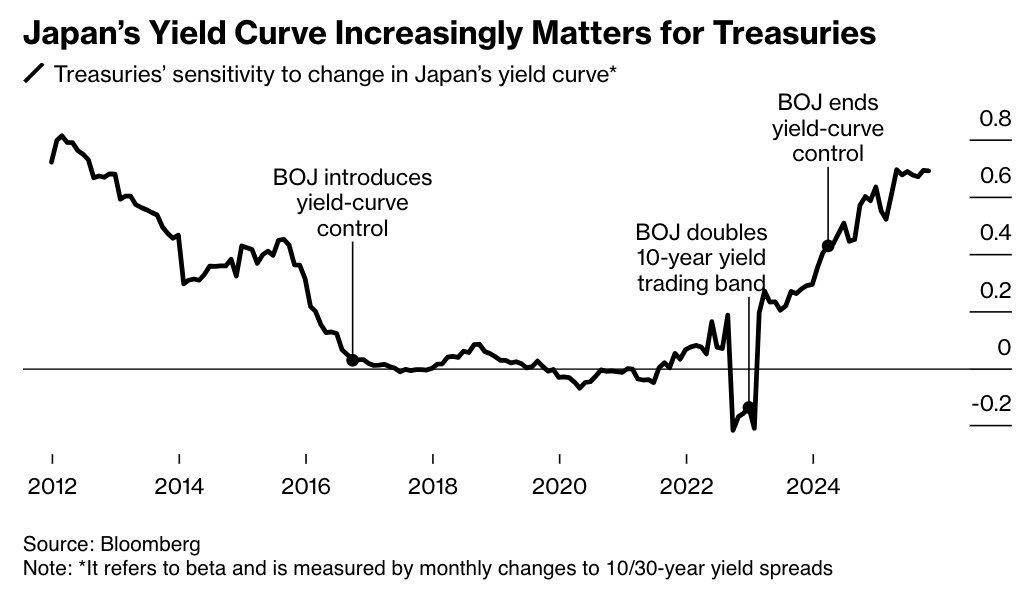
Group 1 - Goldman Sachs indicates that the election of Fumio Kishida as the president of the Liberal Democratic Party (LDP) in Japan is leading to increased volatility in Japanese long-term government bonds, which may impact bond markets in the US and UK [1][3] - The report suggests that every 10 basis points increase in Japanese government bond yields could result in a 2 to 3 basis points rise in yields for US, German, and UK bonds [1][3] - Japan's long-term government bonds have been a bellwether for global bond markets this year, with rising yields reflecting concerns over expanding fiscal deficits [1][3] Group 2 - Fumio Kishida's victory in the LDP presidential election positions her to become Japan's first female Prime Minister, with a platform advocating for fiscal expansion and a right-leaning political stance [3] - Kishida's pro-stimulus approach is expected to lead to increased government bond issuance to fund tax cuts and economic stimulus, resulting in a significant rise in the 40-year Japanese government bond yield by 14 basis points [3][6] - The long-term bond sell-off's sustainability will depend on the evolving political landscape, with upcoming 30-year Japanese government bond auctions likely to reveal investor interest [3][6]
中资离岸债风控周报(9月29日至10月3日):一级市场发行趋缓 二级市场小幅上涨
Sou Hu Cai Jing· 2025-10-06 03:40
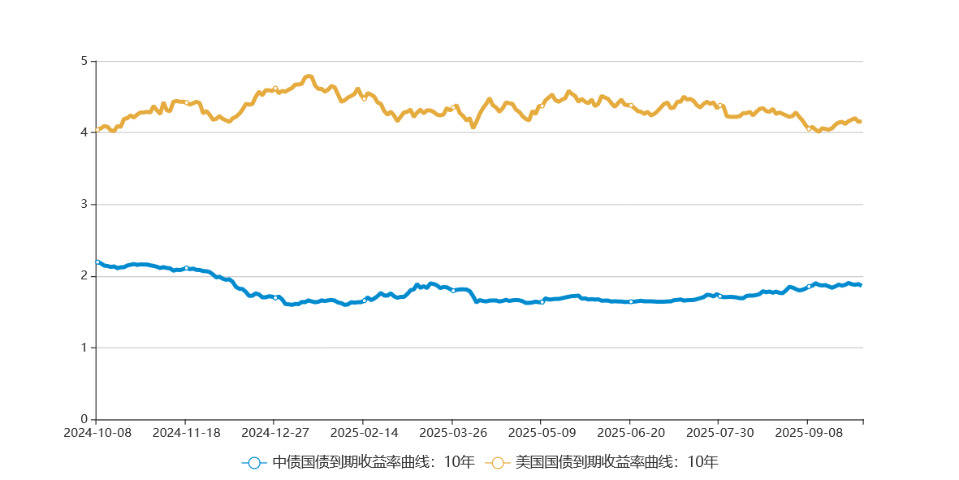
Primary Market - This week (September 29 - October 3), a total of 11 offshore bonds were issued by Chinese entities, including 1 offshore RMB bond, 5 USD bonds, 4 HKD bonds, and 1 EUR bond, with issuance sizes of 500 million RMB, 1.077 billion USD, 1.52 billion HKD, and 100 million EUR respectively [1] - In the offshore RMB bond sector, the largest single issuance was 500 million RMB, with the highest coupon rate at 1.96%, all issued by CITIC Construction Investment Securities [1] - In the USD bond market, the largest single issuance was approximately 97 million USD, with the highest coupon rate at 4.191%, all issued by AIA Group [1] Secondary Market - The yield on Chinese USD bonds slightly increased this week, with the Markit iBoxx Chinese USD Bond Composite Index rising by 0.29% to 249.92 [2] - The investment-grade USD bond index increased by 0.33% to 242.29, while the high-yield USD bond index rose by 0.05% to 245.67 [2] - The real estate USD bond index increased by 0.06% to 186.95, and the municipal investment USD bond index rose by 0.18% to 152.24 [2] - The financial USD bond index increased by 0.19% to 289.69 [2] Benchmark Spread - As of September 30, the yield spread between 10-year Chinese and U.S. government bonds narrowed to 236.49 basis points, a decrease of 0.48 basis points from the previous week [3] Rating Changes - On October 3, Aoyuan Group announced that it would be unable to meet the scheduled payment for the bonds "H20 Aoyuan 1" and "H21 Aoyuan" by September 30, 2025, and these bonds are subject to a 30-day grace period [5] Domestic News - On September 29, the cross-border bond repurchase business achieved over 5.82 billion RMB in transactions on its first day of operation, involving various types of foreign institutional investors [6] - The first foreign consumer REIT, Huaxia CapitaLand Commercial REIT, was listed on the Shanghai Stock Exchange on September 29, marking an important step in the internationalization and diversification of China's public REIT market [7] - Shanghai issued measures to promote the high-quality development of offshore bonds, aiming to create internationally competitive offshore bonds and encouraging the use of RMB [7] Offshore Debt Alerts - On September 30, Country Garden announced that it has completed the initial draft of a comprehensive solution for its offshore debt and is currently formulating a preliminary restructuring plan [8] - On September 30, CITIC Financial Assets International announced the full redemption of 250 million USD notes [9] - On October 3, Fantasia Holdings disclosed that its offshore debt restructuring plan has received support from creditors, with 84.54% of existing noteholders signing or joining the restructuring support agreement [10]
日元日债重挫、日股大涨!市场开启“高市早苗交易”,应对“安倍经济学”回归
Hua Er Jie Jian Wen· 2025-10-06 01:13
Core Viewpoint - The election of Sanae Takaichi, a protégé of the late former Prime Minister Shinzo Abe, is leading to expectations of a return to "Abenomics," characterized by large-scale fiscal stimulus and ultra-loose monetary policy, which is rapidly influencing Japan's financial markets [1][9]. Group 1: Market Reactions - Following Takaichi's election, the Nikkei 225 index surged over 4%, marking its largest single-day gain in months, while the Topix index rose by 3% [1]. - The Japanese yen weakened significantly against the US dollar by 1.5%, approaching the critical level of 150, and the yen also hit a historical low against the euro [3]. Group 2: Economic Policy Expectations - Takaichi's economic policy is heavily influenced by "Abenomics," advocating for fiscal expansion and a close alignment between government and the Bank of Japan, with a focus on demand-driven economic growth [9][10]. - She has expressed strong opposition to interest rate hikes by the Bank of Japan, which has led analysts to revise their expectations regarding potential rate increases in October [9]. Group 3: Investment Strategies - Investors are actively engaging in the "Takaichi trade," anticipating that her policies will weaken the yen, boost the stock market, and lead to a significant rise in long-term Japanese government bond yields [8][12]. - The market is preparing for potential fiscal expansion, with expectations that Takaichi will prioritize economic growth over strict fiscal discipline [10]. Group 4: Bond Market Implications - Despite the positive stock market response, the bond market faces pressure due to concerns that increased fiscal spending will necessitate more government bond issuance, raising Japan's debt burden [11]. - Analysts warn that without a "safety net" accompanying the issuance of new Japanese government bonds, there could be selling pressure on bonds, leading to a steeper yield curve [12].