
家电

Search documents
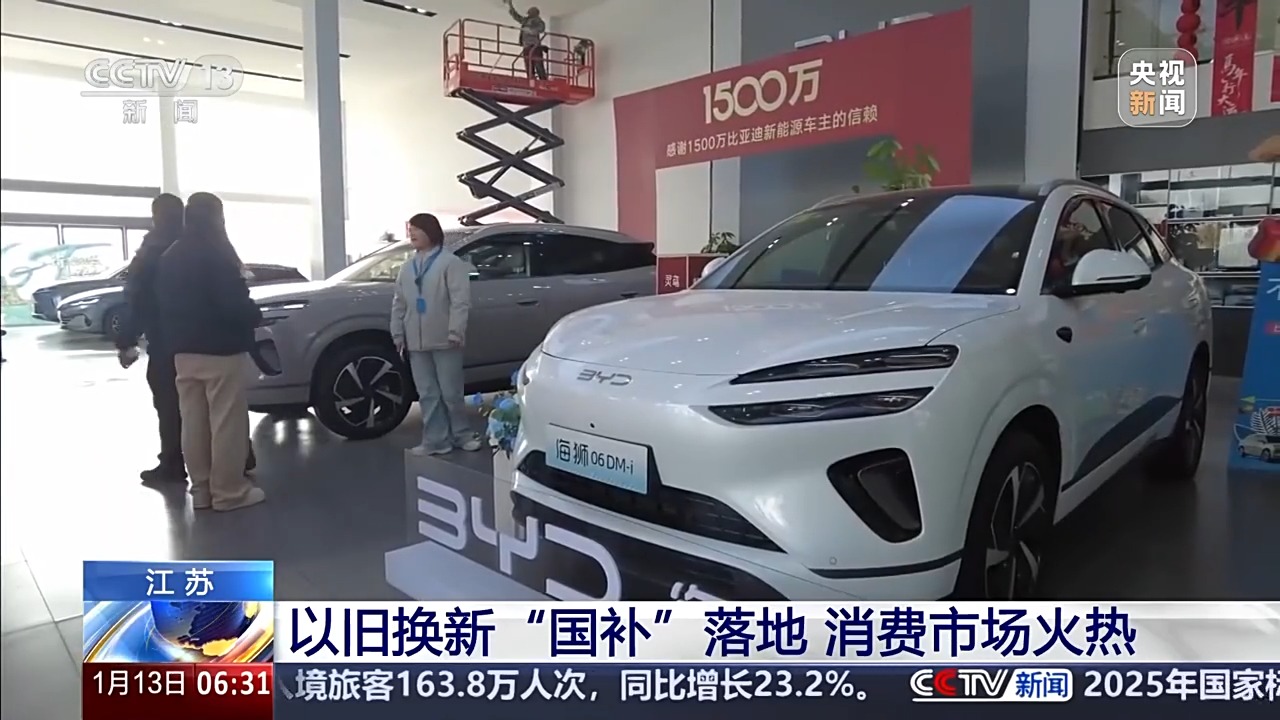
“新国补”落地近两周 各地消费市场迎来“换新”热潮
Yang Shi Xin Wen· 2026-01-13 03:44
Core Viewpoint - The new "National Subsidy" policy has been implemented for nearly two weeks, leading to a surge in the consumption market in Jiangsu, particularly in the automotive sector [1]. Group 1: Automotive Sector - The subsidy for automobiles is calculated based on the vehicle price, with consumers able to receive up to 20,000 yuan for purchasing new energy vehicles and 15,000 yuan for traditional fuel vehicles under specific conditions [2][5]. - In the context of scrapping and updating, new energy vehicles receive a subsidy of 12% of the vehicle price, while traditional fuel vehicles receive 10% [5]. Group 2: Home Appliances and Digital Products - The policy mandates that participating home appliances must meet "first-level energy efficiency" standards, covering six categories including refrigerators and washing machines, with a subsidy of 15% of the final price, capped at 1,500 yuan per item [7][11]. - Digital products such as smartphones and tablets priced under 6,000 yuan are eligible for a 15% subsidy, with a maximum of 500 yuan per item [11][12]. - The implementation of the "National Subsidy" has significantly increased consumer purchasing intent, as evidenced by consumer feedback on the benefits of the subsidies [7]. Group 3: Market Impact - The launch of the subsidy program has led to a notable increase in sales, with over 1.3 billion yuan in subsidies utilized in Hebei province alone, driving sales exceeding 9.2 billion yuan from January 1 to 9 [12]. - Retailers are enhancing consumer experience by offering "one-stop" services for old product recycling, which further incentivizes purchases [9].

家电行业2026年投资策略:基数承压,希冀仍存
Southwest Securities· 2026-01-13 03:32
Core Insights - The home appliance industry is expected to remain in a recovery phase in 2026 due to high base effects and pre-consumed demand, but it also faces a new normal influenced by national subsidies and tariff policies [7][9] - The domestic demand is anticipated to experience a turning point in the second half of 2026, despite being impacted by earlier demand exhaustion [6][9] - Export-oriented appliance companies are likely to see valuation recovery and improved performance due to low base effects from 2025 [6][9] Review of 2025 - The Shenyin Wanguo Home Appliance Index rose by 9.1% in 2025, ranking 24th among all industries, but underperformed the broader market in the second half due to declining domestic subsidies and uncertainties in export tariffs [4][17] - The domestic demand for home appliances is expected to require a longer recovery period due to the exhaustion of demand and changes in consumer habits [4][6] - The home appliance industry faced a weak overall fundamental performance in the second half of 2025, with leading white goods companies showing dividend attributes but lacking investor interest due to market competition and rising costs [4][6] Outlook for 2026 - The supply side of the home appliance industry is expected to remain stable, but increased overseas production capacity may lead to domestic overcapacity under weak demand assumptions [6][9] - Cost pressures are anticipated to gradually increase in 2026, particularly for leading companies that possess better pricing power [6][9] - The home appliance industry is projected to experience a consolidation of market structure, with weaker brands and OEMs likely to exit the market [6][9] Investment Themes - Focus on leading companies with high dividend yields and strong fundamentals, as they are better positioned to withstand industry challenges [9] - Attention to companies expanding overseas, as they adapt to tariff changes and enhance their global manufacturing and R&D capabilities [11] - Consideration of consumer upgrades and innovative product categories, as the demand for home appliances continues to evolve [13] Key Recommendations - The report suggests monitoring leading home appliance companies that demonstrate high cost-performance ratios and increasing dividend rates, especially as public funds show a growing preference for high-dividend sectors [9] - Emphasis on the potential of export-oriented companies that are becoming desensitized to tariff impacts and are expected to benefit from improved operational efficiencies [11] - Recognition of the long-term trend of consumer upgrades, with a focus on innovative categories that enhance lifestyle quality [13]
国信证券晨会纪要-20260113
Guoxin Securities· 2026-01-13 01:07
Group 1: Macro and Strategy - The report highlights the importance of constructing negative duration funds using government bond futures to navigate market cycles [3][8] - Public funds have established a stable presence in the government bond futures market, with a significant number of funds holding short positions [8][9] - The report suggests that the current market for negative duration funds is limited, with most funds using futures primarily for hedging rather than seeking additional returns [10] Group 2: Industry and Company Insights - The medical and biological sector is experiencing strong performance, particularly in areas like brain-computer interfaces and AI healthcare, with significant investment opportunities identified [20][21] - The consumer-grade 3D printing industry is entering a period of widespread adoption, driven by technological advancements and increasing demand for personalized products, with a projected market size exceeding $4 billion by 2024 [22][23] - The food and beverage sector is preparing for the Spring Festival, with various companies expected to benefit from favorable market conditions, particularly in the dairy and beverage segments [27][28] Group 3: Investment Recommendations - The report recommends focusing on leading companies in the 3D printing sector that demonstrate technological advantages and strong market positions [24][25] - In the food and beverage industry, companies like Moutai and Yili are highlighted for their growth potential amid favorable market conditions [27][28] - The service sector is expected to benefit from ongoing government policies aimed at boosting consumer spending, with companies like Ctrip and Huazhu Group recommended for investment [30][33]

2026年郑州市消费品以旧换新补贴活动启动
Zheng Zhou Ri Bao· 2026-01-13 00:47
Core Viewpoint - The announcement by the Municipal Bureau of Commerce regarding the launch of a subsidy program for the replacement of consumer goods, including automobiles, home appliances, and digital smart products, in 2026 aims to stimulate consumption and promote energy-efficient products [1] Automotive Sector - Consumers can apply for vehicle scrapping and replacement subsidies through the national automotive circulation information management system or the "Automobile Trade-in" mini-program [1] - For vehicle replacement subsidies, consumers must retain relevant proof materials until the Henan Province 2026 vehicle replacement subsidy application system is launched [1] Home Appliances Sector - Consumers purchasing specific home appliances such as refrigerators, washing machines, televisions, air conditioners, computers, and water heaters will receive a subsidy of 15% of the final sales price for energy-efficient products [1] - Each consumer can receive a subsidy for one unit per product category, with a maximum subsidy of 1,500 yuan per item [1] Digital Smart Products Sector - Consumers buying eligible digital smart products, including smartphones, tablets, smartwatches, and smart glasses, priced at no more than 6,000 yuan, will also receive a subsidy of 15% of the final sales price [1] - Similar to home appliances, each consumer can receive a subsidy for one unit per product category, with a maximum subsidy of 500 yuan per item [1] - The Cloud Flash Payment APP serves as the entry point for claiming subsidies in the home appliances and digital smart products sectors [1]
四川2025年12月CPI同比上涨0.2%
Sou Hu Cai Jing· 2026-01-13 00:47
Group 1 - Overall, Sichuan's CPI shows a low-level moderate recovery trend, with core CPI continuing to strengthen, having risen for 10 consecutive months [1][2] - In December 2025, pork prices in Sichuan decreased by 16.6% year-on-year and 0.8% month-on-month, primarily due to industry overcapacity and weak terminal demand [1][2] - The increase in consumer demand policies and pre-New Year consumption has led to price increases in communication tools, entertainment durable goods, and household appliances [1][2] Group 2 - In December 2025, the core CPI excluding food and energy prices rose by 0.9% year-on-year, maintaining the same growth rate as the previous month [2] - The core CPI is supported by a 0.9% year-on-year increase in service prices, indicating that positive factors in price movements are gradually accumulating [2]
四川2025年12月CPI同比上涨0.2% 呈现低位温和回升态势
Si Chuan Ri Bao· 2026-01-13 00:25
Group 1 - Overall, Sichuan's CPI shows a low-level moderate recovery trend, with core CPI continuing to strengthen, having risen for 10 consecutive months [1][2] - In December 2025, pork prices in Sichuan decreased by 16.6% year-on-year and 0.8% month-on-month, attributed to industry overcapacity and weak terminal demand [1][2] - The prices of communication tools, entertainment durable goods, and household appliances have increased due to the effects of consumption-boosting policies and rising demand before the New Year [2] Group 2 - In December 2025, the core CPI, excluding food and energy prices, rose by 0.9% year-on-year, maintaining the same growth rate as the previous month [2] - The increase in core CPI is primarily driven by a 0.9% rise in service prices, indicating that positive factors in price movements are gradually accumulating [2]
排名下降暴露日本经济深层弊病
Jing Ji Ri Bao· 2026-01-13 00:22
Group 1 - Japan's nominal GDP per capita for 2024 is projected to be approximately $33,800, ranking 24th among the 38 OECD member countries, a decline from 22nd place in 2023, marking a new record low [1] - The International Monetary Fund (IMF) forecasts that Japan's GDP per capita ranking will drop to 38th globally by 2025, reflecting persistent economic issues such as low economic dynamism, population decline, and yen depreciation [1][2] - Japan's average real GDP growth from 1990 to 2023 has been only 1.0%, indicating a shift from high-speed growth to low-speed growth since the early 1990s [2] Group 2 - Japan's total population, excluding foreigners, was reported at 119.61 million as of July 1, 2025, continuing a trend of population decline for 16 consecutive years [2] - The depreciation of the yen by 30% to 40% against the dollar from 2022 to 2024 has contributed to Japan being surpassed in GDP rankings by countries with more stable currencies [2] - Japan's traditional industries are struggling to adapt, while emerging sectors lack innovation, leading to stagnation in total factor productivity and a weakening of economic competitiveness [3] Group 3 - The aging population and declining birth rates are exacerbating demographic imbalances, increasing the dependency ratio and decreasing capital formation rates, which contribute to a downward spiral in economic growth [3] - The unconventional monetary policies implemented during Abe's administration have led to significant yen depreciation without revitalizing economic momentum, resulting in expanded fiscal deficits and a liquidity trap [3] - Recent comments from Japanese citizens suggest that the decline in GDP per capita is seen as a systemic issue rather than an individual failure, indicating broader dissatisfaction with national policies [3]
优化消费品以旧换新政策实施 推动商品消费扩容升级
Xin Lang Cai Jing· 2026-01-12 23:09
Core Viewpoint - The recent national business work conference has prioritized the implementation of consumption promotion actions, specifically focusing on optimizing the "old-for-new" policy for consumer goods to enhance consumption expansion and upgrading by 2026 [1][5]. Group 1: Policy Implementation and Goals - The Ministry of Commerce reports that in 2025, the sales volume of goods related to the "old-for-new" policy exceeded 2.6 trillion yuan, benefiting over 360 million people [1][6]. - Specific targets include the replacement of over 11.5 million vehicles, 129 million home appliances, 9.1 million digital products, 12 million home renovation items, and 1.25 million electric bicycles [1][6]. - A joint notice from the Ministry of Commerce and six other departments outlines the support for the "old-for-new" policy through long-term special government bond funding and local matching funds [1][6]. Group 2: Subsidy Optimization and Consumer Support - The 2026 policy will adjust subsidies from fixed amounts to a percentage of vehicle prices, with different rates for new energy and fuel vehicles [2][7]. - Consumers purchasing energy-efficient appliances will receive a 15% subsidy based on the product's sales price, with an expansion to include new categories like smart glasses [2][7]. - The central government will continue to allocate long-term special bond funds, enhancing the efficiency of subsidy distribution and ensuring that benefits reach consumers directly [2][7]. Group 3: Industry Impact and Future Directions - The "old-for-new" policy has significantly boosted sales and promoted the adoption of high-quality products like new energy vehicles and energy-efficient appliances, laying a foundation for 2026 [3][8]. - Experts suggest expanding consumer categories, optimizing the consumption environment, and innovating consumption models to further stimulate consumption growth [3][8]. - Recommendations include enhancing the supply system, improving consumer experience, and strengthening the recycling system for old products to support a sustainable consumption ecosystem [4][9].
商务部部署八大重点,消费或在这些领域爆发
Xin Lang Cai Jing· 2026-01-12 23:09
Group 1: Core Objectives of the National Business Work Conference - The conference emphasized the importance of boosting consumption as the top priority for 2026, aiming to create a strong domestic market and enhance high-quality development [1][2] - The focus on "self-initiated openness," "trade innovation," and "two-way investment" indicates a strategic shift towards a more selective and higher-level openness rather than a defensive contraction [1] - The overall direction set by the conference aims to stabilize expectations and strengthen confidence for high-quality business development during the 14th Five-Year Plan period [1] Group 2: Green Consumption Initiatives - The implementation of a consumption upgrade policy, including subsidies for energy-efficient appliances and new energy vehicles, is expected to significantly boost green consumption [3][4] - The "old-for-new" policy is projected to lead to the replacement of 1.83 million vehicles and 192 million home appliances, generating a sales volume of 3.92 trillion yuan and benefiting approximately 494 million consumers [3] - The introduction of a green consumption points system aims to incentivize consumers to choose green products, linking points to public service benefits [4][5] Group 3: Activation of Downstream Market Consumption - The conference identified the activation of consumption in rural and county areas as a key focus for 2026, recognizing the significant potential in these markets [6][7] - Data shows that rural retail sales growth outpaces urban areas, indicating a shift towards quality and service-oriented consumption in these markets [7][8] - The emphasis on enhancing rural consumption and supporting local products aligns with broader strategies to improve the rural economy and increase consumer spending [7][8] Group 4: Promotion of Free Trade Zones and Open High Grounds - The conference called for greater efforts to align with international high-standard trade rules and enhance the construction of free trade zones, particularly in Hainan [9][10] - Hainan's free trade port is set to serve as a testing ground for high-level openness, potentially influencing China's participation in global trade rule restructuring [9][10] - The focus on trade and investment integration aims to create synergies between trade and investment, enhancing the overall efficiency of the business system [11]
优化消费品以旧换新政策 实施推动商品消费扩容升级
Zheng Quan Ri Bao· 2026-01-12 17:18
Core Viewpoint - The national business work conference has outlined key tasks for 2026, with a focus on implementing consumption stimulation actions and enhancing the "Buy in China" brand, particularly through optimizing the old-for-new policy for consumer goods [1] Group 1: Policy Implementation - The Ministry of Commerce reports that in 2025, sales related to the old-for-new policy exceeded 2.6 trillion yuan, benefiting over 360 million people [1] - Specific figures include over 11.5 million vehicles, 129 million home appliances, 9.1 million digital products, and 12 million home renovation items exchanged under the policy [1] - A joint notice from the Ministry of Commerce and six other departments has been issued to enhance the implementation of the old-for-new policy in 2026, with continued funding support from central and local governments [1] Group 2: Subsidy Optimization - The 2026 policy will optimize subsidy standards and ranges, transitioning from fixed subsidies to percentage-based subsidies based on vehicle prices for both new energy and fuel vehicles [2] - Consumers purchasing energy-efficient home appliances will receive a 15% subsidy based on the product's sales price, with an expansion to include new categories like smart glasses [2] - The central government will continue to allocate long-term special treasury bond funds, with local governments providing matching funds to enhance the efficiency of subsidy distribution [2] Group 3: Market Expansion and Consumer Experience - The 2025 old-for-new policy has significantly increased sales and promoted the adoption of high-quality products, laying a foundation for the 2026 upgrades [3] - Experts suggest expanding consumer categories, optimizing the consumption environment, and innovating consumption models to further stimulate consumption [3] - Recommendations include supporting traditional sectors like automotive and home appliances while also expanding to emerging fields like smart devices [3] Group 4: Enhancing Supply and Experience - The focus will be on improving the consumption supply system, supporting the development of AI and low-carbon products, and encouraging personalized goods [4] - Enhancements to consumer experience will involve upgrading offline commercial facilities and improving rural consumption networks [4] - Strengthening the consumption ecosystem includes improving recycling systems for old goods, enhancing quality and price regulation, and optimizing payment and after-sales services to alleviate consumer concerns [4]