玻璃

Search documents
建材子行业Q1景气追踪和展望
2025-04-15 00:58
Summary of the Conference Call on the Building Materials Industry Q1 2025 Industry Overview - The conference call discusses the building materials industry, particularly focusing on the consumption building materials sector in Q1 2025, highlighting various sub-sectors such as waterproofing, gypsum board, coatings, cement, glass, and photovoltaic glass [2][3][4][5][6][10][11][12]. Key Points and Arguments General Market Conditions - In Q1 2025, the consumption building materials industry showed stable B-end demand, with significant central government leverage and verified demand for key projects. However, C-end demand is expected to have limited growth due to high base effects from previous years [2][3][8]. - Municipal infrastructure is under pressure from local debt, but the low base from 2024 supports decent performance in engineering [2][3]. Sub-sector Performance - **Waterproofing Industry**: Revenue faced pressure due to price declines, but high-end products saw significant price increases. The strategy focuses on controlling channel inventory, with potential recovery in profitability if asphalt prices stabilize [3][4][9]. - **Gypsum Board Industry**: The sector performed well with low channel inventory, leading to expected sales growth. Despite a year-on-year price decline, lower costs for paper and coal helped maintain profitability [5][9]. - **Coatings Industry**: Major C-end companies achieved double-digit growth, while B-end remained stable. Some companies expanded channels to drive growth, resulting in a relatively strong overall performance [6][9]. - **Cement Industry**: Price increases in East China were successful, with prices higher than the previous year. Despite a projected demand decline of 5-10%, supply-side inventory levels are reasonable, maintaining profitability [10][14]. - **Glass Industry**: The sector faced significant average losses due to overcapacity and price corrections. Short-term recovery is unlikely without improvements in supply-demand dynamics [11]. - **Photovoltaic Glass Industry**: The first quarter exceeded expectations due to strong demand and price increases. However, concerns exist for Q3 as demand may decline [12][13]. Financial and Strategic Insights - The overall logic for the consumption building materials industry in 2025 indicates no expected volume growth, leading to reduced competition in price wars and lower management and sales expenses. This shift is anticipated to enhance net profit margins despite stagnant volume [8]. - Companies are advised to focus on product differentiation and high-end product pressures while monitoring export impacts on low-end product pricing [15]. Additional Important Insights - The building materials industry is experiencing a transition with a focus on managing costs and inventory levels, which may lead to improved profitability despite lower sales volumes [8][9]. - The performance of various sub-sectors reflects a mixed outlook, with some areas showing resilience while others face challenges due to market conditions and external pressures [3][4][5][6][10][11][12][14].
建材行业2025年一季报业绩前瞻:行业从“量本利”回到“价本利”
Shenwan Hongyuan Securities· 2025-04-14 13:40
Investment Rating - The report gives a "Positive" outlook for the building materials industry in Q1 2025, indicating a rebound after a prolonged downturn [2][3]. Core Insights - The building materials industry is transitioning from a focus on "volume and cost" to "price and profit," with expectations of recovery in Q1 2025 after nearly four years of decline [3]. - The report highlights that various products in the industry have begun to see price increases, suggesting the end of aggressive price competition and a return to rational pricing strategies [3]. - Specific segments such as cement, fiberglass, and consumer building materials are expected to show significant performance improvements in Q1 2025 [3]. Summary by Relevant Sections Cement - The average price of cement in Q1 2025 is projected to be 401 RMB/ton, a year-on-year increase of 37 RMB/ton, while the cost of coal has decreased significantly [3]. - Cement production in January-February 2025 was 170 million tons, a year-on-year decline of 5.7%, but the decline is narrowing compared to 2024 [3]. - Major companies like Conch Cement are expected to see a net profit increase of around 20% in Q1 2025 [4]. Fiberglass - Price increases for various fiberglass products are being implemented, with the average price for non-alkali direct yarn expected to reach 3888 RMB/ton, a year-on-year increase of 711.1 RMB/ton [3]. - China Jushi is projected to see a significant profit recovery, with a net profit forecast of 7.1-7.6 billion RMB in Q1 2025, representing a year-on-year increase of 320-350% [3]. Consumer Building Materials - The real estate market is showing signs of recovery, which may stabilize demand for consumer building materials [3]. - The report anticipates improvements in revenue and profit for companies in this segment in Q1 2025 [3]. Glass - Photovoltaic glass prices have increased due to demand, while flat glass prices remain under pressure [3]. - The average price for photovoltaic glass has risen from 12 RMB/sqm to 14.25 RMB/sqm in early April 2025 [3]. Investment Recommendations - The report recommends focusing on companies such as Conch Cement, Huaxin Cement, and China Jushi for potential investment opportunities in Q1 2025 [3]. - Other recommended companies include North New Building Materials, Rabbit Baby, and Weixing New Materials in the consumer building materials sector [3].


中金公司 关税下如何看待建筑建材?
中金· 2025-04-08 15:42
Investment Rating - The report maintains a positive investment outlook for the construction and building materials sector, emphasizing its resilience to tariffs and trade wars due to its reliance on domestic demand [2][3]. Core Insights - The construction and building materials sector is expected to benefit from fiscal stimulus aimed at domestic consumption and infrastructure projects, making it a key investment focus [3][6]. - Supply-side reforms are likely to favor sectors such as cement, fiberglass, and steel, which are positioned to benefit from reduced competition and improved profitability [3][8]. - Defensive stocks with high cash flow, high ROE, and high dividend yields are highlighted as valuable during market volatility, particularly cement and state-owned enterprises [3][8]. Summary by Sections Investment Opportunities Post-Tariff - The construction and building materials sector remains attractive post-tariff due to its focus on domestic demand and local operations, making it less vulnerable to external shocks [2][3]. - Key beneficiaries include sectors directly impacted by fiscal policies, such as cement and consumer building materials [3][8]. Demand Factors for Building Materials - There are clear demand drivers for building materials, particularly from infrastructure projects and consumer home improvements, indicating a stable outlook for both B-end and C-end demand [6][17]. Sector Selection Strategy - The report suggests a balanced approach between defensive cement stocks and more aggressive consumer building materials, with a preference for companies like Three Trees and North New Materials [4][7]. Cement Industry Outlook - The cement sector is projected to see improved demand driven by fiscal stimulus, with expectations for a stable or improving national cement shipment rate [10][13]. - Recommended stocks include Huaxin Cement and Conch Cement, which are expected to perform well in the upcoming demand season [10][13]. Glass Industry Forecast - The glass sector faces challenges due to declining construction-related demand, but low export exposure and potential rebounds in the second half of the year are noted [11][13]. - Companies like Xinyi Glass are highlighted for their resilience and dividend yield, making them suitable for investment [11][13]. Fiberglass Sector Analysis - The fiberglass industry is less affected by tariffs due to low export ratios, with strong domestic demand in wind energy and thermoplastics providing a buffer [12][13]. - China Jushi is identified as a key player with a strong position in North America and Europe, mitigating tariff impacts [12][13]. Consumer Building Materials Market - The consumer building materials market is experiencing a decline in demand for waterproof materials, while gypsum board demand remains stable [17][19]. - Companies like North New Materials and Three Trees are noted for their strong performance and strategic pricing approaches [19][20]. Future Demand Drivers - Future demand in the consumer building materials sector is expected to be driven by infrastructure and home renovation projects, with Three Trees positioned for aggressive growth [24].

预计4月玻璃期价将低位运行
Hua Long Qi Huo· 2025-04-01 02:58
研究报告 玻璃月报 预计 4 月玻璃期价将低位运行 后市展望:3 月整体市场仍处于偏弱格局,且生产端暂无冷修计划, 行业库存累增,中下游提货意愿较弱,出货偏慢,平板玻璃市场弱势运行; 预计 4 月玻璃产线冷修计划和复产点火计划体量或将变化不大,需求预计 改善空间有限,预计 4 月玻璃期价将低位运行。 交易策略:建议观望 【投资评级:★】 *特别声明:本报告基于公开信息编制而成,报告对这些信息的准确性及完整性不作任何保证。本文中 的操作建议为研究人员利用相关公开信息的分析得出,仅供投资者参考,据此入市风险自负。 华龙期货投资咨询部 投资咨询业务资格: 证监许可【2012】1087 号 黑色板块研究员:魏云 期货从业资格证号:F3024460 投资咨询资格证号:Z0013724 电话:17752110915 邮箱:497976013@qq.com 报告日期:2025 年 4 月 1 日星期二 本报告中所有观点仅供参 考,请投资者务必阅读正文之后 的免责声明。 摘要: 行情回顾:3 月玻璃 2509 合约下跌 7.21% 基本面:据国家统计局数据显示,2025 年 2 月我国平板玻璃产量为 15,173 万重量箱, ...
建筑材料行业跟踪周报:低估值的消费细分龙头具有较高胜率-2025-03-17
Soochow Securities· 2025-03-17 08:08
证券研究报告·行业跟踪周报·建筑材料 建筑材料行业跟踪周报 低估值的消费细分龙头具有较高胜率 2025 年 03 月 17 日 增持(维持) [Table_Tag] [Table_Summary] 投资要点 证券分析师 黄诗涛 执业证书:S0600521120004 huangshitao@dwzq.com.cn 证券分析师 房大磊 执业证书:S0600522100001 fangdl@dwzq.com.cn 证券分析师 石峰源 执业证书:S0600521120001 shify@dwzq.com.cn 行业走势 -24% -20% -16% -12% -8% -4% 0% 4% 8% 12% 16% 2024/3/18 2024/7/16 2024/11/13 2025/3/13 建筑材料 沪深300 相关研究 《政策刺激力度符合预期》 2025-03-10 《建筑业 PMI 低位大幅反弹》 2025-03-03 东吴证券研究所 1 / 22 请务必阅读正文之后的免责声明部分 ◼ 本周(2025.3.10–2025.3.14,下同):本周建筑材料板块(SW)涨跌幅 1.18%,同期沪深 300、万得全 A ...
行业旺季渐行渐近,关注提价背后投资机会
HUAXI Securities· 2025-03-16 14:04
Investment Rating - The industry rating is "Recommended" [5] Core Views - The construction materials industry is entering a peak season, with increasing downstream demand and effective implementation of staggered production, benefiting companies like Conch Cement, Huaxin Cement, and Tapai Group [1][7] - The recovery of second-hand housing transactions and government initiatives to boost consumption are expected to drive demand for consumer building materials, recommending companies such as Sankeshu and Weixing New Materials [1][8] - The government's focus on low-altitude economy development presents opportunities for companies like Huase Group and Design Institute [1][8] - Major engineering projects, such as the Yarlung project, are anticipated to commence, benefiting companies like Zhongyan Dadi [1][9] - The domestic demand for automotive coatings is expected to grow due to strong domestic substitution demand, recommending companies like Songji Coatings [1][11] Summary by Sections Market Overview - In the 11th week of 2025, new home transactions in 30 major cities showed a 2% year-on-year increase, with a total transaction area of 1,733.17 million square meters, up 11% year-on-year [2] - Second-hand housing transactions in 15 monitored cities increased by 42% year-on-year, indicating a robust market [2] Cement Market - The national average cement price rose to 393.86 yuan/ton, a 1.6% increase from the previous week, with significant price hikes in East, Central, and Southwest regions [3][24] - The operating load of cement mills increased to 37.12%, reflecting a recovery in demand [32] Investment Recommendations - Recommended companies include: - Conch Cement and Huaxin Cement for benefiting from rising cement prices [1][7] - Sankeshu and Weixing New Materials for their strong consumer building materials attributes [1][8] - Huase Group and Design Institute for low-altitude economy opportunities [1][8] - Zhongyan Dadi for potential orders from the Yarlung project [1][9] - Songji Coatings for growth in automotive coatings [1][11]





政策稳中求进、水泥持续复价,继续关注建材春季躁动及数字化转型机会
East Money Securities· 2025-03-12 07:45
[Table_Title] 建材行业周报 政策稳中求进、水泥持续复价,继续关 注建材春季躁动及数字化转型机会 2025 年 03 月 09 日 [Table_Author] 东方财富证券研究所 证券分析师:王翩翩 证书编号:S1160524060001 证券分析师:郁晾 证书编号:S1160524100004 证券分析师:姚旭东 证书编号:S1160525010001 [Table_PicQuote] 相对指数表现 -21.64% -13.20% -4.75% 3.69% 12.13% 20.58% 3/7 5/7 7/7 9/7 11/7 1/7 3/7 建筑材料 沪深300 [Table_Summary] 【投资要点】 【配置建议】 【风险提示】 需求不及预期,毛利率不及预期,回款不及预期。 挖掘价值 投资成长 强于大市(维持) [Table_Report] 相关研究 《立邦 2024 年 TUC 业务逆势增长, 指引乐观,2025 行业或迎向上拐点》 2025.03.03 《实物量和二手销售景气修复,水泥 玻纤龙头竞合策略改善,重视建材春 季躁动》 2025.03.02 《复工实物量温和回升、华东水泥开 ...
建筑建材双周报(2025年第4期):施工旺季临近,建筑建材景气上行-2025-03-12
Guoxin Securities· 2025-03-12 02:27
Investment Rating - The report maintains an "Outperform" rating for the construction materials sector, indicating expected performance above the market index by over 10% [1][52]. Core Views - The construction materials sector is experiencing an upward trend due to the approaching construction peak season and accelerated infrastructure funding, with a historical high in policy funding expected in 2025 [1]. - The report highlights the ongoing high demand for coal chemical projects in Xinjiang, with over 700 billion yuan in investments planned for 2025, indicating a robust outlook for leading companies in this sector [1]. - The report suggests a gradual recovery in demand for construction materials as the peak season approaches, with a focus on fiscal policy and real estate policy effects [3]. Summary by Sections Construction Materials - Cement prices increased by 0.7% week-on-week, with a 7% rise in shipment rates in key regions, indicating a slow recovery in demand [2][21]. - Glass prices decreased by 2.07% week-on-week, reflecting weak demand and slow processing plant operations [2][28]. - The fiberglass market shows a slight price increase, with the average price for non-alkali yarn rising by 0.63% week-on-week [2][35]. Investment Recommendations - The report recommends focusing on resilient consumer building material leaders such as Sanke Tree, Beixin Building Materials, and others, while also highlighting opportunities in cement and glass sectors [3][6]. - It emphasizes the importance of monitoring fiscal policy and real estate market developments for potential investment opportunities [3][6]. Market Trends - The construction materials index outperformed the market index by 4.6% during the last reporting period, with a 30.2% increase over the past six months [11]. - The report notes that the construction sector is currently facing insufficient effective demand, with low leverage willingness among residents and enterprises [3][6].
2025年春季建材行业投资策略:把握春旺,关注提价与发货改善
申万宏源· 2025-03-12 01:32
Investment Rating - The report indicates a positive investment outlook for the building materials industry, emphasizing price increases and improved shipping conditions as key drivers for growth in 2025 [1][3]. Core Insights - Price increases are the main theme for the building materials industry in spring 2025, signaling a return to rational competition after a period of aggressive price wars [3][32]. - The cement sector is experiencing price hikes driven by low inventory levels, with a consensus among companies to avoid destructive competition, leading to a gradual recovery in profitability [3][11]. - The consumer building materials segment is witnessing price increases across various categories, indicating a potential turning point for the industry [3][32]. - The fiberglass industry is seeing multiple rounds of price increases, suggesting a recovery in profitability, while the glass sector faces challenges related to construction completions [3][32]. Summary by Sections Cement - Low inventory levels are driving price increases, with significant hikes reported in various regions starting from March 2025 [7][8]. - The industry has reached a consensus to prevent destructive competition, which is expected to lead to a gradual recovery in profitability [11][12]. - Major companies such as Conch Cement are highlighted for their cost and scale advantages, with profitability expected to improve [18][19]. Consumer Building Materials - The demand for consumer building materials is improving due to active second-hand housing transactions, which are expected to boost shipments [36][49]. - Price increases in categories like gypsum board and coatings are signaling a shift towards profitability recovery [36][39]. - Companies such as Beixin Building Materials and Weixing New Materials are recommended for their strong market positions and growth potential [37][40]. Fiberglass - The fiberglass sector is experiencing a recovery in prices, with electronic yarn and cloth prices showing upward trends [52][53]. - The industry is expected to continue benefiting from new application scenarios and sustained demand growth [53][54]. Glass - The flat glass sector is under pressure due to declining construction completions, necessitating close monitoring of supply-side adjustments [32][49]. - Companies like Qibin Group and South Glass A are recommended for their market positions amid these challenges [32][49].


国内高频 | 建筑业开工回落
赵伟宏观探索· 2025-03-10 09:37
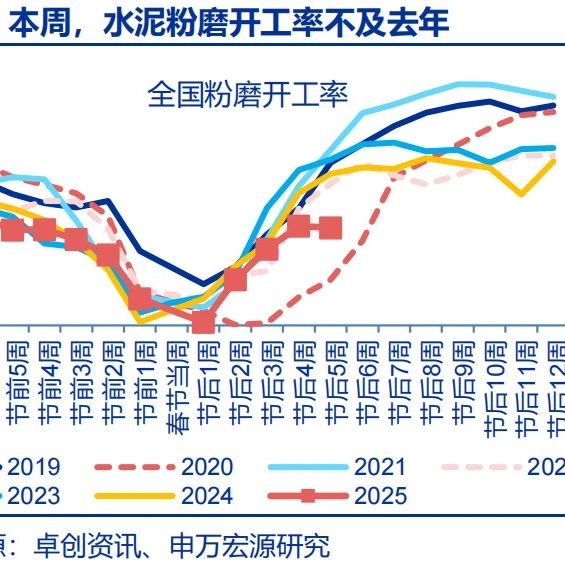
Core Viewpoint - The article highlights the divergence in industrial production, weak construction activity, and a significant increase in real estate transactions, indicating mixed signals in the economy [1][2]. Industrial Production - Industrial production shows a mixed performance, with downstream operations recovering while midstream and upstream sectors experience slight declines. For instance, the operating rate of automotive semi-steel tires increased by 2.7% year-on-year, while PTA and soda ash saw declines of 0.5% and 5.7% respectively [1][5]. - High furnace operating rates have slightly improved, up 2.6% year-on-year, but overall consumption remains weak, down 6.6% compared to last year [4]. Construction Industry - The construction sector remains weak, with national grinding operating rates and cement shipment rates down 6.6% and up 3.8% year-on-year, respectively. The asphalt operating rate is also at historical lows, down 2.5% [6][7]. Real Estate Transactions - National new home transactions have significantly declined, down 66.6% year-on-year, with second and third-tier cities also experiencing negative growth of 24.9% and 12.2% respectively. However, first-tier cities still show positive growth, albeit down 61.4% to 3.5% [2][9]. Transportation and Demand - There is a mild recovery in freight transportation, with railway and highway freight volumes increasing by 0.9% and 1.3% year-on-year, respectively. However, port cargo throughput has weakened, down 2.2% [10]. - Human mobility has decreased, with a 11.4% drop in migration scale index and a decline in domestic and international flight operations [11]. Price Trends - Agricultural product prices have generally declined, with vegetable, pork, and fruit prices down 1.7%, 0.9%, and 0.6% respectively. Conversely, egg prices have increased by 0.7% [14]. - The South China Industrial Price Index has continued to decline, with energy and chemical prices dropping by 2.2% and metal prices by 0.7% [15].