
钢铁

Search documents
20cm速递|科技+顺周期主线价值凸显,科创创业ETF国泰(588360)盘中涨超1%
Mei Ri Jing Ji Xin Wen· 2026-02-10 17:30
Group 1 - The core viewpoint emphasizes that the combination of technology and cyclical sectors remains a key investment theme, with expectations of PPI turning positive driving EPS growth and liquidity support [1] - The article highlights the importance of focusing on stable growth in end-user sectors and the commercialization of ToB applications, particularly in areas such as computing hardware, energy storage, AI applications, and intelligent driving [1] - The Guotai Science and Innovation ETF (588360) tracks the Science and Innovation 50 Index (931643), which includes 50 large-cap emerging industry companies from the Sci-Tech and ChiNext boards, reflecting the overall performance of representative emerging industries [1] Group 2 - The index focuses on industries such as electronics, power equipment, communications, and biomedicine, emphasizing technological attributes and innovative growth, with a relatively balanced industry allocation [1] - The cyclical sectors are expected to show significant price and valuation elasticity during the phase of PPI turning positive, with reduced competition potentially leading to improved performance in sectors like non-ferrous metals, chemicals, machinery, steel, and building materials [1]

期货“护航”稳盈利 钢铁行业交出亮眼答卷
Qi Huo Ri Bao Wang· 2026-02-10 16:38
Core Viewpoint - The Chinese steel industry has shown significant profit improvement in 2025, driven by multiple factors including raw material cost reductions and strategic adjustments by companies [1][2][6]. Group 1: Profit Improvement - The total operating profit of the steel industry in 2025 reached 109.8 billion yuan, indicating an overall improvement [1]. - Among 23 listed steel companies that announced 2025 performance forecasts, 12 reported profits while 11 incurred losses, with notable profit-makers including Hualing Steel and Shougang [1]. - The improvement in profitability is attributed to a combination of factors, including effective risk management through the use of futures and derivatives [1][2]. Group 2: Raw Material Market Dynamics - The primary reason for profit improvement is the decline in raw material costs, particularly iron ore and coking coal, which saw significant price drops [2]. - Steel prices have not decreased as sharply as raw material prices, allowing steel mills to expand their profit margins [2]. Group 3: Industry Structure and Demand - The "anti-involution" policy introduced last year has positively impacted industry valuations and steel mill profitability [3]. - The demand for steel in traditional construction has declined, but high-end manufacturing and emerging industries, particularly in electric vehicles, have seen robust demand growth [3]. - Regional disparities are evident, with eastern coastal steel companies benefiting from product structure adjustments, while central and western companies face more challenges due to reduced demand [3]. Group 4: Risk Management through Financial Tools - The use of financial derivatives for risk management has become a core competitive advantage for large steel companies [4][5]. - Baosteel exemplifies this approach by integrating futures into its operations to lock in raw material costs and stabilize profits [4]. Group 5: Future Outlook for 2026 - The steel industry is expected to continue its high-quality development trajectory, with overall profitability likely to improve but without significant changes [6]. - Profit totals for the industry in 2026 could reach or exceed 150 billion yuan, driven by recovering domestic demand and strong export performance [7]. - The competition will increasingly focus on cost control and high-end product competitiveness, with a shift towards optimizing structure and efficiency [8].

喀麦隆进口:汽车、钢铁和农业投入品推动中国进口额增长25%,达到2268亿中非法郎
Shang Wu Bu Wang Zhan· 2026-02-10 16:01
Core Insights - The value of goods imported from China to Cameroon increased by 25% year-on-year in the second quarter of 2025, reaching 226.8 billion CFA francs (approximately $3.9 million) [1] - The total import volume during the period was 492,013 tons, compared to 438,218 tons in the same period of 2024 [1] Group 1: Key Drivers of Import Growth - The primary driver of this growth was the import of automobiles and parts, which nearly doubled in value from 13.3 billion CFA francs in the second quarter of 2024 to 26.2 billion CFA francs in 2025 [2] - Steel product imports also accelerated significantly, with the value reaching 44.9 billion CFA francs in the second quarter of 2025, up from 11.1 billion CFA francs in the same period of 2024 [2] - Agricultural inputs, particularly pesticides, fungicides, and herbicides, saw a slight increase in import value, estimated at 17.01 billion CFA francs compared to 15.9 billion CFA francs a year earlier [2] Group 2: Import Source Structure - During the review period, 69% of the total value of goods unloaded at the ports of Douala and Kribi came from 11 countries, with China leading at 20% of total imports [3] - Following China, Togo accounted for 15%, while India, Belgium, and France each contributed 7% [3] - This source structure highlights the importance of Asian and regional trade partners in Cameroon’s supply chain, confirming China's dominant position in Cameroon’s foreign trade [3]
宝钢股份总经理刘宝军:运用了人工智能以后,硅钢的制造和之前比,库存下降了50%
Xin Lang Cai Jing· 2026-02-10 12:39
Core Insights - The emergence of AI-driven smart factories in China represents a significant transformation in manufacturing, with 15 leading smart factories recently announced as the pinnacle of intelligent manufacturing in the country [1][3] Group 1: Definition and Characteristics of Leading Smart Factories - Leading smart factories are defined as the highest level of digital, networked, and intelligent development in manufacturing, categorized into four levels: foundational, advanced, excellent, and leading [1][3] - The core characteristics of these factories include advanced manufacturing models, technological innovation, and superior development outcomes [4] Group 2: Performance Metrics and AI Integration - The 15 selected factories exhibit over 70% penetration, usage, and adoption rates of artificial intelligence, resulting in an average production efficiency increase of 30% and a nearly 50% reduction in defect rates [4] - AI integration is emphasized as a collaborative enhancement rather than a replacement, with a requirement for at least 60% application in various scenarios [5] Group 3: Case Studies and Industry Perspectives - XCMG Group highlights the importance of data-driven end-to-end value chain capabilities, achieving a 55% reduction in delivery time for mobile cranes through smart factory implementation [5] - Baowu Steel Group emphasizes the necessity of digitalization and intelligence, reporting a 50% decrease in inventory for silicon steel production after implementing AI models to manage 1,080 critical process parameters [5]

太钢不锈:多举措进一步完善市值管理工作
Zheng Quan Ri Bao Zhi Sheng· 2026-02-10 12:08
Core Viewpoint - Taigang Stainless Steel emphasizes that market value management is a long-term and systematic task, focusing on maintaining good profitability and development prospects [1] Group 1: Market Value Management - The company plans to enhance its market value management through various measures including corporate governance, information disclosure, investor relations, shareholder returns, and capital operations [1]

法国表示已在技术层面与俄罗斯恢复对话渠道
Xin Hua She· 2026-02-10 11:28
Group 1 - The core viewpoint of the article is that French President Macron emphasizes the need for Europe to engage in dialogue with Russia and to develop a unified approach to negotiations [1] - Macron states that France has restored technical dialogue channels with Russia and believes that the number of European participants in this dialogue should be limited [1] - He warns against a "cowardly complacency" in Europe regarding threats from the United States, highlighting that the threats and intimidation from the U.S. have not ceased [1] Group 2 - Macron describes Europe as being in a "geopolitical and geoeconomic emergency" and calls for a reduction in dependency on foreign entities [1] - He advocates for the implementation of an "Europe First" policy to protect key industries in Europe, including steel, chemicals, and defense [1]
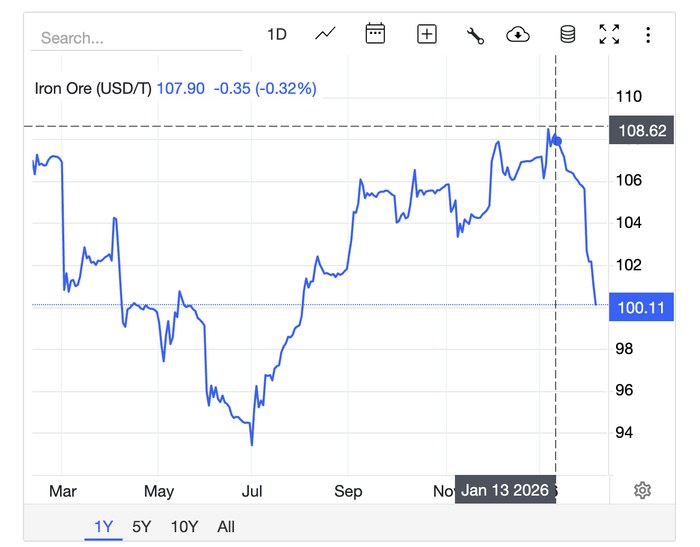
1.7亿吨库存压顶,铁矿石市场为何现“过山车”行情?
Xin Lang Cai Jing· 2026-02-10 10:40
Core Viewpoint - The iron ore market has experienced significant volatility in early 2023, with high inventory levels and fluctuating prices, indicating a complex supply-demand dynamic [1][2][4]. Group 1: Market Dynamics - As of early January, iron ore inventory at 47 ports reached approximately 170 million tons, a two-year high, with a month-on-month increase of 0.8% [1]. - Daily average port throughput was 3.5758 million tons, reflecting a nearly 3% month-on-month increase [1]. - Despite high inventory, iron ore prices surged to $109 per ton in mid-January, marking a 15-month high [1]. - However, prices fell by 7.72% over the past month and were down 5.89% year-on-year [2]. Group 2: Price Fluctuations - On February 6, iron ore prices fell below $100 per ton for the first time since August 2025, with Singapore Exchange futures dropping to $99.35 per ton [4]. - The price increase in January was driven by seasonal inventory replenishment expectations, but this was countered by weak actual demand [5][8]. Group 3: Supply and Demand Factors - The iron ore market is characterized by a supply-demand tug-of-war, with high port inventories and cautious demand from steel mills [8][10]. - The West Simandou iron ore project has made significant progress, with its first shipment of nearly 200,000 tons arriving at Chinese ports, indicating a full supply chain integration [7]. - Analysts predict that the long-term trend will see a downward shift in iron ore prices due to persistent high inventory levels and weak demand [12][18]. Group 4: Future Price Predictions - Goldman Sachs has revised its 2026 iron ore price forecast down to $88 per ton, reflecting a 15% decline from current levels [15]. - Other forecasts suggest that iron ore prices will stabilize between $85 and $110 per ton in 2026, with a central tendency around $90-95 per ton [18].

东北第一霸总,给员工发40亿红包
盐财经· 2026-02-10 09:47
Core Viewpoint - Fangda Group, led by Fang Wei, is known for its generous employee benefits and significant wealth accumulation, showcasing a unique business model that balances employee welfare with aggressive capital expansion [6][9][50]. Group 1: Employee Welfare - Fangda Group has distributed nearly 4 billion yuan in cash bonuses to employees over the past decade, establishing a reputation for being exceptionally generous [6]. - The company has implemented a comprehensive welfare system that includes medical assistance, scholarships, and retirement benefits, creating a family-like support network for its 130,000 employees [12][18]. - Notably, Fangda Group provided 5 billion yuan worth of cars to employees, further emphasizing its commitment to employee satisfaction [15]. Group 2: Wealth Accumulation - Fang Wei's net worth surged to 52.5 billion yuan in 2025, a significant increase from 40.5 billion yuan in 2024, solidifying his position as a leading entrepreneur in Northeast China [8]. - The company's financial success is attributed to strategic acquisitions of state-owned enterprises, allowing for profitable turnaround operations [20][25]. Group 3: Acquisition Strategy - Fang Wei began his career in the iron ore business, leveraging early successes to accumulate capital for future acquisitions [22][24]. - The company has executed a series of successful acquisitions, including the restructuring of state-owned enterprises like Fushun Carbon and Nanchang Steel, which have become core assets [28]. - A notable acquisition was the 410 billion yuan deal for HNA Group, which transformed the struggling airline into a profitable entity within a few years [29][30]. Group 4: Recent Developments - Despite a failed attempt to acquire Sunwoda Group, Fangda Group continues to pursue new opportunities, including a strategic partnership with CATL in the zero-carbon business and a planned investment of 5 billion yuan in a healthcare project [44]. - The company also made headlines by acquiring a property in Shanghai for 456 million yuan, indicating confidence in core asset values amid economic challenges [46]. Group 5: Business Model and Philosophy - Fangda Group's business model is characterized by a blend of aggressive expansion and a strong focus on employee welfare, creating a unique corporate culture [50]. - The company aims to balance market-driven acquisitions with social responsibility, positioning itself as a significant player in the private sector of China [50].


黑色产业链日报-20260210
Dong Ya Qi Huo· 2026-02-10 09:47
Report Date - The report is dated February 10, 2026 [1] Steel Report Core View - The blast furnace operating rate remains at a high level, while the production of electric furnaces has significantly decreased seasonally due to the Spring Festival. Terminal demand has further shrunk, with transactions showing a situation of "prices but no market". Inventory has continued to accumulate, with the accumulation rate of rebar accelerating year-on-year, and hot-rolled coils having shifted from destocking to stockpiling. The significant increase in hot-rolled coil warehouse receipts has exerted upward pressure on coil prices. Overall, finished steel products are oscillating weakly and may test the lower limit of the box-shaped oscillation [3]. Price Data - Rebar: On February 10, 2026, the closing prices of the 01, 05, and 10 contracts were 3,133 yuan/ton, 3,052 yuan/ton, and 3,097 yuan/ton respectively [4]. - Hot-rolled coils: On February 10, 2026, the closing prices of the 01, 05, and 10 contracts were 3,263 yuan/ton, 3,220 yuan/ton, and 3,239 yuan/ton respectively [4]. Spread Data - Rebar spreads: The 01 - 05 spread was 81 yuan/ton, the 05 - 10 spread was -45 yuan/ton, and the 10 - 01 spread was -36 yuan/ton on February 10, 2026 [4]. - Hot-rolled coil spreads: The 01 - 05 spread was 43 yuan/ton, the 05 - 10 spread was -19 yuan/ton, and the 10 - 01 spread was -24 yuan/ton on February 10, 2026 [4]. Iron Ore Report Core View - The supply and demand situation is significantly weak. Overseas shipments have seasonally decreased, and attention should be paid to the impact of the rainy season in the Southern Hemisphere on Australian shipments. Steel mills have decent profits, and molten iron production is expected to steadily increase. Terminal steel consumption has entered the pre - holiday off - season. The accumulation rate of social inventory is slower than in previous years, and port inventory has continued to accumulate above the seasonal level, facing significant pressure. Market risk appetite is low, and prices are under pressure [21]. Price Data - On February 10, 2026, the closing prices of the 01, 05, and 09 contracts were 732 yuan/ton, 761.5 yuan/ton, and 744 yuan/ton respectively. The daily changes were 0, 0, and 1 yuan/ton respectively, and the weekly changes were -17, -16, and -16 yuan/ton respectively [22]. Fundamental Data - On February 6, 2026, the average daily molten iron production was 228.58 tons, the 45 - port desilting volume was 341.08 tons, and the global shipment volume was 2,535.3 tons [26]. Coking Coal and Coke Report Core View - As the Chinese New Year approaches, domestic mines have reduced production, and the supply of coking coal has seasonally shrunk. The domestic and foreign prices of imported coal are inverted, and the arrival volume is at a low level. The first round of coke price increase has been implemented, and coking profits have improved. The resumption of production of blast furnace steel mills has been slow, and the short - term supply and demand are relatively loose. Attention should be paid to the resumption of production rhythm of mines and steel mills after the Spring Festival. There may be a supply - demand mismatch under the background of tight seaborne coal imports [33]. Price Data - On February 10, 2026, the 09 - 01 spread of coking coal was -175 yuan/ton, the 05 - 09 spread was -77.5 yuan/ton, and the 01 - 05 spread was 252.5 yuan/ton [34][36]. - On February 10, 2026, the 09 - 01 spread of coke was -94 yuan/ton, the 05 - 09 spread was -74.5 yuan/ton, and the 01 - 05 spread was 168.5 yuan/ton [36]. Ferroalloy Report Core View - Cost support and the pressure of the downstream terminal steel inventory accumulation are in a game. Silicon manganese is facing its own high - inventory pressure, and the manganese ore quotation provides bottom support. Ferroalloy production is already at a low level, and it is difficult to see a significant reduction in production. The resumption of production of steel mills may drive an increase in molten iron, but the demand increase is limited due to the off - season inventory accumulation of terminal steel products. The decline in finished steel products suppresses prices, and in the short term, it will maintain a range - bound oscillation [48]. Price Data - For silicon iron on February 9, 2026, the basis in Ningxia was 26 yuan/ton, and the spot prices in Ningxia, Inner Mongolia, Qinghai, Shaanxi, and Gansu were 5,370 yuan/ton, 5,390 yuan/ton, 5,300 yuan/ton, 5,400 yuan/ton, and 5,400 yuan/ton respectively [49]. - For silicon manganese on February 10, 2026, the basis in Inner Mongolia was 182 yuan/ton, and the spot prices in Ningxia, Inner Mongolia, Guizhou, Guangxi, and Yunnan were 5,570 yuan/ton, 5,650 yuan/ton, 5,700 yuan/ton, 5,750 yuan/ton, and 5,700 yuan/ton respectively [50][53]. Soda Ash Report Core View - There is an expectation of weakening rigid demand, and soda ash is oscillating weakly, with industrial contradictions still accumulating. If the futures price rises, there is a certain restocking space for middle - stream players such as those involved in futures - cash arbitrage, but the demand elasticity is limited due to the general demand situation. The downward price space needs inventory accumulation to open up. In terms of supply and demand, as new production capacity gradually releases output, the daily production of soda ash is at a high level, and the expectation of high - level long - term supply of soda ash remains unchanged. The inventory of the photovoltaic glass industry is at a high level, the daily melting volume is temporarily stable, and the overall rigid demand is moderately weak. The balance of heavy soda ash continues to be in surplus. Soda ash exports remain at a high level, which continues to relieve domestic pressure to a certain extent [68]. Price Data - On February 10, 2026, the closing prices of the 05, 09, and 01 contracts of soda ash were 1,171 yuan/ton, 1,234 yuan/ton, and 1,282 yuan/ton respectively. The daily changes were -10 yuan/ton, -9 yuan/ton, and -4 yuan/ton respectively, and the daily decline rates were -0.85%, -0.72%, and -0.31% respectively [69]. Glass Report Core View - According to market news, due to environmental protection pressure, four coal - fired production lines in Shahe may undergo cold repair before the Spring Festival, with a total daily melting volume of 2,700 tons. There may be more definite news in the next few days. Coupled with the 1,200 - ton cold repair of Dongtai Zhongbo last week and the expectation of 1,000 - ton cold repair of Deyang Xinyi before the Spring Festival, it means that float glass will experience concentrated cold repair before the Spring Festival, slightly exceeding expectations. The daily melting volume will decline to around 146,000 - 147,000 tons. Although there are many new production lines to be ignited in the Shahe area, even the earliest ones will not be implemented until after the Spring Festival, and it will take several months to produce products. This wave of pre - Spring Festival concentrated cold repair will help relieve the inventory accumulation pressure and spot price pressure after the Spring Festival. In terms of supply and demand, float glass is in a situation of weak supply and demand. Regardless of how the supply expectation changes, the high inventory of the glass middle - stream is a risk point. Currently, it seems that the terminal may not be able to digest it, so once a negative feedback occurs, the spot price pressure will be significant [91]. Price Data - On February 10, 2026, the closing prices of the 05, 09, and 01 contracts of glass were 1,087 yuan/ton, 1,189 yuan/ton, and 1,224 yuan/ton respectively. The daily changes were 23 yuan/ton, 19 yuan/ton, and -9 yuan/ton respectively, and the daily increase/decrease rates were 2.16%, 1.62%, and -0.73% respectively [92].
螺纹热卷日报-20260210
Yin He Qi Huo· 2026-02-10 09:26
研究所 黑色金属研发报告 黑色金属日报 2026 年 02 月 10 日 螺纹热卷日报 第一部分 市场信息 研究员:戚纯怡 期货从业证号: F03113636 投资咨询证号: Z0018817 :021-65789253 :qichunyi_qh@chinastock.c om.cn 1/ 9 【交易策略】 单边:节前维持震荡偏弱走势 套利:建议逢高做空卷煤比,做空卷螺差继续持有。 研究所 黑色金属研发报告 第二部分 市场研判 【相关价格】 现货:网价上海中天螺纹 3190 元(-),北京敬业 3120 元(-),上海鞍钢热卷 3240 元(-),天津河钢热卷 3140 元(-)。 【交易策略】 今日钢材盘面维持震荡偏弱走势,钢材期货价格继续下探。上周钢联数据公布, 五大材整体减产,但铁水仍然增产,钢厂陆续进入节日停产检修的模式;钢材总库存 加快累库进度,其中螺纹累库进度快于热卷,总体社库压力大于厂库;近期天气转 冷,下游工地陆陆续续停工,建材需求快速下滑;而钢材出口受出口许可证下滑,海 外制造业陆续结束补库,热卷需求同样下行。整体钢材基本面边际转弱。预计节前钢 材维持震荡偏弱走势。目前钢材库存偏高,节后资本 ...