装备制造业

Search documents
薛鹤翔:贸易战背景下国内消费的韧性——中国宏观经济周报
Sou Hu Cai Jing· 2025-04-14 17:49
Core Insights - The policies aimed at boosting consumer demand are showing positive effects, with March's consumption market reflecting a favorable trend due to both policy and seasonal factors [2][6][12] - The Consumer Price Index (CPI) experienced a smaller decline than the seasonal average, indicating a recovery in consumer demand and market stability [3][7][12] - The Producer Price Index (PPI) continues to decline, but some industries are witnessing positive price changes due to improved supply-demand structures [4][9][12] Consumer Market - In March, the CPI decreased by 0.4% month-on-month and 0.1% year-on-year, with the decline narrowing significantly compared to previous years [6][12] - Core CPI showed a notable recovery, increasing by 0.5% year-on-year, driven by rising service prices and industrial consumer goods prices [2][6][12] - The price of household appliances and gold jewelry has risen significantly, exceeding the average increase over the past decade [2][6] Industrial Production - The PPI fell by 0.4% month-on-month and 2.5% year-on-year, influenced by international input factors and seasonal declines in energy demand [4][12] - High-tech industries are experiencing rapid development, leading to improved supply-demand structures and positive price changes in certain sectors [4][9] External Factors - The U.S. has implemented a 10% baseline tariff on global imports and specific tariffs on 60 countries, including 34% on China, which may impact international trade dynamics [4][13][25] - Countries are responding differently to the U.S. tariff policies, with China retaliating and the EU preparing for negotiations [4][13] Policy Outlook - The government is expected to continue implementing policies to stimulate consumer demand and support economic recovery, including fiscal measures and monetary policy adjustments [22][23][24] - The focus will be on enhancing domestic demand, promoting equipment upgrades, and improving the overall economic environment [24][25]

3月PMI数据点评:新动能持续蓄势,价格仍是PMI的主要拖累
Zhong Cheng Xin Guo Ji· 2025-04-14 08:53
Group 1: PMI Data Insights - The manufacturing PMI for March 2025 is reported at 50.5%, an increase of 0.3 percentage points from the previous month[2] - The new orders index rose to 51.8%, up 0.7 percentage points, indicating improved demand[12] - The service sector PMI increased to 50.3%, reflecting a 0.3 percentage point rise, while the construction PMI reached 53.4%, the highest since June of the previous year[9] Group 2: Economic Trends and Challenges - Despite the positive PMI trends, the overall economic recovery remains weak, with manufacturing PMI still below seasonal averages[2] - The manufacturing sector is experiencing passive destocking, with finished goods inventory index dropping to 48.0%, indicating a supply-demand gap[4] - Price indices for both factory and raw material purchases fell by 0.6 and 1.0 percentage points, respectively, suggesting ongoing price pressures on profitability[4] Group 3: Sector Performance - High-tech manufacturing and equipment manufacturing sectors are showing significant recovery, with PMIs of 52.3% and 52.0%, respectively[4] - Small and medium-sized enterprises (SMEs) saw a notable rebound in PMI, with small enterprises reaching 49.6%, the highest level since June of the previous year[4] - The construction sector is facing challenges due to funding pressures and low new order indices, which fell to 43.5%[9]
3月物价数据点评:警惕关税带来的价格压力
Soochow Securities· 2025-04-10 13:35
Price Data Overview - In March, CPI decreased by 0.4% month-on-month (previous value: -0.2%) and by 0.1% year-on-year (previous value: -0.7%), indicating a narrowing decline[2] - PPI also fell by 0.4% month-on-month (previous value: -0.1%) and by 2.5% year-on-year (previous value: -2.2%), showing an expanded decline[2] Key Influencing Factors - The decline in CPI was primarily driven by three factors: a 3.5% decrease in domestic gasoline prices due to falling international oil prices, which contributed approximately 0.12 percentage points to the CPI decline[2] - Food prices fell by 1.4% month-on-month, impacting CPI by about 0.24 percentage points, with significant drops in fresh vegetables (5.1%), pork (4.4%), and eggs (3.1%)[2] - Weak terminal consumption and industrial demand continued to exert downward pressure, with service prices slightly below historical levels[2] Future Price Trends - Moving forward, tariff impacts are expected to become a significant factor in price evolution, with supply and demand dynamics shifting[2] - The interplay between excess supply and weakening domestic demand will influence price stability, while tariff shocks may lead to lower prices through increased domestic supply[2] Policy Implications - Incremental policies to counter tariff impacts will be crucial, particularly in promoting consumption and stabilizing the real estate market[2] - The effectiveness of these policies will be key in determining future price trends[2] Risks and Challenges - Potential risks include a weakening real estate market, declining exports, and the possibility that incremental policies may not meet expectations[4] - The go-capacity policy may face tougher decisions, as the short-term pain from capacity reduction could be challenging for the domestic economy to absorb[2]
增值税发票数据显示 一季度高技术产业销售收入增长13.4%
Ren Min Ri Bao· 2025-04-09 22:09
Group 1: High-tech Industry Performance - In the first quarter, China's high-tech industry sales revenue increased by 13.4% year-on-year, continuing a rapid growth trend [1] - Sales revenue in the digital product manufacturing and digital technology application sectors grew by 12% and 11.6% respectively, indicating a deepening integration of digital and physical realms [1] Group 2: Green and Low-carbon Transition - The green low-carbon transition is progressing, with sales revenue from energy-saving and environmental protection services increasing by 28.7% and 17.8% year-on-year [1] - The clean energy sector is performing well, with solar power generation sales revenue rising by 42.3% year-on-year [1] - Driven by the demand for green transportation, the sales revenue of the new energy vehicle manufacturing industry grew by 18.6% [1] Group 3: Growth of the Real Economy - The real economy is expanding, with manufacturing sales revenue increasing by 4.8% year-on-year, accounting for 29.1% of national sales, up 0.8 percentage points from the same period last year [1] - The equipment manufacturing sector saw a sales revenue increase of 9.7%, maintaining a rapid growth rate [1] Group 4: Service Consumption Trends - Service consumption showed a positive trend, with a year-on-year growth of 5.3% in the first quarter [1] - Revenue from scenic area management and travel agency services increased by 40.5% and 15.5% respectively [1] - Revenue from film screenings and artistic performances grew by 39.6% and 15.2% respectively [1] Group 5: Equipment and Consumer Goods Update - Large-scale equipment updates are being effectively promoted, with national enterprise machinery equipment procurement amount increasing by 11% year-on-year [2] - The "old for new" policy for consumer goods continues to show effects, with retail sales of home audio-visual equipment like televisions and daily appliances like refrigerators increasing by 29.3% and 38.4% respectively [2] - Retail sales of communication devices such as mobile phones grew by 27.3% year-on-year [2]
强在中游,弱在建筑——3月PMI数据点评
一瑜中的· 2025-04-01 01:13
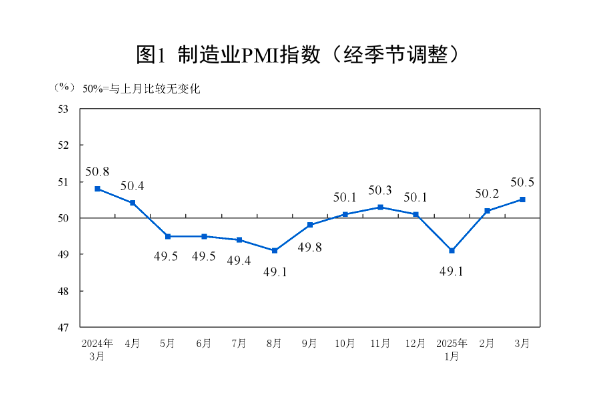
Core Viewpoint - The manufacturing PMI has shown a slight recovery, indicating a mixed economic outlook with strengths in the manufacturing sector and weaknesses in the construction industry [2][4][5]. Group 1: PMI Data Overview - The manufacturing PMI for March is reported at 50.5%, an increase from the previous value of 50.2% [2][16]. - The production index stands at 52.6%, up by 0.1 percentage points from 52.5% [16]. - The new orders index has risen to 51.8% from 51.1%, while the new export orders index is at 49.0%, slightly up from 48.6% [16]. - The employment index is at 48.2%, down from 48.6%, indicating a contraction in employment [16]. - The supplier delivery time index is at 50.3%, down from 51.0%, and the raw material inventory index is at 47.2%, slightly up from 47.0% [16]. Group 2: Sector Performance - The construction sector's PMI is at 53.4%, down from 56.2% year-on-year, indicating a slowdown [5][10]. - The construction employment index has dropped to 41.4% from 45.6%, reflecting a significant decline in workforce [10]. - The new orders index for construction is at 43.5%, down from 46.8%, highlighting ongoing demand concerns [10]. - The basic raw materials PMI is at 49.3%, down from 49.8%, influenced by the weak construction sector [10]. Group 3: Economic Assessment - The comprehensive PMI index for Q1 is at 50.9%, higher than Q4 2023 and Q3 2024, but lower than Q4 2024 and Q1-Q2 2024 [3][13]. - The manufacturing sector shows strength, particularly in the midstream equipment manufacturing, with a PMI of 52% [4][9]. - The EPMI index for March is reported at 59.6%, indicating robust performance in the equipment manufacturing sector [4][9].
3月制造业PMI回升至50.5%,需求回暖提振企业生产意愿
2 1 Shi Ji Jing Ji Bao Dao· 2025-03-31 12:09
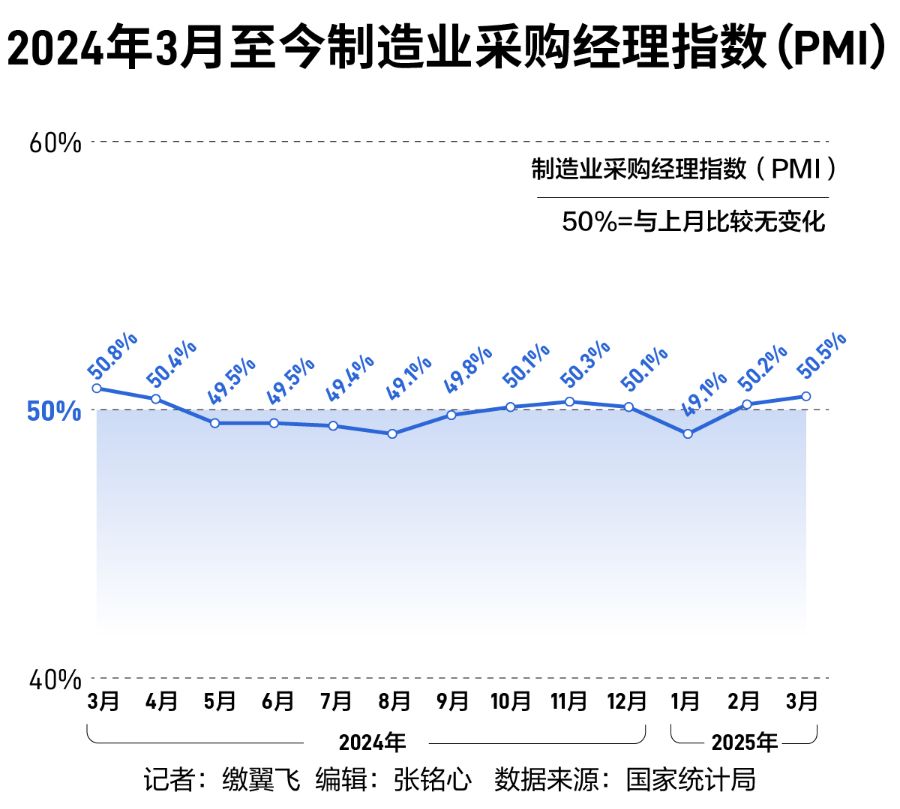
Core Viewpoint - The manufacturing Purchasing Managers' Index (PMI) in March rose to 50.5%, indicating a slight improvement in manufacturing activity compared to February, driven by seasonal factors, policy support, and technological innovations [1][4]. Manufacturing PMI Analysis - The production index, new orders index, new export orders index, and raw materials inventory index all increased, with rises between 0.1 to 0.7 percentage points [1]. - The new orders index reached 51.8%, up 0.7 percentage points from February, indicating sustained demand [4]. - The production index was at 52.6%, reflecting a continuous upward trend for two months [4]. Sector Performance - High-tech manufacturing sectors, such as railway, aerospace, and electronics, showed strong performance with production and new orders indices above 55.0% [6]. - Conversely, industries like wood processing and coal showed indices below the critical point, indicating supply-demand imbalances [6]. - The consumer goods manufacturing PMI rose to 50.0%, driven by policies promoting consumption [6]. Price Indices and Market Dynamics - The main raw materials purchase price index fell to 49.8%, while the factory price index dropped to 47.9%, indicating a supply surplus [7][8]. - The decline in prices is attributed to weak demand and increased production, particularly in the basic raw materials sector [7][8]. Future Outlook - The manufacturing sector is expected to continue its stable recovery in the second quarter, supported by government policies aimed at expanding domestic demand and promoting new urbanization [9]. - The manufacturing production and business activity expectation index was at 53.8%, indicating optimism among enterprises [9]. - However, potential challenges include the impact of increased tariffs on exports and the need for further stabilization in the real estate market [9].
【广发宏观郭磊】3月PMI的几个特征
郭磊宏观茶座· 2025-03-31 11:01
Core Viewpoint - The economy is continuing to improve, with March manufacturing PMI at 50.5, service PMI at 50.3, and construction PMI at 53.4, all showing month-on-month increases [1][4]. Group 1: Economic Indicators - The manufacturing PMI increased by 0.3 points from the previous month, while service PMI also rose by 0.3 points, and construction PMI saw a 0.7 point increase [1][4]. - The export order index has shown resilience, rising slightly, indicating external demand remains stable despite tariff pressures [1][5]. - Small enterprise PMI improved significantly by 3.3 points in March, reflecting better financial conditions [1][5]. - High-tech manufacturing PMI was reported at 52.3, indicating relative strength compared to previous periods [5]. Group 2: Recovery Characteristics - Despite some positive indicators, the overall data reflects a weak recovery, with manufacturing PMI lower than the previous year's value of 50.8 and below the historical average of 0.7 points for March [2][5]. - Service sector performance is also lagging, with March values lower than seasonal expectations, showing a cumulative decline compared to similar periods in previous years [5][6]. - The construction sector's performance is being hindered by insufficient support from infrastructure investments, as indicated by the lower demand from this sector [2][7]. Group 3: Price Indices and Employment - Both price indices showed a month-on-month decline, with expectations for March PPI indicating slight negative growth [10][12]. - Employment indicators in manufacturing, services, and construction sectors showed a decline in March, although the overall trend since September has been upward [12][13]. - The BCI enterprise hiring index also decreased, suggesting a cautious approach to hiring amid structural changes in labor demand [12][13]. Group 4: Future Outlook - The report suggests that the economic trajectory in 2025 may resemble that of 2016, with gradual improvements expected in consumer spending, local investment, and price indices [12][13]. - The overall economic growth is anticipated to experience fluctuations throughout the year, with a focus on validating the effectiveness of policy measures aimed at stabilizing growth [14].

如何理解PMI与EPMI背离?
申万宏源宏观· 2025-03-31 08:10
Core Viewpoint - The divergence between PMI and EPMI is primarily due to the differentiation in the economic conditions of emerging and traditional industries, with the former showing stronger performance in March [1][8]. Manufacturing Sector - In March, the manufacturing PMI increased moderately by 0.3 percentage points to 50.5%, which is below market expectations [1][8]. - The EPMI for strategic emerging industries rose significantly by 10.6 percentage points to 59.6%, indicating a strong recovery in these sectors [1][8]. - High-tech and equipment manufacturing sectors saw substantial PMI increases of 1.4 and 1.2 percentage points, reaching 52.3% and 52% respectively, while traditional sectors like consumer goods manufacturing only saw a marginal increase of 0.1 percentage points to 50% [2][13]. - The production index for EPMI surged by 21.6 percentage points, contrasting with a slight increase of 0.1 percentage points in the manufacturing PMI production index, which reached 52.6% [2][17]. Non-Manufacturing Sector - The non-manufacturing PMI rose by 0.4 percentage points to 50.8%, with the construction sector's PMI increasing by 0.7 percentage points to 53.4%, although this was weaker than seasonal expectations [3][5]. - The service sector's PMI increased by 0.3 percentage points to 50.3%, but this was also below the same period in previous years [3][5]. - The construction sector remains constrained by weak real estate investment, while the service sector is limited by the performance of life services [3][22]. Future Outlook - There are increasing risks to exports, but potential improvements in the economy may arise from accelerated import substitution and recovery in the service sector and real estate sales [3][31]. - The manufacturing sector may receive support from accelerated import substitution in industries like electrical and mechanical equipment, while the construction and service sectors show signs of recovery [3][31]. Regular Tracking - The manufacturing PMI continues to show a mild recovery, with production and new order indices slightly increasing [4][37]. - The non-manufacturing PMI reflects a general improvement, with both construction and service sectors showing slight increases [5][46].
制造业PMI连续两月回升,中小企业回稳运行
Di Yi Cai Jing· 2025-03-31 03:15
3月制造业生产经营活动预期指数为53.8%,连续6个月运行在54%左右的较好水平。 3月份,春节因素影响逐步消退,企业生产经营活动加快,制造业景气水平持续回升。 国家统计局3月31日发布的3月份制造业采购经理指数(PMI)为50.5%,比上月上升0.3个百分点,连续 两个月位于荣枯线之上。 中国物流与采购联合会特约分析师张立群认为,3月份PMI指数在荣枯线上继续小幅回升,表明经济回 升苗头更为明显。同时要注意到,采购量指数回落,购进价格指数和出厂价格指数均有回落,表明供大 于求的问题仍然突出;反映需求不足为主要困难的企业占比仍在60%之上,生产经营活动预期指数也有 所回落,企业恢复生产的信心仍然不足。 张立群表示,综合看,受政策推动经济初显回升态势,但基础还不稳定。要持续加大宏观政策逆周期调 节力度,特别要显著加强政府公共产品投资在扩大内需中的关键作用,坚持不懈地尽快改变市场引导的 需求收缩趋势。 供需两端协同增长 分企业规模来看,3月份大型企业PMI为51.2%,虽较上月下降1.3个百分点,仍保持在扩张区间,表明 大型企业增速虽有所放缓,但仍保持上升势头。大型企业生产指数保持在54%,新订单指数保持在接近 ...
2025年浙江省宁波市新质生产力发展研判:强化“361”产业体系,推动新兴未来产业集群发展[图]
Chan Ye Xin Xi Wang· 2025-03-28 01:17
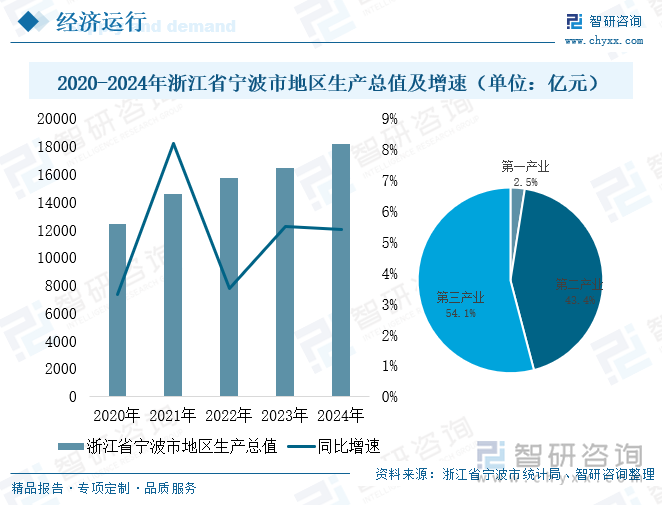
Core Viewpoint - Ningbo City is positioning itself as a hub for advanced manufacturing and a global port city, focusing on the development of trillion-level industrial clusters in digital industries, green petrochemicals, and high-end equipment, while also promoting emerging industries and optimizing industrial space layout [1][2][11]. Group 1: New Quality Productive Forces - New Quality Productive Forces emphasize innovation as the main driver, moving away from traditional economic growth models, characterized by high technology, efficiency, and quality [2]. - The focus is on digitalization, networking, intelligence, and greening, aiming for high-end, intelligent, and sustainable development [2]. Group 2: Economic Performance - Ningbo's GDP reached 18,147.7 billion yuan in 2023, with a year-on-year growth of 5.4%, maintaining a growth rate of 6%-7% in recent years, above the national average [3][5]. - The industrial output value for 2024 is projected to be 7,066.8 billion yuan, with a growth rate of 7.5% [5]. Group 3: Industrial Development - Ningbo is developing six trillion-level industrial clusters, including new functional materials, new energy, key components, smart home appliances, fashion textiles, and modern health [1][11]. - The digital economy's core industry added value reached 1,425.7 billion yuan in 2024, growing by 7.9% [7]. Group 4: Foreign Trade - Ningbo's total import and export volume for 2024 is expected to be 25,448.0 billion yuan, a growth of 6.1% [9]. - Exports reached 9,455.3 billion yuan, growing by 14.1%, while imports were 4,747.2 billion yuan, increasing by 5.6% [9]. Group 5: Policy Support - A series of policies have been implemented to support the development of new quality productive forces, including digital transformation and high-quality development of the software industry [11][13]. - The government aims to strengthen the "361" industrial orientation and "2070" spatial planning to guide industrial upgrades [11][17]. Group 6: Future Trends - The focus will be on technological innovation, industrial upgrading, green low-carbon development, and regional collaboration [24][25]. - Ningbo aims to enhance its industrial competitiveness and accelerate the development of new quality productive forces through strategic initiatives [15][24].