化工

Search documents
我国需要记住这个教训,俄乌战争经验表明,有一招对我国打击最大
Sou Hu Cai Jing· 2026-02-05 08:50
Group 1: Energy Crisis in Europe - The Russia-Ukraine conflict has highlighted Europe's vulnerability in energy dependence, leading to soaring costs for factories, particularly in Germany's chemical industry, which has had to cut production [1] - Natural gas prices surged to €300 per MWh following the explosion of the Nord Stream pipeline, exacerbating the energy crisis [1] - The EU's reliance on Russian natural gas exports plummeted from 45% to 19%, prompting a shift towards US liquefied natural gas imports, although transportation costs have quadrupled [1] - The REPowerEU plan was launched to reduce dependence on Russian energy, increasing the share of green energy to 45% [1] - Germany's automotive sector saw a 5% decline in production due to rising energy costs, while the bankruptcy rate among SMEs in Germany increased [1] Group 2: Impact on Industries - The luxury goods sector remains stable, but the automotive industry has delayed new model releases due to high energy prices [3] - Italy's textile factories closed hundreds of plants due to soaring electricity costs, while Germany had to restart coal power plants, increasing carbon emissions [3] - The chemical product prices in Germany rose by 20% as a result of the energy crisis [1][3] Group 3: Global Oil Market Dynamics - Global oil prices increased from $65 to $72 amid geopolitical tensions, with Iran's oil exports accounting for 4% of global supply [5] - The US has sufficient oil reserves and is shifting towards an export model, while the daily oil flow through the Strait of Malacca reached 20 million barrels [5] - The increase in shipping costs due to attacks in the Red Sea has impacted global supply chains, with European companies relocating to the US, investing hundreds of billions of euros [5] Group 4: Renewable Energy Developments - Spain has made significant progress in photovoltaic power generation, with installed capacity surging and electricity exports to neighboring countries [3] - China's renewable energy sector remains strong, with solar and wind power installations leading globally, and projected renewable energy generation reaching 3.5 trillion kWh by 2024 [7][9] - The expansion of nuclear and hydropower bases is ongoing, further reducing reliance on oil [9]


1月中国大宗商品价格指数创近三年半来新高
Zhong Guo Xin Wen Wang· 2026-02-05 08:21
Core Viewpoint - In January, China's Commodity Price Index (CBPI) reached 125.3 points, marking a month-on-month increase of 6.3% and a year-on-year increase of 12.7%, the highest since July 2022 [1] Group 1: Market Trends - The increase in the CBPI indicates a continued recovery and positive market sentiment, supported by national strategic policies and optimistic business expectations [1][2] - The rise in prices is influenced by international geopolitical changes, expectations of loose monetary policy, and significant fluctuations in commodity futures prices, leading to rapid increases in prices of non-ferrous metals and chemicals [1] Group 2: Sector Analysis - The non-ferrous price index saw a substantial increase, while the chemical price index also rose quickly; the black series price index continued to recover, and agricultural product prices increased slightly [1] - Among the 50 monitored commodities, 33 (66%) experienced price increases, while 17 (34%) saw price declines in January [1] - The top three commodities with the highest price increases were lithium carbonate, refined tin, and refined nickel; the top three with the largest declines were corrugated paper, caustic soda, and coke [1]
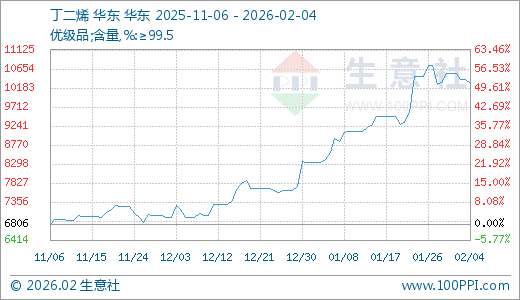
02月04日丁二烯10300.00元/吨 15天上涨11.07%
Xin Lang Cai Jing· 2026-02-05 07:44
Core Insights - The latest price of butadiene as of February 4 is 10,300.00 CNY per ton, with a recent increase of 11.07% over the last 15 days, 20.00% over the last 30 days, and 47.85% over the last 60 days [2][4] Industry Overview - Butadiene is experiencing significant price increases, indicating potential opportunities for investment in related companies [2][4] - The companies involved in butadiene production include Huajin Co., Ltd. (000059), Qixiang Tengda (002408), Rongsheng Petrochemical (002493), Satellite Chemical (002648), Sinopec (600028), Wanhua Chemical (600309), Hengli Petrochemical (600346), and China National Petroleum (601857) [2][4] Investment Strategy - The cyclical stock selection method focuses on companies that produce raw materials, where profits are highly influenced by raw material price fluctuations [2][4] - Utilizing the price fluctuation data from the business community can help identify buy signals for cyclical stocks ahead of quarterly and annual reports, making it a crucial strategy for investing in this sector [2][4]




普利特实控人之弟等拟套现1.1亿 2023年定增募10.8亿
Zhong Guo Jing Ji Wang· 2026-02-05 07:16
Group 1 - The core point of the news is that specific shareholders and company executives of Puli Te (002324.SZ) plan to reduce their shareholdings due to personal financial needs, with a total potential reduction of 6,196,918 shares, which represents 0.55% and 0.08% of the company's total share capital respectively [1] - Shareholder Zhou Wu, holding 5,985,318 shares, plans to reduce his holdings by the same amount through centralized bidding and block trading, while company vice president Li Hong, holding 846,445 shares, plans to reduce his holdings by up to 211,600 shares [1] - The estimated cash amount from the share reductions for Zhou Wu and Li Hong is approximately 111 million yuan, based on the closing price of 17.99 yuan on February 4 [1] Group 2 - Puli Te's announcement on August 8, 2023, regarding the issuance of A-shares to specific investors indicates that a total of 96,084,327 shares were issued at a price of 11.23 yuan per share, raising a total of approximately 1.08 billion yuan [2] - After deducting issuance costs of approximately 10.25 million yuan, the net amount raised from the issuance was approximately 1.07 billion yuan [2]

创金合信基金魏凤春:应对波动市场的确定性布局
Xin Lang Cai Jing· 2026-02-05 07:15
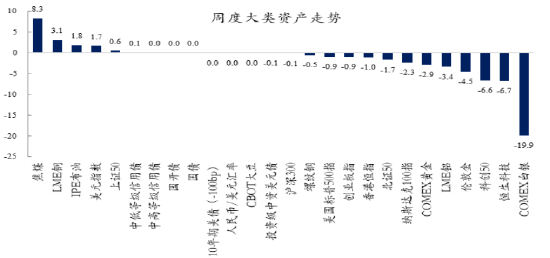
本文作者为创金合信基金首席经济学家魏凤春 上期首席视点从政府纠正市场失灵的角度提出了需要从基本面出发进行布局,其背景是预计2026年波动 加剧是市场基本的特征,本周金银铜罕见的波动验证了这一特征。过渡期的市场,周期的错位与驱动力 的转换是市场波动的主要来源,如何通过相对确定性的策略来应对市场的波动是本首席视点着重讨论的 内容。2026年市场的本质是五大周期共振下的结构重塑,波动源于周期错位,机会藏于周期协同。面对 相对高波动环境,关键在于把握政策托底、产业分化、物价回升等较为确定性的逻辑,以周期为纲、以 盈利为锚,应对波动、把握主线。 一、波澜壮阔的一周 在西方经济学和金融学占主导的金融市场,源远流长的中华文化对现代市场的前瞻性判断越来越受到投 资者的关注。2026年岁在丙午,干支为赤马红羊,过去的一周,市场波动剧烈。虽然说波动是市场的常 态,但凡事都有个度,超过了这个度,量变引起质变,节奏和趋势的边界就模糊了。在之前的首席视点 中,我们已经指出:从周期视角与市场运行规律看,波动加大将成为贯穿全年的核心特征。这并非单纯 是周期玄学在起作用,而是国内市场驱动力切换、全球秩序重构与货币政策不确定性共同作用的必然结 ...
化工ETF(159870)盘中逆市净申购超4亿份,行业迎来多重积极共振
Xin Lang Cai Jing· 2026-02-05 05:42
Group 1 - The chemical sector is currently attracting significant capital attention, with the chemical ETF (159870) seeing net subscriptions exceeding 400 million units, driven by multiple positive factors in the industry [1] - Key supporting factors for the current cycle's price increase include: profitability reaching a historical low after four years of adjustment, limited further downside potential; policy-driven initiatives such as "anti-involution" and "dual carbon" policies controlling new capacity and eliminating outdated production; and a global supply reshaping with high-cost production in Europe and Japan accelerating shutdowns, leading to a 4%-7% exit of core product capacities like ethylene and propylene by 2026-2027 [1] - The chemical sector's P/B valuation is at historically low levels, with capital allocation ratios rebounding from their lows [1] Group 2 - The top ten weighted stocks in the CSI Sub-Industry Chemical Theme Index (000813) include Wanhua Chemical, Salt Lake Industry, and Cangge Mining, collectively accounting for 44.82% of the index [2] - The chemical ETF (159870) closely tracks the CSI Sub-Industry Chemical Theme Index, which is composed of seven sub-indices reflecting the overall performance of listed companies in related sub-industries [2] - As of February 5, 2026, the chemical ETF is priced at 0.87 yuan, with notable stock movements including Sankeshu leading with a 1.05% increase [2]




光大期货能化商品日报(2026年2月5日)-20260205
Guang Da Qi Huo· 2026-02-05 04:00
1. Report Industry Investment Rating No relevant content provided. 2. Core Viewpoints of the Report - The report analyzes the market conditions of various energy - chemical products on February 5, 2026, including crude oil, fuel oil, asphalt, polyester, rubber, methanol, polyolefin, and polyvinyl chloride, and gives an "oscillating" view for each product [1][2][4][5][6]. 3. Summary by Relevant Catalogs 3.1 Research Views - **Crude Oil**: On Wednesday, oil prices rose significantly. WTI March contract rose $1.93 to $65.14/barrel (3.05% increase), Brent April contract rose $2.13 to $69.46/barrel (3.16% increase), and SC2603 rose 15.2 yuan to 473.5 yuan/barrel (3.32% increase). The US - Iran negotiation is facing twists and turns. EIA reported that US crude and distillate inventories decreased while gasoline inventories increased last week. Cold - snap - induced output decline supports oil prices, but geopolitical variables cause fluctuations. It is recommended that investors participate with light positions [1]. - **Fuel Oil**: On Wednesday, the main contracts of fuel oil (FU2603) and low - sulfur fuel oil (LU2604) rebounded. The supply of both high - and low - sulfur fuel oil is expected to be sufficient, while the bunker fuel加注 activity is expected to increase before the Spring Festival. Affected by geopolitics and crude oil costs, the fundamentals are mixed with long and short factors, and there is pressure in the follow - up. Attention should be paid to oil price fluctuations [2]. - **Asphalt**: On Wednesday, the main asphalt contract (BU2603) rebounded. This week, the social inventory rate increased, the refinery inventory level decreased, and the plant operating rate decreased. In the early and middle of February, the inventory in the north is for downstream stocking, and the inventory in the south has some arbitrage demand. During the Spring Festival, the refinery and social inventories will increase. The asphalt is less volatile than crude oil, and the cracking spread has been repaired. The basis has weakened. Refineries are looking for alternative raw materials, and the production schedule may be adjusted later. Attention should be paid to oil price fluctuations and raw material imports [2][4]. - **Polyester**: TA605, EG2605, and PX 603 all rose on Wednesday. The production and sales of polyester yarn in Jiangsu and Zhejiang are slightly differentiated and generally weak. Multiple MEG devices have restart, maintenance, and shutdown plans. With the decline of crude oil prices and the implementation of polyester production cuts, there is an expectation of inventory accumulation in the first quarter. Polyester raw material prices are expected to oscillate with costs. Attention should be paid to unexpected device changes, cost - end price fluctuations, and the risk of insufficient demand recovery in late February [4]. - **Rubber**: On Wednesday, the main rubber contracts (RU2605, NR, BR) all rose. As of February 1, China's natural rubber social inventory increased. The natural rubber exports from Cote d'Ivoire in January decreased year - on - year and month - on - month. The rubber fundamentals show increasing supply and weak demand, and the price is expected to oscillate weakly. Attention should be paid to the impact of external macro - factors [5]. - **Methanol**: On Wednesday, the spot prices in different regions and the prices of downstream products are given. The domestic methanol production is expected to decrease slightly in February, and the import volume will decline. The demand from eastern MTO devices will decrease. The decline in Iranian shipments will support the price, but the reduction of MTO device load may put pressure on inventory reduction. The methanol price is expected to oscillate widely at a low level [5]. - **Polyolefin**: On Wednesday, the prices and production profits of polypropylene and polyethylene are provided. The supply is expected to increase slightly. In February, downstream enterprises will enter the holiday, leading to passive inventory increase. After the Spring Festival, the market will start to digest inventory. The fundamentals are not strongly supported in February, and attention should be paid to the inventory accumulation of refineries and society. The polyolefin price is expected to oscillate at the bottom [6]. - **Polyvinyl Chloride**: On Wednesday, the PVC market prices in East, North, and South China adjusted strongly. In February, the enterprise maintenance is less, and the production will remain high. The real - estate construction is weakening, and the demand for PVC downstream products is limited. The "rush - to - export" demand is generated due to the cancellation of export tax - rebate on April 1. There is an expectation of supply reduction in the future, and the PVC price is expected to oscillate at the bottom [6][7]. 3.2 Daily Data Monitoring - The report provides the basis data of various energy - chemical products on February 5, 2026, including spot price, futures price, basis, basis rate, basis change, and the quantile of the latest basis rate in historical data [8]. 3.3 Market News - The US Energy Information Administration (EIA) reported that as of the week ending January 30, US crude and distillate inventories decreased while gasoline inventories increased due to winter storms. Crude oil production dropped to the lowest level since November 2024, and the crude oil inventory in Cushing, Oklahoma decreased by 743,000 barrels [11]. - The Iranian Foreign Minister clarified the official position on the Iran - US talks in Oman, stating that the talks will be held at around 10 a.m. on the 6th in Muscat. Earlier, an Iranian official source said the talks were cancelled due to new US conditions and differences in the negotiation issues [11]. 3.4 Chart Analysis - **4.1 Main Contract Price**: The report presents the closing price charts of the main contracts of various energy - chemical products from 2022 to 2026, such as crude oil, fuel oil, low - sulfur fuel oil, asphalt, LPG, PTA, ethylene glycol, short - fiber, LLDPE, polypropylene, PVC, methanol, styrene, 20 - number rubber, natural rubber, synthetic rubber, European - line container shipping, p - xylene, and bottle - chip [13][15][17][19][21][23][25][27][28]. - **4.2 Main Contract Basis**: The report shows the basis charts of the main contracts of various energy - chemical products from 2022 to 2026, including crude oil, fuel oil, low - sulfur fuel oil, asphalt, ethylene glycol, PP, LLDPE, natural rubber, 20 - number rubber, p - xylene, synthetic rubber, and bottle - chip [30][33][37][38][40][41]. - **4.3 Inter - period Contract Spread**: The report provides the spread charts of inter - period contracts of various energy - chemical products, such as fuel oil (01 - 05, 05 - 09), asphalt (main and sub - main contracts), European - line container shipping index monthly spread, PTA (01 - 05, 05 - 09), ethylene glycol (01 - 05, 05 - 09), PP (01 - 05, 05 - 09), LLDPE (01 - 05, 05 - 09), and natural rubber (01 - 05, 05 - 09) [43][45][48][51][53][55][57]. - **4.4 Inter - variety Spread**: The report shows the spread and ratio charts of inter - variety of various energy - chemical products, such as crude oil (internal and external markets, B - W), fuel oil (high - low sulfur spread, fuel oil/asphalt ratio), BU/SC ratio, ethylene glycol - PTA spread, PP - LLDPE spread, and natural rubber - 20 - number rubber spread [59][62][64]. - **4.5 Production Profit**: The report presents the production profit and processing fee charts of various energy - chemical products, such as LLDPE, PP, PTA processing fee, and ethylene - based ethylene glycol cash - flow [66][68]. 3.5 Team Member Introduction - **Zhong Meiyan**: Deputy Director of Everbright Futures Research Institute, with a master's degree from Shanghai University of Finance and Economics. She has won multiple "Outstanding Analyst" awards and led the energy research team to win many industry service awards. She has over a decade of experience in futures derivatives market research and has served many listed companies [71]. - **Du Bingqin**: Director of Energy and Chemical Research at Everbright Futures Research Institute, with a master's degree in Applied Economics from the University of Wisconsin - Madison. She has won multiple industry analyst awards and her team has won industry service awards. She is deeply involved in domestic and foreign energy industry research [72]. - **Di Yilin**: Analyst of natural rubber and polyester at Everbright Futures Research Institute, with a master's degree in finance. She has won multiple analyst awards and her team has won a research team award. She is mainly engaged in the research of related futures varieties [73]. - **Peng Haibo**: Analyst of methanol, propylene, pure benzene, PE, PP, and PVC at Everbright Futures Research Institute, with an engineering master's degree. He has passed the CFA Level III exam and has experience combining financial theory with industrial operations [74].
格林期货早盘提示:纯苯-20260205
Ge Lin Qi Huo· 2026-02-05 03:40
更多精彩内容请关注格林大华期货官方微信 格林大华期货研究院 证监许可【2011】1288 号 2026 年 2 月 5 日星期四 Morning session notice 早盘提示 联系方式:15000295386 | 板块 | 品种 | 多(空) | 推荐理由 | | | | | | | | | | | | | | | | | | | --- | --- | --- | --- | --- | --- | --- | --- | --- | --- | --- | --- | --- | --- | --- | --- | --- | --- | --- | --- | --- | | 【行情复盘】 | 周三夜盘主力合约期货 | BZ2603 | 价格上涨 | 70 | 元至 | 6231 | 元/吨,华东主流地区现货价 | | | | | | | | | | | | | | | 格 | 6180 | 元/吨(环比+115),山东地区现货价格 | 6178 | 元/吨(环比+60)。持仓方面, | 多头减少 | 1504 | 手至 | 2.2 | 万手,空头减少 | 1642 | 手至 | 2.41 | ...
黑色建材日报:供应预期扰动,玻碱盘面走强-20260205
Hua Tai Qi Huo· 2026-02-05 03:11
1. Report Industry Investment Ratings - Steel: Sideways [2] - Iron Ore: Short on rallies [5] - Coking Coal and Coke: Sideways [7] - Thermal Coal: No strategy provided [8] 2. Core Views - The steel market is in the off - season with limited overall contradictions. The demand for steel products is weakening, inventory is accumulating, and attention should be paid to winter storage replenishment and raw material price changes [1] - The iron ore market is cautious. Although the supply is at a high level and the downstream demand is fair, the demand support will weaken as winter storage approaches the end, and attention should be paid to subsequent negotiations and steel mill replenishment [3][4] - The coking coal and coke market has supply - side disturbances. Coke production is stable, but demand is restricted. Coking coal supply is tightening, and demand is mainly for on - demand procurement. Attention should be paid to iron water output and finished product prices [6][7] - The thermal coal market has weakening supply and demand near the Spring Festival. The medium - and long - term supply is in a loose pattern, and attention should be paid to non - power coal consumption and replenishment [8] 3. Summary by Related Catalogs Steel - **Market Analysis**: The steel futures market declined yesterday. The rebar futures main contract closed at 3,110 yuan/ton, and the hot - rolled coil main contract closed at 3,274 yuan/ton. The spot building materials market is in the off - season, with a national building materials transaction volume of 36,100 tons [1] - **Supply and Demand Logic**: In the off - season, the overall contradiction in the steel market is limited. The demand for rebar is weakened by the slow - down in market digestion and weak purchasing sentiment. The demand for hot - rolled coils has limited actual pulling effect. The steel inventory is accumulating before the festival, and the supply - demand pressure is slightly increasing [1] - **Strategy**: Sideways for single - side trading, no strategies for inter - period, inter - variety, spot - futures, and options trading [2] Iron Ore - **Market Analysis**: The iron ore price fluctuated slightly yesterday. The prices of mainstream imported iron ore varieties at Tangshan ports fluctuated slightly. Traders' quotation enthusiasm was average, and steel mills' purchases were mainly for rigid demand. The total transaction volume of iron ore at major national ports was 1.034 million tons, a 14% increase from the previous day [3] - **Supply and Demand Logic**: The global iron ore shipment volume increased slightly this period. Australian shipments decreased, while Brazilian shipments increased significantly. The arrival volume of imported iron ore remained stable at a high level. The molten iron output is at a medium - high level in the same period, and the downstream demand is fair. The total inventory of 15 ports increased slightly, and steel mill inventories continued to grow. There is uncertainty in the long - term iron ore market. As winter storage for steel mills approaches the end, the demand support will weaken [3][4] - **Strategy**: Short on rallies for single - side trading, no strategies for inter - period, inter - variety, spot - futures, and options trading [5] Coking Coal and Coke - **Market Analysis**: The coking coal futures main contract closed at 1,209 yuan/ton, and the coke main contract closed at 1,770 yuan/ton. The coking coal auction prices showed mixed trends, and the market sentiment was average. Coking plants are mainly in normal production, with a good shipment enthusiasm and low inventory. Some coking plants want to raise prices further. Steel mills' purchases are mainly for rigid demand, and speculative demand is weak. The price of Mongolian No. 5 raw coal is in the range of 1,030 - 1,040 yuan/ton [6][7] - **Supply and Demand Logic**: For coke, after the first round of price increase, coking enterprises' profits have recovered, and production remains stable. However, due to the weakening of the terminal market, steel transactions have shrunk, prices have declined, and molten iron output has been suppressed. Steel mills mainly purchase on - demand. For coking coal, domestic coal mines are gradually entering the holiday period, and the supply is tightening. Coking enterprises' replenishment is almost complete, and the market is mainly for on - demand procurement [7] - **Strategy**: Sideways for both coking coal and coke single - side trading, no strategies for inter - period, inter - variety, spot - futures, and options trading [7] Thermal Coal - **Market Analysis**: In the production areas, coal prices are weak. Long - term agreement shipments are stable, but overall demand is declining as factories go on holiday and pre - Spring Festival replenishment is almost over. Some coal mines have sales difficulties and inventory pressure. At ports, the market is quiet, and prices are stable. The import market is relatively strong, and there is an expected reduction in future imports [8] - **Supply and Demand Logic**: Near the Spring Festival, both supply and demand of thermal coal are weakening, and coal prices are fluctuating. In the medium - and long - term, the supply pattern remains loose, and attention should be paid to non - power coal consumption and replenishment [8] - **Strategy**: No strategy provided [8]
大成基金张家旺:今年仍看好有色金属 黄金长期逻辑未变
Sou Hu Cai Jing· 2026-02-05 03:04
Group 1 - The A-share market has experienced adjustments in February, with the Shanghai Composite Index nearing 4000 points before rebounding, influenced by significant fluctuations in sectors like metals and AI [1] - The overall performance of cyclical stocks has been strong this year, with a tight supply-demand balance expected to provide a favorable entry point for the metals sector once market volatility stabilizes [1][5] - The recent market fluctuations are attributed to profit-taking from short-term gains and changes in external liquidity expectations, particularly concerns regarding the new Federal Reserve Chair's potential tightening measures [4][6] Group 2 - The non-ferrous metals sector has been the best-performing segment in A-shares over the past three years, with companies in this sector showing consistent growth [5] - The supply of copper is currently fragile due to decreased capital expenditure in the previous cycle, and strong demand from global investments in electrical grids is expected to support copper prices at high levels [5] - The recent adjustments in precious metals like gold and silver are linked to market concerns over potential tightening by the Federal Reserve, but the fundamental drivers for gold's long-term rise remain intact [6] Group 3 - The chemical industry has shown weak performance over the past two years but is experiencing a rebound this year; however, opportunities in chemical stocks may be limited compared to the metals sector [7] - The supply-demand dynamics in the chemical sector are influenced by external factors such as U.S. control over oil supply and OPEC's production decisions, which may hinder strong performance [7]