
金融

Search documents
今日财经要闻TOP10|2025年12月15日
Xin Lang Cai Jing· 2025-12-15 11:56
Group 1: Autonomous Driving - China's first batch of L3 conditional autonomous driving vehicles has received approval for road testing in designated areas of Beijing and Chongqing, marking a significant step towards commercialization [1] - The two approved models include an electric sedan capable of 50 km/h in congested traffic and another capable of 80 km/h on highways and urban expressways, both limited to specific routes [1] Group 2: Financial Sector Reforms - The China Securities Regulatory Commission (CSRC) has initiated reforms to enhance the inclusivity and attractiveness of the capital market, focusing on the implementation of the "1+6" reform measures for the Sci-Tech Innovation Board [3][10] - The CSRC aims to promote high-quality development in the private equity fund sector and expedite the pilot program for commercial real estate REITs [10] - A new round of corporate governance initiatives will be launched to encourage quality companies to increase dividend payouts and share buybacks [11] Group 3: Company Financials - Cambrian Technology plans to use approximately 2.78 billion yuan from its capital reserve to offset accumulated losses, with the aim of bringing its negative retained earnings to zero by the end of 2024 [8] - TCL Technology intends to acquire a 10.7656% stake in Shenzhen Huaxing Semiconductor for 6.045 billion yuan, increasing its ownership from 84.21% to 94.98%, to enhance its competitiveness in the semiconductor display industry [12] Group 4: Currency and Real Estate Market - The onshore and offshore RMB against the USD reached a 14-month high, with the onshore rate peaking at 7.0500 and the offshore rate at 7.046, indicating a favorable external environment for the RMB [13] - In November 2025, the sales prices of commercial residential properties in 70 major cities in China showed a month-on-month decline, with first-tier cities experiencing a 0.4% decrease in new residential prices [14]



华联期货螺纹钢年报:建筑需求疲软拖累,关注政策扰动供应
Hua Lian Qi Huo· 2025-12-15 11:14
交易咨询业务资格:证监许可【2011】1285号 请务必阅读正文后的免责声明。本报告的信息均来自已公开信息,关于信息的准确性与完整性,建议投资者谨慎判断,据此入市,风险自担。 华联期货螺纹钢年报 建筑需求疲软拖累,关注政策扰动供应 20251215 孙伟涛 0769-222110802 从业资格号:F0276620 交易咨询号:Z0014688 审核:姜世东,从业资格号:F03126164,交易咨询号:Z0020059 请务必阅读正文后的免责声明。本报告的信息均来自已公开信息,关于信息的准确性与完整性,建议投资者谨慎判断,据此入市,风险自担。 u 宏观:国内坚持稳中求进的工作总基调,实施更加积极有为的宏观政策。继续实施更加积极的财政政策和适度 宽松的货币政策。外部环境方面,海外贸易摩擦加剧对出口带来压力,但国内产业优势韧性尚可,出口向中高 端转化。全球降息预期虽受到各方面因素约束,美联储降息扩表仍有利于全球流动性。 u 供应:市场预计2026年粗钢产量进一步压减1.5%–2%,政策导向"支持先进、倒逼落后" ,电炉钢、氢冶金、 高端特钢项目享受差别化减量置换支持。行业反内卷将以减碳提质、绿色转型等形式进行约束 ...
【招银研究】美联储如期降息,A股趋势向上——宏观与策略周度前瞻(2025.12.15-12.19)
招商银行研究· 2025-12-15 11:11
美联储主席人选再生变数,沃什成为哈塞特的有力竞争对手。 市场预期哈塞特可能更大程度牺牲美联储独立 性满足特朗普政府降息诉求,相比之下沃什则更偏鹰派。 上周受到12月美联储议息会议偏鸽,叠加美国当周初次申请失业金人数跳升的影响,市场交易偏鸽,美债利率 震荡,美元下跌,人民币升值,黄金上涨。 美股方面, 上周标普500指数上涨0.45%,美联储降息叠加偏鸽表态支撑了市场。短期来看,强劲的盈利基础 和宽松的货币政策构成关键支撑,短期市场有望修复。中期来看,美股估值偏高,AI泡沫担忧和变现压力的 问题仍然存在,未来市场还将在高估值、降息、AI变现之间反复博弈。美股盈利增长仍是核心支撑,但估值 上升空间收窄。 维持对美股的标配,收益预期方面回落至与盈利增速相匹配。若市场出现10%-20%的回调,估值将回归合理区 间,可考虑加大配置力度。配置上适度分散化,在科技股之外,可以关注材料和工业板块。 美债方面, 短期可关注本周公布的11月非农数据、明年初美联储新任主席的提名情况。若非农差于预期,或 是提名的主席人选鸽派倾向浓厚,美债利率可能会进一步下行。趋势上维持利率中枢下移的观点不变,其中短 债将直接受益于美联储的降息和扩表 ...

投资增速改善,经济内生企稳
ZHONGTAI SECURITIES· 2025-12-15 11:09
1. Report Industry Investment Rating - No information provided about the report industry investment rating 2. Core View of the Report - In November 2025, the economy showed a pattern of export improvement, investment stabilization, and consumption decline, reflecting the continued differentiation between the real - estate chain and non - real - estate chain. The market has gradually adapted to "de - real - estate" this year, and the continuous resilience of CPI and the improvement of corporate credit confirm the improvement of the economy's internal driving force. The long - term pessimistic expectations of the market for growth have been revised, and the technology chain dominates the market risk preference. Interest rates are becoming less sensitive to the real estate and economic fundamentals. In the past two weeks, the bond market has shown "bearish characteristics", and in the short term, the spread market between individual bonds can be grasped [4] 3. Summary by Related Catalogs Industrial Production - In November, industrial production slowed down marginally, with the production of downstream consumer goods manufacturing improving. The year - on - year growth rate of industrial added value continued to decline by 0.1 pct to 4.8%. In terms of structure, the production of the mining industry accelerated, while the growth of the manufacturing and water, electricity, and gas supply industries slowed down. The year - on - year growth rates of the three major sectors were 6.3%, 4.6%, and 4.3% respectively, with the growth rates changing by +1.8 pct, - 0.3 pct, and - 1.1 pct compared with the previous month [2]. - Compared with the previous month, the production of the downstream consumer goods manufacturing industry improved, and the production of the mid - stream equipment manufacturing industry slowed down overall. The year - on - year industrial added values of industries such as pharmaceuticals, electronic equipment, textiles, and food all improved compared with the previous month. The growth rates of industrial added values of mid - stream industries such as automobiles and transportation equipment declined from high levels, with the year - on - year growth rates in November both at 11.9%, down 4.9 pct and 3.3 pct respectively from the previous month. In terms of absolute growth rates, the growth rates of chemical raw materials and products (6.7%), transportation equipment (11.9%), automobiles (11.9%), electronic equipment (9.2%), and general equipment (7.5%) were significantly higher than the overall level [1] - The service industry production index declined slightly. In November, the service industry production index increased by 4.2% year - on - year, and the growth rate decreased by 0.4 pct compared with the previous month. In terms of structure, the prosperity of producer services such as information technology, leasing, and finance was higher than the overall service industry and maintained strong resilience [1] Investment - Driven by the improvement of manufacturing investment, the decline of the fixed - asset investment growth rate narrowed. In November, the year - on - year decline of the fixed - asset investment completion amount was 11.98%, and the decline narrowed by 0.24 pct compared with the previous month. Among the three major sub - items, the manufacturing investment growth rate was the most resilient. In November, the growth rates of manufacturing investment and infrastructure investment recovered. The growth rates of manufacturing, infrastructure, and real - estate investment were - 4.5%, - 11.9%, and - 30.3% respectively, with changes of +2.2 pct, +0.2 pct, and - 7.3 pct compared with the previous month. Among manufacturing sub - industries, the investment growth rates of chemical raw material product processing, non - ferrous metal smelting, and general equipment recovered significantly compared with the previous month [3] - The year - on - year decline of the real - estate sales area narrowed, and the sales price declined at an accelerated pace. In November, the year - on - year growth rates of commercial housing sales volume and sales area were - 25.1% and - 17.3% respectively, with changes of - 0.8 pct and +1.5 pct compared with the previous month. The unit price calculated from the sales volume and sales area decreased by - 9.5% year - on - year, further dropping 2.6 pct compared with the previous month. In terms of investment, the year - on - year decline of the real - estate new construction and completion areas stabilized and narrowed. In November, the year - on - year growth rates of the real - estate new construction area and completion area were - 27.6% and - 25.5% respectively, and the year - on - year declines narrowed by 1.9 pct and 2.7 pct respectively compared with the previous month, and the overall situation was still at the bottom - grinding stage [3] Consumption - Consumption declined more than expected, and the resilience of catering consumption was still stronger than that of commodities. In November, the year - on - year growth rate of social retail sales was 1.3%, a decrease of 1.6 pct compared with the previous month, and also lower than the market consensus expectation of 2.93% in the WIND statistics. Among them, the year - on - year growth rates of catering revenue and commodity retail were 3.2% and 1% respectively, with changes of - 0.6 pct and - 1.8 pct compared with the previous month [3] - In commodity retail, in addition to the drag of post - real - estate cycle commodities, the sales growth of gold and silver jewelry slowed down in November. The year - on - year growth rate of gold and silver jewelry in November was 8.5% (down 29.1 pct compared with the previous month), but the monthly sales of gold and silver fluctuated greatly. Coupled with the recent strong performance of gold prices, subsequent sales may still rebound. The year - on - year growth rates of post - real - estate cycle related commodities (household appliances, automobiles, furniture, and decoration materials) continued to decline. In November, the year - on - year sales of household appliances, decoration materials, automobiles, and furniture decreased by 19.4%, 17%, 8.3%, and 3.8% respectively. Affected by influenza and other factors, the growth rate of drug sales accelerated in November, with the growth rate increasing by 1.3 pct compared with the previous month to 4.9% [3] Export and Bond Market - In November, exports returned to high prosperity, investment decline narrowed, and consumption declined. The year - on - year growth rates of exports, investment, and social retail sales were 5.9%, - 12%, and 1.3% respectively, with changes of +7 pct, +0.2 pct, and - 1.6 pct compared with the previous month. The data did not change the weak sentiment in the bond market. After the 10Y interest rate declined slightly by 0.4 bp, it returned to the upward channel, and the market did not significantly price the data [2] - In the past two weeks, the bond market has experienced over - decline, recovery, and then weakening again, showing obvious "bearish characteristics". The pressure on the liability side has not been relieved, and there is still a lack of long - buying power in institutional behavior. In the short term, the spread market between individual bonds can be grasped [4]
创业板指回调,资金逆势加仓,创业板ETF(159915)全天获1.4亿份净申购
Sou Hu Cai Jing· 2025-12-15 10:26
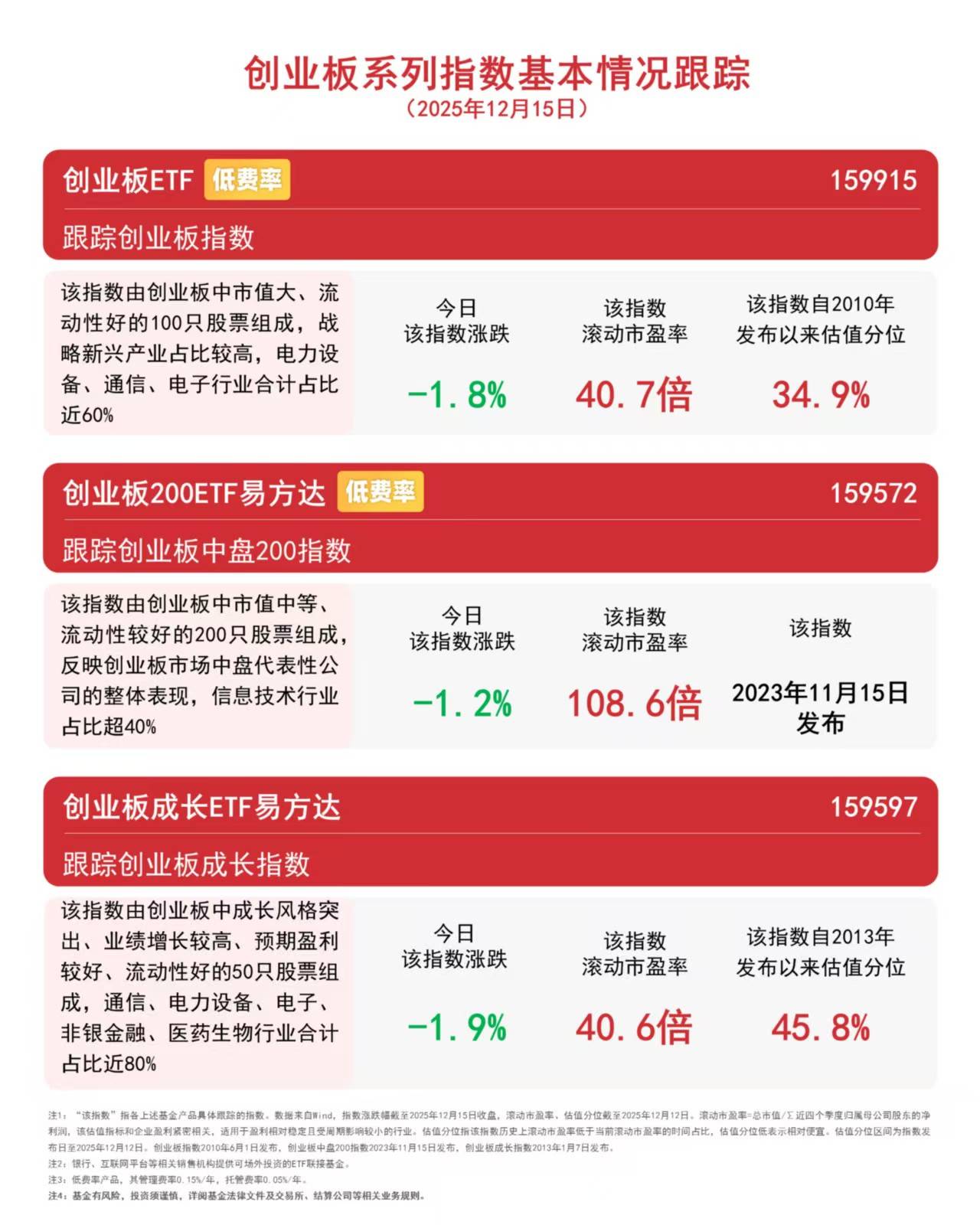
截至收盘,创业板中盘200指数下跌1.2%,创业板指数下跌1.8%,创业板成长指数下跌1.9%,相关ETF获资金逆势加仓,创业板ETF(159915)获1.4亿份净 申购。 深交所及深圳证券信息有限公司近日宣布,对创业板指数等指数实施样本定期调整,并于今日正式实施,其中创业板指数将更换8只样本股。本次调整后, 创业板指数战略性新兴产业权重达到93%,新一期样本公司前三季度营业收入、净利润同比增速分别为16%、24%,研发费用同比增速为13%,其中30家公 司研发强度超10%,进一步强化了指数对新兴产业的表征性,实现"质效焕新"。 | 今日 | 该指数 | 该指数自2 | | --- | --- | --- | | 该指数涨跌 | 滚动市盈率 | 发布以来估 | | -1.8% | 40.7倍 | 34. | | 今日 该指数涨跌 | 该指数 | 该指数自2 | | --- | --- | --- | | | 滚动市盈率 | 发布以来估 | | -1 Q% | 40 6位 | 15 1 | 每日经济新闻 ...

俄罗斯在莫斯科对欧洲清算银行提起诉讼 索要2290亿美元资金
Xin Lang Cai Jing· 2025-12-15 08:32
该央行表示,向莫斯科仲裁法院提起的诉讼金额将与其被冻结资产总额以及由此造成的额外收入损失相 等。 据报道, 俄罗斯央行在莫斯科提起诉讼,寻求向欧洲清算银行索要18.2万亿卢布(2290亿美元)。 该央行上周五在一份声明中表示,将起诉这家总部位于比利时的存款机构,指控其"非法行为"导致"该 行无法处置其资金和证券"。 责任编辑:陈钰嘉 据报道, 俄罗斯央行在莫斯科提起诉讼,寻求向欧洲清算银行索要18.2万亿卢布(2290亿美元)。 该央行上周五在一份声明中表示,将起诉这家总部位于比利时的存款机构,指控其"非法行为"导致"该 行无法处置其资金和证券"。 该央行表示,向莫斯科仲裁法院提起的诉讼金额将与其被冻结资产总额以及由此造成的额外收入损失相 等。 责任编辑:陈钰嘉 ...
如何看待:沪深300的追涨杀跌?
雪球· 2025-12-15 08:13
Core Viewpoint - The article emphasizes that annual rebalancing of indices is a systematic process governed by transparent rules rather than subjective market judgments, highlighting the importance of understanding these rules for effective investment strategies [5][8][11]. Group 1: Annual Rebalancing - Annual rebalancing occurs on the second Friday of December, affecting the sample composition of various indices, which in turn influences valuation and industry distribution [5][6]. - Criticism often arises regarding indices like the Shanghai Composite 50 and CSI 300 for including high-performing tech stocks while excluding underperforming blue-chip stocks, leading to perceptions of "buying high and selling low" [6][10]. - Understanding that rebalancing is a result of predefined rules rather than market sentiment is crucial for investors [8][11][14]. Group 2: Market Capitalization Indices - Market capitalization indices, such as the CSI 300 and Shanghai Composite 50, aim to represent key enterprises in the market rather than to capitalize on price fluctuations [16][18]. - These indices naturally exhibit a tendency to include companies that have increased in value and exclude those that have decreased, which can be misinterpreted as "buying high and selling low" [18][20]. - The design of market capitalization indices prioritizes transparency and alignment with economic structures over short-term gains [20][21]. Group 3: Strategy Indices - Strategy indices, like dividend indices, focus on specific factors such as dividend yield, adjusting their composition based on the stability of dividend payments rather than stock prices [24][25]. - Observers may perceive strategy indices as "buying low and selling high," but they are actually adjusting based on cash return metrics [27][28]. - These indices serve different purposes compared to market capitalization indices, addressing specific risk and return characteristics [28][30]. Group 4: Understanding Index Characteristics - Market capitalization indices and strategy indices are not mutually exclusive; they address different investment needs and can complement each other in a portfolio [31][32]. - The debate surrounding annual rebalancing often stems from investors interpreting long-term rules through short-term emotional lenses [33][34]. - Patience and discipline are essential for investors to navigate the execution of these rules effectively [35].

商务部、央行、金融监管总局三部门发文:加强商务和金融协同,更大力度提振消费
Jin Rong Jie· 2025-12-15 07:48
Core Viewpoint - The Ministry of Commerce, the People's Bank of China, and the Financial Regulatory Administration have jointly issued a notice to enhance collaboration between commerce and finance, aiming to boost consumption through targeted policies and measures [1][2]. Group 1: Policy Measures - The notice outlines three main areas and eleven specific policy measures to strengthen the synergy between commerce and finance [1]. - The first area focuses on deepening collaboration between the commerce and finance systems, encouraging local departments to improve communication and cooperation mechanisms, and detailing implementation guidelines [1]. - The second area emphasizes increasing financial support in key consumption sectors, urging financial institutions to optimize products and services to better align with consumer needs and promote new consumption models [1]. - The third area aims to expand cooperation among government, financial institutions, and enterprises, promoting diverse consumption activities and ensuring effective policy implementation [1]. Group 2: Implementation and Monitoring - The notice stresses the importance of coordinated efforts, policy alignment, and leveraging strengths among departments to effectively stimulate consumption [2]. - It encourages local departments and financial institutions to refine financial support measures based on actual conditions to unlock consumption potential [2]. - There is a call for ongoing tracking and guidance, with an emphasis on sharing progress and promoting successful practices [2].
2025并购狂飙:全球交易额冲高4.5万亿美元,AI与监管政策成引擎
智通财经网· 2025-12-15 07:05
智通财经APP获悉,交易撮合者们正带着一个价值千亿美元的悬念步入2025年的最后几周。派拉蒙天舞 公司(PSKY.US)从奈飞公司(NFLX.US)眼皮底下抢购华纳兄弟探索公司(WBD.US)的收购要约,概括了定 义这个并购大年的几个主题:对变革性联姻重燃的渴望、来自华尔街的大笔支票、中东资金的涌入,以 及美国总统唐纳德·特朗普作为颠覆者和交易促成者的双重角色。 "这些股市回报确实来自人工智能,而人工智能的支出是不可持续的,"摩根大通全球投行业务主席查理 ·杜普雷表示。"如果这方面出现退潮,那么你会看到一个更广泛的市场实际上并没有在进步。" 人工智能热潮促成了今年一些引人注目的交易。萨姆·奥特曼的OpenAI接受了来自软银集团、英伟达公 司(NVDA.US)和华特迪士尼公司(DIS.US)等的主要投资;由贝莱德旗下全球基础设施合作伙伴牵头的财 团同意支付400亿美元收购Aligned数据中心。三月,谷歌母公司Alphabet将其以320亿美元收购网络安全 初创公司Wiz Inc.的交易描述为在人工智能时代为客户提供新保障的一种方式。 "现在每个人都需要成为人工智能银行家,"摩根士丹利全球科技并购主管Wally ...


增量政策或将出台,中证A500ETF(159338)近20日净流入超22亿元,资金抢筹A股核心资产
Mei Ri Jing Ji Xin Wen· 2025-12-15 07:05
消息面上,12月13日,2025—2026中国经济年会在中国国际经济交流中心举办,中央财办分管日常 工作的副主任、中央农办主任韩文秀在会上表示,2025年我国主要经济指标表现好于预期,经济总量预 计达到140万亿元左右。2026年将根据形势变化出台实施增量政策,要协同发挥存量政策和增量政策集 成效应,推动经济稳中向好。 中国银河证券表示,12月中央经济工作会议召开,为明年经济工作指明了初步方向,A股投资重点 关注以下领域:(1) 科技创新主题 :作为"十五五"开局之年,顺应国家战略、具备真实技术壁垒的科 技企业将是A股投资的重要主线。(2) "反内卷"主题 :深入整治"内卷式"竞争,政策效果将持续体 现,以促进行业业绩改善,提升相关板块中长期投资价值。(3) 大消费主题 :大消费板块目前估值处 于历史中低水平,政策利好有望促进业绩与估值双击。(4) 金融板块 :金融机构将加力支持扩大内 需、科技创新、中小微企业等重点领域。(5) 地产链 :随着地产政策加快落地,止跌企稳预期有望得 到强化,给投资者信心提供支撑。(6) 出海主题 :对外开放政策支持下,出海趋势将带动企业盈利空 间进一步打开。 把握A股机遇,或可 ...