
纺织服装

Search documents
泰慕士: 江苏泰慕士针纺科技股份有限公司详式权益变动报告书
Zheng Quan Zhi Xing· 2025-08-13 10:13
Core Viewpoint - The report outlines the equity change of Jiangsu Taimushi Textile Technology Co., Ltd., where Guangzhou Light Industry Trade Group Co., Ltd. will acquire 32,813,168 shares, representing 29.99% of the total share capital, through a share transfer agreement with the previous major shareholder, Xintai Investment [1][29]. Group 1: Equity Change Details - The equity change requires approval from the Guangzhou Municipal Government's State-owned Assets Supervision and Administration Commission and compliance review by the Shenzhen Stock Exchange [2]. - The equity change does not trigger a mandatory tender offer obligation [2]. - The report confirms that the information disclosed is accurate and complete, with no false statements or significant omissions [2]. Group 2: Information Disclosure Obligations - The information disclosure obligation is based on relevant laws and regulations, including the Company Law and Securities Law of the People's Republic of China [1]. - The report states that the information disclosure obligation has been authorized and approved, and it does not conflict with the company's articles of association or internal rules [1]. Group 3: Financial Overview of Guangzhou Light Industry Group - Guangzhou Light Industry Group, the disclosing party, has a registered capital of 199,049.35 million RMB and is primarily engaged in various manufacturing and trading activities [7]. - The group is controlled by the Guangzhou Municipal Government, which holds 90.03% of its shares [7]. Group 4: Recent Financial Performance - The financial data for Guangzhou Light Industry Group over the last three years shows total assets of 2,314,593.96 million RMB in 2024, with total liabilities of 811,440.22 million RMB and a net profit of 110,916.92 million RMB [26]. - The asset-liability ratio has improved from 41.03% in 2022 to 35.06% in 2024, indicating better financial health [26]. Group 5: Future Plans and Commitments - The disclosing party does not have immediate plans to increase its stake in the company within the next 12 months but may consider it based on market conditions [29]. - The disclosing party commits to not transferring its shares for 18 months post-acquisition, except to entities controlled by its actual controller [30].
美印贸易谈判陷僵局:美财长称印度"顽固",9月联大或成缓和契机?
Di Yi Cai Jing· 2025-08-13 09:47
Group 1: Trade Impact on Indian Apparel Industry - The U.S. market accounts for approximately one-third of India's apparel exports, making it a critical market for the industry [1][3] - The additional 25% tariff imposed by the U.S. on Indian products, combined with the existing tariffs, raises the total tariff rate to 50%, significantly impacting competitiveness [1][3] - The Indian apparel sector could see a decline in exports by $2.5 billion to $3 billion due to these tariffs, as buyers may prefer cheaper alternatives from countries like Bangladesh and Vietnam [3] Group 2: Negotiation Stalemate - Trade negotiations between India and the U.S. have stalled, primarily due to India's reluctance to make concessions on agricultural and dairy markets, which are vital for its political base [5] - The U.S. has expressed dissatisfaction with India's trade practices, particularly regarding the import of Russian oil and agricultural products [5] - Despite the challenges, India has made some concessions, including tariff exemptions on industrial goods and allowing certain foreign companies to operate in India [5] Group 3: Broader Economic Context - While the apparel sector faces increased tariffs, other sectors like electronics and pharmaceuticals continue to enjoy tariff exemptions, indicating a selective approach to trade policy [4] - The Indian government is under pressure to support small and medium-sized apparel enterprises affected by the tariffs, with calls for direct financial assistance to mitigate the impact [3]


亚洲电视控股(00707.HK)将继续从事布料及成衣贸易业务 续停牌
Jin Rong Jie· 2025-08-13 06:16
Core Viewpoint - Asia Television Holdings (00707.HK) has clarified that CPL Group primarily engages in the processing, printing, and sales of finished fabrics, as well as subcontracting services. Following the sale, the group has ceased its related business activities [1] Financial Performance - For the fiscal year ending December 31, 2024, CPL Group recorded revenue of approximately RMB 32.4 million, accounting for about 40.7% of the group's total revenue [1] - The trading business, which is one of the group's main operations, generated revenue of RMB 19.96 million, representing approximately 25.1% of total revenue, and incurred a net loss of RMB 0.96 million [1] Stock Trading Status - The company's shares have been suspended from trading on the Hong Kong Stock Exchange since August 11, 2025, and will remain suspended until further notice [1]
绿色再生面料标杆引领纺织新质生产力 福恩股份深市主板IPO获受理
Quan Jing Wang· 2025-08-13 05:51
Core Viewpoint - The company, Fuen Co., Ltd., has been accepted for IPO on the Shenzhen Main Board, positioning itself as a leading global supplier of sustainable ecological fabrics, focusing on innovation and differentiation in the textile industry [1] Financial Performance - Fuen Co., Ltd. achieved revenues of 1.764 billion yuan, 1.517 billion yuan, and 1.813 billion yuan for the years 2022, 2023, and 2024 respectively, with net profits of 277 million yuan, 229 million yuan, and 275 million yuan during the same period [1] Fundraising and Projects - The company plans to raise 1.25 billion yuan through its IPO, with key projects including the integrated project for recycled environmental wool-type colored spinning fabric (800 million yuan) and a high-end recycled materials research institute (450 million yuan) [2] - The integrated project aims to produce 75 million meters of colored fabric, 5 million meters of plain fabric, and 7,200 tons of colored spinning yarn annually, utilizing modern production technologies to enhance automation and product quality [2] Research and Development - The high-end recycled materials research institute will have a construction period of three years, aiming to produce 3,000 tons of high-end recycled knitted fabric annually, enhancing the company's capabilities in the entire textile supply chain [3] - The company has established a comprehensive service capability from trend analysis to garment design, meeting the high customization demands of international brands like Uniqlo, H&M, and ZARA [3] Market Position and Growth - Fuen Co., Ltd. holds a significant market share in the recycled polyester-cotton blended fabric and recycled colored fabric sectors, with sales of approximately 50 million meters and 32 million meters respectively in 2023, and projected increases in 2024 [4] - The company has expanded its overseas market presence, achieving 932 million yuan in overseas revenue in 2024, accounting for 51.71% of total revenue, and has established subsidiaries in Singapore and Hong Kong to optimize overseas services [4] Industry Trends - The textile industry is undergoing a green transformation towards low-carbon, circular, and clean production, with Fuen Co., Ltd. aiming to strengthen its position in the supply chains of major international brands and increase its market share in the domestic market [5]
亚洲电视控股(00707)澄清并终止占营收四成布料加工业务 继续停牌
智通财经网· 2025-08-13 04:39
Group 1 - The company clarifies that CPL Group primarily engages in the processing, printing, and sales of finished fabrics and subcontracting services, and has ceased these operations following the sale [1] - For the fiscal year ending December 31, 2024, CPL Group reported revenue of approximately RMB 320 million, accounting for about 40.7% of the total revenue of the group [1] - The company will continue its fabric and garment trading business, which is one of its main operations, reporting revenue of RMB 19.96 million for the same fiscal year, representing approximately 25.1% of total revenue, with a net loss of RMB 960,000 [1] Group 2 - The company remains suspended from trading [1]
A股异动 | 被立案调查,际华集团再度跌超7%,3日连跌近23%
Ge Long Hui A P P· 2025-08-13 04:02
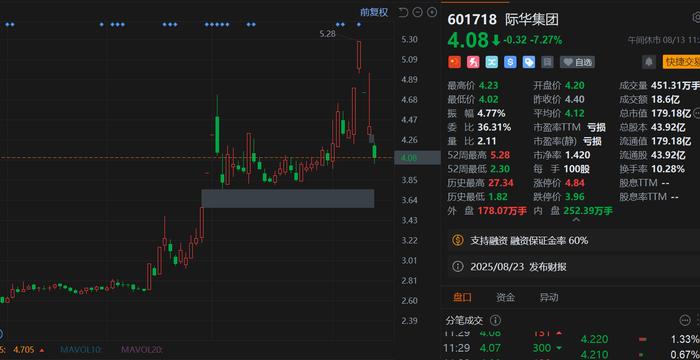
际华集团(601718.SH)再度跌超7%,3日连跌近23%,现报4.08元,总市值跌破180亿元。消息上,此前 连续2日涨停的际华集团突然披露公告称公司于8月8日因公司涉嫌信息披露违法违规,根据《中华人民 共和国证券法》《中华人民共和国行政处罚法》等法律法规,中国证监会决定对公司立案。 值得注意的是,近三年财务数据显示,其营收从2023年的115.61亿元持续下滑至2024年的98.86亿元,同 期净利润更是从盈利1.82亿元骤降至亏损42.28亿元,资产减值计提规模暴增暴露经营风险。(格隆汇) ...

华利集团(300979):2025H1业绩快报点评:收入延续较优增长,净利率环比回落
Changjiang Securities· 2025-08-12 23:30
Investment Rating - The investment rating for the company is "Buy" and is maintained [7]. Core Views - The company reported a revenue of 12.66 billion yuan for H1 2025, representing a year-on-year increase of 10.4% (9.2% in USD), while the net profit attributable to the parent company was 1.66 billion yuan, down 11.4% year-on-year (12.4% in USD) [5][6]. - For Q2, the revenue was 7.31 billion yuan, up 9% year-on-year (7.7% in USD), with a net profit of 900 million yuan, reflecting a year-on-year decline of 17.3% (18.3% in USD) [5][6]. - The company expects a recovery in net profit margin in Q3 due to stable income tax rates and recent efficiency improvements, despite short-term pressures from old factory utilization rates and new factory production [2][5]. Summary by Sections Revenue - The revenue growth is driven by new customer acquisition, while existing customers face operational pressures leading to a decline in their orders. Q2 saw a volume increase of 4.2% year-on-year, but revenue growth slowed by 3.4 percentage points compared to Q1 due to tariff and external demand impacts [5][6]. - The average selling price increased by 4.6% year-on-year (3.4% in USD), attributed to a decrease in the proportion of low-priced old customers [5][6]. Profitability - The gross margin decline has negatively impacted the net profit margin, which was 12.3% in Q2, down 1.9 percentage points quarter-on-quarter and 3.9 percentage points year-on-year. This decline is primarily due to new factories ramping up production and underutilization of some old factories [5][6]. Outlook - The company forecasts net profits attributable to the parent company for 2025-2027 to be 3.49 billion, 4.00 billion, and 4.53 billion yuan, respectively, with year-on-year changes of -9%, +15%, and +13%. The corresponding price-to-earnings ratios are projected to be 17, 15, and 13 times [2][5].
棒杰股份股价下跌2.30% 管理层大换血聚焦主业
Jin Rong Jie· 2025-08-12 19:35
Group 1 - The stock price of Bangjie Co., Ltd. closed at 5.10 yuan on August 12, down 0.12 yuan, a decrease of 2.30% from the previous trading day [1] - The trading volume on that day was 226,686 hands, with a transaction amount of 117 million yuan [1] - Bangjie Co., Ltd. specializes in seamless garment manufacturing, with products primarily used in underwear and sportswear [1] Group 2 - On August 11, the company announced a management restructuring, electing Cao Yuangang as chairman, He Qi as vice chairman, and hiring Xia Jinqiang as general manager [1] - The new management team has backgrounds in finance and investment [1] - The company has terminated its photovoltaic cell project and will focus on its seamless garment business [1] Group 3 - On August 12, the net inflow of main funds was 10.87 million yuan, with a cumulative net inflow of 65.77 million yuan over the past five days [1]

富春染织股价下跌1.83% 公司完成工商变更登记
Jin Rong Jie· 2025-08-12 17:33
Group 1 - The stock price of Fuchun Dyeing and Weaving closed at 16.65 yuan on August 12, down by 0.31 yuan, representing a decline of 1.83% [1] - The trading volume on that day was 53,225 hands, with a transaction amount of 89 million yuan [1] - Fuchun Dyeing and Weaving is primarily engaged in the textile and apparel industry and is registered in Anhui [1] Group 2 - On the evening of August 12, the company announced that it has completed the industrial and commercial change registration procedures and has reissued its business license [1] - On August 12, the net outflow of main funds was 9.3474 million yuan, accounting for 0.29% of the circulating market value [1] - Over the past five days, the net inflow of main funds was 18.5649 million yuan, accounting for 0.57% of the circulating market value [1]

富安娜股价微跌0.55% 公司启动730万元股份回购计划
Jin Rong Jie· 2025-08-12 16:30
Group 1 - The stock price of Fuanna is reported at 7.29 yuan as of August 12, 2025, with a decrease of 0.55% compared to the previous trading day [1] - The trading volume on the same day was 116,300 hands, with a total transaction amount of 85 million yuan and a turnover rate of 2.38% [1] - Fuanna operates in the textile and apparel industry, focusing on the research, production, and sales of home textile and furniture products [1] Group 2 - For the first quarter of 2025, the company achieved a revenue of 536 million yuan and a net profit attributable to shareholders of 56.14 million yuan [1] - On the evening of August 12, Fuanna announced the repurchase of 1 million shares through centralized bidding, accounting for 0.1193% of the total share capital, with a total transaction amount of 7.3 million yuan [1] - The repurchase price range was between 7.28 yuan and 7.32 yuan, in compliance with the company's established plan and relevant regulations [1] Group 3 - On August 12, the net outflow of main funds for Fuanna was 1.7517 million yuan, with a cumulative net outflow of 9.4254 million yuan over the past five days [1]
