
金融服务

Search documents
“微”观行业之变|从一笔联合贷款看“精准滴灌”下金融与科技双向奔赴
Zhong Guo Jin Rong Xin Xi Wang· 2026-01-09 07:37
Core Insights - The article emphasizes the importance of financial support for "hard technology" companies to thrive, highlighting innovative financial models that facilitate precise credit allocation to tech innovation sectors [1][7]. Group 1: Financial Models and Innovations - The "joint credit" model and "common growth plan" are examples of innovative financial strategies that guide resources towards technology innovation, enabling financial institutions to share in the growth of tech companies [1][2]. - The "Zhejiang Science Leading Joint Loan" was introduced by multiple banks to address the diverse financing needs of tech companies, allowing for risk-sharing and resource complementarity among banks [2][3]. - The "Common Growth Plan" allows banks to share the growth benefits of tech companies while managing early-stage risks through strategic cooperation agreements [5][6]. Group 2: Regional Success Stories - In Hangzhou, Yundongchu Technology Co., Ltd. successfully raised over 500 million yuan in C-round financing, aided by a 5 million yuan credit loan from Hangzhou Bank [1][2]. - In Hefei, Zhongke Haoyin Intelligent Technology Co., Ltd. received an 8 million yuan credit loan under the "Common Growth Plan," enabling its growth into a specialized small giant enterprise [5][6]. - In Suzhou, a new digital credit platform has facilitated the collection of over 1.6 billion enterprise operation data points, helping nearly 6,000 companies secure 265.8 billion yuan in credit [6][7]. Group 3: Industry Growth and Trends - The high-tech manufacturing sector has shown significant growth, with a 9.6% increase in value added in the first three quarters of 2025, outpacing overall economic growth [3][7]. - As of September 2025, technology loans in China grew by 11.8%, with loans to small and medium-sized tech enterprises reaching 3.6 trillion yuan, reflecting a 22.3% year-on-year increase [7][8]. - The establishment of a multi-layered financial service system has led to the issuance of 669.1 billion yuan in technology innovation bonds, indicating a robust support framework for tech enterprises [8][9]. Group 4: Future Directions - The "14th Five-Year Plan" emphasizes the need to develop a technology finance system that supports innovation and industry development, aiming for a market-oriented and policy-supported financial ecosystem [8][9]. - Industry experts suggest enhancing financial services for tech innovation through lifecycle support, tailored financial tools, and digital transformation to foster a virtuous cycle between technology, industry, and finance [9].



时隔近4个月,A股成交额历史第6次突破3万亿
2 1 Shi Ji Jing Ji Bao Dao· 2026-01-09 07:17
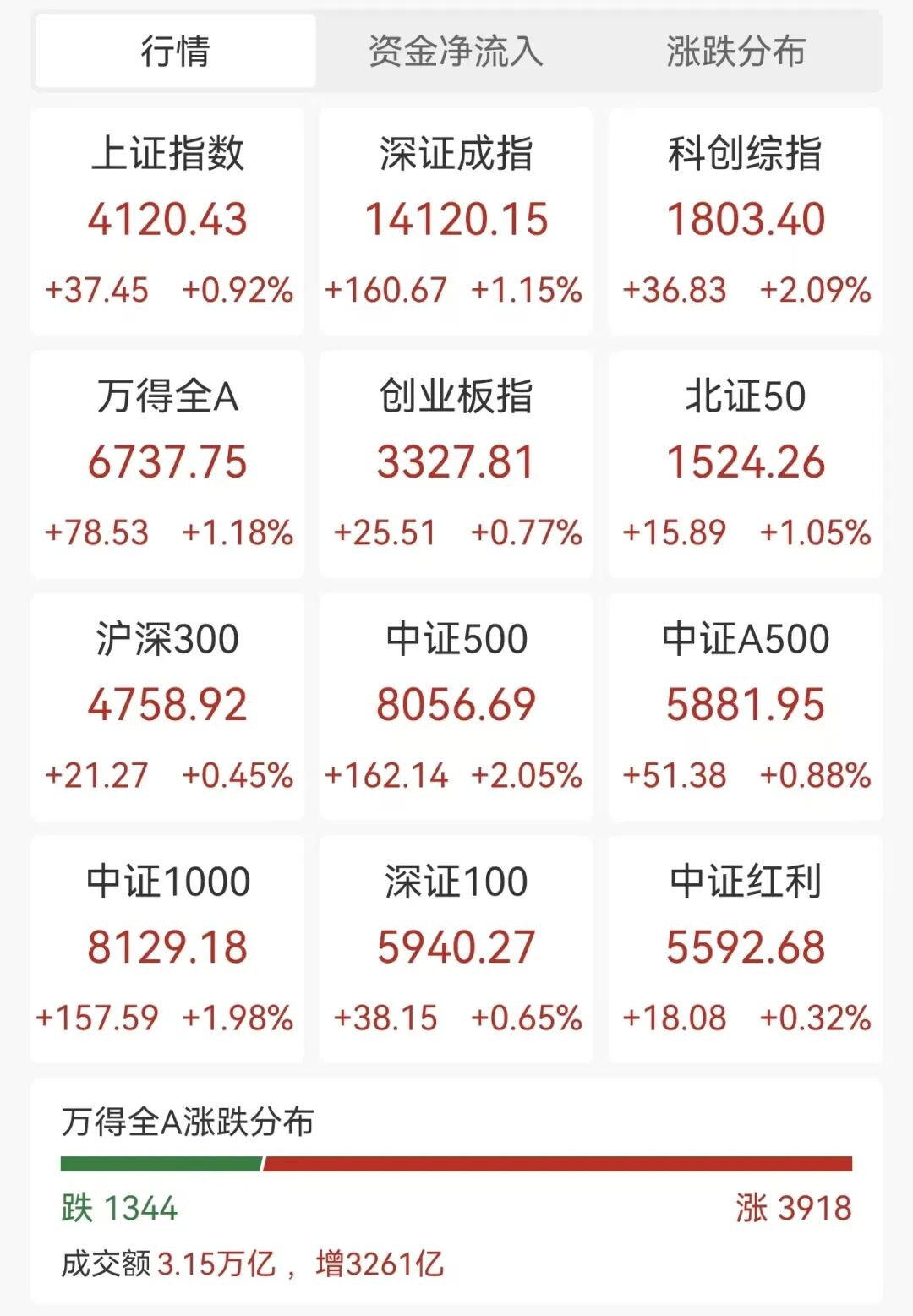
Market Performance - The A-share market experienced a strong rally, with all three major indices rising; the Shanghai Composite Index increased by 0.92%, surpassing the 4100-point mark for the first time in 10 years, marking a 16-day consecutive rise [1] - The ChiNext Index rose by 0.77%, while the overall trading volume exceeded 3 trillion yuan, a significant increase of 326.1 billion yuan from previous levels [2][3] Sector Performance - AI application themes surged, leading sectors included film, short dramas, and gaming, while commercial aerospace, humanoid robots, and small metal concept stocks also saw significant gains [1] - Conversely, the photovoltaic and large financial sectors showed weakness during this trading session [1] Trading Volume Insights - The trading volume of the A-share market has consistently remained above 2.5 trillion yuan for four consecutive trading days since the beginning of January 2026, indicating a rapid increase in investor sentiment [3] - Historical data shows that such high trading volumes are rare, with only six instances of daily trading volumes exceeding 3 trillion yuan in the past [3][4] Economic Analysis - Economist Pan Helin stated that the current performance indicates that the A-share market has entered a full bull market phase, driven by the appreciation of the yuan and the return of global capital [6] - The increase in trading volume beyond 3 trillion yuan is expected to further boost market sentiment, although it may lead to irrational exuberance typical of a bull market [6]

非农前夕,美债上行,黄金还能撑住吗?
Sou Hu Cai Jing· 2026-01-09 06:57
Core Viewpoint - The upcoming non-farm payroll report is particularly significant as it will be the first data released on time after the government shutdown, with mixed signals from previous employment data creating uncertainty in the market [1][6]. Employment Data - The previous non-farm report showed an unexpected increase of 64,000 jobs, but the unemployment rate rose to 4.6%, the highest in four years, indicating a paradox where job growth exists but job searching has become more difficult [1][3]. - Economists predict around 73,000 new jobs for December, with a slight decrease in the unemployment rate to 4.5%, although some institutions remain less optimistic, suggesting the rate may stay at 4.6% [3][5]. - Initial jobless claims were reported at 208,000, slightly below expectations, indicating no significant layoffs, while continuing claims rose to 1.914 million, suggesting increased difficulty in finding new jobs [6][8]. Market Reactions - The rise in 10-year U.S. Treasury yields to 4.18% has created anxiety among investors, as higher yields typically pressure gold prices due to the comparative attractiveness of interest-bearing assets [3][12]. - The current economic environment is characterized by a cooling job market and a lack of clear direction in interest rates, making it challenging for gold to establish a strong upward trend [10][12]. Investor Sentiment - Consumer sentiment reflects rising inflation expectations at 3.4%, while confidence in job opportunities has dropped to the lowest level since the survey began, indicating a growing concern about the economic outlook [8][10]. - Investors are advised to consider their motivations for holding gold, as the current market volatility may not align with short-term speculative strategies but could serve as a hedge in uncertain times [12].
艾德金融:BW Industrial Holdings公开递交S-1表格,申请纳斯达克上市
Sou Hu Cai Jing· 2026-01-09 06:50
Group 1: BW Industrial Holdings - BW Industrial Holdings is a US-based engineering, procurement, and construction (EPC) company specializing in the design, construction, and integration of critical process systems for various industrial sectors [2] - The company's EPC business model involves serving international companies looking to establish and expand production operations in the US [2] - BW Industrial Holdings is expanding its client base to include more domestic and overseas companies with similar technical and project execution needs [2] - The company provides compliance solutions for clients seeking comprehensive EPC services in North America from its headquarters in Houston, Texas [2] Group 2: Eddid Financial - Eddid Financial is a Hong Kong-based financial group focused on fintech, offering a wide range of services including fintech, internet finance, wealth management, asset management, investment banking, and digital assets [3] - The group holds multiple licenses in major financial markets, including various regulated activities licenses issued by the Hong Kong Securities and Futures Commission [3] - Eddid Financial's US subsidiary, Eddid Securities USA Inc., is a registered broker-dealer with the SEC and CFTC, and is a member of FINRA, NFA, SIPC, NASDAQ, NYSE, and NYSE American [4] - Eddid USA provides investment banking services and related products in the US, as well as online self-service retail securities account services [4]

聚焦ETF市场 | 2026年境外ETF做市商扩大中国内地业务版图
彭博Bloomberg· 2026-01-09 06:04
Core Viewpoint - By 2026, foreign market makers are expected to account for 50% of the trading volume of mainland China-listed ETFs, a significant increase from 33% in Q2 2025, driven by ample liquidity and high asset turnover rates [1]. Group 1: Participation of Foreign Market Makers - Foreign market makers are increasingly active in the mainland ETF market, with at least one foreign market maker among the top ten holders of 356 ETFs as of Q2 2025 [4]. - The number of ETFs traded by foreign market makers could reach approximately 500, as some institutions engage in intraday trading [4]. - The expected participation of foreign market makers in 2026 is projected to be at least 50%, translating to around 700 ETFs [4]. Group 2: Liquidity and Market Dynamics - The mainland China ETF market is the second most liquid globally, following the U.S., with asset turnover rates of 12.7 times in 2025, significantly higher than the U.S. [6]. - Jane Street and Optiver are among the first foreign market makers to enter the mainland market, with Citadel, Virtu, and IMC expected to start operations in 2026 [6]. Group 3: Impact on Trading Efficiency - Increased participation of foreign market makers is anticipated to narrow the bid-ask spreads of ETFs, enhancing trading efficiency [9]. - As of December last year, foreign market makers accounted for approximately 70% of trading in mainland-listed Hong Kong stock ETFs and about 90% in other cross-border ETFs, leading to reduced average bid-ask spreads of 12 basis points and 7 basis points, respectively [9]. Group 4: Leading Institutions - Jane Street, Optiver, Susquehanna, Eclipse, and Hudson River Trading (HRT) are among the largest holders of mainland-listed ETFs, with their holdings significantly increasing in recent years [9].

12月非农或不温不火,真正的行情引爆点在前值修正中?
Jin Shi Shu Ju· 2026-01-09 05:55
Core Viewpoint - The U.S. labor market is expected to show moderate growth in December, which may instill some confidence in investors for the new year, but it is not enough to cause excessive market excitement [2] Employment Data Summary - The consensus forecast predicts an addition of 60,000 non-farm jobs in December, with the unemployment rate slightly decreasing to 4.5%. The range for job additions is between 25,000 and 155,000, highlighting uncertainty in hiring conditions [2] - If the forecast is accurate, the job addition will be a slight increase compared to the average monthly addition of 55,000 jobs from January to November 2025, and slightly higher than the preliminary figure of 64,000 jobs in November [2] - The unemployment rate is currently 0.5 percentage points higher than at the beginning of 2025, indicating a divergence between job growth and unemployment rate trends [2][4] Market Impact - The upcoming non-farm payroll report is crucial for influencing Federal Reserve policy expectations and may lead to significant fluctuations in stock, bond, currency, and precious metal markets [2] - A weak non-farm employment report could reinforce market expectations for further interest rate cuts by the Federal Reserve, likely leading to a weaker dollar and a potential initial rebound in U.S. stocks, followed by renewed concerns about economic growth [2][3] - Conversely, a strong non-farm report would weaken the market's rate cut bets, support the dollar, and potentially suppress U.S. stock valuations [3] Labor Market Indicators - The recent JOLTS report indicated a significant decline in job vacancies, which is a leading indicator of future hiring intentions. This decline suggests a weakening demand for labor and supports the expectation of weak job additions in December [5] - The ongoing decrease in the labor turnover rate indicates that employees are less confident in external job opportunities, further signaling a cooling labor market [5] Data Revisions - Experienced traders recognize that revisions to previous months' employment data can significantly alter market perceptions of labor market strength. A substantial downward revision of October and November's job additions could paint a more severe picture of the employment landscape than the December figures alone suggest [6] - Historical trends show that conflicting signals between initial and revised non-farm data often lead to market volatility [6] Future Employment Outlook - Economists generally expect the U.S. labor market to stabilize in 2026, with a more optimistic outlook compared to the beginning of 2025. There are signs of improved hiring activity and a slowdown in layoffs [7] - The employment market is anticipated to remain within a moderate range, with fluctuations expected but overall resilience confirmed [7] - The focus for 2026 will also be on employee retention strategies, as employers prioritize retaining existing staff over aggressive hiring or layoffs [8]
12月非农揭晓在即!黄金高位震荡,日元维持弱势
Xin Lang Cai Jing· 2026-01-09 05:35
Core Viewpoint - The upcoming U.S. non-farm payroll report for December is expected to shift market focus back to economic data and interest rate outlooks, following a period of geopolitical concerns [2][17]. Employment Data Summary - The U.S. job market shows signs of weakness, with November job openings dropping to 7.15 million, the lowest in 14 months, resulting in a ratio of 0.91 job openings per unemployed person, the lowest since March 2021 [3][17]. - The ADP report indicates that 41,000 private sector jobs were added in December, which is above the previous value but slightly below expectations, with four instances of negative growth since June [3][17]. - Initial jobless claims rose slightly to 208,000, up from 200,000, although the four-week average has significantly decreased [3][17]. Market Expectations - The market anticipates an addition of 60,000 jobs in the upcoming non-farm report, down from a previous value of 64,000, with the unemployment rate expected to decrease from 4.6% to 4.5% [3][17]. - Hourly wage growth is projected to rise to 3.6% [3][17]. Federal Reserve Perspective - The Federal Reserve acknowledges the downward risks in the job market, maintaining a forecast for one rate cut this year, although there are significant divisions among market participants [5][19]. - The interest rate market is leaning towards a more dovish stance, betting on two rate cuts this year, with an 86% probability that the January meeting will not result in a rate change [5][19]. Market Reactions - Traders are adopting a cautious approach ahead of the non-farm report, with both stock markets and precious metals slowing their upward momentum [5][19]. - If the employment data falls short of expectations, it could heighten rate cut anticipations, benefiting risk assets like stocks and cryptocurrencies, while gold and silver may aim for historical highs [5][19]. - Conversely, a strong report could lead to a rebound in the U.S. dollar index [5][19].
货币政策预计将保持连续性、稳定性兼顾灵活性丨第一财经首席经济学家调研
Di Yi Cai Jing· 2026-01-09 03:57
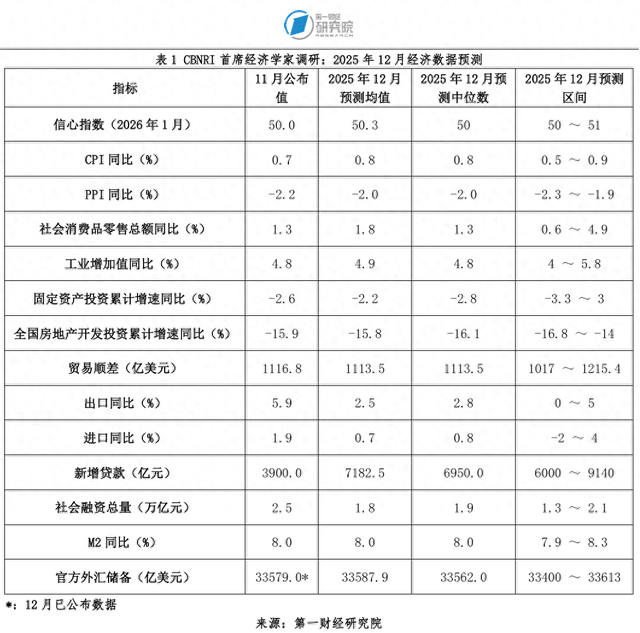
Core Viewpoint - The economic outlook for China in 2025 is expected to show steady progress, with a focus on high-quality development and structural optimization, as indicated by the Chief Economist Confidence Index of 50.32 for January 2026, reflecting a recovery from the previous month [1][4]. Economic Indicators - The average forecast for December 2025 CPI year-on-year growth is 0.8%, slightly higher than the previous month's 0.7% [8][10]. - The average forecast for December 2025 PPI year-on-year growth is -2.0%, an improvement from -2.2% in the previous month [8][10]. - The average forecast for December 2025 industrial added value year-on-year growth is 4.9%, up from 4.8% in November [13]. - The average forecast for December 2025 fixed asset investment cumulative year-on-year growth is -2.2%, an improvement from -2.6% in November [14]. - The average forecast for December 2025 social retail sales year-on-year growth is 1.8%, with a range from 0.6% to 4.9% [10][11]. - The average forecast for December 2025 trade surplus is $1113.5 billion, slightly lower than the previous month's $1116.8 billion [17]. - The average forecast for December 2025 new loans is 7182.5 billion yuan, a significant increase from the previous month's 3900 billion yuan [19]. - The average forecast for December 2025 total social financing is 1.8 trillion yuan, down from 2.5 trillion yuan in November [21]. - The average forecast for December 2025 M2 year-on-year growth is 8%, consistent with the previous month's figure [21][23]. - As of December 2025, China's foreign exchange reserves are expected to be $33579 billion, reflecting a slight increase from the previous month [23]. Policy Outlook - The macroeconomic policy for 2026 is expected to be more proactive, with an increase in fiscal deficit and government debt issuance to support economic growth [25][27]. - Monetary policy is anticipated to remain accommodative, with potential interest rate cuts and reserve requirement ratio reductions to ensure liquidity and lower financing costs [26][27].
金风科技盘中涨超14% 大和称对蓝箭航天潜在投资收益将支撑金风短期盈利表现
Zhi Tong Cai Jing· 2026-01-09 03:20
Core Viewpoint - Goldwind Technology (金风科技) shares rose over 14% during trading, currently up 7.2% at HKD 17.28, with a trading volume of HKD 2.339 billion [1] Group 1: Company Developments - Blue Arrow Aerospace recently submitted its prospectus to the Sci-Tech Innovation Board, indicating that Goldwind's subsidiary, Jianghan Asset, holds a 4.14% stake in Blue Arrow, making it the sixth largest shareholder [1] - Daiwa upgraded Goldwind's H-share rating from "Hold" to "Outperform" based on potential investment returns supporting short-term profitability [1] Group 2: Market Impact - The proposed IPO of SpaceX may drive significant revaluation, further influencing Goldwind's stock performance [1] - The target price for Goldwind's H-shares has been raised from HKD 13 to HKD 17 [1]

新财观|COP30峰会释信号:内地与香港协同引领绿色资金新流向
Xin Hua Cai Jing· 2026-01-09 03:13
Global Climate Governance - The current global climate funding gap is significant, with developing countries needing approximately $215 billion to $387 billion annually for adaptation, while public funding only reaches $23 billion to $30 billion, less than one-tenth of the required amount [2] - Disagreements between developed and developing countries regarding funding responsibilities and technology transfer remain unresolved, complicating climate financing mechanisms [2] COP30 Key Outcomes and Funding Mechanism Breakthroughs - COP30 achieved structural progress in several areas, despite ongoing disagreements on fossil fuel issues, establishing new directions for global climate governance [3] - A significant breakthrough in climate funding mechanisms was reached, with an agreement to triple global climate adaptation funding by 2035 and a new "Tropical Forest Forever Fund" initiated by Brazil, aiming for a target size of $125 billion [4] - The establishment of the "Belém Action Mechanism" (BAM) marks the first inclusion of "just transition" in the UNFCCC framework, providing institutional support for affected industries and communities during energy transitions [5] - COP30 initiated the transition of global carbon markets from rule-making to infrastructure connectivity, promoting technical cooperation among countries on carbon market standards [6][7] China's Green Finance Strategy - China announced a new Nationally Determined Contribution (NDC) target, committing to reduce total greenhouse gas emissions by 7% to 10% by 2035, enhancing transparency and demonstrating responsibility in global climate governance [8] - The green finance system in China is maturing, with a multi-layered policy framework established since 2016, leading to a significant increase in green loans and investments in energy transition and ecological protection [9] - The green bond market in China is expanding, with cumulative issuance exceeding 4 trillion yuan, primarily funding clean energy and green infrastructure projects [10] Hong Kong's Role in Green Finance - Hong Kong is positioning itself as an international green finance hub, with significant growth in green and sustainable debt issuance, reaching approximately $84.4 billion in 2024 [18] - The regulatory framework for green finance in Hong Kong is advancing, with the introduction of a sustainable finance classification directory and enhanced disclosure requirements for listed companies [16][25] - Hong Kong is leveraging its offshore RMB center advantage to attract international investments in green bonds, enhancing the appeal of "green RMB" products [17][18] Collaboration Between Mainland China and Hong Kong - The collaboration between Mainland China and Hong Kong in green finance is evolving towards a three-tiered integration of products, standards, and platforms [20] - The mutual accessibility of green financial products, including green bonds and transition finance, is expected to enhance cross-border capital flows [21] - Joint efforts in standardization and information disclosure are underway, with both regions working towards a unified green finance classification system [24][25] - Infrastructure connectivity is being established to facilitate cross-border green capital movement, addressing challenges in regulatory recognition and environmental impact verification [26][27]