
餐饮

Search documents
港股速报 | 港股低开 百胜中国公布年报 净利润增长11% 股价涨超8%
Mei Ri Jing Ji Xin Wen· 2026-02-05 02:05
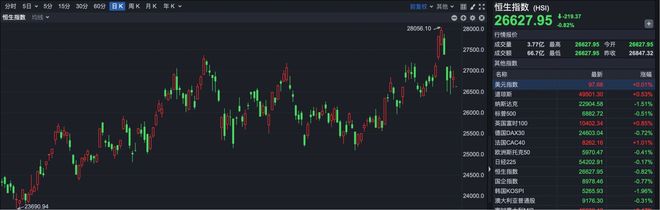
Market Overview - The Hong Kong stock market opened lower today, with the Hang Seng Index starting at 26,627.95 points, down 219.37 points, a decline of 0.82% [2][3] - The Hang Seng Technology Index opened at 5,295.89 points, decreasing by 70.55 points, a drop of 1.31% [2][3] Company Performance - Yum China (HK09987) reported strong annual results for 2025, with operating profit reaching $1.3 billion, reflecting an 11% year-on-year growth. The company opened 1,706 new stores, expanding its network to 18,101 locations across over 2,500 towns in China. In Q4 2025, operating profit surged by 25%, with same-store sales increasing for the third consecutive quarter [5][7] - Lee & Man Paper (HK02314) is expected to achieve a profit of approximately HKD 1.88 billion to HKD 2.00 billion in 2025, representing a year-on-year growth of 38% to 47% [7] - ZTO Express (HK02057) anticipates total revenue for 2025 to be between RMB 48.5 billion and RMB 50 billion, indicating a year-on-year growth of about 9.5% to 12.9%, primarily due to an increase in parcel volume [7] - Baidu Group (HK09888) announced a new share buyback plan, allowing for the repurchase of up to $5 billion in shares, effective until December 31, 2028. The board also expects to declare its first dividend in 2026, supported by sustainable funding sources [7] Market Sentiment - The market is currently experiencing a significant style rotation, with a clear "seesaw" effect between the previously strong technology growth sector and dividend value styles. The dividend sector is regaining its appeal due to its high yield and low valuation advantages after a prior correction [9] - The ongoing accommodative monetary policy and emerging cyclical recovery expectations, along with the demand for allocation from long-term funds like insurance, suggest that the Hong Kong stock market's dividend sector has clear investment value. A market style rebalancing combined with fundamental improvements is anticipated to create a "Davis Double Play" effect [9]

港股餐饮股逆势上涨,九毛九、海底捞涨近4%
Jin Rong Jie· 2026-02-05 02:05
Group 1 - The Hong Kong stock market's restaurant sector is experiencing an upward trend ahead of the Spring Festival holiday, with notable increases in stock prices [1] - Yum China has seen a rise of over 7%, while Tsui Wah Holdings has increased by more than 4% [1] - Other companies such as Jiumaojiu and Haidilao have also reported gains of nearly 4%, and Shanghai Xiaonan Guo has risen by nearly 3% [1]

港股百胜中国盘初大涨超8%
Jin Rong Jie· 2026-02-05 01:57
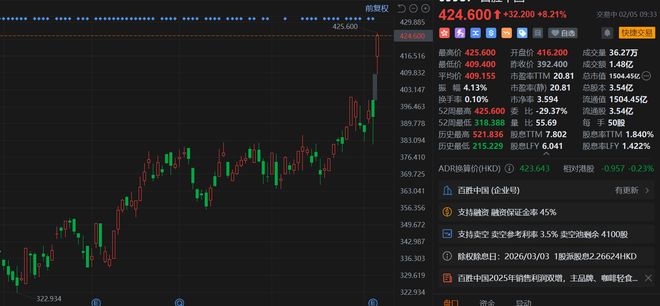
本文源自:金融界AI电报 百胜中国(9987.HK)盘初大涨超8%,现报424.6港元刷新阶段新高,总市值超1500亿港元。 ...
百胜中国早盘涨超7% 去年四季度同店销售额增长3%
Xin Lang Cai Jing· 2026-02-05 01:57
Core Viewpoint - Yum China (09987) reported a revenue increase of 4% year-on-year for the fiscal year 2025, reaching $11.797 billion, with a net profit growth of 2% to $929 million, and earnings per share of $2.52 [1] Financial Performance - Total revenue for Q4 was $2.823 billion, reflecting a 9% year-on-year increase, while net profit rose by 22% to $140 million, with earnings per share of $0.40 [1] - Operating profit increased by 25% to $187 million during the same quarter [1] - Same-store sales grew by 3%, marking the third consecutive quarter of growth [1] Expansion Plans - The company opened 1,706 new stores in 2025, expanding its network to 18,101 locations across over 2,500 towns in China [1] - For 2026, the company aims to exceed 20,000 total stores, with a net addition of over 1,900 stores [1] - The proportion of franchise stores among new openings for KFC and Pizza Hut reached 40%-50% [1] Capital Expenditure and Shareholder Returns - Capital expenditure is projected to be between $600 million and $700 million [1] - The company plans to return $1.5 billion to shareholders [1]
港股异动丨百胜中国盘初大涨超8% Q4营业利润跃升25% 门店总数突破1.8万家
Xin Lang Cai Jing· 2026-02-05 01:44
来源:格隆汇APP 另外,公司2025年向股东回馈15亿美元,计划2026年继续回馈15亿美元,普通股每股现金股息增加21% 至0.29美元。 受业绩利好影响,百胜中国(9987.HK)盘初大涨超8%,现报424.6港元刷新阶段新高,总市值超1500亿港 元。 消息上,百胜中国宣布2025年第四季度系统销售额同比增长7%;同店销售额同比增长3%,连续第三个 季度实现增长;同店交易量连续第12个季度实现增长,经营利润增长25%。全年总收入同比增长4%至 118亿美元;经营利润同比增长11%至13亿美元;经营利润率同比增长60个基点至10.9%,剔除特殊项目 后,为公司美国上市以来新高。全年净新增门店1,706家,门店总数达18,101家。 ...
港股异动 | 百胜中国(09987)高开逾6% 去年四季度同店销售额增长3% 经营利润增长25%
Zhi Tong Cai Jing· 2026-02-05 01:44
Core Viewpoint - Yum China (09987) experienced a significant stock increase of over 6%, reflecting positive financial results and growth in same-store sales for the fourth quarter of the previous year [1] Financial Performance - Total revenue for 2025 reached $11.797 billion, marking a 4% year-over-year increase [1] - Net profit stood at $929 million, a 2% growth compared to the previous year, with earnings per share (EPS) at $2.52 [1] - The company declared a dividend of $0.29 per share [1] - In the fourth quarter alone, total revenue was $2.823 billion, up 9% year-over-year [1] - Net profit for the fourth quarter was $140 million, reflecting a 22% increase, with EPS at $0.40 [1] - Operating profit grew by 25% to $187 million during the fourth quarter [1] - Same-store sales increased by 3%, achieving growth for the third consecutive quarter [1] Expansion Plans - The company opened 1,706 new stores in 2025, expanding its network to 18,101 locations across over 2,500 towns in China [1] - For 2026, the company aims to exceed 20,000 total stores, with a net addition of over 1,900 stores [1] - Franchise stores accounted for 40%-50% of the net new stores for both KFC and Pizza Hut [1] Capital Expenditure and Shareholder Returns - Capital expenditure is projected to be between $600 million and $700 million [1] - The company plans to return $1.5 billion to shareholders [1]
全球大公司要闻 | 英伟达200亿注资OpenAI,Alphabet谷歌云收入增48%
Wind万得· 2026-02-05 01:42
Group 1 - Alphabet's Q4 revenue reached $113.83 billion, a year-on-year increase of 18%, with Google Cloud revenue at $17.66 billion, up 48% [2] - Nvidia plans to invest $20 billion in OpenAI, potentially its largest single investment, and aims to participate in another funding round before OpenAI's IPO [2] - Eli Lilly reported Q4 revenue of $19.292 billion, a 43% increase year-on-year, with net profit rising 50% to $6.636 billion [2] Group 2 - Alibaba's Jack Ma was seen at the company's headquarters focusing on AI business development, raising market interest in Alibaba's AI strategy [4] - JinkoSolar announced a stock price deviation of 30% over three trading days, clarifying that it has no undisclosed major information and remains focused on ground photovoltaic business [4] - China Shipbuilding Defense signed contracts for 16 box ship constructions valued between $736 million and $896 million, indicating strong competitiveness in shipbuilding [4] Group 3 - Yum China reported Q4 revenue of $2.82 billion, an 8.8% year-on-year increase, with adjusted EPS at $0.4, up from $0.3 [5] - Hong Kong Stock Exchange's CEO stated that the IPO market is not facing a "logjam," with sufficient funds available for new listings [5] - TSMC plans to produce 3nm chips in Kumamoto, Japan, enhancing its global competitiveness in advanced manufacturing [6] Group 4 - Apple partnered with Alphabet to use it as its preferred cloud service provider, with plans to release new products in 2026 [8] - Amazon's AI assistant Alexa+ is now available to all U.S. users, with plans to invest in OpenAI and accelerate film production using AI [8] - Tesla's Shanghai factory delivered 69,129 vehicles in January, a 9% year-on-year increase, despite a significant drop in sales in the UK market [8] Group 5 - Samsung Electronics' market value surpassed 1 trillion KRW (approximately $688 billion), benefiting from a super cycle in memory chips [11] - Toyota raised its global vehicle production target for 2028 to 11.3 million units, a 10% increase from 2026 [11] - SK Hynix announced record performance bonuses for employees, reflecting strong market conditions and rising NAND prices [11] Group 6 - Amundi plans to reduce exposure to U.S. dollar assets due to concerns over U.S. policy changes, suggesting a shift towards European and emerging markets [14] - Nestlé's CEO plans to restructure the company, focusing on core businesses and divesting non-core assets to boost growth [14] - BMW Group announced plans to launch around 20 new models by 2026, emphasizing electric vehicle development and partnerships [14]




百胜中国高开逾6% 去年四季度同店销售额增长3% 经营利润增长25%
Zhi Tong Cai Jing· 2026-02-05 01:28
Core Viewpoint - Yum China (09987) reported a total revenue of $11.797 billion for the fiscal year 2025, reflecting a year-on-year increase of 4% [1] - The company achieved a net profit of $929 million, up 2% from the previous year, with earnings per share (EPS) of $2.52 [1] Financial Performance - For Q4, total revenue reached $2.823 billion, representing a 9% year-on-year increase [1] - Net profit for Q4 was $140 million, a significant growth of 22%, with EPS of $0.40 [1] - Operating profit increased by 25% to $187 million during the same quarter [1] - Same-store sales grew by 3%, marking the third consecutive quarter of growth [1] Expansion Plans - In 2025, the company opened 1,706 new stores, expanding its network to 18,101 locations across over 2,500 towns in China [1] - For 2026, the company aims to exceed 20,000 total stores, with a net addition of over 1,900 stores [1] - The proportion of franchise stores among new openings for KFC and Pizza Hut reached 40%-50% [1] Capital Expenditure and Shareholder Returns - Capital expenditure is projected to be between $600 million and $700 million [1] - The company plans to return $1.5 billion to shareholders [1]
券商晨会精华 | AI Agent正处于从技术积累到规模化爆发的0-1关键阶段
智通财经网· 2026-02-05 00:32
Market Overview - The market rebounded yesterday, with the Shanghai Composite Index returning to 4100 points and the Shenzhen Component Index turning positive after a drop of over 1% earlier. The ChiNext Index narrowed its losses in the afternoon. The total trading volume in the Shanghai and Shenzhen markets was 2.48 trillion yuan, a decrease of 63.3 billion yuan from the previous trading day. Over 3200 stocks rose in the market, with coal, space photovoltaic, and airport shipping sectors seeing significant gains, while AI applications, precious metals, and computing hardware sectors experienced notable declines. By the close, the Shanghai Composite Index rose by 0.85%, the Shenzhen Component Index increased by 0.21%, and the ChiNext Index fell by 0.4% [1]. AI Industry Insights - Changjiang Securities believes that the AI Agent is at a critical 0-1 stage, transitioning from technological accumulation to large-scale explosion. The competition in the AI industry has focused on traffic entry, with edge models becoming the core breakthrough. AI Agents are evolving into personal assistants with autonomous analysis and problem-solving capabilities, breaking the limitations of traditional tools. The synergy of AI smartphones, AIPC, and AI glasses is creating a comprehensive edge AI ecosystem covering various scenarios such as daily office work and smart travel. The industry is supported by policy, technological breakthroughs, and market demand, making it a favorable time for the AI edge sector [1]. Restaurant Industry Outlook - Citic Securities indicates that the restaurant industry is currently in a phase of multiple turning points, with a potential recovery in valuation. The industry is experiencing marginal improvements in fundamentals, ongoing policy support, price mechanism recovery, and expected valuation increases. Since the second half of 2025, retail dining revenue and same-store performance in major restaurant segments have shown continuous recovery, coupled with a slowdown in supply expansion and reduced competition intensity, creating a more favorable external environment for business recovery and profit improvement. The restaurant sector is positioned as a clear beneficiary of consumption stimulus policies due to its high frequency, strong scenarios, and short decision-making chains. The national push for reasonable price recovery is leading to price adjustments by restaurant companies, with historical data suggesting that cost disturbances are more likely to have a temporary impact, allowing for a potential mid-to-long-term recovery in gross margins. Valuation improvements in the restaurant sector are often driven by improved inflation expectations, aligning with overseas experiences [2]. Home Appliance Industry Analysis - Citic Jiantou notes that the home appliance sector is expected to underperform the CSI 300 index in 2025 due to tariff increases, fluctuations in the old-for-new policy, and high base expectations in the second half of the year. From a long-term perspective, the competitiveness of companies will ultimately return to the essence of product innovation and efficiency advantages. Therefore, from an investment standpoint, there are two main lines: first, overseas expansion will continue to be the most important source of growth; second, the benefits of transformation [3].
美股收盘:三大股指走势分化,科技股“折戟”,贵金属“逆袭”
Jin Rong Jie· 2026-02-05 00:18
Group 1: US Stock Market Performance - On February 5, US tech stocks experienced a significant decline, with the Nasdaq Composite dropping over 2% during intraday trading, casting a shadow over the market [1] - The three major US indices closed mixed, with the Dow Jones Industrial Average rising 0.53%, while the Nasdaq fell 1.51% and the S&P 500 decreased by 0.51% [1] - Notable tech stocks faced substantial losses, with AMD's stock plummeting over 17% after its Q1 earnings outlook fell short of analysts' expectations; other tech giants like Nvidia, Tesla, and Meta also saw declines exceeding 3% [1] Group 2: Performance of Chinese Stocks - The Nasdaq Golden Dragon China Index also performed poorly, closing down 1.95%, with popular Chinese stocks generally declining [1] - Bilibili's stock fell over 6%, Baidu dropped more than 4%, and Alibaba, NIO, and Xpeng all saw declines exceeding 2%; however, Li Auto and Bawang Tea experienced gains of over 1% [1] Group 3: Precious Metals Market - In contrast to the US tech stocks, international gold prices surged on February 5, with COMEX gold futures rising 1.04% to $4986.4 per ounce, and silver futures increasing by 5.36% to $87.765 per ounce [2] - Spot gold and silver also saw significant increases, with spot gold rising over 1% and spot silver climbing more than 1.6% [2] Group 4: Economic Data and Federal Reserve Policy - The ADP reported that the US private sector added only 22,000 jobs in January, significantly below the Dow Jones economists' forecast of 45,000, indicating a weak job market [2] - The delay in the release of the January employment report and the Consumer Price Index (CPI) report by the Bureau of Labor Statistics has added uncertainty to the market, with investors closely monitoring upcoming economic data and Federal Reserve policy adjustments [2]