金融业

Search documents
2025年11月中国企业信用指数较10月上升1.11点 攀升至下半年峰值
Bei Jing Shang Bao· 2025-12-23 10:17
Core Insights - The corporate credit index in China reached 162.66 in November 2025, marking an increase of 1.11 points from October, indicating a positive change in corporate credit levels amid stable economic growth [1] Industry Summary - Nearly 80% of industries experienced a month-on-month increase in their credit indices, with the top five performing sectors being finance, manufacturing, water conservancy, environmental and public facilities management, and electricity, heat, gas, and water production and supply [1] - The credit index for the resident services, repair, and other service industries saw the highest growth among all sectors, while the manufacturing sector ranked second in terms of credit index growth [1] - The real estate industry has maintained a month-on-month increase in its credit index for four consecutive months, indicating a recovery trend in credit levels [1] Regional Summary - The top five provinces in terms of credit index rankings are Anhui, Shaanxi, Tianjin, Shandong, and Chongqing, with Shandong making its first appearance in the national top five in 2025 [1]
新疆证监局实现走访全覆盖 助力辖区上市公司高质量发展
Zheng Quan Shi Bao Wang· 2025-12-22 08:10
Core Viewpoint - The Xinjiang Securities Regulatory Bureau is actively engaging with listed companies to enhance their quality and promote stable capital markets and high-quality economic development through regular visits and tailored support [1][2]. Group 1: Organizational Leadership and Coordination - A normalized work mechanism for joint visits has been established, clarifying responsibilities and streamlining processes to create an efficient collaborative framework [1]. - The approach includes a full-chain closed-loop management system for addressing company feedback, ensuring timely responses and follow-ups on issues raised by enterprises [1]. Group 2: Problem Identification and Resolution - Since the beginning of 2024, 61 listed companies have been visited, covering key industries such as manufacturing, mining, finance, and information technology, ensuring comprehensive outreach [2]. - Direct engagement with companies has led to the identification of 54 resolved issues related to industrial policy alignment, financing channels, and operational support [2]. Group 3: Policy Communication and Development Promotion - The bureau is focused on interpreting major policy directions and promoting compliance with regulations, encouraging companies to leverage policy opportunities for growth and innovation [2]. - Key regulatory points are communicated through policy interpretation, case analysis, and interactive Q&A sessions, guiding companies to enhance their investment value and operational transparency [2]. Group 4: Integration with Local Economic Activities - The Xinjiang Securities Regulatory Bureau is integrating company visits with local economic initiatives, enhancing capital market services to support regional economic development [3]. - Future efforts will continue to strengthen the visit mechanism, balancing regulation and service to effectively address enterprise needs and challenges [3].
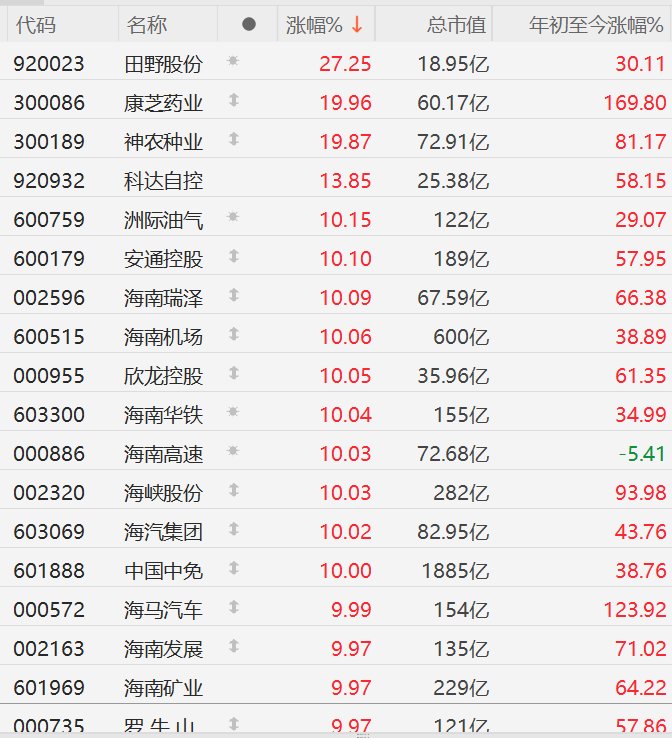
海南板块掀涨停潮,中国中免等超20股涨停
Ge Long Hui· 2025-12-22 02:54
Group 1 - The core viewpoint of the news is that the launch of the Hainan Free Trade Port's full island closure operation has led to a significant surge in stock prices within the Hainan sector, with over 20 stocks hitting the daily limit up, indicating strong market optimism [1][2] - On December 18, the first day of the closure, Sanya's duty-free market showed robust performance, with total sales reaching 118 million yuan, and a customer flow of over 36,000, reflecting a year-on-year increase of over 60% in foot traffic and an 85% increase in sales [1] - The Hainan Free Trade Port policy is characterized by "zero tariffs, low tax rates, and simplified tax systems," which significantly reduces operational costs for businesses and is expected to attract high-end manufacturing, aviation logistics, and digital economy industries to the region [2] Group 2 - The report from CITIC Securities highlights that the Hainan closure policy is a crucial part of China's new round of reform and opening-up, with unprecedented levels of institutional design and policy coverage [2] - The financial sector in Hainan is adopting a regulatory model of "freeing up the first line and controlling the second line," facilitating cross-border capital flow, and the establishment of the EF account system is seen as an upgrade for financial openness [2] - Hainan's relaxed immigration policies and talent introduction plans are expected to optimize the population structure and accelerate urbanization, providing strong support for the construction of the Free Trade Port [2]



海南封关首日,网友热议:大输家可能不是李嘉诚,而是霍氏家族?
Sou Hu Cai Jing· 2025-12-20 23:36
Core Viewpoint - The opening of Hainan Free Trade Port marks a significant shift in China's approach to foreign trade, impacting various stakeholders, particularly the Ho family and Li Ka-shing [1][22]. Group 1: Impact on Li Ka-shing - Li Ka-shing has strategically divested from mainland China and Hong Kong assets, selling properties at significant discounts, including a HKD 5 billion sale of his long-held residence [5][7]. - Over the past decade, Li has liquidated over HKD 250 billion in assets, reducing his exposure in China from 75% to 15%, while investing approximately USD 30 billion in Southeast Asia [5][7]. - The retail sector in Hong Kong is projected to decline by 7.3% in 2024, while Hainan's duty-free sales have surpassed RMB 100 billion, indicating a shift in consumer spending [7][15]. Group 2: Challenges for the Ho Family - The Ho family, having invested heavily in Nansha since the 1980s, faces strategic challenges as the focus of national policy shifts away from trade towards digital technology and cultural tourism [3][11]. - The value of Ho family's land in Nansha, previously estimated at RMB 300 billion, is likely to decrease due to the diversion of trade functions to Hainan [13][20]. - Internal family disputes regarding the Nansha project have surfaced, complicating asset management and highlighting differing views on the project's future [13][20]. Group 3: Policy Changes and Economic Implications - The expansion of the "zero tariff" policy to approximately 6,600 product categories enhances Hainan's connectivity with international markets, posing challenges to Hong Kong's traditional advantages [3][15]. - The Hainan Free Trade Port is positioned as a key element in China's broader strategy for high-level openness, complementing the development of the Guangdong-Hong Kong-Macao Greater Bay Area [22]. - Collaborative efforts between Hainan and Hong Kong aim to leverage mutual strengths, with Hainan focusing on trade and Hong Kong enhancing its international financial services [16][18].

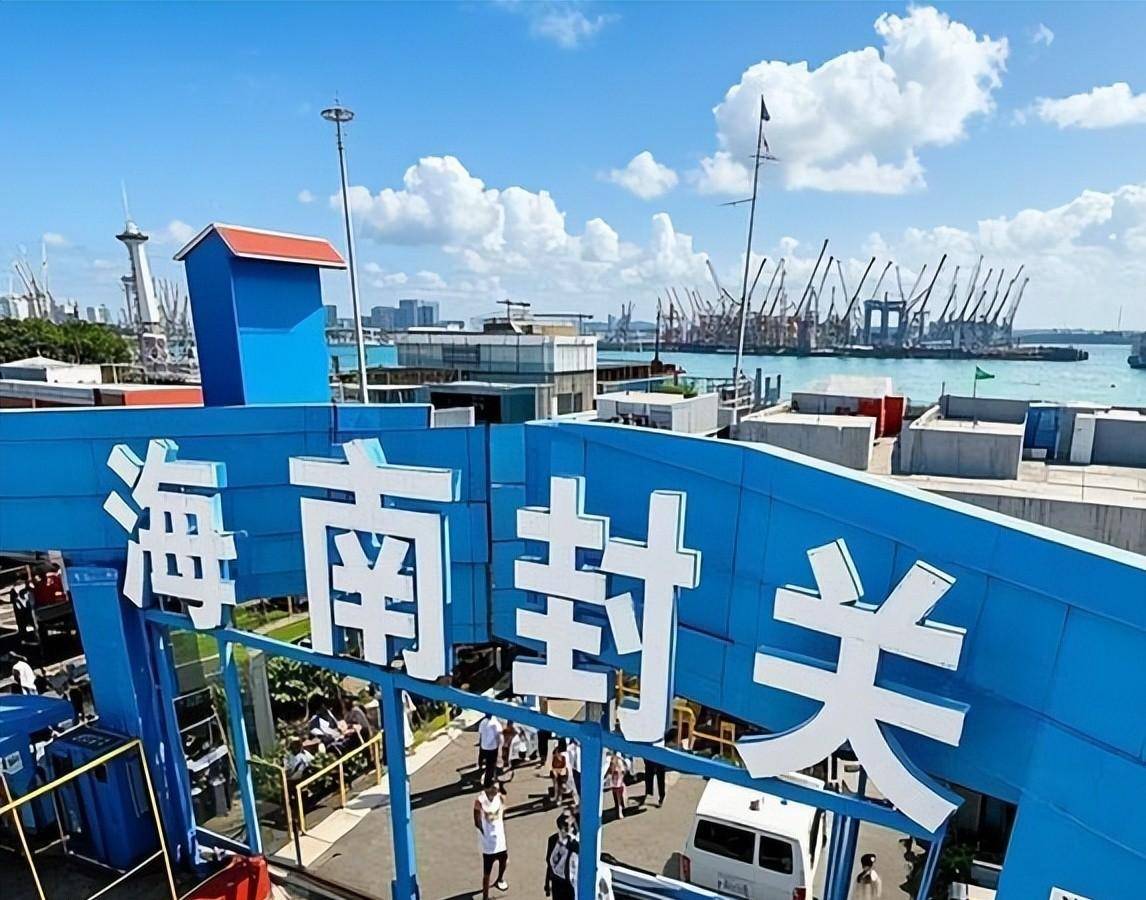
当海南成为自贸港:新加坡为何开始“选边站”?
Sou Hu Cai Jing· 2025-12-20 17:11
Core Insights - The Hainan Free Trade Port is undergoing significant institutional changes, with a focus on implementing a "zero tariff" policy that has expanded from 21% to 74% of goods, covering approximately 6,600 tax items, posing a challenge to Singapore's regional hub status [1][3]. Policy Changes - Hainan officially launched its full island closure operation on December 18, marking a strategic shift initiated five years ago with the release of the Hainan Free Trade Port Construction Overall Plan in June 2020 [3]. - The province has expanded its duty-free processing policy from the Yangpu Free Trade Port Area to the entire region, with 129 pilot enterprises approved by October 2025 [3]. - Hainan has introduced a negative list for cross-border data flow management, facilitating unique digital economy cooperation models such as "game exports" [3]. Economic Performance - Hainan's annual average growth rate for goods trade has reached 31.3%, significantly surpassing the national average, while actual foreign investment has grown at an annual rate of 14.6%, also above the national average [5]. - The geographical advantage of Hainan as the nearest maritime exit for Southwest and Northwest China allows for an average time savings of about 10 days compared to routes from Eastern China [6]. Competitive Landscape - Hainan is positioned as the shortest port route from China to Southeast Asia, as well as to Africa, Europe, and Oceania, directly challenging Singapore's traditional hub status [7]. - The competition has expanded into various sectors, including shipping, where the "China Yangpu Port" has registered 73 international vessels with a total capacity of 7.1631 million deadweight tons [8]. Financial Sector Developments - Hainan's multi-functional free trade account policy is being optimized, with innovative measures such as "one line open, two lines managed" and limited cross-border management for same-name accounts [9]. - The annual duty-free shopping limit for Hainan has been raised to 100,000 yuan per person, with total duty-free shopping exceeding 200 billion yuan by the end of August 2025, enhancing its competitiveness in attracting regional consumption [9]. Future Outlook - Post-closure, Hainan is expected to save approximately 20% in tax costs for imported equipment, with customs facilitating the clearance of "zero tariff" and bonded goods, significantly improving efficiency [10]. - Hainan's policies are expected to strengthen its appeal for high-end manufacturing and modern service industries, while Singapore is attempting to solidify its economic influence in Southeast Asia through deeper cooperation with Japan [11]. - Hainan's strategy includes establishing commercial cooperation platforms targeting Thailand, Malaysia, Singapore, and Indonesia, contrasting with Singapore's "choosing sides" approach [11].

中信建投:海南有望成为产业迁移的热土
Zheng Quan Shi Bao Wang· 2025-12-19 00:49
Core Viewpoint - The Hainan closure policy is a significant initiative in China's new round of reform and opening-up, characterized by unprecedented depth in institutional design and broad policy coverage [1] Group 1: Policy Framework - Hainan's free trade port policy system is built on "zero tariffs, low tax rates, and simplified tax systems," which significantly reduces operational costs for enterprises [1] - The financial sector in Hainan adopts a regulatory model of "freeing up the first line and controlling the second line," facilitating the liberalization and convenience of cross-border capital flows [1] - The establishment of the EF account system provides an upgraded infrastructure for financial openness [1] Group 2: Economic Opportunities - The policy dividends are expected to make Hainan a hotspot for industrial migration, with high-end manufacturing, air logistics, and digital economy industries likely to cluster in the region, creating new economic growth points [1] - Hainan's measures to relax visa policies and optimize the tourism environment effectively stimulate overseas consumption and enhance its status as an international tourism consumption center [1] Group 3: Demographic Changes - The relaxation of household registration policies and talent introduction plans in Hainan significantly promote population structure optimization and urbanization processes [1] - The influx of high-quality talent provides strong support for the construction of Hainan's free trade port [1] Group 4: Challenges and Future Outlook - The Hainan closure policy faces risks and challenges from deteriorating international economic and trade relations and rising global trade protectionism, which may restrict population migration [1] - Overall, the Hainan closure policy is expected to significantly enhance Hainan's position in the global value chain and inject new momentum into China's high-quality economic development [1] - Hainan needs to continue deepening policy implementation, strengthening risk prevention, and promoting the continuous achievement of new results in free trade port construction [1]

11月进出口额同比增长4.3% | 高频看宏观
Sou Hu Cai Jing· 2025-12-18 13:29
Economic Activity Index - The China High-Frequency Economic Activity Index (YHEI) as of December 16, 2025, is 1.05, a decrease of 0.09 from December 9, 2025. The decline is attributed to drops in the "coastal coal transportation price index" and "import dry bulk freight index" by 0.23 and 0.05 respectively [1][3]. Consumption Data - In November, the total retail sales of consumer goods reached 43,898.0 billion yuan, with a year-on-year growth rate of 1.3%, down 1.6 percentage points from the previous month. Retail sales of goods grew by 1.0%, and catering revenue increased by 3.2% [24][25]. - The proportion of online retail sales of physical goods in total retail sales decreased from 26.7% in the same period last year to 25.9% [24]. Foreign Trade - In November, the total import and export value was 549.025 billion USD, showing a year-on-year increase of 4.3% after a brief period of negative growth. Exports and imports grew by 5.9% and 1.9% respectively, with the trade surplus increasing by 20.68 percentage points year-on-year to 14.74% [24][25]. Industrial Production - The industrial added value for large-scale industries grew by 4.8% year-on-year in November, a decrease of 0.1 percentage points from the previous month. High-tech industries saw an increase of 8.4%, up 1.2 percentage points from the previous month [25]. - The mining sector's added value growth rose from 4.5% to 6.3%, while manufacturing and electricity, gas, and water supply sectors saw declines to 4.6% and 4.3% respectively [25]. Monetary Policy - As of December 16, 2025, the central bank's net fund injection through open market operations was 55.6 billion yuan, with a reverse repurchase amount of 695.1 billion yuan and an expiration of 639.5 billion yuan. The 7-day reverse repurchase rate stood at 1.4% [5][10]. Interest Rates - The overnight interbank rate decreased by 3 basis points to 1.37%, while the 7-day repurchase rate remained stable at 1.50%. The 1-year and 5-year swap rates were consistent with previous levels at 1.54% and 1.63% respectively [10][15]. Real Estate Market - In the week ending December 16, 2025, new and second-hand housing transaction areas in first-tier cities increased by 22.62% and 9.18% respectively. In second-tier cities, the increases were 8.98% and 6.56%, while third-tier cities saw increases of 38.5% and 14.78% [35][41]. Shipping and Logistics - The China Coastal Bulk Freight Index (CCBFI) decreased by 66.79 points to 1,058.23 points, while the Baltic Dry Index fell by 353 points to 2,204 points. The China Export Container Freight Index (CCFI) rose by 3.18 to 1,118.07 [33][42].

恒指公司:恒生指数有望录得2017年以来最佳年度表现 金融业为最大贡献行业
智通财经网· 2025-12-18 12:01
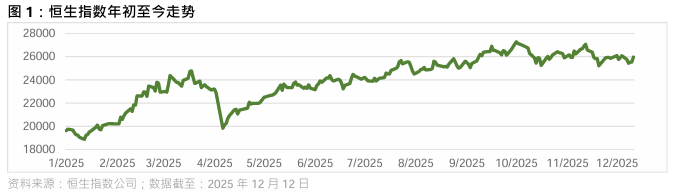
Group 1 - The Hang Seng Index (HSI) is expected to have one of its best performances in the past decade in 2025, driven by record inflows from the Stock Connect, optimism about the future of artificial intelligence, and interest rate cuts [1][4] - As of December 12, 2025, the HSI has recorded a year-to-date increase of 29%, primarily driven by the financial, information technology, and consumer discretionary sectors [1][4] - The financial sector has been the largest contributor to the HSI's performance this year, accounting for 40% of the index's increase, with a contribution of 2,389 points [4] Group 2 - The HSI was launched in November 1969 and has become a globally recognized benchmark for the Hong Kong stock market, with a total of 16 exchange-traded products (ETPs) tracking the index, managing assets worth $23.5 billion as of November 2025 [3] - The number of constituent stocks in the HSI has increased to 89 following the latest index review on December 8, 2025, moving towards a target of 100 constituent stocks [3] - Alibaba (09988) has been the largest contributor to the HSI's performance this year, driving an increase of 1,332 points, which represents 23% of the overall increase [6]



每日投资策略-20251218
Zhao Yin Guo Ji· 2025-12-18 03:00
Macro Economic Overview - The US economy shows signs of slight weakening in employment, with October non-farm payrolls significantly declining due to the end of government layoffs, although private employment continues to expand [2] - November non-farm payrolls rebounded better than market expectations, primarily in construction, healthcare, and education services, while the unemployment rate unexpectedly rose to 4.6%, the highest in nearly four years [2] - The overall job market is weakening but not severely deteriorating, with initial and continuing claims for unemployment benefits showing slight improvement [2] - The economic growth rate and unemployment rate are expected to stabilize by 2026, with inflation anticipated to decrease before rising again, and the Federal Reserve may lower interest rates once in June [2] Global Market Performance - The Hang Seng Index closed at 25,469, up 0.92% year-to-date, while the Hang Seng Tech Index rose 1.03% [2] - The Shanghai Composite Index increased by 1.19%, and the Shenzhen Composite Index saw a rise of 1.68% [2] - In the US, the Dow Jones fell by 0.47%, and the S&P 500 decreased by 1.16%, while the Nasdaq dropped by 1.81% [2] - The DAX in Germany and CAC in France also experienced slight declines, while the FTSE 100 in the UK rose by 0.92% [2] Sector Performance in Hong Kong - The Hong Kong stock market saw a rebound, with materials, information technology, and financial sectors leading the gains, while utilities, telecommunications, and real estate lagged [4] - Southbound capital recorded a net inflow of HKD 7.909 billion, with Xiaomi, Meituan, and Alibaba being the top net purchases, while China Mobile and CNOOC saw significant net sales [4] - The Hang Seng Financial Index rose by 1.03% year-to-date, while the Hang Seng Industrial Index increased by 0.94% [3] Chinese Market Developments - The Chinese market regulatory authority warned that requiring merchants to offer "lowest prices online" could constitute monopoly behavior, encouraging platform companies to develop algorithm screening to prevent algorithmic monopolies [4] - The Hainan Free Trade Port is set to launch full island closure, focusing on "one line open, one line controlled" to promote trade and investment liberalization, significantly reducing business operating costs [4] US Market Insights - The US stock market continued to decline, with technology, industrial, and communication services sectors leading the losses, while energy, consumer staples, and materials sectors saw gains [4] - The AI sector faced continued sell-offs, with Nvidia and Caterpillar experiencing significant declines [4] - The Federal Reserve's latest survey indicated that CFOs expect a 4.2% increase in US prices next year, significantly higher than the Fed's forecast of inflation returning close to 2% [4]
南向资金持股偏好:聚焦医疗保健、工业与金融,AH股占比过半
Jin Rong Jie· 2025-12-18 02:21
Group 1 - As of December 17, the total shareholding of southbound funds in Hong Kong Stock Connect stocks accounts for 19.33% of the total share capital, with a total market value of HKD 60,627.61 billion [1] - There are 247 stocks where the shareholding ratio of southbound funds exceeds 20% [1] Group 2 - China Telecom has the highest shareholding ratio at 72.27%, followed by Gree Power and China Gas with 70.08% and 69.75% respectively [3] - The stocks with high southbound fund holdings are primarily concentrated in the healthcare, industrial, and financial sectors, with 56, 36, and 34 stocks respectively [3] - Over half of the stocks with high southbound fund holdings are AH concept stocks, with 128 out of the 247 stocks also listed in mainland China and Hong Kong, representing 51.82% [3]