
零食

Search documents
好想你跌2.04%,成交额5.42亿元,主力资金净流入642.02万元
Xin Lang Cai Jing· 2026-01-07 01:56
Core Viewpoint - The company "好想你" has experienced fluctuations in stock performance and financial metrics, with a notable decrease in revenue but a significant increase in net profit year-over-year. Financial Performance - As of January 7, the stock price of 好想你 decreased by 2.04% to 11.52 CNY per share, with a total market capitalization of 5.158 billion CNY [1] - For the period from January to September 2025, the company reported a revenue of 1.062 billion CNY, a year-on-year decrease of 9.77%, while the net profit attributable to shareholders was -4.7088 million CNY, showing a year-on-year increase of 92.24% [2] Shareholder Information - As of September 30, 2025, the number of shareholders decreased by 20.94% to 46,300, while the average number of circulating shares per person increased by 26.49% to 7,432 shares [2] - The company has distributed a total of 1.638 billion CNY in dividends since its A-share listing, with 921 million CNY distributed over the past three years [3] Institutional Holdings - The second-largest circulating shareholder is 兴全商业模式混合(LOF)A, holding 22.3161 million shares, unchanged from the previous period [3] - 兴全新视野定期开放混合型发起式 has increased its holdings by 188,400 shares to 17.7729 million shares, while 招商优势企业混合A is a new shareholder with 6 million shares [3]

2025年零售圈十大收购事件发布
Tai Mei Ti A P P· 2026-01-06 13:14
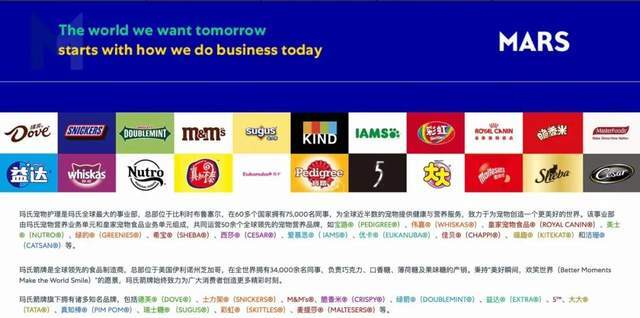
Core Insights - The retail industry experienced a significant wave of mergers and acquisitions in 2025, indicating a major capital reshuffle within the sector [1][27] - Major companies are either divesting non-core assets to focus on their main businesses or acquiring new brands to expand their portfolios [1][27] - Private equity firms are playing a crucial role in driving brand transformation and expansion in the retail sector [1][27] Group 1: Major Mergers and Acquisitions - Alibaba divested its stake in Suning and Intime Retail, marking a strategic shift to optimize resource allocation [3][26] - Mars, Incorporated completed the acquisition of Kellanova for approximately $35.9 billion, creating a global snack empire [5][7] - KKR acquired an 85% stake in Vista International, which is linked to the domestic beverage brand Da Yao, enhancing its control over the Chinese soda market [9][10] Group 2: Strategic Adjustments and Performance - After KKR's acquisition, Gao Xin Retail reported a revenue of 71.55 billion yuan, with a net profit of 386 million yuan, marking a turnaround from previous losses [4] - The acquisition of Kellanova by Mars is one of the largest in the packaged food sector in the last decade, highlighting the trend of consolidation among food giants [7][8] - CPE Yuanfeng's acquisition of Burger King China aims to accelerate local expansion with a commitment to invest $350 million [16][17] Group 3: Industry Trends and Future Outlook - The retail sector is shifting from scale expansion to lean operations, focusing on supply chain and brand value [2][27] - The relationship between brands and capital is evolving from mere financial support to active operational involvement, indicating a search for sustainable growth [27] - The ongoing mergers and acquisitions signal a re-evaluation of the value of physical retail, with supply chain and product strength becoming central to competition [27]


2025年食品行业并购盘点:从万辰的“联邦”到涪陵的“败局”,有钱花不出去的“大厂”与被榨干的效率
3 6 Ke· 2026-01-06 05:36
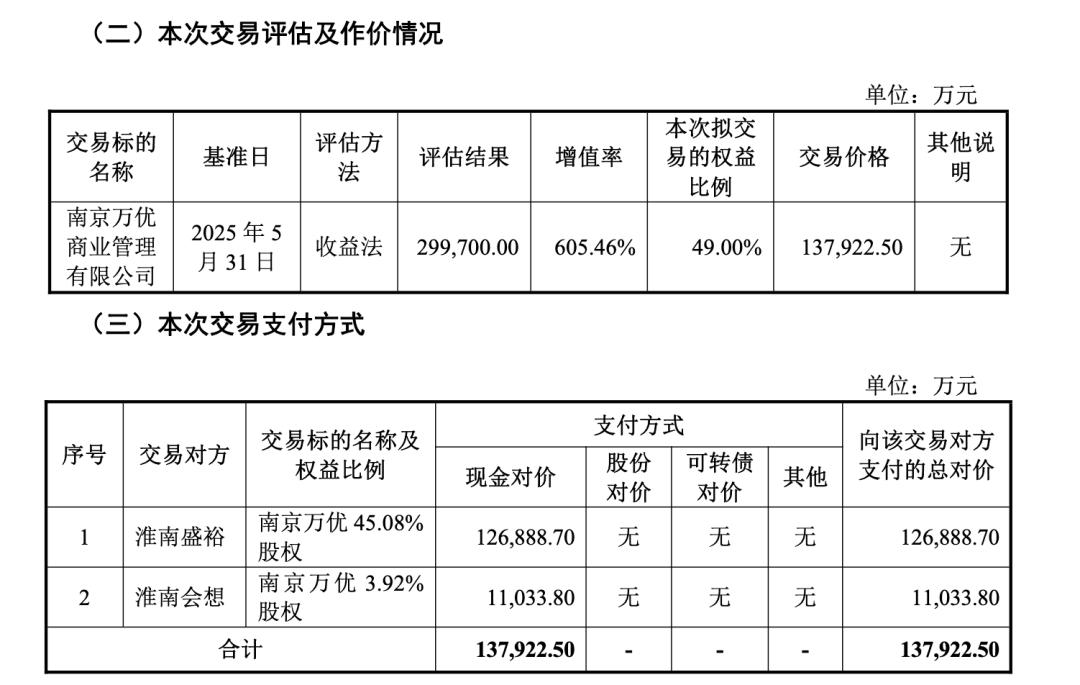
Core Insights - The mergers and acquisitions (M&A) in the Chinese food industry in 2025 are characterized by a focus on necessary integrations rather than large-scale deals, reflecting a shift towards survival in a saturated market [1] Group 1: Snack Industry Developments - Wanchen Group has transformed from a grassroots brand into a significant capital player, acquiring 49% of Nanjing Wanyou for 1.379 billion yuan, which is crucial for its brand integration strategy [2][3] - Nanjing Wanyou, under the "Good Idea" brand, generated 4.1 billion yuan in revenue in the first five months of 2025, highlighting its importance in Wanchen's portfolio [2] - The rapid expansion strategy of Wanchen has slowed significantly, with daily store openings dropping from 26 to less than 7, indicating market saturation and operational challenges [4] Group 2: Dairy Industry Trends - New Hope Dairy's acquisition of Fuzhou Aoni has taken six years to finalize, reflecting a cautious approach in a changing dairy market [7][9] - The acquisition is seen as a strategic move to solidify New Hope's presence in the southern market, but the company has shifted its focus from aggressive acquisitions to more sustainable growth strategies [9] - Junyao Health has adopted a different strategy by acquiring Runying Biotechnology, focusing on probiotic products, which saw a 60% revenue increase in the first three quarters of 2025 [9][10] Group 3: New Tea Beverage Sector - Mixue Ice City has made headlines by acquiring a 53% stake in the craft beer brand "Xianpi Fulu Jia" for nearly 300 million yuan, aiming to create a "day tea, night beer" business model [11][13] - The acquisition has faced criticism for its high premium, but the company leverages its extensive cold chain logistics to address the challenges of craft beer distribution [11] - In contrast, Heytea has paused its expansion plans, reflecting the industry's struggle with over-saturation and declining profitability [13] Group 4: Condiment Industry Challenges - Fuling Mustard's attempt to acquire Sichuan Weizimei has failed due to valuation disagreements, highlighting the difficulties traditional food companies face in finding growth opportunities [14][16] - The condiment industry is experiencing stagnation, with Fuling Mustard holding significant cash but struggling to identify viable growth avenues [16] - Industry leader Haitian Flavoring has opted for a Hong Kong listing to enhance its international presence and repair its reputation following regulatory challenges [16] Group 5: Overall Industry Trends - The 2025 M&A wave in the Chinese food and beverage sector reflects a broader theme of disillusionment, with consumers prioritizing value over brand prestige [17] - Companies are increasingly focusing on cost efficiency and profitability, as evidenced by Wanchen's and New Hope's strategic shifts [17] - The industry is moving towards consolidation, with larger firms dominating the market and employing data-driven strategies to optimize costs across the supply chain [17][18]




太平洋证券:建议关注餐饮链低基数下的修复 四大方向把握明年消费投资脉络
智通财经网· 2026-01-06 01:56
Core Viewpoint - The report from Pacific Securities suggests that the food and beverage sector, particularly frozen food, is expected to recover due to low base effects and reduced competition, leading to improved profitability. The sector's low valuation may benefit from a "Davis Double" effect as demand recovers and leading companies explore new product opportunities [1][3]. Group 1: Industry Performance and Trends - In 2025, consumer demand is under pressure, with the liquor and restaurant chains lagging behind. The overall consumption has been flat, with retail sales and CPI data at low levels, impacting traditional consumption [2]. - The liquor sector has shown a decline in performance, with major brands like Moutai experiencing a drop in prices from 2200 yuan to 1550 yuan. Most liquor companies, except for a few leaders, have reported declining revenues and profits [2]. - The snack and beverage sectors have shown resilience, characterized by high-frequency consumption and low average transaction values. New products and channels have positively impacted their performance [2][3]. Group 2: Future Outlook and Recommendations - The central economic work conference has prioritized boosting domestic demand, with expectations for policy support to stimulate recovery. There is potential for improvement in consumer spending if housing prices stabilize and supportive policies are implemented [3]. - For 2026, the focus is on the recovery of the restaurant chain sector, particularly frozen foods, as competition eases and profitability improves. The beverage sector, especially low-cost and high-frequency items, is also expected to perform well [3][4]. - Investment opportunities are identified in four areas: overseas demand, cost benefits, new product launches, and value-for-money consumption. Companies like Moutai, Anqi Yeast, and various beverage brands are highlighted for their potential [4].

A股指数涨跌不一:创业板指跌0.45%,商业航天、CPO等板块跌幅居前
Feng Huang Wang Cai Jing· 2026-01-06 01:36
Market Overview - The three major indices opened mixed, with the Shanghai Composite Index up 0.06% and the Shenzhen Component Index up 0.01%, while the ChiNext Index opened down 0.45% [1] - The human brain engineering and lithium mining sectors showed significant gains, while commercial aerospace and CPO sectors experienced declines [1] Index Performance - Shanghai Composite Index: 4026.02, up 0.06%, with 1018 gainers and 808 losers [2] - Shenzhen Component Index: 13830.30, up 0.01%, with 1318 gainers and 1066 losers [2] - ChiNext Index: 3279.81, down 0.45%, with 650 gainers and 552 losers [2] External Market - U.S. stock indices closed higher, with the Dow Jones reaching a record high, driven by strong financial stocks [3] - The Dow Jones increased by 594.79 points (1.23%) to 48977.18, the Nasdaq rose by 160.19 points (0.69%) to 23395.82, and the S&P 500 gained 43.58 points (0.64%) to 6902.05 [3] - Most Chinese concept stocks saw gains, with the Nasdaq Golden Dragon China Index up 0.49% [3] Institutional Insights - Huatai Securities anticipates a strengthening spring market, recommending investments in growth sectors such as electric equipment and renewable energy, as well as sectors related to domestic demand improvement [4] - CITIC Securities highlights a "growth first, liquor accumulation" trend in the cross-year market, with a focus on sectors like snacks and dairy that show clear growth potential [5] - Huaxi Securities predicts 2026 will be a significant year for the market, supported by favorable macro policies and improving corporate earnings [6] - Guojin Securities expects 2026 to be the year of recoverable commercial rockets, emphasizing the importance of cost reduction through recoverable technology [7][8] - Tianfeng Securities sees growth potential in cosmetics, gold jewelry, and duty-free sectors amid the recovery of high-end consumption [9]





Don’t Push for Growth in 2026, Push for Yield: The Case for 3 Top Dividend Stocks
Yahoo Finance· 2026-01-05 18:22
分组1 - PepsiCo has a strong dividend yield of 4% and a remarkable 53-year history of increasing dividends, indicating a solid defensive investment option [1] - The company has demonstrated significant pricing power, particularly in its snack business, leading to impressive gross margins of 53.6% and operating margins around 15% [2] - PepsiCo is a major player in the carbonated beverage and snack industry, benefiting from past acquisitions and a strong brand portfolio, making it a top choice for defensive investors [3] 分组2 - The macroeconomic environment for 2026 is expected to differ significantly from the previous year, with concerns about inflation and a slowing job market impacting growth stock performance [4] - Restaurant Brands, another defensive stock, has shown stable cash flows and growth potential, with a core dividend yield of 3.7% and expectations for continued growth despite market conditions [9][10] - Constellation Energy focuses on nuclear energy, which is increasingly in demand, and is expected to provide robust dividend distributions and growth potential in the medium to long term [12][13]


可选消费W01周度趋势解析:免税优异表现拉动增长,港股消费跌幅较大-20260105
Haitong Securities International· 2026-01-05 14:47
Investment Rating - The report assigns an "Outperform" rating to multiple companies including Nike, Midea Group, JD Group, Haier Smart Home, Gree Electric, and others, while Lulu Lemon is rated as "Neutral" [1]. Core Insights - Duty-free sales have shown exceptional performance, driving growth in the discretionary sector, while Hong Kong consumer stocks have experienced significant declines [4][11]. - The luxury goods sector has outperformed, with a weekly increase of 1.5%, while the retail sector also saw a rise of 1.1% [5][13]. - The report highlights that the overall sentiment in travel-related sectors remains high, contributing positively to the discretionary consumption outlook [3]. Weekly Performance Review - The weekly performance of various sectors is as follows: luxury goods > retail > overseas sportswear > overseas cosmetics > US hotels > domestic sportswear > credit cards > snacks > pets > domestic cosmetics > gold and jewelry > gaming, with respective weekly changes of 1.5%, 1.1%, 0.8%, -0.3%, -0.4%, -2.4%, -2.4%, -2.8%, -2.9%, -4.5%, -4.6%, and -5.6% [11][12]. - The retail sector's growth was significantly driven by China Duty Free, which saw a 7.6% increase due to strong sales during the New Year holiday [6][13]. Monthly and Year-to-Date Performance - Monthly performance shows retail leading with a 4.9% increase, followed by overseas sportswear and US hotels, while domestic cosmetics and gaming sectors faced declines [11]. - Year-to-date performance indicates that overseas cosmetics and US hotels have performed well, while domestic cosmetics and snacks have shown negative growth [12]. Valuation Analysis - The report notes that the valuation of various sectors remains below their average over the past five years, with expected PE ratios for 2025 indicating significant potential for growth [9][14]. - Specific sectors such as overseas sportswear are projected to have a PE of 31.2 times, which is 59% of the past five-year average, while domestic sportswear is at 13.3 times, 70% of the average [14][15].
为什么现在的零食热量都按“份”算?
3 6 Ke· 2026-01-05 11:53
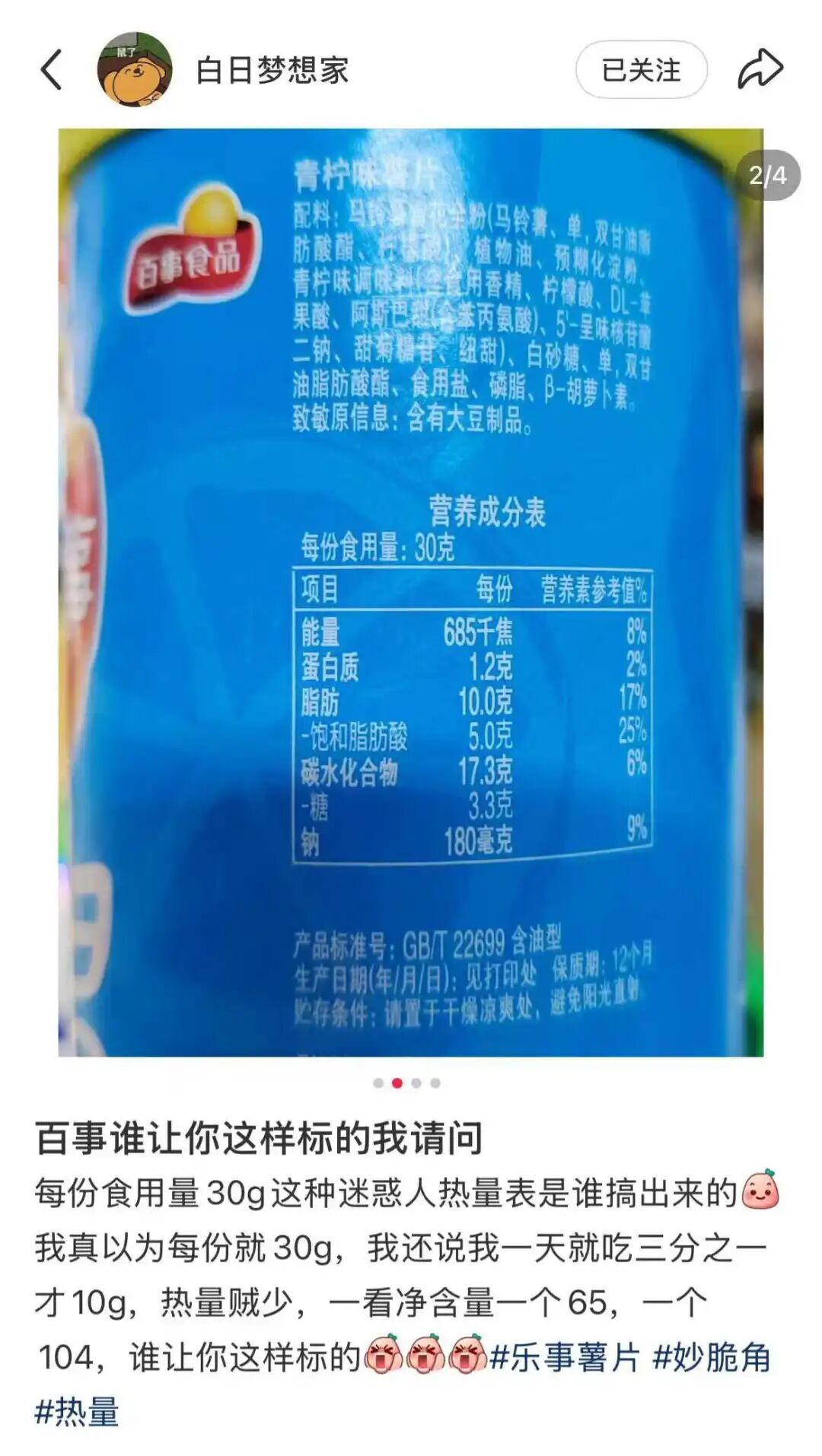
Core Viewpoint - The article highlights the issue of snack packaging labeling calories per "serving" instead of the traditional "per 100g," leading consumers to unknowingly consume higher calories than expected [1][4][25]. Group 1: Consumer Awareness - Consumers are increasingly finding that the calorie counts on snack packaging are based on "serving" sizes, which can be significantly smaller than the total package weight, resulting in higher caloric intake than anticipated [1][4]. - The discrepancy in serving sizes can lead to confusion, as some products may label servings in fractions or specific weights that do not align with consumer expectations [4][9]. Group 2: Regulatory Standards - The labeling of nutritional information per "serving" is compliant with national regulations, as outlined in the GB28050-2011 and GB28050-2025 standards, which allow for both "per 100g" and "per serving" formats [19][20]. - The standards specify that serving sizes can vary based on the type of food, and manufacturers are encouraged to use reference values for serving sizes [20][24]. Group 3: Industry Practices - Many snack brands, such as Orion and Lay's, have adopted the "per serving" labeling to standardize nutritional information across various product sizes, which can create a perception of lower calorie content [24][25]. - The choice of serving size often aims to simplify consumer understanding and calculation of caloric intake, although it may also contribute to misleading perceptions of healthiness [24][25].

盐津铺子涨2.03%,成交额5179.02万元,主力资金净流入522.66万元
Xin Lang Cai Jing· 2026-01-05 02:18
Core Viewpoint - Salted Fish's stock price has shown a slight increase of 2.03% this year, with a market capitalization of 19.008 billion yuan, indicating a stable performance in the food and beverage sector, particularly in the snack industry [1] Financial Performance - For the period from January to September 2025, Salted Fish achieved a revenue of 4.427 billion yuan, reflecting a year-on-year growth of 14.67% [2] - The net profit attributable to shareholders for the same period was 605 million yuan, representing a year-on-year increase of 22.63% [2] Shareholder Information - As of September 30, 2025, the number of shareholders for Salted Fish increased to 18,000, a rise of 65.13% compared to the previous period [2] - The average number of circulating shares per shareholder decreased by 39.44% to 13,663 shares [2] Dividend Distribution - Since its A-share listing, Salted Fish has distributed a total of 1.428 billion yuan in dividends, with 1.032 billion yuan distributed over the last three years [3] Institutional Holdings - As of September 30, 2025, Hong Kong Central Clearing Limited was the fourth largest circulating shareholder, holding 6.8755 million shares, a decrease of 2.1773 million shares from the previous period [3] - Other notable institutional shareholders include Fu Guo Consumption Theme Mixed A and Fu Guo Value Creation Mixed A, which increased their holdings by 280,300 shares and 153,700 shares, respectively [3]

洽洽食品涨2.04%,成交额3434.42万元,主力资金净流入291.70万元
Xin Lang Cai Jing· 2026-01-05 02:16
Core Viewpoint - Qiaqia Food's stock price has shown a modest increase of 2.04% since the beginning of the year, reflecting a stable performance in the market despite a decline in revenue and net profit for the first nine months of 2025 [1][2]. Financial Performance - For the period from January to September 2025, Qiaqia Food reported a revenue of 4.501 billion yuan, representing a year-on-year decrease of 5.38% [2]. - The net profit attributable to shareholders for the same period was 168 million yuan, which is a significant decline of 73.17% compared to the previous year [2]. Stock Market Activity - As of January 5, 2025, Qiaqia Food's stock price was 22.06 yuan per share, with a market capitalization of 11.159 billion yuan [1]. - The stock has experienced a 0.27% increase over the last five trading days, a 2.60% increase over the last 20 days, and a 4.06% increase over the last 60 days [1]. Shareholder Information - As of September 30, 2025, the number of shareholders for Qiaqia Food was 54,300, which is a decrease of 5.84% from the previous period [2]. - The average number of circulating shares per shareholder increased by 6.20% to 9,297 shares [2]. Dividend Distribution - Since its A-share listing, Qiaqia Food has distributed a total of 4.693 billion yuan in dividends, with 1.654 billion yuan distributed over the last three years [3]. Institutional Holdings - As of September 30, 2025, Hong Kong Central Clearing Limited was the third-largest circulating shareholder, holding 3.9811 million shares, a decrease of 15.9915 million shares from the previous period [3]. - New institutional shareholders include E Fund Yuxin Bond A and Ping An Low Carbon Economy Mixed A, holding 3.9671 million shares and 3.7000 million shares, respectively [3].
