交通运输

Search documents
险资新一轮举牌潮涌:权益投资打上“长钱长投”印记
Zhong Guo Zheng Quan Bao· 2025-08-08 07:27
Core Viewpoint - The insurance industry is experiencing a new wave of equity stakes, with a focus on high-dividend assets to enhance long-term stable returns amid low interest rates and asset scarcity [1][4][5] Group 1: Recent Activities - Ruizhong Insurance has recently increased its stake in China Shenhua H-shares to 5%, marking the 11th equity stake disclosed by the China Insurance Industry Association this year [1][2] - The company also increased its holdings in Citic Bank H-shares, reaching a 5% stake, and has previously made similar moves with Longyuan Power H-shares and China Duty Free H-shares [2][3] Group 2: Investment Strategy - The current trend in equity stakes is characterized by a preference for high-dividend stocks, which provide stable cash flow and dividends, aligning with the long-term liability needs of insurance companies [4][5] - The low interest rate environment and the gradual expiration of high-yield assets have led insurers to seek stable, long-term investment opportunities [4][5] Group 3: Regulatory and Accounting Influences - The implementation of new accounting standards is prompting insurers to optimize their asset allocation by increasing long-term equity investments, which can help smooth profit fluctuations [6][7] - Under the new accounting rules, high-dividend stocks can be classified in a way that minimizes the impact of market fluctuations on financial statements, thus enhancing stability [6][7]
聚焦优质现金流资产 富国中证800自由现金流ETF联接今日发行
Zhong Guo Jing Ji Wang· 2025-08-08 07:15
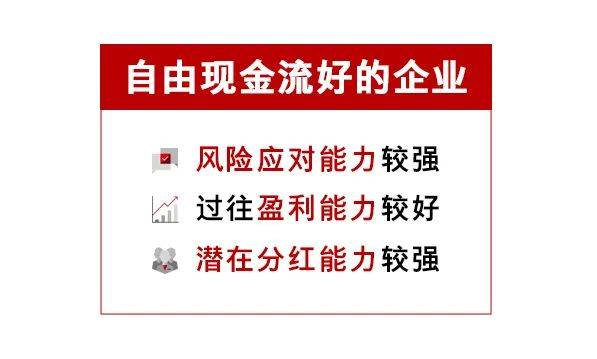
Core Viewpoint - The launch of the WFG CSI 800 Free Cash Flow ETF Linked Fund highlights the increasing importance of free cash flow as a measure of a company's true profitability and financial health in the context of economic transformation [1][2]. Group 1: Free Cash Flow Importance - Free cash flow is defined as the cash generated from operating activities minus capital expenditures, reflecting a company's ability to distribute cash to investors or for strategic decisions [1]. - Companies with higher free cash flow typically exhibit better profitability quality and stronger risk resilience, making free cash flow a critical indicator for sustainable dividends [1]. Group 2: Fund Structure and Investment Strategy - The WFG CSI 800 Free Cash Flow ETF Linked Fund focuses on the 50 "cash cow" companies within the CSI 800 index, excluding financial and real estate sectors, which have sufficient free cash flow rates [2]. - The index is characterized by a significant large-cap style, with over 60% of its constituents being companies with a market capitalization exceeding 100 billion [2]. Group 3: Sector and Performance Analysis - The index emphasizes cyclical sectors, with the top five industries being transportation, non-ferrous metals, food and beverage, oil and petrochemicals, and home appliances, collectively accounting for over 60% of the index weight [2]. - Historical performance indicates that the 800 Free Cash Flow Total Return Index has shown positive returns in six consecutive years since 2019, with a historical win rate exceeding 90% [2]. Group 4: Current Market Position - The current economic environment presents a favorable configuration window for the fund, as the 800 cash flow index is expected to benefit from policies aimed at expanding domestic demand [3]. - The current price-to-earnings ratio (TTM) of the 800 cash flow index is 10.31, which is relatively low compared to historical levels, indicating a substantial margin of safety for investors [3].
今年险资已举牌21次上市公司 超去年全年
Jin Rong Shi Bao· 2025-08-08 07:04
Group 1 - The insurance capital market is experiencing a wave of shareholding activities, with 21 instances of insurance companies taking stakes in listed companies this year, surpassing the total of 20 for the entire year of 2024 [1][2] - Major insurance companies involved in this trend include China Post Insurance, Taikang Life, and several others, indicating a strong interest in equity investments [1][2] - The surge in shareholding activities is attributed to adjustments in asset allocation strategies by insurance companies, driven by supportive policies for long-term capital market investments [1][2] Group 2 - The companies targeted for shareholding include major banks and firms across various sectors, with bank stocks being the most frequently targeted [2] - Ping An Life has notably made 7 investments in bank stocks this year, indicating a focused strategy on this sector [2] - The regulatory environment has been favorable, with policies encouraging insurance funds to increase their equity investments, leading to a significant rise in the market value of equity holdings [2][3] Group 3 - The Ministry of Finance has adjusted the assessment methods for insurance fund performance, emphasizing long-term investment strategies [3] - This change is expected to enhance the role of insurance funds in providing long-term capital to the market, aligning asset investments with insurance liabilities [3] - Industry experts predict that the trend of insurance capital shareholding will continue in the second half of the year, supported by ongoing policy initiatives [3]


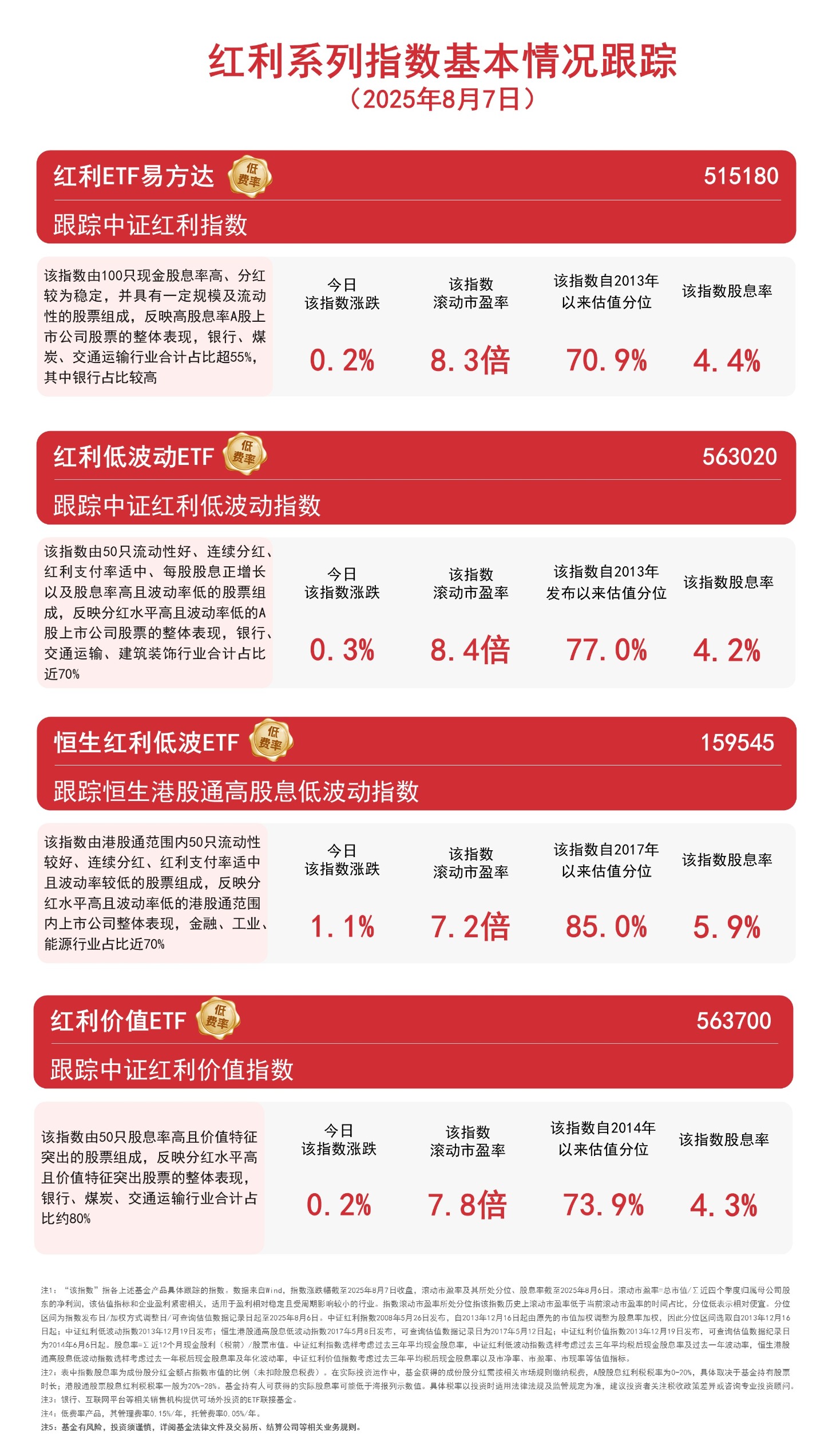
红利板块走势分化,恒生红利低波ETF(159545)获净申购2100万份
Sou Hu Cai Jing· 2025-08-08 05:31
Group 1 - The core indices related to dividend-paying stocks showed mixed performance, with the China Securities Dividend Low Volatility Index up by 0.3%, the China Securities Dividend Index up by 0.2%, and the China Securities Dividend Value Index up by 0.1%. In contrast, the Hang Seng Hong Kong Stock Connect High Dividend Low Volatility Index decreased by 0.4% [1][5][7] - The Hang Seng Dividend Low Volatility ETF (159545) experienced a net subscription of 21 million units, reaching a historical high of 4.1 billion yuan in total scale as of yesterday [1][6] - The composition of the indices reflects a focus on stocks with moderate dividend payout ratios, positive growth in earnings per share, high dividend yields, and low volatility, with significant representation from the banking, transportation, and construction industries, which together account for approximately 70% of the A-share market [5][7] Group 2 - The Hang Seng Dividend Low Volatility Index consists of 50 stocks within the Hong Kong Stock Connect that are characterized by good liquidity, continuous dividend payments, moderate dividend payout ratios, and low volatility, with nearly 70% representation from the financial, industrial, and energy sectors [7][8] - The China Securities Dividend Value Index tracks 50 stocks that exhibit high dividend yields and value characteristics, indicating a focus on companies that provide consistent returns to shareholders [9][10]

国泰海通 ·2025研究框架培训邀请函|洞察价值,共创未来
国泰海通证券研究· 2025-08-08 05:31
Core Viewpoint - The article outlines the schedule and topics for the 2025 research framework training organized by Guotai Junan Securities, emphasizing a comprehensive approach across various sectors and inviting participation from interested parties [19]. Group 1: Event Schedule - The training sessions are scheduled for August 18-19 and August 25-26, covering a range of topics from macroeconomic research to sector-specific studies [14][19]. - The first two days focus on total, consumption, and financial sectors, while the latter two days will delve into cyclical, pharmaceutical, technology, and manufacturing sectors [19]. Group 2: Research Topics - The training will include sessions on food and beverage research, retail and service research, textile and apparel research, internet applications, home appliances, agriculture, forestry, animal husbandry, and fishery research [15]. - Additional topics will cover macroeconomic research, strategy research, overseas strategy research, fixed income research, fund evaluation, financial engineering, small and medium-sized enterprises, and new stock research [15][16]. - The second week will feature non-metallic building materials, non-ferrous metals, public utilities, biological medicine, cultural communication, electronics, and various engineering and manufacturing studies [16][17].

自由现金流不同指数有何区别?全景解析来了
Sou Hu Cai Jing· 2025-08-08 03:20
Core Insights - The article emphasizes the importance of free cash flow (FCF) as a measure of a company's ability to generate actual cash available for distribution to shareholders or reinvestment, rather than just accounting profits [1][21] - The market has shifted towards a "value" style since 2022, with a focus on dividends and cash flow, supported by regulatory policies aimed at enhancing the quality and sustainability of corporate earnings and cash flows [21] Free Cash Flow Indices Overview - The CSI All Share Free Cash Flow Index focuses on large, medium, and small-cap stocks, selecting 100 constituents with positive free cash flow and enterprise value, primarily in coal, oil, petrochemicals, and transportation sectors, highlighting defensive attributes [3] - The CSI 300 Cash Flow Index is limited to constituents of the CSI 300, selecting 50 large-cap blue-chip stocks with positive operating cash flow for five consecutive years, concentrated in traditional high-dividend sectors like oil and petrochemicals, suitable for low-volatility investors [4] - The CSI 800 Free Cash Flow Index selects 50 large and medium-cap stocks from the CSI 300 and CSI 500, with over 40% in the energy sector, indicating significant exposure to commodity cycle fluctuations, suitable for tactical strategies [5] - The FTSE China A-Share Free Cash Flow Index includes Hong Kong Stock Connect eligible stocks (approximately 30% from Hong Kong), selecting 50 large and medium-cap stocks, with a high proportion of central and state-owned enterprises, offering cross-border allocation and hedging attributes, but with liquidity risks in Hong Kong stocks [6] - The National Index Free Cash Flow covers a broader range, selecting 100 non-financial and non-real estate stocks from the Shanghai, Shenzhen, and Beijing exchanges, with diversified industries including oil, petrochemicals, automotive, and home appliances, demonstrating both offensive and defensive characteristics [7] Sample Selection Criteria - The selection criteria for these indices include positive free cash flow and enterprise value, exclusion of financial and real estate sectors, and a focus on companies with consistent positive operating cash flow over multiple years [11][17] - The indices are weighted by free cash flow, with individual stock weight limits set at 10%, and are adjusted quarterly [14][17]
A股市场大势研判:沪指走出四连阳,再创阶段新高
Dongguan Securities· 2025-08-07 23:30
Market Overview - The Shanghai Composite Index has achieved a four-day winning streak, reaching a new high for the year at 3639.67 points, with a slight increase of 0.16% [2][4] - The Shenzhen Component Index closed at 11157.94 points, down by 0.18% [2] - The market showed mixed performance, with over 3000 stocks declining, indicating a lack of significant profit-making opportunities [4] Sector Performance - The top-performing sectors included Non-ferrous Metals (1.20%), Beauty Care (0.99%), Real Estate (0.82%), Textiles and Apparel (0.81%), and Transportation (0.73%) [3][4] - Conversely, the worst-performing sectors were Pharmaceutical Biology (-0.92%), Electric Equipment (-0.74%), Communication (-0.47%), Defense and Military Industry (-0.39%), and Household Appliances (-0.29%) [3][4] - Concept indices that performed well included Rare Earth Permanent Magnet (3.24%), Brain-Computer Interface (2.69%), Hyperbaric Oxygen Chamber (2.56%), Terahertz (1.65%), and Blood Oxygen Monitor (1.62%) [3][4] Economic Indicators - In July, China's total imports and exports reached 3.91 trillion yuan, marking a growth of 6.7%. Exports were 2.31 trillion yuan, up by 8%, while imports were 1.6 trillion yuan, increasing by 4.8% [4] - The Ministry of Industry and Information Technology and other departments issued opinions to promote the development of the brain-computer interface industry [4] Future Outlook - The overall market trend remains strong, supported by a recovery in the funding environment and fundamentals, with the margin financing balance returning to over 2 trillion yuan, indicating rising market confidence [4] - However, the Shanghai Composite Index is approaching previous high levels, suggesting potential selling pressure in the near term [4] - Recommended sectors for future investment include Financials, Non-ferrous Metals, Construction Decoration, Agriculture, Forestry, Animal Husbandry, and Machinery Equipment [4]
上半年深圳重大项目投资进度达58.1%
Zhong Guo Chan Ye Jing Ji Xin Xi Wang· 2025-08-07 22:36
Group 1: Economic Development and Investment - Shenzhen has completed an investment of 178.65 billion yuan in major projects in the first half of the year, achieving an investment progress rate of 58.1% [1][2] - The city has planned a total of 798 major projects with a total investment of approximately 3.2 trillion yuan by 2025, focusing on modern industries, public welfare, and infrastructure [2] - Major projects in modern industries include the Shenzhen International Exchange Center and various headquarters for companies like Xiaomi and JD.com, which are expected to enhance the city's industrial capabilities [1][2] Group 2: Social Welfare and Public Services - Shenzhen plans to invest 95.37 billion yuan in 292 major projects aimed at improving public welfare by 2025, focusing on education, healthcare, and cultural tourism [3] - The city has increased its educational capacity significantly, adding 100,000 public high school seats and addressing the tight supply of high school placements [3] - In healthcare, Shenzhen has reached a total of 75,000 hospital beds and established 82 elderly care institutions, with community services benefiting over 200,000 elderly residents [4]





越南提出多项交通建设领域目标
Shang Wu Bu Wang Zhan· 2025-08-07 16:53
Core Viewpoint - The Vietnamese government aims to achieve significant infrastructure development goals by the end of the year, including the construction of 3,000 kilometers of highways and various major projects to enhance transportation and urbanization [1] Infrastructure Development Goals - The government plans to complete 3,000 kilometers of highways by the end of the year [1] - Key projects include the first phase of Long Thanh Airport, coastal roads, and at least 100,000 social housing units [1] - The approval process for major projects such as the North-South high-speed railway and the Lao Cai-Hanoi-Haiphong railway is to be expedited [1] Maritime and Port Development - Investment in maritime development is highlighted as having relatively low costs and minimal land acquisition needs [1] - Existing ports and terminals have significant development potential [1] Importance of Highway Construction - Highway construction is deemed crucial for driving development in inland areas [1] Focus on Rail and High-Speed Rail - The Ministry of Construction is urged to prioritize technology transfer and talent development in the railway and high-speed rail sectors [1] Urbanization and Infrastructure Quality - The government emphasizes accelerating urbanization while improving quality [1] - Urban infrastructure development should align with modern, green, and smart city concepts to adapt to climate change [1]
港股红利板块大涨,恒生红利低波ETF(159545)最新规模超40亿元,居同标的ETF第一
Mei Ri Jing Ji Xin Wen· 2025-08-07 14:56
Group 1 - The core viewpoint of the article highlights the strong performance of dividend sectors, with the Hang Seng High Dividend Low Volatility Index rising by 1.1%, achieving a four-day consecutive increase this week [1] - The CSI Dividend Low Volatility Index increased by 0.3%, while both the CSI Dividend Index and CSI Dividend Value Index rose by 0.2% [1] - The Hang Seng Dividend Low Volatility ETF (159545) saw a net subscription of 10.2 million units today, accumulating over 1.5 billion yuan in the past month, with a total scale exceeding 4 billion yuan, ranking first among similar ETFs [1] Group 2 - According to China Merchants Securities, in the current low-interest-rate environment, dividend assets offer relatively high and stable returns, attracting significant investor attention [1] - Policy guidance is encouraging long-term capital to enter the market, further increasing the demand for long-term allocation of dividend assets [1]