
军工

Search documents
新战争形态驱动行业升级,军工板块结构性轮动清晰,航空航天ETF(159227)延续上涨态势
Mei Ri Jing Ji Xin Wen· 2025-09-24 07:09
Group 1 - The three major indices continued to rise, with semiconductor and gaming sectors leading the gains, while the military industry maintained an upward trend [1] - The largest aerospace ETF (159227) showed a steady increase, up 0.36% with a trading volume of 71.16 million yuan, maintaining its position as the top in its category [1] - The military industry is expected to experience structural rotation internally, with clear rotation characteristics in sectors such as low-altitude economy, commercial aerospace, deep-sea technology, large aircraft, and military trade [1] Group 2 - The aerospace ETF (159227) tracks the National Aerospace Index, which has a strong military attribute, with 97.96% of the index comprising military-related sectors [2] - The weight of aerospace equipment in this ETF is as high as 65.4%, significantly exceeding that of other military indices [2] - This ETF provides investors with an efficient way to capture core military aerospace opportunities [2]
国防ETF(512670)上涨1%,我国海军正式进入“弹射时代”
Xin Lang Cai Jing· 2025-09-24 06:40
Group 1 - The successful launch and recovery of the J-15T, J-35, and KJ-600 carrier-based aircraft from the Fujian aircraft carrier marks China's entry into the "catapult era," making it the second country after the United States to possess an electromagnetic catapult aircraft carrier [1] - The first appearance of the Fujian carrier's catapult training exceeded expectations, indicating significant advancements in electromagnetic catapult technology and the potential for rapid development in commercial aerospace and high-speed vehicles [1] - The J-35, as a new generation multi-role fifth-generation fighter, has successfully completed carrier-based catapult launches, suggesting that its application has reached a critical point, with potential for accelerated development of variants suitable for different military branches [1] Group 2 - The transition to the "catapult era" is a milestone for the Chinese Navy, enhancing its capabilities and supporting the growth of military exports [2] - As of September 24, 2025, the CSI Defense Index (399973) rose by 0.83%, with notable increases in stocks such as Ruichuang Micro-Nano (688002) up by 3.10% and Zhenhua Wind Power (688439) up by 3.04% [2] - The CSI Defense Index reflects the overall performance of listed companies in the defense industry, with the top ten weighted stocks accounting for 43.88% of the index [3]
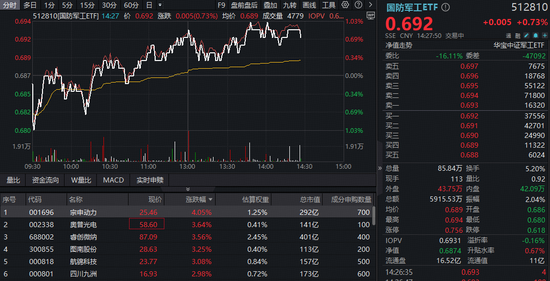
利好催化,国防军工震荡走高,512810拉升1%!机构:关注中东局势升级带来的军贸机遇
Xin Lang Ji Jin· 2025-09-24 06:36
Group 1 - The defense and military industry sector experienced a significant rise on September 24, with the popular defense ETF (512810) increasing by over 1% in the afternoon, with a trading volume exceeding 59 million yuan [1] - Key stocks in the sector included Aopu Optoelectronics, Tunan Co., and Ruichuang Micro-Nano, which saw gains of 4.05%, 3.25%, and 2.97% respectively [1] - Conversely, Xiangdian Co., Feiliwa, and Qiyi Er experienced declines of 3.17%, 1.54%, and 1.48% respectively [1] Group 2 - The 2025 Air Force Aviation Open event took place from September 19 to 23 in Changchun, showcasing the J-20 fighter jet for the first time, highlighting China's aerospace equipment technology strength [3] - A strategic defense agreement was signed between Saudi Arabia and Pakistan, which is expected to deepen cooperation in military trade [3] - Huatai Securities noted that the worsening situation in the Middle East has raised concerns about the reliability of American equipment, potentially boosting China's military trade demand [3] - Global defense spending is increasing, with expectations for China's equipment exports to the Middle East strengthening, particularly with the upcoming Dubai Airshow in November serving as an important showcase [3] - Huafu Securities projected significant growth in both domestic and international demand for the defense industry from 2025 to 2027, driven by multiple catalysts including the 14th Five-Year Plan and rapid military trade development [3] - The defense ETF (512810) passively tracks the CSI Military Industry Index, which includes top-weighted stocks such as China Shipbuilding, Guangqi Technology, and AVIC Shenyang Aircraft [3] Group 3 - The top ten weighted stocks in the CSI Military Industry Index include China Shipbuilding, Guangqi Technology, AVIC Shenyang Aircraft, Aero Engine Corporation of China, AVIC Optoelectronics, AVIC Xi'an Aircraft, Feiliwa, China Great Wall, Aerospace Electronics, and AVIC Aircraft [4]

早盘直击|今日行情关注
申万宏源证券上海北京西路营业部· 2025-09-24 03:14
Market Overview - A-shares experienced profit-taking pressure on Tuesday, with significant declines in leading indices such as the Sci-Tech 50 and ChiNext, which saw drops exceeding 2% at one point. However, indices rebounded in the afternoon, with the ChiNext closing in the green and the Sci-Tech 50 nearly flat, indicating that profit-taking was concentrated but did not alter the underlying upward trend of the market [1] Future Outlook - The slowdown in the market is seen as beneficial for the mid-term trend of A-shares. As the index approaches the 3900-point mark, there is divergence in the market due to accumulated gains and varying performance across sectors. This necessitates a re-evaluation of market leaders, which is a normal phenomenon in a fluctuating upward market and will not impact the mid-term trend [2] - Since 2016, the Shanghai Composite Index has reached a peak of 3731 points in 2021, and it has now surpassed this level. Other major indices like the CSI 300 and ChiNext still have room for catch-up, suggesting potential for further gains in these lagging indices [2] Sector Highlights - The technology sector may experience internal differentiation in September, with opportunities for low-positioned stocks to catch up. Following significant gains in August, sectors such as robotics, new energy, and military industry are expected to see a rebound, while traditional sectors like finance and consumer goods also present catch-up opportunities [2] - Key trends to watch include: 1. The continued domestic adoption of robotics, with products expanding from humanoid to quadruped and functional robots, creating opportunities in sensors and controllers [3] 2. The ongoing trend of semiconductor localization, focusing on semiconductor equipment, wafer manufacturing, materials, and IC design [3] 3. The military sector is expected to see a rebound in orders by 2025, with signs of recovery in mid-term performance across various military sub-sectors [3] 4. The innovative drug sector is entering a recovery phase after nearly four years of adjustment, with positive net profit growth expected to continue into 2025 [3] 5. The banking sector is witnessing a recovery in mid-term performance following the impact of loan rate re-pricing, with attractive dividend yields drawing interest from long-term institutional investors [3]

A股开盘速递 | 三大股指集体低开 通信设备等板块跌幅居前
智通财经网· 2025-09-24 01:44
Group 1 - The A-share market opened lower with the Shanghai Composite Index down 0.45% and the ChiNext Index down 0.79%, with sectors like communication equipment, CPO, tourism and hotels, and precious metals leading the declines [1] - CITIC Securities suggests that the next wave of investment opportunities will focus on resources, new productive forces, and overseas expansion, indicating a shift in resource stocks from cyclical to dividend attributes due to supply constraints and global geopolitical tensions [1] - The report emphasizes that the globalization of China's manufacturing leaders will convert market share advantages into pricing power and profit margin improvements, leading to market capitalization growth that surpasses domestic economic fundamentals [1] Group 2 - Guotai Junan Securities believes that a bull market driven by the recovery of China's profit fundamentals may be in the making, with liquidity constraints easing and potential for a rebound in Hong Kong stocks that lagged behind from June to August [2] - The report highlights that opportunities in cyclical manufacturing sectors (non-ferrous metals, machinery, chemicals) will become the mid-term focus as the market prepares for a genuine bull market [2] - Recommendations include focusing on upstream resources (copper, aluminum, oil, gold), capital goods (engineering machinery, heavy trucks, lithium batteries, wind power equipment), and raw materials (basic chemicals, fiberglass, paper, steel) as well as sectors related to domestic demand recovery such as food and beverage, pork, tourism, and scenic spots [2]
让钱动起来:M1回暖与企业现金流活化的交叉印证
Huachuang Securities· 2025-09-23 23:30
Group 1 - The report indicates that M1 has shown a significant recovery, with a year-on-year increase of 11 percentage points from September 2024 to June 2025, which correlates with a 9 percentage point increase in non-financial corporate cash flow, suggesting a new cash flow cycle for enterprises has begun [1][7][10] - Non-financial operating cash flow saw a notable year-on-year increase of nearly 1 trillion yuan in Q2 2025, marking it as the primary positive contributor to the growth of cash and cash equivalents [7][10][17] - Historical cash flow cycles are referenced, indicating that the current improvements in operating cash flow, narrowing negative contributions from financing cash flow, and reduced negative contributions from investment cash flow align with the characteristics of the beginning of a new cash flow cycle [1][7][17] Group 2 - The overall improvement in non-financial operating cash flow is primarily attributed to reduced purchasing rather than increased sales, with a notable contraction in cash outflows for purchases, which is a rare occurrence historically [2][20][27] - Industries experiencing net inflow expansion due to downstream prosperity include automotive, machinery, electronics, non-ferrous metals, and chemicals, while those benefiting from significant cost reductions include construction, transportation, real estate, utilities, and new energy [2][8][20] - Leading contributors to cash increment across the A-share market include construction (+1.4 percentage points), new energy (+1.3 percentage points), real estate (+1.0 percentage points), and electronics (+1.0 percentage points), while coal and food & beverage sectors showed negative contributions [3][8][17] Group 3 - The report highlights that the automotive and food & beverage sectors have shown healthy cash flow expansion, indicating improved cash collection and sales quality, which is crucial for maintaining cash flow health [35][36] - The construction and transportation sectors are noted for their significant net inflow expansions, driven by cost control and operational efficiency improvements [2][29] - The electronics sector has benefited from increased demand driven by AI and technological advancements, leading to improved operating cash flow and accelerated capital expenditures [3][8][35]
AI+军用: 新时代智权赛,重塑战场新生态
2025-09-23 02:34
Summary of Key Points from Conference Call Records Industry Overview - The military industry in China is mature and has significant international market potential, with foreign trade becoming a focal point [1][2] - The end of the 14th Five-Year Plan has catalyzed policies, leading to a recovery in upstream military electronics orders, although challenges remain [1][2] - The 15th Five-Year Plan will commence in 2026, with a goal of military modernization by 2027, emphasizing the need for new combat capabilities [1][2] Core Insights and Arguments - Increased global military equipment demand due to rising geopolitical tensions and conflicts, validating the performance of domestic equipment in international markets [1][2] - The integration of AI in military applications is driving modernization, with China aiming for AI development goals by 2030 [1][2][5] - The 2025 military parade showcased advanced military technologies, including hypersonic weapons and unmanned systems, indicating a shift towards joint operations and modern combat systems [1][6] AI Applications in Military - AI applications in the military encompass various areas, including command operations, equipment maintenance, autonomous drones, and logistics management [5][7] - The U.S. leads in military AI, with significant investments in AI companies and rapid decision-making enhancements within NATO [5][9] - China's military AI development involves numerous companies, including aerospace and navigation firms, contributing to a comprehensive upgrade of military capabilities [9] Emerging Technologies and Equipment - The 2025 military parade highlighted new technologies such as AI-enabled drones and ground robots, enhancing overall military effectiveness [8][9] - Specific advancements include lightweight automatic rifles and smart wearable devices for soldiers, improving operational efficiency [8][9] Long-term and Short-term Outlook - Long-term prospects for military informationization and intelligence construction in foreign trade are promising, potentially expanding the domestic military market [10] - Short-term recovery in foreign trade requires time, with the military sector showing thematic investment trends [11] New Production Forces and Trends - Key development areas include commercial aerospace, low-altitude economy, and deep-sea technology, which are prioritized in national development plans [12][14] - The deep-sea technology sector is crucial for national security and economic interests, with ongoing advancements in underwater research and resource development [13][14] Investment Recommendations - Focus on military AI industrialization, with attention to emerging themes in commercial aerospace and unmanned intelligence [16][17] - Key companies to watch include those involved in national defense and aerospace, as well as firms specializing in AI and information technology [16][17]
地缘经济论 | 第六章 地缘经济新格局下的产业发展战略
中金点睛· 2025-09-23 00:14
Core Viewpoint - The article discusses the competitive geoeconomic strategy of the Trump administration, emphasizing the importance of economic security as a core component of national security, particularly focusing on the manufacturing sector and strategic industries [2][3][4]. Group 1: Competitive Geoeconomic Strategy - The Trump administration's geoeconomic strategy has shifted towards a more competitive stance, challenging globalization and emphasizing economic goals over political ones [4][5][10]. - The strategy aims to ensure economic scale advantages based on a specific industrial structure, particularly in high-tech manufacturing [15][16]. - The focus on economic security reflects a broader trend where economic and national security concerns are increasingly intertwined, leading to a more aggressive use of tariffs and investment policies [12][15]. Group 2: Manufacturing and Strategic Industries - The article highlights the significance of reinforcing the manufacturing base in the U.S. economy, noting that while the manufacturing sector's GDP share is low, its total output remains substantial [17][19]. - The U.S. military-industrial complex is particularly emphasized, with American firms leading globally in military revenue, indicating a strong manufacturing foundation [19][21]. - The competitive strategy includes a focus on strategic industries that can provide both micro and macro geoeconomic power, particularly in high-tech sectors [36][37]. Group 3: Policy Implementation and Investment - The Trump administration has implemented various policies to promote domestic manufacturing, including tariffs and incentives for foreign direct investment (FDI) [14][25]. - The article notes a significant increase in FDI commitments during the Trump 2.0 period, particularly in the semiconductor industry, indicating a shift towards attracting foreign investment [25][26]. - The approach contrasts with the Biden administration's focus on political alliances and green energy, showcasing a divergence in economic strategies [10][11][40]. Group 4: Implications for Global Trade - The competitive geoeconomic strategy has led to a decentralization of global supply chains, with U.S. trade patterns shifting towards neighboring countries like Canada and Mexico [26][28]. - The article suggests that the U.S. strategy has resulted in increased exports from allies while potentially weakening China's geoeconomic power due to the outflow of manufacturing capabilities [31][32]. - The emphasis on "friend-shoring" and "on-shoring" reflects a broader trend of reshaping global trade dynamics in response to geopolitical tensions [26][28]. Group 5: Importance of Industrial Policy - The article argues for a greater emphasis on industrial policy, particularly demand-side policies, to enhance economic security and competitiveness [42][43]. - It highlights the need for targeted government interventions to influence economic structures and maintain strategic advantages in key industries [44][46]. - The increasing use of industrial policies globally since 2018 underscores the urgency for nations to adapt to the evolving geoeconomic landscape [48][50].



下一波的线索是什么?股市不会止步于此,外资继续流入
Zheng Quan Shi Bao Wang· 2025-09-22 11:17
Group 1 - The overall industry selection framework focuses on resources, new productive forces, and globalization [2] - Resource stocks are shifting from cyclical attributes to dividend attributes due to supply constraints and global geopolitical expectations [2] - The globalization of leading Chinese manufacturing companies is expected to convert market share advantages into pricing power and profit margin improvements [2] Group 2 - The Chinese stock market is expected to continue its upward trajectory, driven by the demand for assets and capital market reforms aimed at improving investor returns [3] - The recent communication between Chinese and U.S. leaders indicates a stabilization of short-term risk outlook [3] - The upcoming reforms in the capital market, including the launch of the growth tier on the Sci-Tech Innovation Board, are anticipated to accelerate market adjustments [3] Group 3 - The current market remains in a consolidation phase since September, with a positive funding environment supporting the ongoing trend [4] - The key factor for the continuation of the positive feedback from the funding side is the profitability effect [4] - Focus areas for investment include domestic computing power chains, innovative pharmaceuticals, robotics, chemicals, batteries, and leading consumer stocks [4] Group 4 - The three main drivers of the current upward trend in A-shares remain unchanged, with a focus on low penetration sectors [5] - Attention is drawn to solid-state batteries, AI computing power, humanoid robots, and commercial aerospace [5] - The market is still in a bull market phase, with expectations for further growth [5] Group 5 - There has been significant inflow of both domestic and foreign capital into the Chinese stock market, with a notable increase in passive fund inflows [6] - The reduction in positions in high-priced options indicates a cautious outlook for the Shanghai Composite Index [6] - Overall, the long-term outlook for the Shanghai Composite Index remains bullish [6] Group 6 - The market is currently experiencing a rotation among sectors, with a focus on individual stocks rather than indices [7] - Key areas of interest include humanoid robots, AI, new energy, and innovative pharmaceuticals [7] - The market is expected to continue its rotation while maintaining a high level of focus on individual stock performance [7] Group 7 - The current market conditions suggest that a bull market driven by improving corporate earnings is in the making [8] - Opportunities are identified in upstream resources, capital goods, and raw materials due to improved operating conditions [8] - Domestic demand-related sectors are also expected to present opportunities as earnings recover [8] Group 8 - The market is transitioning from a focus on existing stocks to an expansion of new opportunities driven by incremental capital [9] - The emphasis is on identifying opportunities based on industry trends and economic conditions rather than merely switching between high and low positions [9] - The market is expected to see a broadening of investment opportunities as new capital flows in [9] Group 9 - The potential for low-position stocks to experience a rebound is increasing as the market approaches the fourth quarter [10] - Historical trends indicate that stocks that performed well in the third quarter may not continue their momentum into the fourth quarter [10] - The focus is on cyclical stocks and those benefiting from global pricing resources as key areas for investment in the upcoming quarter [10] Group 10 - The recovery of free cash flow in export-advantaged manufacturing sectors is anticipated due to policy changes and global re-industrialization [11] - The valuation system for China's advantageous manufacturing sectors is expected to undergo systematic restructuring [11] - The return of global capital to China is likely to drive a bullish trend in high-end manufacturing sectors [12]

A股四季度策略展望:慢牛进行时
Huajin Securities· 2025-09-22 11:11
Core Views - The A-share market is expected to continue a slow bull trend in the fourth quarter, with increased volatility, following a strong performance in the third quarter led by technology stocks [3][4] - The market is likely to experience a structural recovery in earnings and continued credit repair, supported by a resilient export environment and steady growth in manufacturing and infrastructure investment [3][4][19] - Key sectors to focus on include technology, cyclical industries, and consumer sectors, with a balanced style favoring both large and small-cap stocks [4][5] Market Trends - The third quarter saw a bull market with the ChiNext Index and STAR Market leading gains, driven by liquidity easing and improved risk appetite [10][14] - The fourth quarter is anticipated to maintain a low-level recovery in earnings, with potential inflows from foreign investment and new funds, although IPOs and sell-offs may increase [4][5] - The overall market valuation is currently neutral to high, with supportive policies likely to sustain risk appetite [4] Industry Allocation - Technology remains the main focus for investment in the fourth quarter, with significant opportunities in core assets and cyclical sectors [5] - Recommended sectors for attention include TMT (Technology, Media, Telecommunications), machinery, electric new energy, pharmaceuticals, military industry, non-ferrous metals, chemicals, and non-bank financials [5][19] - The market style is expected to be balanced, with large-cap and small-cap stocks performing well during periods of structural recovery in earnings and credit [5][54]