
有色金属

Search documents
突发抛售,集体跳水!
Zhong Guo Ji Jin Bao· 2026-02-04 00:23
Market Overview - The Nasdaq index experienced a significant decline, nearly erasing its gains for the year, with a drop of 2.39% during intraday trading [2] - Major U.S. stock indices closed lower, with the S&P 500 down 0.84% at 6917.81 points, the Nasdaq Composite down 1.43% at 23255.19 points, and the Dow Jones Industrial Average down 0.34% at 49240.99 points [2][3] - Among the seven major tech companies, only Microsoft saw an increase, while Nvidia, Facebook, and Amazon all fell by more than 2% [2] Software Sector Impact - A sell-off in software stocks was triggered by the release of an AI legal plugin by Anthropic, leading to a significant drop in the software sector [4] - The U.S. software services index fell by 4.10%, with all component stocks declining [4] Gold and Commodities - Following the sell-off in tech stocks, international gold prices rebounded, with COMEX gold futures nearing $5000 per ounce [5] - The U.S. metals sector saw gains, with Southern Copper rising over 11% and AngloGold up over 6% [5] Geopolitical Tensions - Rising tensions between the U.S. and Iran have led to an increase in oil prices, with NYMEX WTI crude futures reported at $63.77 per barrel [8] - The U.S. military shot down an Iranian drone, escalating geopolitical tensions in the region [7]


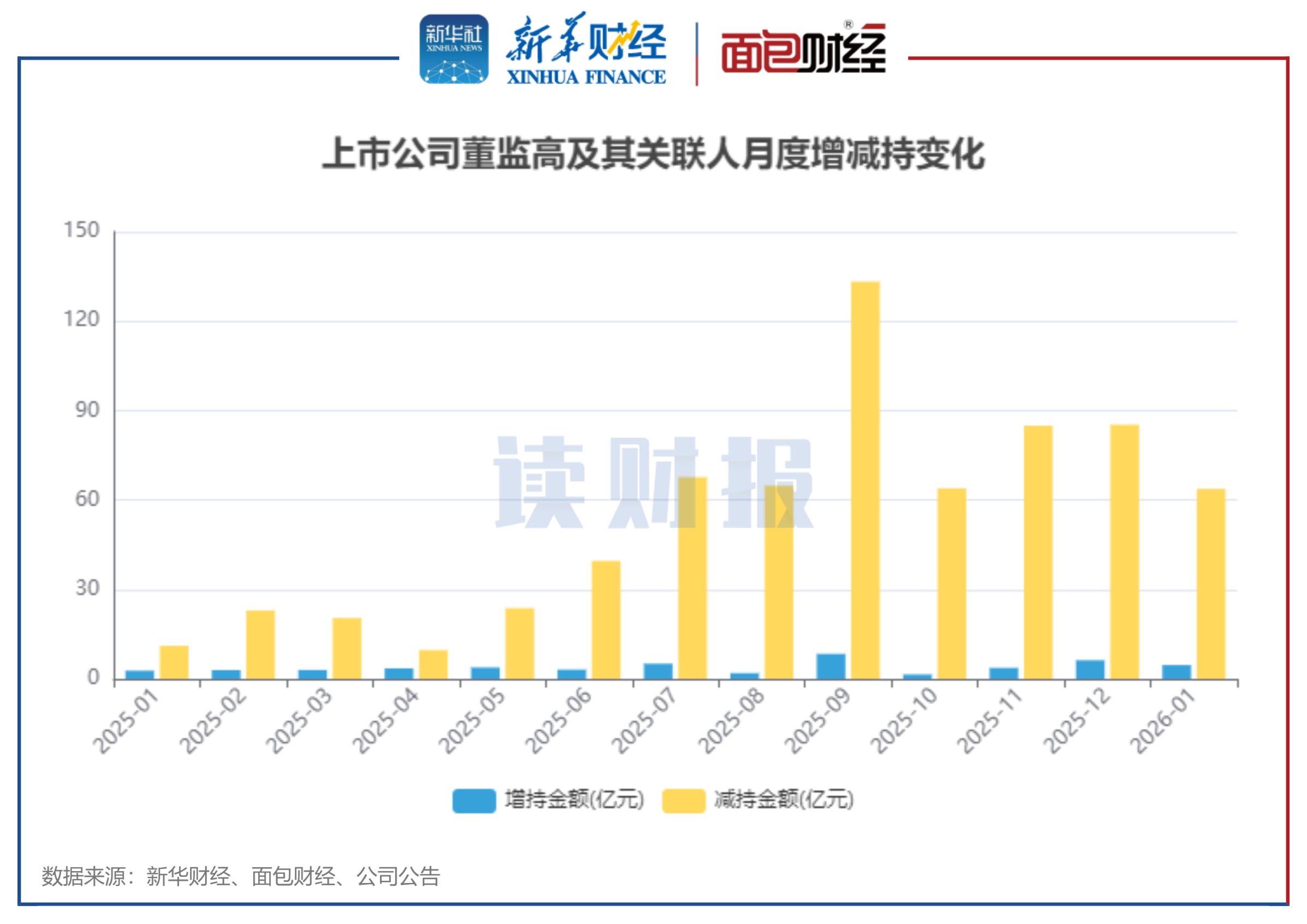
【读财报】1月董监高增减持动态:增持总额同比增逾六成 大中矿业、凯普生物增持金额较多
Xin Hua Cai Jing· 2026-02-03 23:27
Core Viewpoint - In January 2026, the total amount of stock reduction by executives and their related parties in the Shanghai and Shenzhen stock markets reached approximately 6.373 billion yuan, with a net reduction of about 5.91 billion yuan after accounting for increases [1][4]. Group 1: Stock Reduction - The total reduction amount in January 2026 was approximately 6.373 billion yuan, involving 222 companies [4][12]. - The highest reduction amount was from Tianshan Aluminum, with a reduction of approximately 816 million yuan [5][12]. - The second highest reduction was from Gaode Infrared, totaling approximately 798 million yuan [5][12]. - Perfect World ranked third with a reduction of approximately 464 million yuan [5][12]. - The non-metallic mineral industry had the highest reduction amount, approximately 1.113 billion yuan, followed by the defense industry at about 889 million yuan [12][21]. Group 2: Stock Increase - The total amount of stock increase in January 2026 was approximately 462 million yuan, involving 34 companies [13][21]. - The highest increase was from Dazhong Mining, with an increase of approximately 392 million yuan [15][18]. - The second highest increase was from Kaipu Biological, totaling approximately 27 million yuan [15][18]. - The third highest increase was from Sentai Co., with an increase of approximately 15 million yuan [15][18]. - The steel industry had the highest increase amount, approximately 392 million yuan, followed by the pharmaceutical industry at about 27 million yuan [21].
上证早知道|本周日,全球首个直播机器人晚会;“股王”巨资回购股份
Shang Hai Zheng Quan Bao· 2026-02-03 23:02
Group 1 - The Central Bank of China reported a net liquidity injection of 700 billion yuan through Medium-term Lending Facility (MLF) in January 2026, while the net injection through other structural monetary policy tools was 641 billion yuan [4] - The China Light Industry Federation indicated that the added value of large-scale light industry in China grew by 5.3% year-on-year in 2025, contributing to 16.5% of national industrial revenue and 18.8% of profits [4] - The Shanghai Futures Exchange announced adjustments to silver futures contract margin ratios and price limits, effective from February 4, 2026, with price limits set at 19% and margin ratios at 20% for maintaining positions [4][5] Group 2 - The Central Document No. 1 emphasized the expansion of drone IoT applications in agriculture, highlighting the need for technological innovation and the integration of AI with agricultural development [7] - The upcoming global live-streamed robot gala "Robot Wonderful Night" on February 8, 2026, will feature over 200 robots, showcasing advanced robotic technologies [8] - The China Nonferrous Metals Industry Association proposed expanding the national copper strategic reserve and exploring commercial reserve mechanisms, which may include copper concentrate [9] Group 3 - Guizhou Moutai announced a share buyback of 329,800 shares in January 2026, totaling 451 million yuan, with a cumulative buyback of 416,900 shares amounting to 571 million yuan by the end of January [11] - Hanjian He Shan plans to acquire 99.9978% of Xingfu New Materials, with the stock resuming trading on February 4, 2026 [11] - Zhiyang Innovation is planning a major asset restructuring involving the acquisition of Shenzhen Lingming Photon Technology, with trading suspended from February 4, 2026 [12]

能源早新闻丨十种有色金属产量,首次突破8000万吨大关
中国能源报· 2026-02-03 22:32
Industry Updates - In January and February 2025, a total of 6,233 new registered renewable energy generation projects were added nationwide, including 36 wind power projects and 6,190 solar power projects, with 48 centralized solar projects and 6,142 distributed commercial and industrial solar projects [2] - The domestic prices of gasoline and diesel have increased by 205 yuan and 195 yuan per ton, respectively, due to recent fluctuations in international oil prices [3] - The production of ten non-ferrous metals in China has surpassed 8 million tons for the first time, reaching 8,175 million tons, which is a 3.9% increase compared to the previous year [3] - Ningxia has become the first province in China to achieve "green electricity self-sufficiency," with a 70% increase in renewable energy investment and a 38% increase in installed capacity expected by 2025 [4] - The first gas ignition test at the Leitan-1 well in Sichuan Province marks a significant milestone in the province's oil and gas exploration efforts [5] - A total of 30 low-efficiency coal-fired units have been shut down and converted in Shandong Province, with a combined installed capacity of 490,500 kilowatts [5] International News - Mexico will stop supplying oil to Cuba, as stated by U.S. President Trump, indicating a shift in energy supply dynamics in the region [6] - Hungary has filed a lawsuit against the EU regarding the ban on importing Russian energy, challenging the "REPowerEU" energy plan [7] Corporate News - The National Pipeline Group has achieved a historic milestone with both incoming and outgoing natural gas volumes exceeding 30 billion cubic meters in a single month, reflecting a year-on-year increase of over 14% [8]
美军击落一架接近航母的伊朗无人机;原油大涨!白银涨8%,黄金涨6%;央行开展8000亿买断式逆回购;周生生回应“足金挂坠检出铁”丨每经早参
Mei Ri Jing Ji Xin Wen· 2026-02-03 22:10
Group 1 - The U.S. stock market experienced a collective decline, with the Dow Jones down 0.34%, Nasdaq down 1.43%, and S&P 500 down 0.83%, indicating a bearish sentiment in the tech sector as major companies like Broadcom, Microsoft, Nvidia, and Meta saw significant drops [3] - International oil prices rose, with WTI crude oil increasing by 3.12% to $64.08 per barrel and Brent crude oil up by 2.88% to $68.21 per barrel, reflecting a positive trend in the energy sector [4] - European stock indices closed slightly lower, with Germany's DAX down 0.07%, France's CAC40 down 0.02%, and the UK's FTSE 100 down 0.26%, indicating a cautious market environment in Europe [5] Group 2 - The Central Committee of the Communist Party of China released a document focusing on agricultural modernization and rural revitalization, emphasizing the need for technological innovation in agriculture and the development of key agricultural technologies [6] - The Ministry of Industry and Information Technology of China highlighted the importance of advancing in fields such as 6G, quantum technology, and bio-manufacturing, aiming for breakthroughs in these future industries [9] - The People's Bank of China announced an operation to conduct 800 billion yuan of reverse repos to maintain liquidity in the banking system, indicating a proactive monetary policy stance [10] Group 3 - The recent news regarding the "couple's online purchase of contaminated vegetables" led to legal actions against the individuals involved for extortion, showcasing the legal implications of consumer safety issues [11] - The incident at Lingyin Temple, where 380,000 reservations were made but many did not show up, prompted a review of the reservation system to improve attendance and manage visitor expectations [12] - Reports of potential increases in VAT rates for the gaming and financial sectors were dismissed by experts, reinforcing the stability of current tax policies in these industries [13] Group 4 - The announcement of a large-scale robot gala by Zhiyuan Robotics, set to be broadcasted globally, signifies a growing interest in integrating robotics with entertainment, potentially influencing the tech and entertainment sectors [21] - The response from Chaozhou Jewelry regarding quality concerns over their products, backed by authoritative testing, aims to maintain brand reputation and consumer trust [23] - Tencent's revival of the classic QQ Farm game is expected to enhance user engagement and interaction, reflecting a trend in leveraging nostalgia in gaming [24]


铜价波动藏风险 家电企业下好套保先手棋
Zhong Guo Zheng Quan Bao· 2026-02-03 20:23
Group 1 - Recent fluctuations in copper prices have seen a peak of 110,000 yuan/ton on January 30, followed by a decline of 2.82%, and a further drop to 98,500 yuan/ton by February 2, marking a decrease of over 9% [1][2] - The demand for copper remains strong in the medium to long term, driven by sectors such as renewable energy, electricity, and AI computing, with the domestic air conditioning industry consuming approximately 850,000 tons of copper annually [1][4] - The supply side shows limited short-term increases from major copper suppliers, with declining ore grades affecting production, particularly at the Mantoverde copper mine in Chile and Southern Copper [3] Group 2 - The copper market's medium to long-term outlook remains unchanged, with expectations of gradual price recovery, although not as rapid as before [3] - The overall price trend for non-ferrous metals is projected to rise significantly by 2025, influenced by capital flows and market sentiment [2] - Major air conditioning companies, such as Midea Group and Haier, have reported revenue growth despite rising copper prices, with Midea achieving 363.06 billion yuan in revenue, a 13.82% increase year-on-year [5][6] Group 3 - Companies are actively engaging in commodity hedging to mitigate cost pressures from fluctuating raw material prices, with Midea and Haier planning to conduct hedging activities valued at up to 6 billion yuan and 5.46 billion yuan, respectively [6][7] - The industry is witnessing a consensus on price increases to offset rising raw material costs, with estimates suggesting a 3%-5% price hike could cover the impact of copper prices at 105,000 yuan/ton [7]



2025年有色金属行业效益创新高
Xin Lang Cai Jing· 2026-02-03 19:46
本报北京2月3日电(记者蒋菡)记者从中国有色金属工业协会今天举行的新闻发布会上获悉,2025年, 有色金属行业在内外复杂环境的多重考验下,坚守高质量发展主线,全年运行呈现"稳中向好、质效双 升"的良好态势,行业效益水平创下历史新高,尽显"传统产业焕发朝阳活力"的发展韧性。 下游应用领域的升级迭代和拓展,为有色金属行业创造了新的增长极。航空航天、新能源(如新能源汽 车、光伏)、新一代信息技术、AI等战略性新兴产业的快速发展,对有色金属产品的市场需求持续扩 大。这种以新质生产力为核心的需求拉动,正推动行业产品结构加速向高附加值领域升级,为效益增长 注入动力。 2025年,规模以上有色金属工业企业实现利润总额5284.5亿元,较上年增长25.6%,创历史新高。 (来源:工人日报) 中国有色金属工业协会副会长陈学森分析,国家一系列稳增长政策落地见效,"两新"政策行动深入推 进,货币政策与积极财政政策协同发力,为实体经济发展、基础设施投资提供有力支撑,直接拉动铜、 铝等大宗金属消费需求。 ...
缩量大涨!A股反弹可持续多久?
Guo Ji Jin Rong Bao· 2026-02-03 15:51
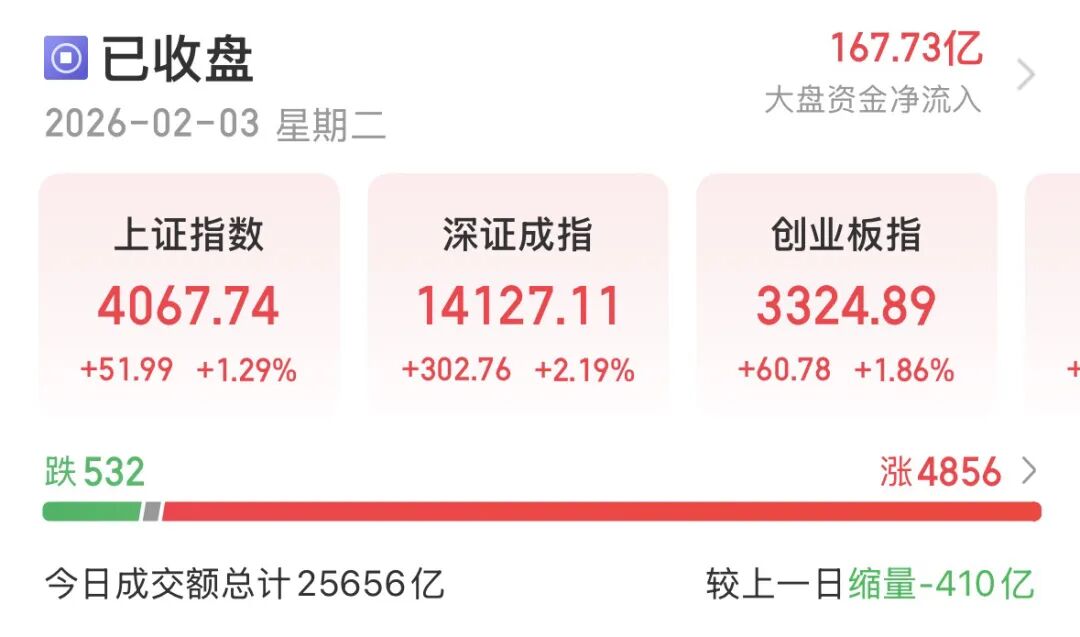
Market Overview - A-shares exhibited a "V-shaped" trend with a total trading volume of 2.67 trillion yuan, despite a slight contraction in volume [1][5] - The market showed a good profit effect with 4,856 stocks closing in the green, particularly in technology sectors such as military, machinery, and power equipment, as well as resource sectors like non-ferrous metals, steel, and chemicals [1][12] Sector Performance - The Shanghai Composite Index rose by 1.29% to 4,067.74 points, while the ChiNext Index increased by 1.86% to 3,324.89 points, and the Shenzhen Component Index climbed by 2.19% [5] - Technology and resource stocks rebounded significantly, with specialized equipment, aerospace, optoelectronic devices, and fertilizers showing notable gains [6][12] - Among the 31 first-level industries, all but the banking sector saw gains, with 24 sectors rising over 1%, and the comprehensive sector up by 5.63% [7][11] Notable Stocks - In the machinery sector, 11 related stocks hit the daily limit, including Robotech, which surged by 20%, and other stocks like Jieput and Oatmeal Technology also saw significant increases [9][10] - The power equipment sector experienced a surge with 16 stocks hitting the daily limit, including Zairun New Energy and Aotwei, both rising by nearly 20% [10] - The non-ferrous metals sector rebounded, with notable gains from companies like Xiaocheng Technology, which rose by 18.67% [11] Market Sentiment and Outlook - Despite the positive market performance, there remains a cautious sentiment among investors, with concerns about the sustainability of the rebound due to pre-holiday risk aversion [3][15] - Analysts suggest that the current rebound is primarily driven by emotional recovery and technical corrections rather than strong fundamental support, indicating a potential for short-term volatility [12][16] - The market is expected to enter a phase of consolidation, with a likelihood of further fluctuations before establishing a more stable upward trend [19][20]
A股流动性与风格跟踪月报(202602):成长占优,大小盘表现差异收敛-20260203
CMS· 2026-02-03 14:32
Market Style Outlook - The report continues to recommend a growth style as the market is still in the spring rally phase, with the performance gap between large and small caps expected to narrow, favoring large caps first and then small caps. Recommended indices include CSI 1000, ChiNext 50, CSI 300 Quality, and CSI 800 Information [1][4][11] - Historical data from 2016 to 2025 indicates that small-cap and growth styles have a higher winning probability in February, particularly due to the upcoming Two Sessions, which historically boosts small-cap performance due to increased market risk appetite [4][11][12] Liquidity and Capital Supply-Demand - In February, incremental capital is expected to continue net inflow, with foreign capital likely to remain net inflow before the holiday and financing expected to return post-holiday. The macro liquidity environment is anticipated to remain stable and ample [2][4][26] - The stock market saw a net outflow of tracked funds in January, with financing becoming the main source of incremental capital, while ETF experienced significant net redemptions. However, new equity fund issuance has rebounded, indicating a potential recovery in risk appetite for financing funds [2][4][26] Market Sentiment and Capital Preference - In January, the overall A-share risk premium initially decreased and then increased, with technology style being relatively dominant. Small-cap growth and Sci-Tech 50 indices saw significant trading activity, while large-cap growth style remained less concentrated [3][4][11] - The report highlights that the market's risk appetite is expected to remain high leading up to the Two Sessions, which typically favors small-cap stocks due to their greater elasticity [4][11][15] Fundamental Analysis - The manufacturing PMI for January recorded at 49.3, indicating a return to contraction territory, with both production and demand showing signs of cooling. The report emphasizes the ongoing structural contradiction of insufficient domestic demand, which will continue to be a focus for policy efforts [16][17][18] - The report notes that while the price index has strengthened, the demand side has weakened more significantly, suggesting a need for policies aimed at expanding domestic demand [16][17][18] External Liquidity - The report discusses the potential impact of the newly nominated Federal Reserve Chairman's policies, which may lead to a stronger dollar in the short term, putting pressure on A-share cyclical styles. However, sectors like technology and AI, which are driven by industrial trends, are expected to be less affected [20][23][24] Capital Market Dynamics - The report indicates that foreign capital tends to significantly increase holdings before the holiday, with a tendency to slow or reverse net inflows post-holiday. This pattern is attributed to new capital allocation and rebalancing strategies by foreign investors at the beginning of the year [26][27]
有色金属周度观点-20260203
Guo Tou Qi Huo· 2026-02-03 14:27
1. Report Industry Investment Rating There is no information about the report industry investment rating in the provided content. 2. Core Viewpoints of the Report The report provides weekly viewpoints on various non - ferrous metals, analyzing their market conditions, supply - demand situations, and future trends. Each metal has its own unique characteristics and influencing factors, with different outlooks for price movements and market trends [3]. 3. Summary by Metal Copper - **Market situation**: The copper market is in an acceleration phase, with prices reaching the annual increase targets set by overseas investment banks. The copper resource premium has cooled rapidly, and the short - term price peak may deter capital allocation trading. The market may shift towards focusing on fundamentals [3]. - **Domestic supply**: In the first quarter, the global copper concentrate supply - demand is tight, and the TC is at a low level and further decreasing. Domestic smelters are still increasing production steadily in January due to high sulfuric acid prices. The开工 rate of copper products in January - February is expected to be lower than last year. The long - term narrative and weak supply - demand reality strengthen the positive market structure [3]. - **Overseas supply**: Some major copper producers like Freeport - McMoRan and Glencore are expected to have lower production in 2026 due to factors such as declining ore grades and water shortages in Chilean mines [3]. - **Trend**: Observe the ebb of market investment sentiment. Copper prices are expected to be bearish before the Spring Festival and bullish after. Pay attention to the copper price performance at the MA40 - 60 daily lines, which may attract some point - price stockpiling [3]. Aluminum and Alumina - **Alumina**: Domestic operating capacity has decreased by 150,000 tons to 9.505 million tons. The alumina market is in surplus, and the inventory has increased to 514,000 tons. The cash cost support is low, and the spot price needs large - scale production cuts to stabilize. The basis is at a low level, and the upward momentum of the futures price is weak [3]. - **Demand**: The operating rate of domestic aluminum downstream leading enterprises has decreased by 1.5% to 59.4%. High aluminum prices have suppressed downstream demand, and some processing enterprises have entered the holiday early. The apparent consumption in January is negative year - on - year [3]. - **Inventory and spot**: The overall demand is weak. The social inventory of aluminum ingots has increased by 33,000 tons to 829,000 tons, and the social inventory of aluminum rods has increased by 26,000 tons to 267,000 tons. The spot premium has declined [3]. - **Trend**: Pay attention to the support at the recent low of 23,800 yuan. If it is broken, the price may seek support at 23,000 yuan. In the current high - volatility situation, consider selling out - of - the - money call options [3]. Zinc - **Market situation**: The Shanghai zinc futures price has risen sharply and then fallen rapidly, erasing all the gains of last week on Monday [3]. - **Spot and supply**: The inventory of LME zinc has increased to 110,000 tons, and the social inventory of SBI zinc has increased to 125,700 tons. The import loss of zinc has widened. Refineries have basically completed their stockpiling, and the acceptance of high - priced zinc ore has weakened. The inventory of zinc concentrate at major Chinese ports has increased by 81,000 tons to 377,500 tons. The domestic refined zinc production is expected to decline by about 50,000 tons in February [3]. - **Consumption**: As the Spring Festival approaches, high zinc prices have significantly suppressed terminal demand. Downstream zinc enterprises have insufficient orders, and their willingness to stockpile is low [3]. - **Trend**: After high - volatility trading dominated by capital and the macro - environment, the Shanghai zinc market is expected to return to the fundamental trading logic. In February, with both supply and demand weak, the price may enter a phased range - bound after testing the cost support. Consider the rebound of TC as a signal of further decline [3]. Lead - **Market situation**: The "Wash Panic" last week led to a decline in the valuation of the non - ferrous metal sector, which resonated with the oversupply of lead. The Shanghai lead market is in a weak downward trend and continues to trade at a low level [3]. - **Spot and supply**: The LME lead inventory has decreased to 205,600 tons, and the spot is at a discount. The import profit of lead ingots is over 300 yuan/ton. The supply pressure from the overseas market is transmitted to the domestic market. The social inventory of SBI lead has increased to 36,700 tons. The plan to use recycled lead as an alternative delivery product has weakened the impact of the low supply of deliverable products in the Shanghai lead market. The profit of recycled lead refineries is poor, and the production cut area has expanded [3]. - **Consumption**: As the Spring Festival atmosphere thickens, downstream enterprises have gradually reduced production and taken holidays. The finished product inventory of most battery enterprises is 25 - 30 days, and some have over 30 days. The pre - holiday stockpiling enthusiasm is general [3]. - **Trend**: The short - term concentrated release of bearish sentiment in the market. Lead still needs to pay attention to the bottom - cost support. Although the refineries are reluctant to sell and the downstream rigid - demand procurement has recovered, the supply and demand are weak during the Spring Festival. It is advisable to view the market as a range - bound around the cost line [3]. Nickel and Stainless Steel - **Investment**: The Shanghai nickel futures price has dropped sharply from a high level, and the trading volume has decreased. The open interest has slowly recovered. The Shanghai stainless steel market shows a similar trend, with an increase in trading volume [3]. - **Macro and demand**: The external sentiment has collapsed, and the weak fundamentals of nickel cannot support the price. Under the expectation of a shortage of nickel ore supply, the spot market shows some resistance. Downstream terminals are afraid of high prices, and the actual trading is weak. The inventory of steel mills is still at a low level, and traders are cautious [3]. - **Spot and supply**: The premium of Jinchuan nickel is 9,250 yuan, the import nickel is at a discount of 50 yuan, and the electrowinning nickel is at par. The spot price of Jinchuan nickel is resistant to decline, and the price of high - nickel iron has started to rebound. The market is currently dominated by policy sentiment [3]. - **Conclusion and strategy**: As the market shows fear of high prices, it is recommended to be cautious [3]. Tin - **Market situation**: After the risk - control upgrade of the Shanghai Futures Exchange, the Shanghai tin futures price rose briefly last week, but the premium - pulling effect was restricted. After the market sentiment reversed on Thursday night, the price fell rapidly and hit the limit down on Monday. The market reduced its positions. The price decline is temporarily limited by the pre - Spring Festival rigid - demand stockpiling [3]. - **Supply**: The Indonesian tin exchange started tin ingot trading in mid - January, and the country's tin production quota is expected to remain stable in 2026. The supply in southern Myanmar is basically normal, and the production in Wa State has resumed. The domestic tin concentrate processing fee has been raised, and the production of primary tin is stable in the first two months, while the production of recycled tin is restricted by raw material supply [3]. - **Consumption**: Under high tin prices, the tin market demand is uneven. The rapid decline in silver prices is beneficial for the first - quarter production rush in the photovoltaic industry. However, the expected increase in photovoltaic components in Q1 is limited, and the impact on tin consumption is also limited. The LME tin inventory is 7,095 tons, and the domestic social inventory has increased by 555 tons to 11,556 tons [3]. - **Trend**: The previously recommended short - call option on the 2603 contract can be closed [3]. Lithium Carbonate - **Futures**: The lithium carbonate futures price has corrected from a high level. The high - priced lithium carbonate has led to a large number of hedging positions being closed, and long - position liquidation is the mainstream. The position structure is fragile [3]. - **Spot**: The spot price of electric - grade lithium carbonate has corrected. The price of electric - grade lithium carbonate is 156,000 yuan, and the price difference between industrial - grade and electric - grade is 3,500 yuan. Upstream mines are not eager to sell, and downstream enterprises have sufficient inventory and are reducing new orders. There are some point - price orders due to the price decline [3]. - **Macro and demand**: Lithium - iron enterprises are actively producing, and the overall situation is similar to last week. The downstream demand is stable, and the demand for power and energy - storage cells has not decreased significantly under the influence of the export - tax - rebate policy [3]. - **Supply**: The confidence of traders in hoarding goods has weakened, and the inventory in the middle - stream is high. There may be selling pressure in the spot market. The price of Australian ore remains strong at 2,090 US dollars [3]. - **Trend**: The price is in a high - level range - bound, with extremely high short - term uncertainty. Pay attention to risk prevention [3]. Industrial Silicon - **Price**: The operating center of industrial silicon futures has moved up, and the price has reached 9,000 yuan/ton. The spot point - price range is concentrated at 8,950 - 9,000 yuan/ton. Downstream pre - holiday stockpiling is coming to an end, and the market has returned to the on - demand procurement rhythm [3]. - **Supply - demand**: A leading silicon enterprise in Xinjiang plans to cut production by 50% at the end of January. If implemented, the industry supply in February may decrease by about 60,000 tons. The overall industry operating rate continues to decline. The production of downstream polysilicon is expected to be 103,800 tons in January and 90,000 tons in February. The operating rate of organic silicon monomers is expected to decline due to maintenance plans in February. The operating rates of aluminum alloy enterprises are divided [3]. - **Inventory**: The current inventory of industrial silicon is at a high level, reaching 554,000 tons, with a slight decrease of 2,000 tons compared to last week [3]. - **Trend**: The market is expected to switch to a de - stocking pattern in February. However, due to the continuous increase in the northern factory inventory, there is still hedging pressure. Although there is marginal improvement in the fundamentals, the short - term sentiment is still affected by the repeated production - cut expectations, and the overall trend is oscillating upwards [3]. Polysilicon - **Price**: Affected by the decline in precious - metal prices and spot quotes, the polysilicon futures price has fallen below the previous low, closing at around 47,000 yuan/ton. The spot - market price range of traders is 45,000 - 49,000 yuan/ton. Leading enterprises support the price through production cuts [3]. - **Supply - demand**: The polysilicon production is expected to be 103,800 tons in January and 90,000 tons in February. The silicon - wafer production is 459,360 MW in January and is expected to be 453,100 MW in February, with little change. Although leading polysilicon enterprises have cut production, the silicon - wafer end is cautious about increasing production. The export volume of polysilicon is limited, and the industry has over - expanded in the past. The price of silver auxiliary materials has declined but still provides medium - term support. The battery - cell and component sectors focus on de - stocking, and the demand for upstream polysilicon is limited [3]. - **Inventory**: The factory inventory of polysilicon has increased to 333,000 tons, with a weekly increase of 300 tons. The number of physical - delivery warehouse receipts has increased by 1,570 lots. The overall industry inventory pressure is significant [3]. - **Trend**: The polysilicon industry meeting emphasizes curbing industry involution. Although there is an expectation of rush - exporting in the spot market, the high price of silver auxiliary materials restricts the production - increasing willingness of downstream sectors. The demand for polysilicon is limited. Under the production - cut measures of leading enterprises, the industry de - stocking pressure still needs to be alleviated. The market sentiment is weak, and the spot price continues to decline. The polysilicon futures price is expected to continue to be under pressure. Pay attention to the actual spot transactions in the later stage [3].