航空

Search documents
多重因素推动红利资产配置价值,港股通红利低波ETF(159117)涨超1.1%
Sou Hu Cai Jing· 2025-11-10 06:22
Group 1 - The market is expected to maintain a stable risk appetite and profit expectations as it enters a macroeconomic event and corporate financial data vacuum period from the end of this year to early next year [1] - The technology sector led the gains in Q3, while the dividend sector experienced an overall pullback; the combination of stable risk appetite, balanced market style, and medium to long-term capital allocation demand is likely to enhance the value of dividend asset allocation [1] Group 2 - In the oil and petrochemical sector, global crude oil supply and demand expectations are stable, with oil prices fluctuating within a range; leading companies possess high dividend yield advantages [1] - In the aviation sector, high passenger load factors, market-driven ticket pricing, and a slowdown in fleet growth are expected to support the continuous rise of industry profitability [1] - Hong Kong bank stocks have recently performed well, with higher dividend yields compared to A-shares; state-owned banks have an overall yield above 5%, making them more attractive to institutions seeking stable cash flow [1] - Tax advantages for insurance companies holding H-shares for over 12 months allow them to exempt corporate income tax on dividend income, further amplifying the appeal of high dividend characteristics [1] - Among A/H listed banks, except for China Merchants Bank, A-shares generally trade at a premium to H-shares, with the premium rate for the four major banks ranging from 23% to 35%, allowing for lower funding costs when allocating to Hong Kong bank stocks [1] - The Hong Kong Stock Connect Dividend Low Volatility ETF (159117) rose by 1.15%, with the latest price at 1.06 yuan as of November 10, 2025 [1]
美泰对等贸易框架协议公布
Mei Ri Jing Ji Xin Wen· 2025-11-10 06:12
Core Points - The U.S. and Thailand have reached a joint statement regarding a framework for a bilateral trade agreement, focusing on tariff reductions and non-tariff barriers [1] - Thailand will eliminate tariffs on 99% of goods, covering all U.S. industrial products, food, and agricultural products, while the U.S. will maintain a 19% tariff on Thai goods, with some exceptions [1] - Thailand commits to addressing non-tariff barriers for U.S. industrial products, food, and services, including accepting U.S. standards and certifications [1] Tariff Summary - Thailand will remove tariffs on 99% of goods, impacting all U.S. industrial products, food, and agricultural products [1] - The U.S. will keep a 19% tariff on Thai goods, but certain items listed in a specific executive order will have zero tariffs [1] Non-Tariff Barriers - Thailand will accept U.S. manufactured vehicles that meet U.S. standards and U.S. FDA-approved medical products [1] - Thailand will expedite the entry of U.S. certified meat, poultry, and horticultural products into its market [1] - Thailand will not impose a digital services tax and will ensure the free transmission of data across borders [1] Trade Commitments - Thailand will purchase approximately $2.6 billion worth of U.S. agricultural products annually, including feed corn and soybean meal [1] - Thailand will also buy about $5.4 billion in U.S. energy products each year, including LNG, crude oil, and ethane [1] - An order for 80 U.S. aircraft is included, totaling $18.8 billion [1] Future Negotiations - The U.S. and Thailand will negotiate the "Reciprocal Trade Agreement" in the coming weeks, preparing for signing and domestic procedures to implement the agreement [1]
利好来了!千亿巨头,涨停
中国基金报· 2025-11-10 05:07
Core Viewpoint - The consumer sector experienced significant upward movement, with China Duty Free Group hitting a trading limit and reaching a nearly two-year high in stock price [6][10]. Market Performance - On November 10, the A-share market showed a downward trend, with the ChiNext Index falling over 2%, while the Shanghai Composite Index and Shenzhen Component Index saw minor declines of 0.03% and 0.59%, respectively [2][3]. - The total trading volume reached 1.45 trillion CNY, with a predicted increase to 2.28 trillion CNY, reflecting a rise of 262.9 billion CNY [3]. Sector Analysis - The consumer sector, particularly food and beverage and duty-free segments, led the market gains, while sectors like engineering machinery and electronic components faced declines [3][6]. - The lithium battery sector showed resilience, with notable activity in chemical, semiconductor, and superhard materials sectors [3]. Stock Highlights - China Duty Free Group's stock reached a peak of 86.89 CNY, with a trading volume of 874,400 shares and a market capitalization of 179.76 billion CNY [8]. - Other stocks in the food and beverage sector, such as Dongbai Group and Sanyuan Foods, also saw significant gains, with some stocks hitting their trading limits [10][11]. Economic Indicators - The recent implementation of new duty-free policies in Hainan resulted in a 34.86% year-on-year increase in duty-free shopping amounts, totaling 506 million CNY, with 72,900 shoppers participating [10]. - The Consumer Price Index (CPI) showed a 0.2% month-on-month and year-on-year increase, indicating a positive trend in consumer spending [10][12]. Policy Support - The Ministry of Finance announced continued efforts to boost consumption through fiscal subsidies for personal consumption loans, particularly in key sectors like elderly care and childcare [12].


【立方早知道】利好来了!国办重磅发文/新能源车购置税明年起减半/新央企重组来了
Sou Hu Cai Jing· 2025-11-10 04:07
Group 1: Corporate Developments - China Aviation Oil (Singapore) Corporation Limited announced a restructuring with another enterprise group, pending approval, with no significant impact on normal operations expected [1] - Tianjun Technology's controlling shareholder donated shares and cash to educational foundations, with no change in control or governance structure [19] - Weixin Technology plans to raise up to 2.937 billion yuan through a private placement, potentially leading to a change in control [20] Group 2: Economic Indicators - In October, the Consumer Price Index (CPI) rose by 0.2% month-on-month and year-on-year, with core CPI increasing by 1.2%, marking the sixth consecutive month of growth [4] - The Producer Price Index (PPI) saw a month-on-month increase of 0.1%, the first rise this year, while the year-on-year decline narrowed to 2.1% [4] Group 3: Industry Trends - From January 1, 2026, the purchase tax for new energy vehicles will shift from full exemption to a 50% reduction, leading to a surge in market demand [7] - The State Council released a significant policy on "scene cultivation and opening," outlining 22 key scenarios across various sectors, including digital economy and clean energy [3] Group 4: Market Movements - The stock of Weixin Technology will resume trading on November 10, 2025, following the announcement of its fundraising plan [20] - The tourism sector is set to see a new IPO with the approval of Shaanxi Tourism's application, marking a significant event after a four-year hiatus in tourism company listings [15]
周期论剑|三季报深度挖掘
2025-11-10 03:34
Summary of Key Points from Conference Call Records Industry Overview - The conference call discusses the Chinese stock market, focusing on the transition to a valuation recovery and expansion cycle, driven by factors such as the decline in risk-free returns, capital market reforms, and economic transformation certainty [1][3][4]. Market Predictions - The stock market is expected to challenge ten-year highs by 2026, with a broad valuation reshaping across various sectors, particularly in emerging technology, manufacturing, and financial sectors post-economic stabilization [1][4]. - Short-term predictions indicate lithium carbonate prices may peak at 87,000 CNY/ton in November 2025, with a potential drop to around 75,000 CNY/ton by early 2026. Long-term expectations suggest a price range of 60,000-70,000 CNY/ton for 2026 [1][5]. Chemical Industry Insights - The chemical industry is currently at a low point, with net profits hitting a 20-year low. However, a decrease in capital expenditure and potential demand recovery may improve the industry's outlook by 2026. Recommended stocks include leading companies in coal chemicals, spandex, and soda ash [1][7][8]. Transportation Sector Opportunities - The aviation and oil transportation sectors are highlighted as having significant investment potential. The aviation industry benefits from market-driven ticket pricing and a slowdown in fleet growth, while oil transportation is supported by an increase in crude oil production and geopolitical factors. Recommended companies include China National Airlines, Spring Airlines, and COSCO Shipping Energy [1][2][9][11]. Lithium Battery Sector - The lithium battery sector is expected to see a significant increase in demand, with global energy storage demand projected to grow by 55% year-on-year in 2026. The overall lithium battery production is anticipated to rise from 2,100 GWh in 2025 to 2,700 GWh, leading to a demand increase of 400,000 tons of lithium carbonate [5][6]. Public Utilities Sector - The public utilities sector is experiencing stable conditions, with optimistic long-term price expectations for the northern region. Companies in thermal power, hydropower, and cost-effective wind and solar power are recommended for investment [1][29][30]. Real Estate and Property Management - The real estate sector faces challenges, with companies expecting to resolve historical issues over the next three years. However, new projects show higher profit margins, and the focus is shifting towards profitability rather than scale. The property management sector is also under pressure due to rising costs and collection difficulties, but there are opportunities for high-quality service providers [22][24]. Construction Industry Outlook - The construction industry is entering a phase of potential recovery, with expectations of policy support in the coming months. Companies involved in traditional infrastructure and resource sectors are recommended for investment [28]. Steel Industry Performance - The steel industry is showing positive performance, with leading companies exceeding expectations. The outlook for 2026 suggests a gradual recovery in demand, continued supply contraction, and improved cash flow for leading firms [21]. Summary of Recommendations - Focus on leading companies in various sectors, including: - **Chemical Industry**: Hualu Chemical, Huafeng Chemical, and Boyuan Chemical [8][10]. - **Aviation**: China National Airlines, Spring Airlines, and China Eastern Airlines [11]. - **Public Utilities**: Companies in thermal and hydropower sectors [30]. - **Construction**: China Railway Construction and China Communications Construction [28]. This summary encapsulates the key insights and recommendations from the conference call, providing a comprehensive overview of the current market landscape and future expectations across various industries.
格隆汇港股聚焦(02.18)︱中国人保1月原保费收入979.85亿元;蓝光嘉宝服务拟回购不超10%H股
Ge Long Hui· 2025-11-10 01:26
Major Events - Bluestar Jiahe Services (02606.HK) plans to repurchase up to 10% of its issued H-shares [1] - China People's Insurance Group (01339.HK) reported original premium income of 97.985 billion yuan in January, a year-on-year increase of 6.67% [1] - Hengteng Network (00136.HK) signed a strategic cooperation agreement with Evergrande Tourism Group [1] Financial Data - New Star Printing (01975.HK) achieved a net profit of 27.5 million HKD in the interim period, with an interim dividend of 1.5 HKD cents [1] Earnings Forecast - Qihua Environmental Protection (00976.HK) expects an increase in annual net loss [1] - Zhuyou Intelligent Manufacturing Technology (00726.HK) anticipates a net profit increase of approximately 40.8% for the year [1] - Birmingham Sports (02309.HK) raised its earnings forecast, expecting a mid-term profit of 70 million HKD [1] - Huazhang Technology (01673.HK) expects a mid-term profit of 15 to 20 million yuan, turning from loss to profit year-on-year [1] - Raffles Interior (01376.HK) anticipates a net loss of 4.5 million Singapore dollars for the 2020 fiscal year [1] - Fengcheng Holdings (08216.HK) expects a net profit increase of over 50% for the year [1] - New Fengtai Group (01771.HK) forecasts a net profit growth of approximately 20% for the year [1] - Yefeng Group (01695.HK) expects an annual loss not exceeding 4 million Malaysian ringgit [1] Operational Data - China People's Insurance Group (01339.HK) reported original premium income of 97.985 billion yuan in January, a year-on-year increase of 6.67% [1] - New China Life Insurance (01336.HK) reported original premium income of 34.63 billion yuan in January, a year-on-year increase of 12.78% [1] - China Property & Casualty Insurance (02328.HK) reported original insurance premium income of 53.112 billion yuan in January, a year-on-year increase of 1.2% [1] - China Metallurgical Group (01618.HK) signed new contracts worth 103.59 billion yuan in January, a year-on-year increase of 129.7% [1] - China Eastern Airlines (00670.HK) reported a 60.59% year-on-year decline in passenger turnover in January [1] - Sinopec Oilfield Services (01033.HK) recently signed overseas contracts worth 2.323 billion yuan [1] - China Southern Airlines (01055.HK) reported a 59.16% year-on-year decline in passenger turnover in January [1] - Huili Group (00806.HK) reported total managed assets of approximately 14.8 billion USD at the end of January [1]

新华财经早报:11月10日
Xin Hua Cai Jing· 2025-11-10 00:57
据中国人民银行官网,2025年11月7日,第三次中瑞部级金融会议在瑞士伯尔尼举行。中国人民银行副行长宣昌能与瑞士联邦财政部国务秘书斯托菲尔共同 主持会议。中国人民银行、国家金融监管总局、中国证监会、国家外汇管理局和瑞士联邦财政部、瑞士国家银行、瑞士金融市场监管局参会。双方围绕经济 金融形势、全球金融治理、双边金融监管合作、本币合作、金融市场互联互通、数字创新和可持续金融等议题进行了深入交流。中方还向瑞方介绍了二十届 四中全会精神和"十五五"规划的主要内容。(新华财经) 国家统计局9日发布数据显示,10月份,扩内需等政策措施持续显效,叠加国庆中秋假期带动,全国居民消费价格指数(CPI)环比上涨0.2%,同比上涨 0.2%,扣除食品和能源价格的核心CPI同比上涨1.2%,涨幅连续第6个月扩大。受国内部分行业供需关系改善、国际大宗商品价格传导等因素影响,工业生 产者出厂价格指数(PPI)环比由上月持平转为上涨0.1%,为年内首次上涨;同比下降2.1%,降幅比上月收窄0.2个百分点,连续第3个月收窄。(新华财 经) 商务部新闻发言人9日就欧方关于安世半导体问题的声明答记者问时表示,欢迎欧方继续发挥影响力,促荷方尽快纠 ...

8点1氪丨水贝市场暂时处于半停滞状态;中储粮项目事故致7死调查报告公布;Meta去年靠诈骗广告赚了约160亿美元
3 6 Ke· 2025-11-09 23:55
Group 1 - The Chinese government will adjust the new energy vehicle purchase tax from full exemption to a 50% reduction starting January 1, 2026, which is expected to create a new consumption peak in the market [3][4] - Industry insiders believe that the stricter technical thresholds will compel automakers to increase investment in core technology research and development, focusing on product quality and efficiency rather than relying solely on policy benefits [4] Group 2 - Pfizer has agreed to acquire Metsera for up to $10 billion, successfully outbidding Novo Nordisk amid regulatory challenges faced by the latter [7] - Meta's internal documents reveal that approximately 10% of its revenue, around $16 billion, comes from fraudulent and prohibited advertisements, highlighting significant regulatory gaps in its advertising business [2][3] Group 3 - The sales revenue of the Pang Donglai Group has surpassed 20 billion yuan, exceeding last year's total by 3 billion yuan, despite the company's intention to control sales growth [4] - Major fast-food chains, including McDonald's, have issued warnings about declining consumer spending among low-income customers in the U.S., which could have significant implications for the overall economy [7]

财经早报:谷歌最强芯片来袭 英伟达“烧钱”散热丨2025年11月10日
Xin Lang Zheng Quan· 2025-11-09 23:48
Group 1 - The Ministry of Commerce of China responded to the EU's statement regarding ASML, emphasizing that the source of the global semiconductor supply chain chaos lies with the Netherlands and urging the EU to work towards resolving the issue [2] - The Ministry of Commerce announced adjustments to export controls on dual-use items to the US, including a ban on exports to military users and stricter reviews for certain materials [3] - The Consumer Price Index (CPI) in October showed a year-on-year increase of 0.2%, marking a shift from decline to growth, while the core CPI rose by 1.2%, the highest since March 2024 [5] Group 2 - The State Council issued an opinion to promote the large-scale application of new scenarios, focusing on five areas and proposing 22 key scenarios for development [6] - The Ministry of Finance outlined six key areas for fiscal policy, including boosting consumption and supporting employment and foreign trade [7] - New financing and margin trading accounts decreased in October, but the total number of accounts reached approximately 15.4 million, with a margin balance of 2.49 trillion yuan [8] Group 3 - China Eastern Airlines resumed flights on the China-India route after five years, with a high passenger load factor of over 95% [10] - The Chinese government plans to adjust the purchase tax for new energy vehicles from full exemption to a 50% reduction starting January 1, 2024, leading to a surge in orders [11] - The restructuring of state-owned energy enterprises is underway, with significant announcements expected [12] Group 4 - JD.com announced the launch of a new electric vehicle priced at 49,900 yuan for battery rental and 89,900 yuan for full purchase, aiming to attract consumers [13] - NVIDIA's market value dropped by $45.51 billion in four days due to short selling, while CEO Jensen Huang visited TSMC to secure more chips [16] - The sales revenue of Pang Donglai Group exceeded 20 billion yuan, marking a significant increase compared to the previous year [17] Group 5 - The semiconductor industry is entering a critical two-year window, with lithium hexafluorophosphate prices reaching 120,000 yuan per ton, indicating a favorable cycle [18] - The market for lithium iron phosphate is thriving, with leading manufacturers experiencing full order books and competition for high-end capacity [18] - The sports events are driving the cultural tourism market, contributing to its continuous growth [18]


科技赛道仍是主线焦点 4000亿消费电子龙头立讯精密获220多家机构调研
Zhong Guo Zheng Quan Bao· 2025-11-09 21:37
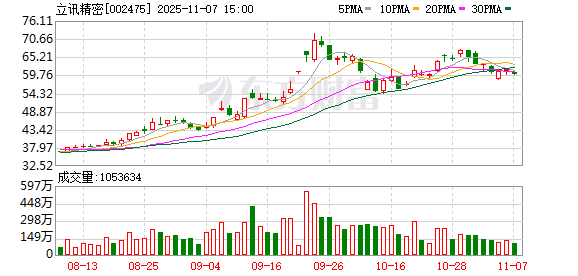
Core Insights - Over 400 A-share listed companies have been investigated by institutions since November, with Lixun Precision receiving the most attention from over 200 institutions [2][3] - The focus of institutional research is on "hard technology" sectors such as electronic components and integrated circuits [2][8] Company-Specific Insights - Lixun Precision's stock price was reported at 59.9 yuan per share, with a market capitalization of 436.2 billion yuan as of November 7 [2] - During the investigations, Lixun Precision was asked about its future technology focus in the context of the AI era, emphasizing the need for advancements in both hardware and software capabilities [4] - Tongyu Communication discussed its proactive technological layout in the transition from 5G to 6G, highlighting its focus on multi-beam communication and low-orbit satellite internet as core infrastructure for future developments [5] Industry Trends - The "14th Five-Year Plan" development strategies of listed companies are a key area of interest for institutions, with companies like HNA Holding and China Energy Construction outlining their future plans [7] - The technology sector remains a focal point for investment, with institutions recommending attention to semiconductor manufacturing, new energy systems, quantum technology, and AI applications [8]