
软件

Search documents
中原证券晨会聚焦-20251028
Zhongyuan Securities· 2025-10-28 02:15
Core Insights - The report highlights the ongoing recovery and growth in various sectors of the Chinese economy, particularly in the automotive and AI industries, driven by favorable policies and market dynamics [5][21][24] - The A-share market is experiencing a steady upward trend, supported by positive macroeconomic indicators and government strategies aimed at enhancing capital market quality [8][14][15] Domestic Market Performance - The Shanghai Composite Index closed at 3,996.94, with a daily increase of 1.18%, while the Shenzhen Component Index rose by 1.51% to 13,489.40 [3] - The average price-to-earnings ratios for the Shanghai Composite and ChiNext are 16.18 and 49.51, respectively, indicating a favorable environment for medium to long-term investments [8][14] Industry Analysis - The automotive industry achieved record production and sales figures in September 2025, with 3.28 million vehicles produced and 3.23 million sold, marking year-on-year increases of 17.15% and 14.86% respectively [21][22] - The new energy vehicle penetration rate reached 49.72% in September, reflecting strong growth in this segment [22] - The software industry is witnessing a continuous increase in revenue, with a 12.6% year-on-year growth in the first eight months of 2025, driven by domestic demand and technological advancements [24][25] Investment Recommendations - The report suggests maintaining a "stronger than market" rating for the automotive sector, focusing on the impact of policies promoting vehicle upgrades and the commercialization of smart driving technologies [23] - In the AI sector, companies like DeepSeek are making significant advancements in model efficiency, which could enhance the overall market potential for AI applications [37][38] - The report emphasizes the importance of investing in companies that are adapting to the evolving landscape of IP derivatives and digital consumption trends, particularly among younger consumer demographics [19][20]

硅谷“大裁员”何时休?
虎嗅APP· 2025-10-28 01:06
Group 1 - The article discusses the significant layoffs in Silicon Valley, with over 100,000 positions cut globally in the tech industry in 2023, driven primarily by the rise of artificial intelligence (AI) and economic uncertainty [11][8][4] - Major companies like Salesforce and Meta have implemented layoffs, with Salesforce cutting approximately 8,000 jobs in 2023 and an additional 1,000 in 2024, while announcing further cuts in 2025 [18][19] - AI is reshaping the workforce, leading to a reduction in traditional roles while simultaneously increasing demand for AI specialists and engineers [55][56] Group 2 - Companies are balancing layoffs with recruitment in AI fields, as seen with Salesforce planning to hire 5,000 salespeople for AI products despite cutting 4,000 customer service roles [56][32] - Microsoft and Amazon have also made significant cuts, with Microsoft reducing over 6,500 positions in 2024 to focus on AI product development [24][25] - Traditional industries, including automotive and retail, are not immune to these trends, with companies like General Motors and Starbucks also announcing layoffs [44][45] Group 3 - Startups and unicorns are also undergoing transformations, with companies like Fiverr and Yotpo cutting significant portions of their workforce to focus on AI-driven products [34][35] - The article highlights that even AI-focused companies are not exempt from layoffs, as seen with Scale AI and xAI reducing their workforce to optimize operations [37][39] - The overall trend indicates a shift in the job market, where lower-skilled positions are being replaced by higher-skilled roles in AI and technology [53][54]



隔夜美股 | 三大指数均创历史新高 苹果(AAPL.US)市值逼近4万亿美元
智通财经网· 2025-10-27 22:30
Market Overview - The three major indices reached historical highs, with the S&P 500 closing above 6800 points for the first time, driven by eased international trade tensions [1] - The Dow Jones increased by 337.47 points (0.71%) to 47544.59, the Nasdaq rose by 432.59 points (1.86%) to 23637.46, and the S&P 500 gained 83.47 points (1.23%) to 6875.16 [1] U.S. Stocks - Apple (AAPL.US) rose by 2.2%, nearing a market capitalization of $4 trillion [1] - Tesla (TSLA.US) increased by 4%, and Qualcomm (QCOM.US) surged by 11% [1] - The Nasdaq Golden Dragon China Index rose by 1.58%, with Xpeng Motors (XPEV.US) up over 6% and Baidu (BIDU.US) up 4.8% [1] European Stocks - The DAX30 index in Germany rose by 72.95 points (0.30%) to 24316.92 [2] - The FTSE 100 in the UK increased by 6.18 points (0.06%) to 9651.80, while the CAC40 in France rose by 13.55 points (0.16%) to 8239.18 [2] - The Euro Stoxx 50 index gained 34.95 points (0.62%) to 5709.45, and the IBEX35 in Spain rose by 135.80 points (0.86%) to 15993.20 [2] Oil Market - Light crude oil futures for December fell by $0.19 to $61.31 per barrel (down 0.31%), while Brent crude oil futures dropped by $0.32 to $65.62 per barrel (down 0.49%) [3] - OPEC+ is likely to agree on a small production increase of 137,000 barrels per day in December, following a cumulative increase of over 2.7 million barrels per day since April [3] Cryptocurrency Market - Bitcoin decreased by 0.2% to $114,328.6, and Ethereum fell by 0.82% to $4,125.06 [4] - The gold price dropped over 3%, closing at $3,982.67, as market sentiment improved due to eased trade tensions [4] Macroeconomic Insights - The Federal Reserve is expected to lower the federal funds rate by 25 basis points to a target range of 3.75%-4.0% [5] - A potential split in voting among decision-makers is anticipated, with some favoring a larger cut of 50 basis points [5] Employment Data - The Chicago Fed estimates that the U.S. unemployment rate remained stable at 4.35% in October, compared to 4.34% in September [6] Regulatory Changes - The UK plans to abolish the requirement for short sellers to disclose their identities, moving towards a system similar to that of the U.S. [7] Company Developments - Nvidia (NVDA.US) and Deutsche Telekom are set to jointly invest €1 billion (approximately $1.2 billion) in an AI data center in Germany [8] - Qualcomm (QCOM.US) launched two AI chips aimed at the data center market, with plans for commercialization starting next year [9] - IBM (IBM.US) is launching a digital asset platform to assist financial institutions and businesses in blockchain services [9] - Meta Platforms (META.US) appointed Vishal Shah to a key role in its AI team as part of a strategic shift [10] Analyst Ratings - Berkshire Hathaway (BRK.A.US, BRK.B.US) received a rare "sell" rating from KBW, citing concerns over its earnings outlook and macro risks [11]


看不起的软件 今晚业绩都很好
小熊跑的快· 2025-10-27 13:13
Core Viewpoint - The market has largely written off the software sector, especially after Morgan Stanley's prediction of "AI killing software," leading to a 7-month decline in software stocks. However, recent earnings reports from several companies have exceeded expectations, indicating a potential turning point in market sentiment [1]. Group 1: Company Performance - Kingsoft Office, Dameng, Deepin Technology, and Nankai have all reported better-than-expected earnings, suggesting a recovery in the sector that has been largely ignored by the market for a long time [1]. - The military information technology sector is also showing positive performance, contributing to the overall optimism in the software industry [1]. Group 2: Market Sentiment - Public fund holdings in the computer sector are currently below 2%, reflecting a lack of confidence and interest from investors [1]. - The recent positive earnings reports may signal a shift in market expectations, indicating that the sector could be on the verge of a turnaround [1].

四只私募基金在琼签约 首期规模超20亿元投向新兴产业
Zhong Guo Xin Wen Wang· 2025-10-27 13:08
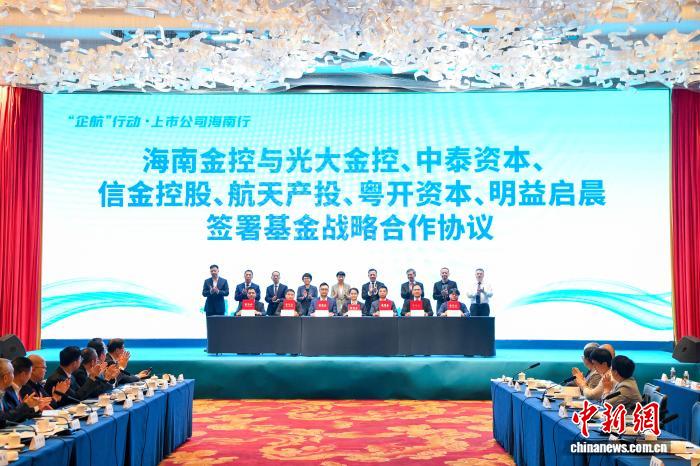
Group 1 - The "Qihang" action's "Listed Companies Hainan Tour"招商大会 and signing ceremony took place in Haikou, with four strategic cooperation agreements signed, aiming to raise over 2 billion RMB for emerging industries such as aerospace, low-altitude economy, intelligent manufacturing, high-end equipment, and digital information [1][3] - A total of 12 companies, including Shandong Gold Group and Zhongtai Securities, signed investment intention letters during the event, which attracted over 90 companies nationwide, including 70 listed companies with a total market value exceeding 1.6 trillion RMB [3][4] - The event highlighted the advantages of Hainan's free trade port policies, with companies expressing intentions to deepen cooperation in regional funds, industrial funds, and mergers and acquisitions to seize opportunities in high-tech industry development [3][4] Group 2 - The signing of the "Initiative to Support the Development of Hainan Free Trade Port" by participating companies aims to build cooperation bridges, introduce advanced international technologies, mature management experiences, and quality projects to promote Hainan as a headquarters base for Chinese enterprises going global and foreign enterprises coming in [5]

金山办公:Q3净利同比增35.42%,三大主营业务营收均实现双位数增长
Ge Long Hui· 2025-10-27 11:48
Core Insights - Kingsoft Office (688111.SH) reported strong Q3 2025 financial results, with revenue of 1.521 billion yuan, a year-on-year increase of 25.33% [1] - The net profit attributable to shareholders reached 431 million yuan, up 35.42% year-on-year, while the net profit excluding non-recurring items was 421 million yuan, reflecting a 39.01% increase [1] - The company generated a net cash flow from operating activities of 538 million yuan, marking a 19.30% year-on-year growth [1] Revenue Breakdown - All three main business segments of Kingsoft Office achieved double-digit revenue growth in Q3 [1] - WPS 365 business revenue surged to 201 million yuan, a significant increase of 71.61% year-on-year [1] - WPS personal business revenue was 899 million yuan, growing by 11.18% year-on-year [1] - WPS software business revenue reached 391 million yuan, up 50.52% year-on-year [1] R&D Investment - Kingsoft Office's R&D expenditure for Q3 was 536 million yuan, representing an 18.08% increase year-on-year [1] - The R&D expense ratio stood at 35.24%, indicating a strong commitment to product development and iteration [1]

北京全力推动四季度160项重点项目开工
Xin Jing Bao· 2025-10-27 11:23
Economic Overview - Beijing's GDP reached 3.8 trillion yuan in the first three quarters of 2025, with a year-on-year growth of 5.6% [1] - The city plans to implement six major special actions in the fourth quarter to promote sustained economic development across various sectors [1] Investment and Infrastructure - The municipal government will allocate 74 billion yuan in fixed asset investment by the end of October 2025 [2] - A total of 155 local government special bond projects have been issued, amounting to 108.2 billion yuan [2] - The city aims to initiate 160 key projects in the fourth quarter, focusing on urban renewal and quality land supply near transit areas [2] Industry Development - Beijing will introduce new reform measures in technology transfer and talent incentives, particularly in the Zhongguancun area [3] - The city is focusing on stabilizing production in key sectors such as new energy vehicles and pharmaceuticals, while promoting digital and green economy initiatives [3][7] - The number of enterprises with technology innovation centers has reached 1,475, with over 1,000 recognized as "little giant" enterprises [6][7] Consumer Trends - The total retail sales in Beijing reached 980.31 billion yuan in the first three quarters, reflecting a 5.1% decline year-on-year [8] - Service consumption accounted for 59.8% of total consumption, marking the highest level in five years, indicating a shift towards service-oriented spending [8] - The city is leveraging digital technologies to enhance personalized consumption experiences, particularly in education, culture, and entertainment sectors [8] Social Development - Significant progress has been made in social welfare initiatives, including the establishment of new elderly care centers and the expansion of educational facilities [4][5] - The city plans to enhance employment support and improve living standards through various community services and infrastructure projects [5]
推进国产图示应用迈入智能化时代 万兴科技发布万兴图示V15
Zheng Quan Ri Bao Wang· 2025-10-27 11:16
Core Insights - Wankey Technology has launched the upgraded Wankey Diagram V15 desktop application, focusing on AI drawing and intelligent office efficiency [1] - The integration of AI capabilities and templates aims to enhance the user experience in visualizing information [1] - The company is committed to expanding intelligent office scenarios and providing professional visualization solutions [1] Company Overview - Wankey Technology operates in the digital creative software sector, with products available in over 200 countries and regions [1] - The company has developed several popular products, including Wankey Miao Ying, Wankey Diagram, and Wankey Mind Map [1] Industry Trends - The integration of AIGC (AI-Generated Content) is reshaping the innovation pathways in drawing and visualization [1] - The launch of Wankey Diagram V15 represents a significant step in the deep integration of AI drawing and office applications within the industry [1]
金山软件(03888.HK):金山办公第三季度净利润约为4.63亿元 同比增加39.38%
Ge Long Hui· 2025-10-27 11:08
Core Viewpoint - Kingsoft Software (03888.HK) reported strong financial results for its subsidiary, Beijing Kingsoft Office Software Co., Ltd., indicating significant growth in both revenue and net profit for the third quarter of 2025 [1] Financial Performance - The revenue for the third quarter of 2025 was approximately RMB 1.521 billion, representing a year-on-year increase of 25.33% [1] - The net profit for the same period was around RMB 463 million, showing a year-on-year increase of 39.38% [1] - Basic earnings per share for the third quarter were reported at RMB 0.93 [1] Year-to-Date Performance - For the first three quarters of 2025, the total revenue was approximately RMB 4.178 billion, reflecting a year-on-year increase of 15.21% [1] - The net profit for the first three quarters was about RMB 1.243 billion, which is a year-on-year increase of 13.32% [1]

广东举办残疾人毕业生专场招聘 66家企业现场提供150个岗位
Nan Fang Ri Bao Wang Luo Ban· 2025-10-27 09:24
Group 1 - The event held on October 26 in Guangdong Province aimed to connect employers with disabled graduates, featuring 66 companies offering 150 job positions across various sectors including intelligent manufacturing, high-tech, healthcare, and large supermarkets, with over 590 recruitment opportunities available [1] - The recruitment event included specialized services such as career ability assessments, policy consultations, and sign language translation to support disabled graduates and employers [1] - High demand for positions such as baristas and software engineers was noted, with many candidates actively engaging with company representatives [1][2] Group 2 - Shenzhen Can-You Group, a high-tech company with over 90% of its employees being disabled, emphasized that disabled individuals can excel in high-tech fields, not just manual labor [2] - The recruitment fair utilized a hybrid approach, combining online and offline recruitment, with 147 companies offering 320 positions online, aiming to recruit over 2000 individuals [2] - The event also included training programs focused on career development, workplace mindset shifts, skills enhancement, interview techniques, and resume optimization [2] Group 3 - The Guangdong Provincial Disabled Persons' Federation highlighted the importance of providing tailored employment services for disabled graduates, implementing a "100%" service model that includes comprehensive tracking and support [3] - The initiative aims to assist disabled graduates in achieving higher quality employment through personalized career guidance [3]