
家电

Search documents
能否期待-开门红
2026-01-05 15:42
Summary of Key Points from Conference Call Records Industry Overview - The conference call discusses the Chinese asset revaluation process and its challenges, drawing comparisons with Japan's economic history in the 1990s and 2000s [1][5][12]. Core Insights and Arguments - **Chinese Asset Revaluation Drivers**: The revaluation is primarily driven by valuation enhancement, AI industry growth, and capital inflows. However, challenges such as population issues, real estate, and local government debt persist [1][4][12]. - **Market Performance**: The Hong Kong stock market experienced a significant rise during the New Year holiday, with the Hang Seng Index up nearly 3%. However, the lack of substantial trading volume and capital inflow raises questions about the sustainability of this rally [2][4]. - **Sector Performance**: The non-ferrous metals sector is expected to perform strongly in 2026, driven by geopolitical factors, green energy transitions, and AI technology. Prices for gold, copper, and aluminum are anticipated to reach new highs due to supply constraints and demand recovery [2][19][21]. - **Policy Changes**: The 2025 national subsidy policy emphasizes quality and efficiency, with adjustments in energy efficiency product subsidies and a focus on stabilizing market expectations [1][13][23]. Important but Overlooked Content - **Japan's Economic Lessons**: Japan's experience in the 1990s highlights the importance of avoiding reliance on infrastructure investment, timely real estate reforms, and addressing structural issues to ensure long-term economic stability [5][11][12]. - **Investment Trends**: Historical data indicates that fixed asset investment in the first year of a five-year plan may not significantly exceed the previous year, suggesting a need for careful observation of specific investment volumes [14][15]. - **Service Consumption**: There are signs of improvement in service consumption, which is crucial for overall economic recovery. Monitoring upcoming data, especially during the Spring Festival, will be essential [20]. Conclusion - The conference call emphasizes the need for China to learn from Japan's past economic challenges while navigating its own asset revaluation process. The focus on policy adjustments, sector performance, and investment trends will be critical for future economic stability and growth [1][5][12].
机器人板块2026年展望-1月金股德昌股份投资逻辑更新
2026-01-05 15:42
Summary of Conference Call on Robotics Sector and Dechang Co., Ltd. Industry Overview - The robotics sector is expected to enter a critical phase in 2026, transitioning from 1 to 10 in development stages, with mass production anticipated in the second half of the year [2] - The focus will be on Tesla's robotics supply chain and domestic robotics body production, with potential investment opportunities arising from new marginal changes among leading companies [2][4] Key Points on Dechang Co., Ltd. - Dechang Co., Ltd. is a leader in the automotive EPS motor sector, with over 80% of its revenue coming from home appliances, yet it is rapidly expanding in the automotive EPS motor business, which is expected to reach 400 million RMB in revenue by 2024 [3][9] - The company has a gross margin of approximately 20% and a net margin of about 15%, with projected revenue of 700 million RMB this year, indicating strong growth potential [3][10] - Dechang's EPS motor products are competitive due to their strong performance, rapid response in joint R&D, and lower overall costs compared to competitors like Nidec, enhancing profitability [12] Investment Logic for Dechang Co., Ltd. - Dechang is recommended as a key investment due to its strong capabilities in EPS motors and its potential to replicate this success in the robotics motor segment, which is not yet fully reflected in its market valuation [7][13] - The company is expected to secure significant orders in the robotics sector, leveraging its established relationships with major EPS system manufacturers [7][8] Market Dynamics and Opportunities - The initial phase of Tesla's robotics supply chain may experience chaos, with a clearer picture expected by the second half of next year as companies secure their positions [4][5] - There are anticipated investment opportunities in various downstream applications, such as elder care and tourism, as the robotics sector moves towards mass production [6] Future Projections - Dechang's order book suggests a future business scale of 2 to 3 billion RMB, with revenue expected to reach 1.5 billion RMB by 2025 [11] - The company is positioned to expand into high-growth areas like humanoid robotics, which is seen as a significant growth avenue [13] Challenges and Considerations - Tariffs and exchange rate fluctuations have impacted the net profit of Dechang's home appliance business, but improvements are expected by 2025 as the company focuses on enhancing profit quality [15] - The overall market capitalization of Dechang is approximately 8 billion RMB, with a total market value of around 89 billion RMB, indicating a positive outlook for long-term growth [16]


今夜喜报:11家公司业绩预增!
Shang Hai Zheng Quan Bao· 2026-01-05 15:39
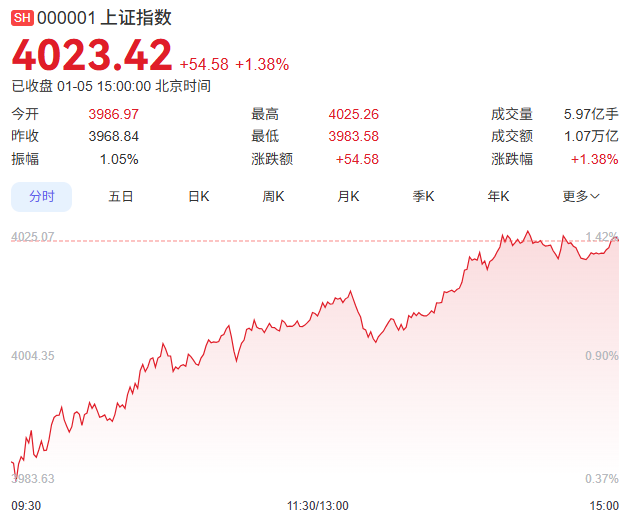
Core Viewpoint - The A-share market experienced a strong start in 2026, with major indices rising, and the Shanghai Composite Index closing above 4000 points, indicating positive market sentiment and potential growth opportunities for listed companies [1]. Group 1: Company Performance - As of January 5, 2026, 13 listed companies announced profit increases, with 2 companies expected to turn losses into profits and 11 companies projecting varying degrees of profit growth [3]. - Yinglian Co. and Nanxing Co. are both expected to turn losses into profits, representing two distinct paths: substantial improvement in core business for Yinglian and the elimination of financial burdens for Nanxing [4]. - Yinglian Co. anticipates a net profit of 32 million to 42 million yuan for 2025, driven by revenue growth in the fast-moving consumer goods metal packaging sector and improved production efficiency [4]. - Nanxing Co. expects a net profit of 9 million to 12 million yuan for 2025, a significant recovery from a loss of 175 million yuan the previous year, primarily due to the removal of a large goodwill impairment charge [4]. Group 2: Industry Trends - The recovery of industry cycles and operational optimizations are key drivers for the performance growth of 11 companies, with factors such as industry prosperity and proactive management playing significant roles [7]. - The rise in industry prosperity is particularly evident in the non-ferrous metals sector, with Chifeng Gold projecting a net profit of 3 billion to 3.2 billion yuan for 2025, a year-on-year increase of 70% to 81%, attributed to a 49% rise in gold product sales prices [8]. - Huayou Cobalt expects a net profit of 5.85 billion to 6.45 billion yuan for 2025, benefiting from the recovery in metal prices and management improvements [8]. - Companies like Whirlpool, Taotao Automotive, and Ugreen attribute their profit growth to proactive measures such as enhancing technological innovation, improving operational efficiency, and expanding market presence [9][10]. Group 3: Market Demand and Growth Opportunities - The surge in demand in specific sectors has created growth opportunities for several companies, with Dingtai High-Tech expecting a net profit of 410 million to 460 million yuan for 2025, a year-on-year increase of 81% to 103% due to rising demand for high-end PCB products [11]. - Zhongcai Technology anticipates a net profit of 1.55 billion to 1.95 billion yuan for 2025, driven by increased demand in the domestic and overseas wind power markets, resulting in both volume and price growth [11]. - LZ Group expects a net profit increase of 17% to 23% for 2025, benefiting from rising production and sales across various business segments and the recovery of its lithium hexafluorophosphate business [11].


2026年投资展望系列之十二:股债之锚,2026通胀的温度
HUAXI Securities· 2026-01-05 15:14
证券研究报告|宏观研究报告 [Table_Date] 2026 年 01 月 05 日 PPI呈现"上半年磨底、三季度分化、10-11月温和回升"的修复路 径。8 月是"反内卷"政策落地之后,PPI 的关键分水岭。分行业来看,绝 大多数高权重行业均陷入负值区间,仅有色金属链条形成唯一的正向支 撑。究其原因,内需不足与"内卷式"竞争形成"双重压制",PPI 的下行压 力主要源于以下两类核心行业:第一类是高权重的中游制造行业,主要 受"内卷"竞争拖累。第二类是上游资源与原材料行业,受地产基建需求 疲软与国际油价回落的共振拖累。 ► 2026 年 CPI 展望:猪周期有望企稳,通胀中枢温和抬升 在 2026 年基期轮换中,猪肉权重有望上升,金银珠宝权重或下 降。回顾 2016 年与 2020 年两次基期轮换,均呈现"食品降、服务升"的 特征,主要遵循"消费升级"主线。2026 年权重调整逻辑或发生逆转:其 一,地产供需格局重塑,居住项权重面临下调(预计-3.0pct)。其二, 疫后修复弹性释放,服务类消费权重显著抬升(预计文娱+2.2pct,交 通+1.4pct)。其三,恩格尔系数回归下行通道,食品烟酒权重延续调降 ...
视频丨推广绿色消费积分、推动废旧物品回收再利用……9部门发文推进绿色消费
Xin Lang Cai Jing· 2026-01-05 14:34
Core Viewpoint - The Ministry of Commerce and nine other departments have released a notice to implement green consumption promotion actions, focusing on enhancing the supply of green products and encouraging sustainable consumption practices across various sectors. Group 1: Green Product Supply - Increase the supply of green agricultural products by encouraging enterprises to expand procurement of quality items such as organic and geographical indication products [1] - Support the establishment of dedicated sales areas for green agricultural products, showcasing quality certifications and traceability labels [1] - Promote direct procurement activities between green agricultural production bases and large supermarkets or restaurants to enhance market supply [1] Group 2: Green Appliances and Home Decor - Encourage the purchase of certified green smart appliances and fluorine-free air conditioners [3] - Improve energy and water efficiency standards for home appliances and advance the certification system for green smart appliances [4] - Promote the selection of green home decor products and materials, focusing on sustainability and smart technology [5] Group 3: Green Automotive Consumption - Support consumers in purchasing new energy vehicles and strengthen the automotive industry chain [6] - Explore the potential of the used car market and new consumption models such as RV camping and car-sharing [6] Group 4: Green Service Consumption - Develop green dining by urging restaurants to comply with regulations, reduce waste, and promote eco-friendly packaging [8] - Foster green accommodation by encouraging hotels to use non-toxic, biodegradable products and innovative services [8][9] - Promote green housekeeping by advocating for the use of eco-friendly cleaning products and innovative service models [10][11] Group 5: Green Supply Chain and Consumption Models - Promote green supply chain practices such as shared delivery and the use of eco-friendly packaging [12] - Encourage the establishment of a green consumption points system to reward sustainable consumer behavior [14] - Innovate in green sharing services, leveraging technology for efficient resource use [15] Group 6: Waste Reduction and Recycling - Encourage the reduction of single-use plastic products and promote reusable packaging solutions [15][16] - Strengthen the recycling of used goods, including furniture and electronics, and support reverse logistics systems [16] - Promote the circulation of second-hand goods through online platforms and community markets [16] Group 7: Optimizing Green Consumption Environment - Encourage the use of green energy and smart management systems in businesses [18] - Advocate for consumer awareness of green consumption practices, such as reducing single-use items [18] Group 8: Strengthening Green Consumption Foundations - Promote the establishment of green circulation entities and encourage green certification [20][21] - Support leading enterprises in driving green development across supply chains [22] - Engage in global standard-setting for green consumption [23][24] Group 9: Policy Support and Financial Innovation - Integrate green consumption initiatives with modern commerce and retail innovations [25] - Provide financial support for green consumption through favorable banking services [26][27] - Explore innovative financial products to support green infrastructure projects [28]

华帝股份:截至2025年12月31日股东总户数为36862户
Zheng Quan Ri Bao Wang· 2026-01-05 14:17
Group 1 - The core point of the article is that Vatti Corporation (华帝股份) has reported a total of 36,862 accounts in its combined ordinary and margin trading accounts as of December 31, 2025 [1]

美的MB - HS4033电饭煲,Plus会员到手459!
Xin Lang Cai Jing· 2026-01-05 14:16
秒 新浪财经APP 24小时全球 息盒资讯 下载APP > 广告 (Firest (Midea 喷部钢化玻璃 京东家电家居 X 好家庭 Ulidea 花瓣IH包裹式加热 0氟陶瓷不粘涂层 升级去陈增香3.0 限时直降 先到冠博 到手价不高于 (新年购物季京东家电家居 又好又便宜 * 599 超信标扣 限时抢购 (Midea 喷部钢化玻璃 京东家电家居 双好又便宜 Ulides 花瓣IH包裹式加热 0氟陶瓷不粘涂层 升级去陈增香3.0 阿直降 完到元得 到手价不高于 (新年购物季京东家电家居 又好又便宜 未 599 超值折扣 限时抢购 ...


规则变了!中国对一带一路顺差首超美国,全球贸易正在换重心
Sou Hu Cai Jing· 2026-01-05 14:15
Core Viewpoint - China's trade surplus with Belt and Road Initiative (BRI) countries has surpassed its surplus with the United States for the first time, indicating a significant shift in global trade dynamics [1][4]. Group 1: Trade Surplus Data - In the first eleven months of 2025, China's trade surplus with BRI countries accounted for 45% of its total trade surplus, approximately $480 billion, while the surplus with the U.S. dropped to 24%, a decline of over 10 percentage points year-on-year [1]. - This shift represents a historical turning point in global trade, moving the focus away from the U.S. as a dominant trade partner [1][10]. Group 2: U.S. Market Dynamics - The U.S. has transformed from a key customer to an unreliable variable due to actions such as tariffs, supply chain decoupling, and technology restrictions, which have inadvertently pushed China to diversify its trade routes [4][10]. - The trade relationship with BRI countries is characterized by a more pragmatic approach, focusing on cost-effectiveness and reliable supply rather than political conditions [8][10]. Group 3: Belt and Road Initiative - The BRI has evolved into a multifaceted trade ecosystem, with over 155 participating countries, representing nearly 80% of global nations, primarily from developing and emerging markets [6]. - China's manufacturing products have a natural competitive advantage in these markets, ranging from infrastructure equipment to consumer goods [6][8]. Group 4: Financial and Trade Implications - The shift in trade surplus structure signifies a transition from a single-core dependency to a diversified trade network, impacting global financial systems and the balance of power [10][12]. - The increasing use of the Chinese yuan in trade settlements among BRI countries indicates a gradual move away from dollar dominance, suggesting a potential reconfiguration of global financial rules [12][16]. Group 5: Strategic Outlook - This transition is not without risks, as BRI countries may face political instability and market volatility, but it represents a critical step for China in diversifying its trade relationships and reducing reliance on any single market [14][18]. - The change in trade dynamics signals a potential decline in U.S. influence and a redefinition of global trade rules, marking a new era in international relations [16][18].

家电行业2026年1月投资策略:2026年家电国补政策延续,有望拉动内销需求企稳回升
Guoxin Securities· 2026-01-05 13:58
Core Insights - The 2026 home appliance national subsidy policy is expected to stimulate domestic demand and stabilize retail sales, particularly in the white goods sector [2][3][20] - The policy continues to support the replacement of old appliances with new ones, focusing on six major categories, including refrigerators, washing machines, and air conditioners, with a subsidy of 15% of the product price, capped at 1500 yuan per item [3][21][22] - The white goods production in January showed a positive trend, with a total output of 34.53 million units, representing a 6% year-on-year increase, driven by the national subsidy policy [4][24] Monthly Research Tracking and Investment Thoughts - The national subsidy policy for 2026 aims to boost the replacement demand for home appliances, which is expected to support domestic sales [20][21] - January's white goods production saw a recovery, with air conditioner production increasing by 11% year-on-year, indicating a potential stabilization in demand [4][24] - In November, the domestic sales of major appliances faced pressure due to high base effects from the previous year, but exports of refrigerators and washing machines showed good growth [5][32] Key Data Tracking - In December, the home appliance sector experienced a relative return of -1.06% compared to the Shanghai Composite Index, which rose by 2.28% [34] - The prices of raw materials such as copper and aluminum increased by 13.5% and 4.8% respectively in December, while cold-rolled steel prices decreased by 3.2% [36] - The shipping index for major routes showed a mixed performance, with the West America route down by 6.4% and the Europe route up by 4.8% [45] Key Company Announcements and Industry Dynamics - The report highlights key companies such as Midea Group, Haier Smart Home, TCL, and Gree Electric as strong performers in the white goods sector, with recommendations for investment based on their resilience and growth potential [14][15][54] - The home appliance industry is expected to face challenges due to high inflation in overseas markets and geopolitical tensions, but leading companies are adapting by enhancing local production capabilities [50][51]




一图读懂:2025年上海市消费品以旧换新取得积极成效
Xin Hua Cai Jing· 2026-01-05 13:53
Core Viewpoint - Since 2025, Shanghai has effectively implemented the "old for new" consumption policy, resulting in significant sales and consumer engagement in various sectors [3][4]. Group 1: Sales Performance - The sales revenue from "old for new" products in Shanghai exceeded 121.23 billion yuan, benefiting over 21.95 million people [4]. - The retail sales of social consumer goods in Shanghai increased by 5% year-on-year from January to November, surpassing the national average by 1 percentage point and accelerating by 8.1% compared to the same period last year [6]. Group 2: Product Categories - The "old for new" program included over 320,000 vehicles, more than 4.5 million digital products, and over 4.9 million home appliances [5]. - The program also facilitated the replacement of over 1.19 million kitchen and bathroom items and more than 330,000 electric bicycles [5]. Group 3: Environmental Impact - The "old for new" initiative contributed to a 2.7 percentage point increase in the total retail sales, promoting green transformation and upgrading of industries [6]. - The proportion of new energy vehicles in the "old for new" car replacement program reached 64%, exceeding the national average, and led to a 21.6% year-on-year increase in new energy vehicle retail sales from January to November [6]. Group 4: Recycling and Consumer Engagement - From January to November 2025, the sales of second-hand cars grew by 36%, and the recycling volume of scrapped vehicles increased by over 80% [7]. - The offline participation in home appliance and furniture exchanges reached 4.65 million people, with 2,105 offline merchants and nearly 7,500 stores, generating sales of 21.2 billion yuan [7].
