工业母机

Search documents
新征程·新蓝图|着眼取得决定性突破 加强重点领域关键核心技术攻关
Xin Hua She· 2025-11-05 01:44
Core Insights - The document emphasizes the need to strengthen original innovation and tackle key core technologies, proposing extraordinary measures to achieve decisive breakthroughs in critical areas such as integrated circuits, industrial mother machines, high-end instruments, basic software, advanced materials, and biomanufacturing [2] Group 1 - The proposal aims to promote deep integration of technological and industrial innovation [2] - It highlights the importance of advancing education, technology, and talent development in a coordinated manner [2] - The initiative seeks to accelerate high-level technological self-reliance and lead the development of new productive forces [2]
通知 | 关于组织参加2025世界智能制造博览会的通知
机器人圈· 2025-11-03 13:00
Overview - The 2025 World Intelligent Manufacturing Expo will be held from November 27 to 29, 2025, at the Nanjing International Expo Center, aiming to help Chinese enterprises grasp global industry trends and connect with cutting-edge technologies and quality resources [1][2]. Expo Highlights - The expo is designed to be a high-end, international, and professional platform, gathering leading global intelligent manufacturing companies to showcase advanced technologies and solutions [2]. - It will attract representatives from over 20 countries, with government officials attending to provide the latest policy guidance through industry white papers [2]. - More than 30 experts and academicians will present keynote speeches on cutting-edge research and technology, aiding enterprises in technological upgrades [2]. - Over 50 Fortune 500 companies and industry leaders will participate, showcasing new products and applications, facilitating supply-demand matching and collaboration [2]. Exhibition Areas - The exhibition will cover over 65,000 square meters, divided into several halls focusing on different aspects of intelligent manufacturing [5]. - Key areas include: - **Intelligent Robot Hall**: Featuring collaborative and embodied intelligent robots [6][7][8]. - **Smart Factory Hall**: Showcasing advanced manufacturing processes and exemplary smart factories [9][10][11]. - **Industrial Software and Solutions Hall**: Highlighting industrial AI, edge computing, and digital supply chains [12][13][15]. - **Industrial Mother Machine Hall**: Displaying high-performance CNC machines and additive manufacturing technologies [16][17][18]. - **Intelligent Detection Equipment Hall**: Featuring general and specialized intelligent detection solutions for various industries [19][20]. Interactive and Special Exhibits - The expo will include interactive areas such as robot competitions and smart driving experience zones, enhancing visitor engagement [21][22]. - A special exhibition will celebrate the achievements of intelligent manufacturing over the past decade, showcasing significant breakthroughs across various industries [23]. Concurrent Activities - The expo will host a major theme conference, signing events, and numerous specialized summits, focusing on the latest advancements in intelligent manufacturing [25]. - Activities will include product launches, supply-demand matching, and financial sessions, aimed at enhancing the platform's effectiveness for exhibitors [25]. Registration Information - Interested companies in the robotics and core components sectors are encouraged to register by November 14, 2025 [26].

热词里的“十五五”丨解锁核心科技引领新质生产力发展“密码”--经济·科技--人民网
Ren Min Wang· 2025-11-02 12:31
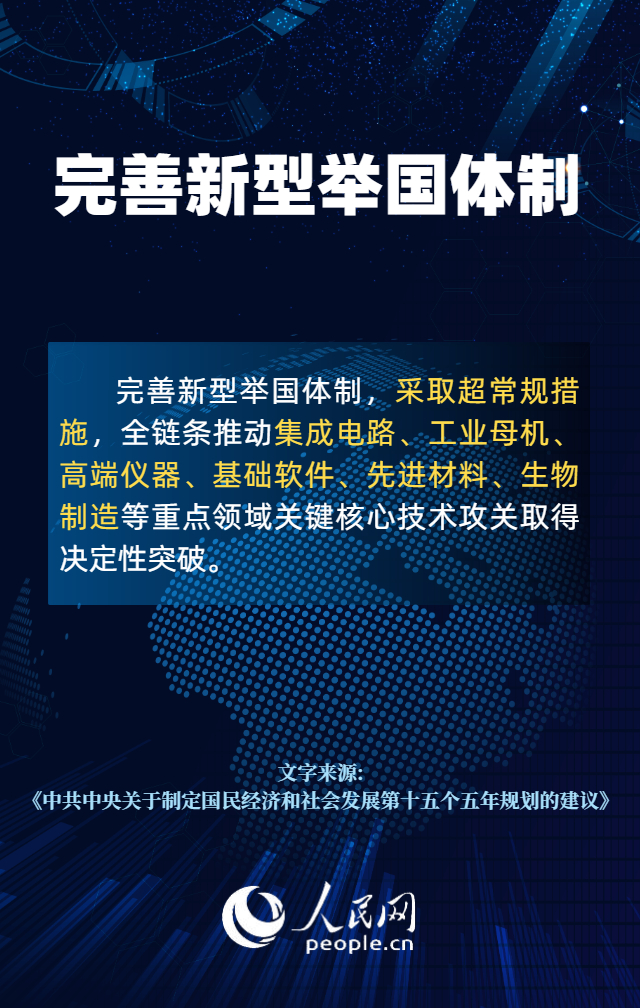
Core Viewpoint - The article emphasizes the importance of technological modernization as a foundation for China's modernization, highlighting the need for breakthroughs in key core technologies during the 14th Five-Year Plan period [1][4]. Group 1: New National System - The establishment of a new type of national system is crucial, employing extraordinary measures to drive decisive breakthroughs in key areas such as integrated circuits, industrial mother machines, high-end instruments, basic software, advanced materials, and biomanufacturing [3]. Group 2: Original Innovation - There is a strong focus on enhancing original innovation by strategically and systematically increasing investment in basic research, fostering an environment conducive to original and disruptive innovations, and producing more landmark original achievements [6]. Group 3: Efficient Application of Major Scientific Achievements - The article discusses the need to improve regional innovation systems, establish regional technology innovation centers, and accelerate the efficient transformation and application of major scientific achievements, including the construction of verification platforms and enhancing intellectual property protection [8]. Group 4: Cultivating Leading Technology Enterprises - Support for high-tech enterprises and technology-based SMEs is essential, including increasing the proportion of R&D expense deductions and enhancing government procurement of independently innovative products [11]. Group 5: Coordinated Mechanism - A coordinated mechanism for integrated promotion is necessary to strengthen planning alignment, policy collaboration, resource integration, and evaluation linkage, promoting a virtuous cycle of independent technological innovation and talent cultivation [13]. Group 6: National Strategic Talent Force - The article highlights the need to accelerate the development of a national strategic talent force, cultivating various talents such as strategic scientists, leading technology figures, and skilled workers, while optimizing talent structure and promoting regional coordination [15]. Group 7: Data Element System - There is a call to improve the foundational system for data elements, building an open, shared, and secure national integrated data market to deepen the development and utilization of data resources [18]. Group 8: Implementation of "Artificial Intelligence+" Action - The article advocates for accelerating innovation in artificial intelligence and related digital technologies, breaking through foundational theories and core technologies, and integrating AI with various sectors to enhance productivity and societal governance [20].

以推动高质量发展为主题 奋力开创中国式现代化建设新局面——多部门负责人在《〈中共中央关于制定国民经济和社会发展第十五个五年规划的建议〉辅导读本》发表署名文章
Shang Hai Zheng Quan Bao· 2025-11-01 03:56
Group 1: Economic and Social Development Planning - The 20th Central Committee's Fourth Plenary Session approved the suggestions for the 15th Five-Year Plan, outlining systematic planning and strategic deployment for China's economic and social development [1] - Emphasis on promoting the deep integration of technological and industrial innovation, enhancing the inclusiveness and adaptability of capital market systems, and expanding high-level opening-up [1][2] Group 2: Technological Innovation - The Ministry of Science and Technology aims to achieve decisive breakthroughs in key core technologies through a full-chain approach, integrating innovation and industrial chains [2][3] - Focus on original innovation and tackling key technologies in areas such as integrated circuits, advanced materials, and biomanufacturing [2][3] Group 3: Consumer Spending and Economic Growth - The National Development and Reform Commission emphasizes the need to boost domestic consumption and optimize the environment for consumer spending [6][7] - Measures include removing unreasonable restrictions in consumption and enhancing residents' income to increase consumption rates [6][7] Group 4: Investment Strategies - The government aims to optimize investment structures and enhance the effectiveness of investments, particularly in infrastructure and consumer-related sectors [8][9] - Plans to implement significant landmark projects that align with national strategic needs and promote a unified national market [9][11] Group 5: Market Regulation and Competition - The State Administration for Market Regulation is focused on establishing a unified market system, eliminating barriers to competition, and addressing "involution" in market practices [10][11] - Emphasis on strengthening anti-monopoly and fair competition regulations to ensure a healthy market environment [12][13] Group 6: State-Owned Enterprises and Private Sector - The State-owned Assets Supervision and Administration Commission aims to optimize the layout of state-owned enterprises and enhance their roles in key industries [14][15] - Support for private enterprises through legal protections and policies to stimulate their growth and participation in national projects [16][17] Group 7: Fiscal Policy and Debt Management - The Ministry of Finance outlines a proactive fiscal policy to support high-quality development and manage government debt sustainably [17][19] - Focus on increasing public investment in technology and social welfare while ensuring fiscal discipline and preventing local government debt risks [18][19]
沪指高位整固 “十五五”规划建议引领市场热点
Zheng Quan Shi Bao· 2025-10-31 18:23
Market Overview - A-shares experienced a rally followed by a pullback, with the Shanghai Composite Index breaking through 4000 points for the first time in 10 years before adjusting [1] - Daily trading volume exceeded 2 trillion yuan, with weekly trading volume surpassing 10 trillion yuan [1] - Margin trading saw significant increases, with over 41.3 billion yuan added, bringing the total margin balance to a historical high of 2.48 trillion yuan [1] Sector Performance - The electronics sector received over 9 billion yuan in net financing, while power equipment and communications sectors saw net inflows of over 6.3 billion yuan and 5 billion yuan, respectively [1] - Major inflows were noted in the power equipment sector, with over 49.5 billion yuan in net inflows from institutional investors, while the electronics sector experienced a net outflow of over 16.2 billion yuan [1] - The forestry sector surged, with the index rising over 48% to reach a 6.5-year high, driven by the publication of the "15th Five-Year Plan" [2] Policy Impact - The "15th Five-Year Plan" emphasizes green development, aiming for carbon neutrality and ecological safety, which has positively influenced market sentiment [2] - The new energy sector saw a broad rally, with various sub-sectors like energy storage and hydrogen energy reaching historical highs [2] - Key sectors highlighted for investment include communication infrastructure, semiconductor manufacturing, and industrial software, driven by policy support [3]





“十五五”规划建议的18个新提法 释放哪些重要信号?
Mei Ri Jing Ji Xin Wen· 2025-10-30 15:27
Group 1: Economic and Social Development - The "15th Five-Year Plan" emphasizes the importance of technology and innovation, mentioning "technology" 46 times and "innovation" 61 times, highlighting the need for original and disruptive innovations [1] - The plan includes measures to improve people's livelihoods, such as expanding free education and exploring the extension of compulsory education [1][16] - It proposes to enhance public service spending to boost consumer capacity, indicating a shift towards improving the consumption environment [7][10] Group 2: Future Industries and Technological Innovation - The plan aims to promote emerging industries like quantum technology, biotechnology, hydrogen energy, and artificial intelligence as new economic growth points [2][3] - It suggests establishing a risk-sharing mechanism for future industry investments to address uncertainties in technology and market [4][5] - The plan calls for a comprehensive implementation of "Artificial Intelligence+" to drive research and development across various sectors [6][7] Group 3: Consumption and Housing - The plan proposes to eliminate unreasonable restrictions on consumption in sectors like automobiles and housing, signaling a new phase in consumer development [8][19] - It aims to optimize the supply of affordable housing to meet the basic needs of urban wage earners and disadvantaged families, marking a shift from a "safety net" to a "universal" approach [19] Group 4: Energy and Environmental Goals - The plan sets a target for peak coal and oil consumption, aligning with the broader goal of achieving carbon neutrality by 2030 [9] - It emphasizes the need for a new energy system and the development of clean energy sources to support this transition [9] Group 5: Fiscal and Monetary Policy - The plan advocates for a more proactive fiscal policy to enhance sustainability and stimulate effective investment [10] - It suggests a stable and continuous approach to fiscal and monetary policies during the "15th Five-Year Plan" period [10] Group 6: Trade and International Cooperation - The plan focuses on expanding market access and opening up service sectors, indicating a shift towards enhancing service trade competitiveness [11][12] - It highlights the importance of developing green trade and intermediate goods trade to stabilize foreign trade [12][13]
“十五五”规划建议联合点评
Zhong Xin Qi Huo· 2025-10-30 06:40
1. Report Industry Investment Rating No information provided in the given content. 2. Core Viewpoints of the Report - The policy orientation in the Proposals aligns with expectations. Some planning contents may have medium - to long - term impacts on major asset classes. For example, strategic positions of science, technology, and emerging industries are strengthened; there are impacts on consumption, investment, anti - involution, macro - economic policies, financial markets, RMB internationalization, and supply chain security [9][10]. - For different asset classes: - Equity index: The market is expected to consolidate at the end of the year and has an offensive window before next year's Two Sessions, focusing on technology and "anti - involution" themes [2]. - Government bonds: The short - term impact is limited, and the bond market is expected to fluctuate with a slightly stronger bias in November and December [2]. - Commodities: The demand - pull effect will diverge, with new energy - related demand growth likely to benefit more [3]. - Energy transition and carbon neutrality: Focus on the shift between traditional and new energy sources, and carbon prices may fluctuate upward [3]. - Technological self - reliance and advanced manufacturing: Sectors related to new - quality productive forces are expected to maintain rapid growth [3]. 3. Summary According to the Catalog 3.1 Macro Economy - On October 28, the Proposals and the Explanation were released. The policy orientation in the Proposals aligns with expectations. In terms of structure, compared with the 14th Five - Year Plan Outline, the importance of opening - up and social welfare protection chapters has increased. Digital development is incorporated into the science and technology chapter, new - type urbanization is merged into regional economic layout, and two other chapters are consolidated into Part III [8][9]. - Qualitative planning is made for the next five - year key tasks, with quantitative targets and detailed arrangements to be determined in the Plan Outline. Some planning contents may impact major asset classes: - Science, technology, and emerging industries: Stocks and related commodities in the technology sector may benefit as key technological fields are expected to attract more capital and real demand [10]. - Consumption: "Vigorously boost consumption" may lead to relaxed restrictions on real estate and vehicle purchases, benefiting related stocks and commodities [12]. - Investment: The proportion of construction - related demand in commodities may decline, while products related to "a better life" may have incremental demand [12]. - Anti - involution: Policy attention on key sectors' prices will continue, curbing disorderly competition and regulating local government investment - promotion practices [13]. - Macroeconomic policy: The pricing logic of refined oil products may change due to potential consumption tax reform [13]. - Financial markets: The equity market will focus more on shareholder returns, and the futures and derivatives markets may enter a new development stage [13]. - RMB internationalization: The central level of RMB exchange rate volatility may decline [14]. - Supply chain security: Certain strategic minerals may see incremental demand [14]. 3.2 Equity Index - The equity market has fully priced in short - term policy positives, and the medium - term upward trend is consolidated. Adopt a long - term perspective with short - term tactical operations, focusing on four policy themes: - Stabilize growth: Expect further strengthening of counter - cyclical adjustments [15][16]. - Manufacturing and technology: Emphasize advanced manufacturing and self - reliance, highlighting emerging and future industries and key fields [17]. - Optimize traditional industries: Require major cyclical industries to enhance their position and competitiveness, which may increase leading enterprises' market share [18]. - Boost domestic demand: Focus on people's livelihood, but the shift to consumption - driven growth takes time. The stock market is expected to be optimistic before next year's Two Sessions, focusing on technology and "anti - involution" themes [19][20]. 3.3 China's Government Bonds - The Proposals convey a medium - to long - term policy tone of "seeking progress while maintaining stability" with high - quality development as the theme. The weight of economic growth may increase, and growth sources and modes may adjust. - Regarding monetary policy, it aims to improve the central banking system, build a sound monetary policy framework and a comprehensive macroprudential governance system. The next stage of building the macroprudential governance framework focuses on four areas [22][23]. - The short - term impact on the bond market is limited. In November and December, the bond market is expected to fluctuate with a slightly stronger bias, influenced by monetary policy, year - end institutional allocations, and fund fee reform [24]. 3.4 Commodities - On the supply side, the Proposals call for optimizing and upgrading traditional industries, which will support commodity prices through supply elasticity management in different sectors such as ferrous metals, energy and chemicals, non - ferrous metals, and agricultural products [26]. - On the demand side, policies support economic growth and set a floor for commodity demand, but the impact varies by sector. New energy - related metals like copper, aluminum, and lithium will see clear demand growth, while other commodities face different challenges and opportunities [27]. - The commodities market is entering a phase of structural divergence. Short - term policy expectations may boost sentiment, but long - term trends depend on fundamentals [28]. 3.5 Energy transition and Carbon Neutrality - Energy: The Proposals emphasize accelerating new energy system construction, promoting green transformation, and increasing new energy supply. They also call for developing new energy storage and strengthening power grid construction, which may increase demand for certain metals. For fossil energy, consumption is expected to peak, and the consumption structure may change [30]. - Carbon market: The Proposals mention expanding the carbon market and developing a voluntary emission reduction market. In the short term, carbon prices are affected by quota carry - over policies; in the long term, they may fluctuate upward due to tightened quota allocations and market expansion [31]. 3.6 Technological Self - Reliance and Advanced Manufacturing - The 15th Five - Year Plan Proposals elevate scientific and technological self - reliance to the second main objective. It emphasizes advanced manufacturing and breakthroughs in "bottleneck" technologies. Investment in key areas like integrated circuits is expected to maintain rapid growth, driving related material demand [33].
以“超常规”之举筑牢科技自立自强根基
Nan Fang Du Shi Bao· 2025-10-30 06:38
Core Insights - The article emphasizes the importance of "super-normal" measures in the 15th Five-Year Plan, focusing on key core technology breakthroughs in areas such as integrated circuits and high-end equipment, reflecting a strategic urgency for technological self-reliance [1][2] Group 1: Strategic Context - The global landscape is undergoing unprecedented changes, driven by a new wave of technological revolution and industrial transformation, presenting significant development opportunities in strategic frontier technologies like AI and biomedicine [1] - There is a growing trend of unilateralism and protectionism in the international environment, leading to increasing technological blockades and strategic constraints faced by the country [1] Group 2: Innovation and Resource Allocation - "Super-normal" signifies a shift in resource allocation, requiring the breaking down of departmental, regional, and industry barriers to concentrate resources for organized scientific research [3] - The need for a fundamental transition from factor-driven to innovation-driven economic development is highlighted, necessitating a reconfiguration of the innovation ecosystem [2] Group 3: Policy Support and Talent Development - Policy support must be forward-looking and inclusive, with fiscal policies favoring major technological projects and monetary policies providing low-cost, long-term funding for tech companies [4] - The competition for key core technologies ultimately boils down to talent competition, necessitating reforms in the scientific system to empower researchers and encourage disruptive innovations [4]
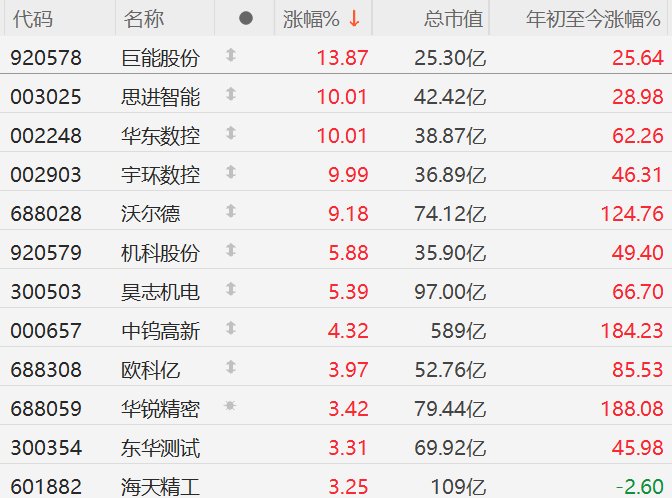
A股工业母机概念股集体上涨,巨能股份涨超13%,思进智能、华东数控、宇环数控涨停,沃尔德涨超9%,机科股份、昊志机电涨超5%
Ge Long Hui· 2025-10-30 04:37
Core Viewpoint - The A-share market saw a collective rise in industrial mother machine concept stocks, with significant gains reported for several companies, indicating a positive trend in this sector [1]. Group 1: Stock Performance - Jueneng Co., Ltd. (巨能股份) experienced a rise of over 13.87%, with a total market capitalization of 2.53 billion and a year-to-date increase of 25.64% [2]. - Sijin Intelligent (思进智能) and Huadong CNC (华东数控) both reached the 10% limit up, with increases of 10.01% and a market cap of 4.24 billion, showing a year-to-date rise of 28.98% [2]. - Yuhuan CNC (宇环数控) also saw a 9.99% increase, with a market cap of approximately 3.69 billion and a year-to-date increase of 46.31% [2]. - World (沃尔德) rose by 9.18%, with a market cap of 7.41 billion and a remarkable year-to-date increase of 124.76% [2]. - Other notable performers included Jike Co., Ltd. (机科股份) with a 5.88% rise and a market cap of 3.59 billion, and Haozhi Electromechanical (昊志机电) with a 5.39% increase and a market cap of 9.7 billion [2].



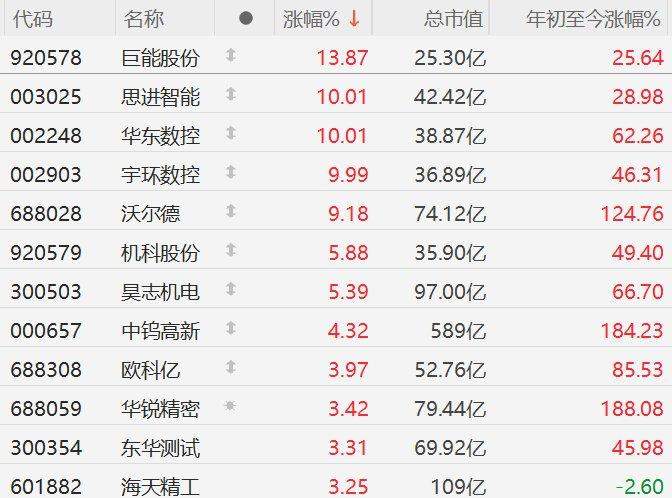
A股工业母机概念股集体上涨,华东数控涨停
Ge Long Hui A P P· 2025-10-30 03:41
Group 1 - The core viewpoint of the news is that the industrial mother machine concept stocks in the A-share market experienced a collective rise, indicating strong market interest and potential growth in this sector [1] Group 2 - Major stocks that saw significant increases include: - Juneng Co., Ltd. (巨能股份) with a rise of 13.87%, total market value of 2.53 billion, and a year-to-date increase of 25.64% [2] - Sijin Intelligent (思进智能) increased by 10.01%, total market value of 4.24 billion, and a year-to-date increase of 28.98% [2] - Huadong CNC (华东数控) also rose by 10.01%, total market value of 3.89 billion, with a year-to-date increase of 62.26% [2] - Yuhuan CNC (宇环数控) saw a rise of 9.99%, total market value of 3.69 billion, and a year-to-date increase of 46.31% [2] - World (沃尔德) increased by 9.18%, total market value of 7.41 billion, with a remarkable year-to-date increase of 124.76% [2] - Other notable stocks include: - Jike Co., Ltd. (机科股份) with a rise of 5.88%, total market value of 3.59 billion, and a year-to-date increase of 49.40% [2] - Haizhi Electromechanical (昊志机电) increased by 5.39%, total market value of 9.70 billion, and a year-to-date increase of 66.70% [2] - Zhongtung High-tech (中钨高新) rose by 4.32%, total market value of 58.9 billion, with a year-to-date increase of 184.23% [2] - The MACD golden cross signal formation indicates a positive trend for these stocks [1]