
公用事业

Search documents
从最新季绩,看巴菲特的“舍”与“得”
Jin Rong Jie· 2025-05-06 12:05
于是,伯克希尔的2025年业绩,很可能成为股神;亲自主持下的最后一年业绩。 在年度股东大会召开前夕,伯克希尔公布了2025年第1季业绩,对比于巴菲特的金句,这份业绩所体现 的投资结果;,或更能体现股神;的投资理念和风格。 投资本钱还有利息可收 今年五月初投资界的头等盛事莫过于在奥马哈举行的伯克希尔(BRK.B.US)年度股东大会,这次与别 不同的是,巴菲特在股东大会临近结束时宣布将于2026年1月1日退休,而63岁的副董事长格雷格·阿贝 尔(Greg Abel)将为其接班人,但巴菲特仍担任伯克希尔董事长一职。 从并表的主营业务来看,伯克希尔旗下的子公司经营稳定,第1季并表收入为897.25亿美元,按年微跌 0.16%;主营业务的税前利润为114.57亿美元,按年下降14.10%;但真正令其业绩与上年同期拉开距离 的是投资亏损64.35亿美元,相较上年同期为投资收益18.76亿美元,差距达83亿美元。 不过需要注意的是,这笔投资亏损主要来自未出售投资,只是因为期内股价出现波动而暂时亏损而已, 这也是巴菲特多次强调短期投资损益只是会计处理需要,并不能作为投资业绩准绳的原因。当股价回 升,未来的投资收益可能显著上升 ...
A股市场2025年一季报业绩综述:全A净利边际改善,价格和政策有支撑的领域占优
BOHAI SECURITIES· 2025-05-06 10:55
| 略 | | 投资策略 | | --- | --- | --- | | | [Table_MainInfo] 全 A | 净利边际改善,价格和政策有支撑的领域占优 | | 研 | | ——A 股市场 2025 年一季报业绩综述 | | 究 | 分析师: 宋亦威 | SAC NO: S1150514080001 2025 年 05 月 06 日 | | | [Table_Analysis] 证券分析师 | [Table_Summary] | | | 宋亦威 | 投资要点: | | | 022-23861608 | 2025Q1 全 A 单季营收同比增速较 2024Q4 出现回落,而单季归母净利 | | | songyw@bhzq.com | 同比增速由负转正显著改善。具体而言,2025Q1 全 单季营收和净利 A | | | [Table_Author] 严佩佩 | | | | | 同比增速分别为-0.2%/3.7%,前者较 2024Q4 回落 1.7 个百分点,后者 | | | 022-23839070 SAC No:S1150520110001 | 较 2024Q4 回升 17.5 个百分点。 | | ...
超长信用债交易跟踪:超长信用债配置价值提升
CMS· 2025-05-06 05:35
1. Report Industry Investment Rating No information provided in the content. 2. Core View of the Report The allocation value of ultra - long credit bonds has increased, with rising trading volume and a higher proportion of low - valuation transactions. The trading volume and price performance vary among different regions and industries of ultra - long urban investment bonds and ultra - long industrial bonds [1][2][3]. 3. Summary by Relevant Catalogs 3.1 Ultra - long Credit Bonds: Rising Trading Volume and Higher Proportion of Low - valuation Transactions - **Trading Volume**: The daily trading activity of ultra - long credit bonds increased this week. The average daily trading volume was 3.3 transactions, up from 3.0 last week. The trading volume of ultra - long credit bonds with a remaining maturity of 7 - 10 years increased significantly. The total trading volume this week was 30.3 billion yuan, a 12.64% increase from last week. The trading activity of industrial bonds was higher than that of urban investment bonds [2][11]. - **Trading Term**: The institutional preference for duration decreased. The average trading term of ultra - long credit bonds was 9.83 years, a decrease of 0.31 years from last week. The average trading term of ultra - long urban investment bonds decreased by 1.07 years, and that of industrial bonds decreased by 0.14 years [3][12]. - **Trading Price**: The trading yield of ultra - long credit bonds increased by 1bp to 2.37%. The trading yield of ultra - long urban investment bonds increased by 8bp, while that of ultra - long industrial bonds decreased by 1bp. The proportion of low - valuation transactions of ultra - long credit bonds rose to 53%, with a significant increase in ultra - long industrial bonds from 38% last week. The proportion of low - valuation transactions of credit bonds with a remaining maturity of 15 - 20 years decreased by about 55 percentage points [3][13]. 3.2 Ultra - long Urban Investment Bonds: Rising Trading Volume in Xinjiang and Sichuan, Marginal Increase in the Proportion of Low - valuation Transactions in Hebei - **Trading Volume**: The trading volume of ultra - long urban investment bonds in Xinjiang was relatively high at 1.47 billion yuan this week. The trading volume in Hebei and Shandong decreased significantly compared to last week, by 870 million yuan and 490 million yuan respectively, while that in Xinjiang and Sichuan increased [15]. - **Trading Term**: The average trading term of ultra - long urban investment bonds was 8.68 years. The trading term of ultra - long urban investment bonds in Liaoning increased by 0.12 years compared to last week, while that in Anhui decreased by 14.03 years [17]. - **Trading Price**: The trading yields of urban investment bonds in Liaoning and Shandong were relatively high, exceeding 3%. The trading yields of ultra - long urban investment bonds in Shandong and Beijing increased by 38bp and 32bp respectively compared to last week, while those in Fujian and Zhejiang decreased by 21bp and 16bp respectively. The proportion of low - valuation transactions of ultra - long urban investment bonds in Xinjiang decreased by 86 percentage points compared to last week, while that in Hebei and Hubei increased [17]. 3.3 Ultra - long Industrial Bonds: Rising Trading Volume in Utilities and Petrochemical Industries, Decreasing Proportion of Low - valuation Transactions in Commerce and Retail and Coal Industries - **Trading Volume**: The trading volume of ultra - long industrial bonds in the utilities industry was relatively high at 9.86 billion yuan this week. The trading volume of ultra - long industrial bonds in the utilities and petrochemical industries increased significantly compared to last week, by 5.76 billion yuan and 2.11 billion yuan respectively. The trading volume of ultra - long industrial bonds in the comprehensive industry decreased by about 3.49 billion yuan [20]. - **Trading Term**: The trading terms of ultra - long industrial bonds in the utilities and comprehensive industries shortened significantly this week, by 2.31 years and 0.85 years respectively compared to last week. The trading terms of ultra - long industrial bonds in the non - ferrous metals and transportation industries lengthened significantly, by 9.79 years and 5.92 years respectively [23][24]. - **Trading Price**: The trading yields of ultra - long industrial bonds in the social services and coal industries increased by 65bp and 48bp respectively compared to last week. The proportion of low - valuation transactions of ultra - long industrial bonds in the electronics industry was relatively high at 100%. The proportion of low - valuation transactions of ultra - long industrial bonds in the commerce and retail and coal industries decreased significantly this week [24].
模型提示市场情绪指标进一步回升,红利板块行业观点偏多——量化择时周报20250430
申万宏源金工· 2025-05-06 04:15
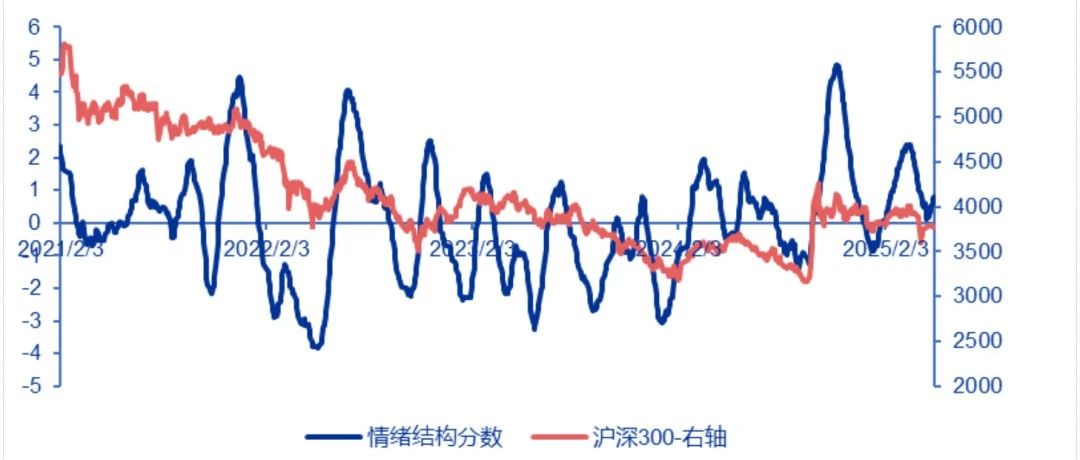
Group 1 - The core viewpoint of the article indicates that market sentiment is recovering, with a model perspective leaning towards bullishness as the sentiment index rose to 0.8 as of April 30, following a continuous upward trend for eight trading days since the low on April 18 [2][3] - The A-share market continues to show signs of sentiment recovery, with notable improvements in the main buying power indicator and price-volume consistency indicator, both of which have increased scores compared to the previous week [3][4] - The model suggests that sectors such as beauty care, public utilities, banking, and oil and petrochemicals have short-term bullish signals, while most other sectors, including real estate, retail, and construction decoration, have seen significant declines in short-term scores [13][14] Group 2 - The model indicates that the overall market continues to favor large-cap and value styles, although there is a short-term strengthening trend in growth and small-cap styles [15][16] - The main funds have seen a net outflow from the Sci-Tech Innovation Board, with a cumulative net outflow exceeding 2.72 billion RMB over three trading days, indicating a shift in investment focus [8][10] - The recent trading volume for the entire A-share market was approximately 1.2 trillion RMB on Wednesday, showing stability compared to the previous week [5]

万字特稿|认识下巴菲特的指定接班人:格雷格·阿贝尔
贝塔投资智库· 2025-05-06 03:53
Core Viewpoint - The article discusses the transition of leadership at Berkshire Hathaway, focusing on Greg Abel as the successor to Warren Buffett, highlighting his management style, investment philosophy, and the challenges he may face in maintaining the company's legacy [2][5][39]. Group 1: Leadership Transition - The 2024 Berkshire Hathaway annual meeting will be the first without Charlie Munger, with Greg Abel sitting next to Warren Buffett as his successor [1]. - Buffett has praised Abel's investment approach, noting his patience and decisiveness, similar to Munger's style [2]. - Abel's appointment as CEO is seen as crucial for understanding Berkshire's future trajectory [2][5]. Group 2: Abel's Management Style - Abel is characterized as detail-oriented and focused on execution, contrasting with Buffett's more hands-off approach [3][37]. - He has built a reputation for establishing trust, identifying opportunities, and managing risks effectively [4][8]. - Abel's management style includes direct communication with underperforming subsidiaries, emphasizing accountability [37][38]. Group 3: Business Performance and Challenges - Berkshire's overall performance has declined compared to its historical averages, with a ten-year annual return of 11.6%, below the S&P 500's 13.2% [9]. - Some subsidiaries, like GEICO and BNSF, are facing significant challenges, necessitating a reevaluation of their strategies [38][39]. - Abel's strategies may include setting profit targets for CEOs, establishing an operational management team, and integrating procurement resources to enhance efficiency [40][41][42]. Group 4: Future Outlook - Despite the challenges, Buffett believes Berkshire can still outperform the S&P 500 by 1-2 percentage points under Abel's leadership [43]. - Abel's understanding of Berkshire's intrinsic value is expected to guide the company through its next phase [43].

198股获杠杆资金大手笔加仓
Zheng Quan Shi Bao Wang· 2025-05-06 01:55
4月30日沪指下跌0.23%,市场两融余额为17864.83亿元,较前一交易日减少157.89亿元。 证券时报·数据宝统计显示,截至4月30日,沪市两融余额9097.76亿元,较前一交易日减少82.62亿元; 深市两融余额8716.69亿元,较前一交易日减少73.59亿元;北交所两融余额50.38亿元,较前一交易日减 少1.68亿元;深沪北两融余额合计17864.83亿元,较前一交易日减少157.89亿元。 分行业看,申万所属行业中,融资余额增加的行业有3个,增加金额最多的行业是银行,融资余额增加 3.25亿元;其次是美容护理、机械设备行业,融资余额分别增加784.92万元、598.69万元。 具体到个股来看,融资余额出现增长的股票有1130只,占比30.71%,其中,198股融资余额增幅超过5% 。融资余额增幅最大的是闽东电力,该股最新融资余额2.67亿元,较前一交易日增幅达83.24%;股价表 现上,该股当日下跌1.10%,表现弱于沪指;融资余额增幅较多的还有博创科技、芭薇股份,融资余额 增幅分别为69.00%、61.15%。 融资余额增幅前20只个股中,从市场表现来看,平均上涨2.67%,涨幅居前的有大 ...
26股获融资客逆市净买入超5000万元
Zheng Quan Shi Bao Wang· 2025-05-06 01:44
截至4月30日,市场融资余额合计1.78万亿元,较前一交易日减少156.33亿元,其中,沪市融资余额 9022.97亿元,较前一交易日减少81.79亿元;深市融资余额8683.58亿元,较前一交易日减少72.87亿元; 北交所融资余额50.37亿元,较前一交易日减少1.68亿元。 证券时报·数据宝统计显示,具体到个股,4月30日共有1130只股获融资净买入,净买入金额在千万元以 上的有203只,其中26只融资净买入额超5000万元。江淮汽车融资净买入额居首,当日净买入2.46亿 元,其次是招商银行、华夏银行,融资净买入金额分别为2.09亿元、1.83亿元,融资净买入金额居前的 还有博创科技、利欧股份、闽东电力等。 分行业统计,获融资客净买入超5000万元个股中,汽车、电力设备、银行等行业最为集中,分别有6 只、4只、3只个股上榜。板块分布上,大手笔净买入个股中,主板有20只,创业板有3只,科创板有3 只。 融资客大手笔净买入个股中,从最新融资余额占流通市值比例看,算术平均值为4.34%,融资余额占比 最高的是优刻得,该股最新融资余额8.53亿元,占流通市值的比例为9.44%,融资余额占比较高的还有 祥鑫科技、 ...



两轮贸易摩擦,信用债投资复盘与展望
Changjiang Securities· 2025-05-05 23:31
1. Report's Investment Rating for the Industry No investment rating for the industry is provided in the report. 2. Core Viewpoints of the Report - From August 2017 to January 2020, the credit bond market evolved in four stages under the intertwined influence of Sino - US trade frictions and policy hedging, presenting a pattern of "strengthened safe - haven properties of interest - rate bonds and re - structured risk pricing of credit bonds" [3][21]. - The market logic gradually returned to fundamental verification in the later stage, with external shocks having a diminishing marginal impact. Policy hedging effectiveness, credit repair rhythm, and cross - border capital flows became key variables affecting the market trend [12]. - After the implementation of the 54% tariff policy on April 2, 2025, the core logic of the credit bond market shifted to "safe - haven trading + policy hedging". Short - term high - grade varieties are favored, and in the short - term, safe - haven sentiment will dominate the market. In the medium - term, attention should be paid to economic data and the possible impact of the valuation repair of Chinese dollar - denominated bonds [100][105]. 3. Summary by Directory First Stage: Anticipation Disturbance Period (August 2017 - June 2018) - **Interest Rate Curve Differentiation and Credit Risk Pricing Re - structuring**: The bond market was in a "loose money, tight credit" policy combination. The short - end of the interest - rate bond market benefited from the targeted RRR cut in April 2018, while the long - end was suppressed by factors such as rising international oil prices, Fed rate hikes, and regulatory tightening. Private enterprise default amounts increased, and investors' behaviors diverged. The inability to transform "loose money" into "loose credit" intensified the structural contradictions in the credit bond market [22][24][25]. - **Credit Bond Financing Fluctuations due to Trade Friction Evolution**: Credit bond financing fluctuated. It declined initially due to trade friction concerns and financial risk prevention policies, then rebounded briefly in early 2018 due to liquidity release policies, and finally decreased again after the addition of tariffs and the implementation of the asset management new rules [29][30]. - **Overall Rise in Credit Bond Yields and Widening of Credit Spreads**: Credit bond yields rose overall, and credit spreads widened. Market concerns about credit risks spread from local industries to the whole market, especially in export - oriented industries. Although the targeted RRR cut in April 2018 curbed risk spread, private enterprise default events increased, and the pricing logic of the credit bond market became more complex [36][37]. - **Initial Appearance of Credit Bond Default Pressure with Wide Industry Distribution**: Credit bond defaults and extensions increased slightly. Defaults were no longer concentrated in traditional over - capacity industries but spread to more sectors. Policy uncertainties affected corporate financing efficiency and solvency [42][43]. Second Stage: Policy Hedging Period (July - November 2018) - **Differentiated Efficiency of Interest - Credit Transmission under Policy Hedging**: As Sino - US trade frictions escalated, domestic policies shifted. The central bank's RRR cut pushed short - term interest rates down, but long - term interest rates rebounded due to factors such as local government bond issuance and CPI increase. The "bull - steep" market of interest - rate bonds and the financing repair of credit bonds diverged [48]. - **Industry Financing Differentiation between Trade Pressure and Domestic Demand Hedging**: Different industries' credit bond financing showed a differentiated trend. Export - oriented industries such as commercial trade and light manufacturing saw a decline in net financing, while the public utility industry benefited from domestic demand support and had an increase in net financing [51]. - **Overall Decline in Credit Bond Yields and Narrow - range Fluctuation of Credit Spreads**: After the formal implementation of tariffs, the market's pricing of trade frictions became less sensitive. Credit bond yields declined, and credit spreads fluctuated within a narrow range. Although trade frictions escalated again in September 2018, the bond market reacted calmly. Low - grade industrial bond credit spreads widened, and the impact of domestic policies on the bond market gradually exceeded external shocks [55]. - **Relative Advantage of Non - standard Bonds of Urban Investment Entities after Trade Friction Upgrade**: Credit bond defaults increased, mainly among private enterprises. Non - standard bonds of non - urban investment entities had a significant increase in default cases, while those of urban investment entities were relatively stable, reflecting the positive role of local policy coordination [61][62]. Third Stage: Wide - Credit Verification Period (December 2018 - April 2019) - **"Time Difference" Game between Liquidity Drive and Credit Repair**: The bond market was driven by both the easing of trade frictions and domestic policy loosening. Although the G20 Summit in December 2018 and the central bank's full - scale RRR cut in January 2019 boosted market sentiment, private enterprise credit spreads remained high. The bond market turned bearish in April 2019 as economic fundamentals improved [69]. - **Differentiated Financing between State - owned and Private Enterprises under Tariff Easing and Policy Loosening**: State - owned enterprises benefited from policy loosening and had an increase in net financing, while private enterprises were still affected by the lagged impact of previous tariffs. Their net financing showed a fluctuating trend [72]. - **Credit Bond Yields Oscillated and Industrial Bond Spreads of Different Industries Differentiated**: As trade frictions eased, credit bond yields oscillated, and credit spreads differentiated. The market logic shifted to fundamental verification. Industries such as electrical equipment and chemical industry, which were affected by tariffs, had a slower credit spread repair than the overall market [74][78]. - **Credit Bond Default Situation Remained Flat Year - on - Year with Insufficient Improvement for Private Enterprises**: During the negotiation easing period, the number of credit bond extensions and defaults remained basically the same as the previous stage. Financial institutions preferred high - credit entities, and private enterprises still faced challenges in financing [81]. Fourth Stage: Resonance Period of Liquidity Stratification and Cross - border Capital Pricing (May 2019 - January 2020) - **Dual Pricing Logic of Credit Risk Events and Foreign Capital Safe - haven**: The takeover of Baoshang Bank in May 2019 led to concerns about liquidity stratification. Foreign capital increased its allocation of interest - rate bonds, and the bond market showed a pattern of safe - haven interest - rate bonds and differentiated credit bonds. The bond market was driven by both "safe - haven sentiment" and "foreign capital allocation" [85]. - **Increased Financing of Urban Investment Bonds with Swinging Trade Friction Expectations**: During the liquidity stratification stage, urban investment bond net financing continued to grow. Regulatory policies relaxed the "borrowing new to repay old" restrictions, and the central bank's policies provided a low - cost replacement space for urban investment platforms [88]. - **Overall Decline in Credit Bond Yields with Intensified Structural Differentiation**: Credit bond yields declined overall, but the market showed intensified structural differentiation. Yields of some industries such as electronics and automobiles increased, while those of infrastructure - related industries remained stable. High - grade state - owned enterprise industrial bond credit spreads narrowed, while those of AA + private enterprise industrial bonds widened [90][93]. - **Credit Bond Defaults under the Prolonged Trade Friction**: Under the continuous impact of trade frictions, credit bond defaults increased, mainly due to factors such as the slowdown of the macro - economic environment, the adjustment of corporate profit growth, and the impact on export - oriented enterprises. Non - standard bonds of urban investment platforms had relatively stable repayment performance [96]. Outlook on Credit Bond Trends in the Current Trade Friction - After the implementation of the 54% tariff policy on April 2, 2025, the credit bond market's core logic shifted. Interest - rate bonds reacted first, and the steep downward movement of the interest - rate curve opened up the valuation space for credit bonds. High - grade varieties are favored, and in the short - term, safe - haven sentiment will dominate. In the medium - term, attention should be paid to economic data and the possible impact of the valuation repair of Chinese dollar - denominated bonds. It is recommended to adopt a strategy of "moderately extending duration" + "moderately lowering credit quality" [100][105].
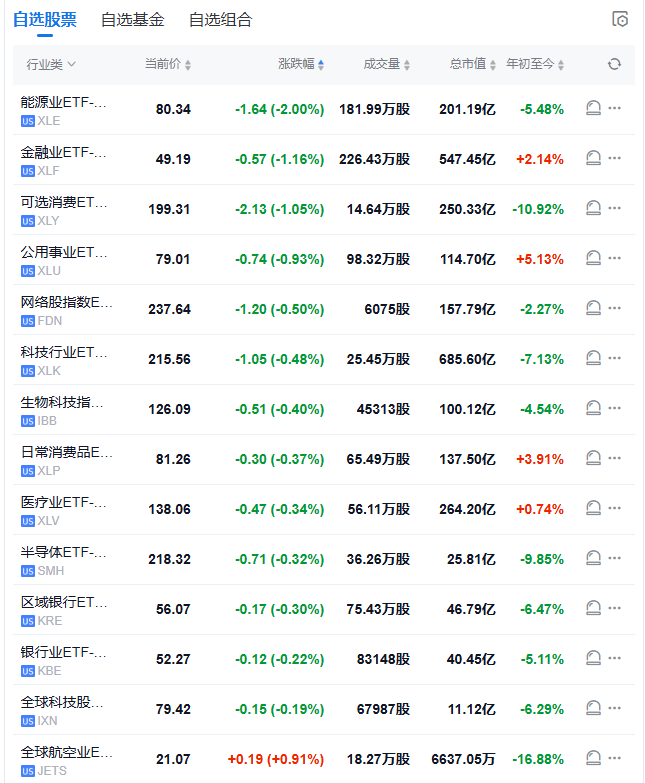
美股盘初,主要行业ETF普跌,能源业ETF跌2%,金融业ETF、可选消费ETF跌超1%。
news flash· 2025-05-05 13:52
Market Overview - Major industry ETFs in the US stock market experienced declines, with the energy sector ETF dropping by 2%, and both the financial and consumer discretionary ETFs falling by over 1% [1] Energy Sector - The energy sector ETF is priced at 80.34, reflecting a decrease of 1.64, or 2.00% [2] - The total market capitalization for the energy sector ETF is 201.19 billion, with a year-to-date change of -5.48% [2] Financial Sector - The financial sector ETF is currently at 49.19, down by 0.57, or 1.16% [2] - This ETF has a total market capitalization of 547.45 billion, showing a year-to-date increase of 2.14% [2] Consumer Discretionary Sector - The consumer discretionary ETF is priced at 199.31, down by 2.13, or 1.05% [2] - The total market capitalization for this ETF is 250.33 billion, with a year-to-date decline of 10.92% [2] Utility Sector - The utility sector ETF is at 79.01, down by 0.74, or 0.93% [2] - It has a total market capitalization of 114.70 billion, with a year-to-date increase of 5.13% [2] Technology Sector - The technology sector ETF is priced at 215.56, reflecting a decrease of 1.05, or 0.48% [2] - The total market capitalization for the technology sector ETF is 685.60 billion, with a year-to-date decline of 7.13% [2] Biotechnology Sector - The biotechnology index ETF is at 126.09, down by 0.51, or 0.40% [2] - Its total market capitalization is 100.12 billion, with a year-to-date decrease of 4.54% [2] Semiconductor Sector - The semiconductor ETF is priced at 218.32, down by 0.71, or 0.32% [2] - The total market capitalization for this ETF is 25.81 billion, with a year-to-date decline of 9.85% [2] Regional Banks - The regional bank ETF is at 56.07, down by 0.17, or 0.30% [2] - It has a total market capitalization of 46.79 billion, with a year-to-date decrease of 6.47% [2] Global Technology Sector - The global technology ETF is priced at 79.42, down by 0.15, or 0.19% [2] - Its total market capitalization is 11.12 billion, with a year-to-date decline of 6.29% [2] Global Airline Sector - The global airline ETF is at 21.07, up by 0.19, or 0.91% [2] - The total market capitalization for this ETF is 663.70 million, with a year-to-date decline of 16.88% [2]
量化择时周报:模型提示市场情绪指标进一步回升,红利板块行业观点偏多-20250505
Shenwan Hongyuan Securities· 2025-05-05 09:41
Quantitative Models and Construction Methods 1. Model Name: Market Sentiment Timing Model - **Model Construction Idea**: The model is built from a structural perspective to quantify market sentiment using various sub-indicators[7] - **Model Construction Process**: - The model uses sub-indicators such as industry trading volatility, trading crowding, price-volume consistency, Sci-Tech Innovation Board (STAR 50) trading proportion, industry trend, RSI, main buying force, PCR combined with VIX, and financing balance ratio[8] - Each sub-indicator is scored based on its sentiment direction and position within Bollinger Bands. Scores are categorized as (-1, 0, 1)[8] - The final sentiment structural indicator is the 20-day moving average of the summed scores. The indicator fluctuates around 0 within the range of [-6, 6][8] - **Model Evaluation**: The model effectively captures market sentiment trends and provides actionable insights for timing decisions[8] 2. Model Name: Moving Average Scoring System (MASS) - **Model Construction Idea**: This model evaluates long-term and short-term trends of indices using N-day moving averages to generate timing signals[18] - **Model Construction Process**: - For N moving averages (N=360 for long-term, N=60 for short-term), scores are assigned based on the relative position of adjacent moving averages. If a shorter moving average is above a longer one, it scores 1; otherwise, it scores 0[18] - The scores are standardized to a 0-100 scale and averaged to derive the trend score at a specific time point[18] - Long/short-term timing signals are generated based on the crossover of the trend score with its 100/20-day moving average[18] - **Model Evaluation**: The model provides clear signals for sector rotation and market style preferences, favoring value and defensive sectors in the current environment[18] 3. Model Name: RSI Style Timing Model - **Model Construction Idea**: The model uses the Relative Strength Index (RSI) to compare the relative strength of different market styles (e.g., growth vs. value, small-cap vs. large-cap)[22] - **Model Construction Process**: - For two indices A and B, calculate the standardized ratio of their net values over a fixed period[22] - Compute the average gain (Gain) and average loss (Loss) over N days, where gains on down days are treated as 0 and losses on up days are treated as 0[22] - RSI formula: $ RSI = 100 - 100 / (1 + Gain / Loss) $ - RSI values range from 0 to 100, with values above 50 indicating stronger buying pressure[22] - The model calculates 5-day, 20-day, and 60-day RSI values. When the 20-day RSI exceeds the 60-day RSI, the numerator style is favored; otherwise, the denominator style is favored[22] - **Model Evaluation**: The model effectively identifies style dominance, currently favoring large-cap and value styles while noting short-term strengthening of growth and small-cap styles[22] --- Model Backtesting Results 1. Market Sentiment Timing Model - Sentiment indicator value as of April 30, 2025: 0.8, indicating a recovery in market sentiment[9] 2. Moving Average Scoring System (MASS) - Short-term signals: Positive for sectors like beauty care (72.88), utilities (86.44), banking (74.58), and oil & petrochemicals (22.03)[19] - Long-term signals: Positive for sectors like banking (95.54), machinery (78.55), and steel (51.25)[19] 3. RSI Style Timing Model - Growth/Value (300 Growth/300 Value): RSI 20-day = 53.02, RSI 60-day = 50.42, favoring value[25] - Small-cap/Large-cap (SW Small/SW Large): RSI 20-day = 48.84, RSI 60-day = 53.62, favoring large-cap[25] --- Quantitative Factors and Construction Methods 1. Factor Name: RSI - **Factor Construction Idea**: Measures the relative strength of buying and selling forces over a specific period[22] - **Factor Construction Process**: - Calculate the average gain (Gain) and average loss (Loss) over N days[22] - Formula: $ RSI = 100 - 100 / (1 + Gain / Loss) $ - RSI values range from 0 to 100, with higher values indicating stronger buying pressure[22] - **Factor Evaluation**: Provides a robust measure of market momentum and style preferences[22] --- Factor Backtesting Results 1. RSI - Growth/Value (300 Growth/300 Value): RSI 20-day = 53.02, RSI 60-day = 50.42, favoring value[25] - Small-cap/Large-cap (SW Small/SW Large): RSI 20-day = 48.84, RSI 60-day = 53.62, favoring large-cap[25]