
矿业

Search documents
国际铜银价格从高位回落
Zhong Guo Neng Yuan Wang· 2025-12-15 09:25
Group 1: Oil and Metal Prices - International crude oil prices declined, with West Texas Intermediate (WTI) closing at $57.34 per barrel, down 0.69% and Brent crude at $61.17 per barrel, down 0.62% [1] - Precious metal prices showed mixed results, with silver retreating from high levels, while platinum and palladium prices increased [1] Group 2: Uranium and Iron Ore Prices - Uranium (U3O8) price rose to $77.90 per pound, an increase of 0.45% [2] - Iron ore prices also saw an uptick, with 62% grade iron ore powder at $106.05 per ton, up 0.28%, and 58% grade at $93.55 per ton, up 0.40% [3] Group 3: Base Metal Prices - London Metal Exchange (LME) copper futures fell to $11,551.00 per ton, down 2.39%, while aluminum decreased to $2,873.00 per ton, down 0.78% [3] - Other base metals also experienced declines: lead at $1,966.00 per ton, down 0.88%; zinc at $3,138.50 per ton, down 1.83%; nickel at $14,585.00 per ton, down 0.07%; and tin at $41,125.00 per ton, down 1.56% [3] Group 4: Precious Metal Prices - Gold prices increased to $4,298.0 per ounce, up 0.42%, while silver fell to $62.01 per ounce, down 2.41% [3] - Platinum rose to $1,756.8 per ounce, up 2.98%, and palladium increased to $1,513.0 per ounce, up 0.97% [3]
美国三大因素主导铜价2026持续冲高?
3 6 Ke· 2025-12-15 09:18
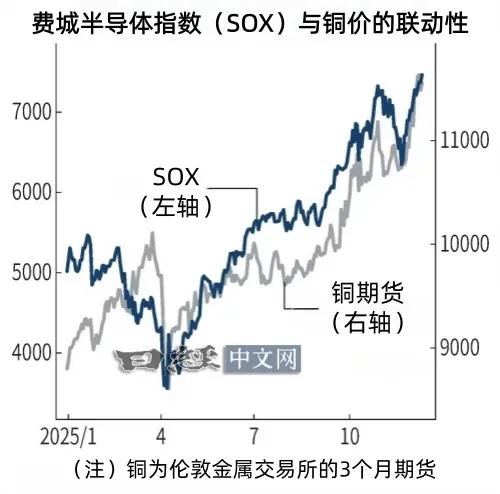
Core Viewpoint - The recent surge in copper prices is attributed not only to the supply shortage caused by the landslide at the Grasberg mine in Indonesia but also to three key factors originating from the United States, leading to predictions that copper prices will continue to reach historical highs by 2026 [1]. Group 1: Supply and Demand Dynamics - The international price of copper has been continuously rising, with the London Metal Exchange (LME) three-month copper futures reaching a peak of $11,771 per ton on December 8, marking the highest level in over 16 months [1]. - The Grasberg mine incident, which is the second-largest copper producer globally, is cited as a primary reason for the current price surge, but market analysts believe that this alone does not fully explain the dramatic increase [1]. Group 2: U.S. Economic Factors - The first factor is the optimistic outlook for the U.S. economy following three consecutive interest rate cuts by the Federal Open Market Committee (FOMC), with predictions of an additional cut in 2026. This economic support is believed to positively influence copper prices, which are often seen as a barometer for global economic health [2]. - The second factor is the rise of artificial intelligence (AI), which has driven up the stock prices of major tech and semiconductor companies in the U.S. This trend is expected to have a ripple effect on global markets, including copper [2][5]. - The third factor is renewed concerns over tariffs imposed by former President Trump on copper, which had previously caused a spike in U.S. copper prices. The potential for future tariff increases has led to market speculation and adjustments [5][6]. Group 3: Market Sentiment and Speculation - There is a noted correlation between the Philadelphia Semiconductor Index and copper prices, indicating that investor sentiment around AI and technology is influencing copper market dynamics [5]. - The net long positions in copper futures have reached their highest level in approximately nine months, suggesting that speculators are increasingly betting on copper as they would on AI-related stocks [5]. - The inventory levels of copper in the U.S. are significantly higher than at the beginning of the year, while global inventories outside the U.S. are showing signs of shortage, contributing to the upward pressure on prices [6].

2025并购狂飙:全球交易额冲高4.5万亿美元,AI与监管政策成引擎
智通财经网· 2025-12-15 07:05
智通财经APP获悉,交易撮合者们正带着一个价值千亿美元的悬念步入2025年的最后几周。派拉蒙天舞 公司(PSKY.US)从奈飞公司(NFLX.US)眼皮底下抢购华纳兄弟探索公司(WBD.US)的收购要约,概括了定 义这个并购大年的几个主题:对变革性联姻重燃的渴望、来自华尔街的大笔支票、中东资金的涌入,以 及美国总统唐纳德·特朗普作为颠覆者和交易促成者的双重角色。 "这些股市回报确实来自人工智能,而人工智能的支出是不可持续的,"摩根大通全球投行业务主席查理 ·杜普雷表示。"如果这方面出现退潮,那么你会看到一个更广泛的市场实际上并没有在进步。" 人工智能热潮促成了今年一些引人注目的交易。萨姆·奥特曼的OpenAI接受了来自软银集团、英伟达公 司(NVDA.US)和华特迪士尼公司(DIS.US)等的主要投资;由贝莱德旗下全球基础设施合作伙伴牵头的财 团同意支付400亿美元收购Aligned数据中心。三月,谷歌母公司Alphabet将其以320亿美元收购网络安全 初创公司Wiz Inc.的交易描述为在人工智能时代为客户提供新保障的一种方式。 "现在每个人都需要成为人工智能银行家,"摩根士丹利全球科技并购主管Wally ...


铜价狂飙逼近1.2万美元!AI数据中心引爆“红色金属”争夺战,供应链已拉响警报
Zhi Tong Cai Jing· 2025-12-15 07:01
Group 1 - The price of copper is approaching $12,000 per ton due to soaring demand for data centers driven by artificial intelligence and supply constraints, with a year-to-date increase of 35% [1] - Copper is essential for powering infrastructure needed for data centers, electric vehicles, and energy transition [1] - A survey predicts a shortage of 124,000 tons of copper this year and 150,000 tons next year, driven by significant investments in grid modernization and expansion [1] Group 2 - Global copper demand is expected to reach 27 million tons this year, with a 2.7% increase projected for 2024, and a 3.7% growth in demand from China [2] - Supply disruptions, including an incident at Freeport-McMoRan's Grasberg mine, have reinforced expectations of tight supply [2] - Copper inventories in major exchanges have increased by 54% this year, reaching 661,021 tons [2] Group 3 - Comex inventory has reached a record high of 405,782 tons, accounting for 61% of total exchange inventory, compared to 20% at the beginning of 2025 [3] - The supply of refined copper is under scrutiny due to ongoing reviews of import tariffs, with a 50% exemption on tariffs effective from August 1 [4]
斥资10.15亿美元“落子”巴西,洛阳钼业海外扩张提速
Huan Qiu Lao Hu Cai Jing· 2025-12-15 05:40
Group 1 - The core point of the news is that Luoyang Molybdenum Co., Ltd. plans to acquire Equinox Gold Corp. for a total of $1.015 billion, which includes $900 million in cash at closing and up to $115 million in contingent cash payments based on sales [1] - The acquisition will allow Luoyang Molybdenum to indirectly hold 100% of the rights to three gold mines in Brazil, which contain a total gold resource of 5.013 million ounces and an average grade of 1.88 g/t [1] - Following this acquisition, the company's annual gold production is expected to reach 8 tons, contributing to a potential total gold output of over 20 tons when combined with another acquisition in Ecuador [1] Group 2 - Luoyang Molybdenum is a leading player in the non-ferrous metals industry, controlling various strategic mineral resources globally, including copper, cobalt, molybdenum, nickel, and gold [2] - The company has previously completed three acquisitions totaling $4.3 billion, securing an 80% stake in the TFM copper-cobalt project and a 95% stake in the KFM copper-cobalt project in the Democratic Republic of Congo [2] - According to the company's five-year development plan, copper production is expected to increase to 800,000 to 1 million tons by 2028, while cobalt production is projected to reach 90,000 to 100,000 tons, further solidifying its position in the global copper-cobalt supply chain [2] - The company's financial performance has improved significantly, with a reported revenue of 145.485 billion yuan for the first three quarters, a slight decrease of 5.99% year-on-year, and a net profit of 14.280 billion yuan, a substantial increase of 72.61% year-on-year [2] - In the third quarter, the company achieved a revenue of 50.713 billion yuan, a year-on-year decline of 2.36%, while the net profit surged by 96.40% to 5.608 billion yuan [2]

引入王东生为首席顾问,大唐黄金资源、人才、技术三维重构加速价值跃升
Zhi Tong Cai Jing· 2025-12-15 03:27
Core Viewpoint - The appointment of Wang Dongsheng as the chief consultant for Datang Gold signifies a strategic upgrade for the company, focusing on resource integration, capacity expansion, and technological empowerment in the mining industry [1][5]. Group 1: Strategic Importance of Appointment - Wang Dongsheng's extensive experience and expertise in the mining sector are expected to serve as a catalyst for Datang Gold's strategic transformation, enhancing its management capabilities and resource acquisition [1][5]. - His role will facilitate the company's resource expansion and capacity enhancement strategies, leveraging his network and experience to identify high-value mining rights and expedite resource reserve cycles [3][5]. Group 2: Talent and Management Enhancement - Wang Dongsheng's background in various leadership roles within major mining organizations positions him to build a strategic talent matrix for Datang Gold, integrating both technical and managerial expertise [3][4]. - This dual approach is anticipated to significantly improve the company's management efficiency and support future mergers and acquisitions [3][4]. Group 3: Technological Advancement - The integration of AI in mining operations is a key focus, with Wang Dongsheng being one of the early experts in AI mining applications, which will enhance exploration efficiency and support deep mining initiatives [4]. - Datang Gold's existing partnerships with AI technology developers and its commitment to AI-driven mining models will be accelerated by Wang's involvement, potentially transforming the company into a new benchmark in the AI mining sector [4][5]. Group 4: Future Outlook - The strategic appointment of Wang Dongsheng is viewed as a pivotal step for Datang Gold, indicating a shift from traditional resource-focused strategies to a more integrated ecological approach, which could lead to significant value creation in the capital market [5].
上证180ETF指数基金(530280)红盘向上,机构建议均衡配置等待“春季躁动”行情
Xin Lang Cai Jing· 2025-12-15 03:02
Core Viewpoint - The Shanghai Stock Exchange 180 Index shows a slight increase, with notable gains in key constituent stocks, reflecting a stable market environment amid industrial growth and potential policy changes [1][2]. Group 1: Market Performance - As of December 15, 2025, the Shanghai 180 Index rose by 0.13%, with significant increases in stocks such as China Merchants Energy (up 4.77%) and Ping An Insurance (up 4.62%) [1]. - The Shanghai 180 ETF Index Fund increased by 0.17%, with the latest price reported at 1.2 yuan [1]. Group 2: Industrial Growth - In November, the industrial added value for large-scale enterprises increased by 4.8% year-on-year, driven by advancements in the equipment manufacturing sector [1]. - The equipment manufacturing industry saw a robust growth of 7.7% in added value year-on-year, contributing 56.4% to the overall industrial growth [1]. Group 3: Investment Insights - According to AVIC Securities, the market may remain stable towards the end of the year, with a focus on the impact of potential interest rate hikes by the Bank of Japan on global liquidity [1]. - Recommendations include a balanced allocation between dividend and technology styles, with attention to industries that may experience marginal catalysts, anticipating a "spring rally" [1]. Group 4: ETF Composition - The Shanghai 180 Index consists of 180 securities selected for their large market capitalization and liquidity, reflecting the overall performance of core listed companies in the Shanghai market [2]. - As of November 28, 2025, the top ten weighted stocks in the Shanghai 180 Index account for 26.13% of the index, including major companies like Kweichow Moutai and Ping An Insurance [2].





铜:长期驱动逻辑仍存,价格回落有限
Guo Tai Jun An Qi Huo· 2025-12-15 02:34
Report Industry Investment Rating - Not provided in the given content Core Viewpoint - The long - term driving logic for copper still exists, and the price decline is limited [1] Summary by Related Catalogs Fundamental Tracking - **Futures Data**: The closing price of the Shanghai copper main contract was 94,080 with a daily increase of 2.03%, and the night - session closing price was 91,550 with a decline of 2.69%. The price of the LME copper 3M electronic disk was 11,553 with a decline of 2.37%. The trading volume and open interest of the Shanghai copper index and LME copper 3M electronic disk both increased compared to the previous day. The inventory of Shanghai copper increased by 1,102 to 32,563, and the inventory of LME copper increased by 50 to 165,900. The cancellation warrant ratio of LME copper was 39.78% with a decline of 0.40% [1] - **Spot Data**: The price of Shanghai 1 bright copper increased by 500 to 82,900. The spot - to - near - month futures spread was - 20, a decrease of 25 compared to the previous day. The near - month contract - to - consecutive - first - contract spread was - 60, a decrease of 30 compared to the previous day [1] Macro and Industry News - **Macro News**: The People's Bank of China will flexibly and efficiently use various monetary policy tools such as reserve requirement ratio cuts and interest rate cuts. Trump prefers to let Warsh or Hassett serve as the Fed chair and hopes the interest rate will be 1% or lower in a year [1] - **Industry News**: China's imports of copper ore and concentrates in November were 252.6 million tons, and the cumulative imports from January to November were 2.7614 billion tons, a year - on - year increase of 8.0%. The US is negotiating with Central African countries to provide over $1 billion for two key mineral and railway projects. Chile's copper export value in November was $4.282 billion, a year - on - year increase of 4.57%. In October, the copper production of Chile's state - owned miner Codelco decreased by 14.3% year - on - year to 111,000 tons. The mining investment in Chile from this year to 2034 is expected to reach $104.549 billion, higher than the previous forecast [1][3] Trend Intensity - The trend intensity of copper is 0, indicating a neutral state [3]
套利机器全速运转,美国疯狂囤铜引爆全球供应警报
Jin Shi Shu Ju· 2025-12-15 02:04
受供应中断以及市场对美国关税政策的担忧引发的需求激增推动,铜价今年大幅飙升,多次创下历史新 高。这轮涨势预计将持续到2026年。 持续的矿山生产中断削弱了未来供应增长的预期,也为铜价上涨提供了支撑。德意志银行在上周三发布 的一份报告中称2025年是"严重受干扰的一年",生产受挫迫使几家主要矿商下调产量预估。德意志银行 汇编的数据显示,过去一周,几家主要铜生产商更新了产量指引,将2026年铜产量预估下调了约30万 吨。 花旗集团分析师预计,在能源转型和人工智能领域引领的强劲需求支撑下,这种红色金属的价格将大幅 上涨。电气化、电网扩张和数据中心建设需要大量铜用于布线、电力传输和冷却基础设施。 "总体而言,我们认为市场将明显处于短缺状态,其中矿山供应在2025年第四季度和2026年第一季度最 为疲弱,"该行表示,并预计价格和市场紧张状况将在2026年上半年达到顶峰。 花旗集团指出,矿山供应受限导致的预计短缺,以及美国因套利机会继续"囤积"铜库存,预计都将助推 价格上涨:"我们预计美国将继续囤积全球铜库存,并且在牛市情景下,将进一步抽走美国以外本已枯 竭的库存。"该行预计,铜价将在2026年初达到每吨13000美元, ...
引入王东生为首席顾问,大唐黄金(08299)资源、人才、技术三维重构加速价值跃升
智通财经网· 2025-12-15 00:56
Core Viewpoint - The appointment of Wang Dongsheng as the chief consultant for Datang Gold (08299) is a strategic move aimed at enhancing the company's resource integration, capacity expansion, and technological empowerment in the mining industry [1][5]. Group 1: Strategic Importance of the Appointment - Wang Dongsheng's extensive experience in the mining sector, including over 35 years in metal mineral resource exploration and development, positions him as a key asset for Datang Gold [1][2]. - His previous roles in various high-level positions within major mining organizations provide him with a wealth of knowledge and a strong network, which can facilitate resource acquisition and management improvements for Datang Gold [2][3]. Group 2: Resource Expansion and Capacity Enhancement - The company has already initiated mineral acquisition activities, and Wang's expertise is expected to help identify high-value mining rights, thereby shortening resource reserve cycles and rapidly increasing production capacity [3][5]. - Wang's successful international mining acquisition cases will enable Datang Gold to explore overseas resource opportunities, mitigating domestic resource constraints and diversifying assets [3][4]. Group 3: Talent and Organizational Development - Wang is anticipated to establish a strategic talent matrix that combines technical and management expertise, significantly enhancing the company's management capabilities and supporting future acquisitions and resource integration [3][4]. - His connections within the industry are expected to attract top talent, which is crucial for the company's growth through external acquisitions [3][4]. Group 4: Technological Advancement through AI - Wang's involvement is expected to accelerate the implementation of AI in mining operations, improving exploration efficiency and expanding the scope of mineral exploration, particularly in deep mining [4][5]. - Datang Gold has already begun its AI mining initiatives, and Wang's expertise in AI applications in mining will enhance the company's technological capabilities, potentially transforming it into a new model of "resource + AI" [4][5]. Group 5: Strategic Transformation - The appointment of Wang Dongsheng signifies a critical step in Datang Gold's strategic evolution, aiming for a transformation from a focus on resource development to a more integrated ecological approach [5]. - This shift represents not only an evolution in the company's development model but also a fundamental reconfiguration of its operational strategy, positioning Datang Gold to lead in the intelligent mining wave [5].